



Every year, millions of Americans move across the country. About 8.2 million people relocated to a different state in 2022 alone, roughly one in five of everyone who moved, according to the U.S. Census Bureau. Most face the same fork: drive the car for days, or ship it?
That is where car shipping comes in. Moving a vehicle coast to coast sounds complicated, but it follows a predictable process once you see how the pricing, timing, and companies actually work. This guide covers all of it, from what a cross-country move costs in 2026 to how long it takes and how to book without getting burned.
Want real numbers before you read further? Get a free, no-obligation car shipping quote and see exactly what your cross-country move costs, with no pressure and no commitment.
What Shipping a Car Across the USA Actually Involves

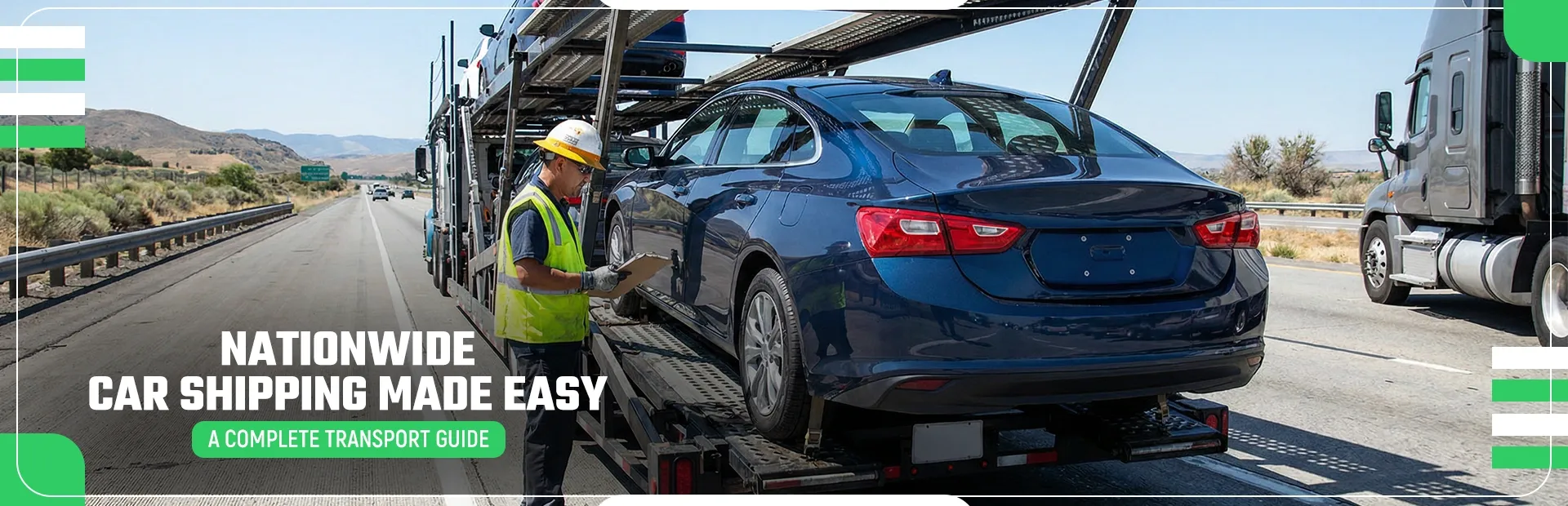
Car shipping across the USA means paying a company to move your vehicle on a multi-car hauler over a long-distance route instead of driving it yourself. On a coast-to-coast trip, your car almost always rides on an open carrier alongside eight or nine other vehicles, the same kind of truck you see delivering new cars to dealerships.
The reason people ship instead of drive comes down to wear, time, and money. AAA's 2025 Your Driving Costs study puts the true cost of owning and operating a new vehicle at $11,577 a year, or about 77 cents per mile at 15,000 miles annually. A 3,000-mile drive burns fuel, adds serious mileage, and costs you three or four days on the road plus hotels and meals. Shipping skips all of that.
Behind every booking sit two players, and knowing the difference protects your wallet. A broker arranges the move and finds you a truck heading your direction. A carrier is the company that actually owns the truck and drives your car. Many of the biggest names in auto transport are brokers, not truck owners, which is not a red flag by itself, it just changes who you hold accountable when you have a question at pickup. If you want the deeper mechanics, our guide to how broker and carrier pricing differs breaks down where your money goes, and our roundup of interstate car shipping myths clears up the assumptions that trip up first-timers.
Want the full lay of the land before you book? Start with our car transport guide and benefits overview, then come back for the numbers below.
What It Costs to Ship a Car Across the Country in 2026

Here is the honest answer most people want up front: shipping a car cross-country on an open carrier in 2026 typically runs $1,200 to $2,500, according to Extra Space Storage's 2026 car shipping cost guide. Anyone quoting a flat number without your route and vehicle details is guessing.
Your quote is built from five things: total distance, vehicle size and weight, route popularity, transport type, and timing. The single biggest driver is distance, but the math is not linear. Price per mile actually drops the farther you go, because carriers spread their fixed costs over more miles.
|
Distance |
Typical Cost Per Mile |
What That Looks Like |
|
Under 500 miles |
$1.25–$2.25/mile |
Short regional hops cost the most per mile |
|
500–1,200 miles |
$0.85–$1.25/mile |
Mid-range moves |
|
1,200–2,000 miles |
$0.70–$0.85/mile |
Long domestic routes |
|
2,000+ miles (cross-country) |
$0.40–$0.70/mile |
Best per-mile value |
Source: Extra Space Storage, 2026.
Real cross-country lanes land where you would expect. A move from California to New York, roughly 2,900 miles, runs about $1,300 to $2,400. A Florida-to-Washington haul near 3,100 miles runs about $1,500 to $2,700.
Three of those five price levers are ones you can actually control: your transport type, your date flexibility, and your timing. Seasonal demand swings prices hard, snowbird routes into Florida and Arizona spike in fall and winter, so booking off-peak or staying flexible on pickup dates can save real money. Our seasonal car relocation service is built around those demand windows. For the full picture, see our complete breakdown of car shipping costs in the USA and the five factors that determine your quote and how to influence them.
Open vs Enclosed for a Cross-Country Move
Nearly every long-distance booking comes down to one choice: open or enclosed. Over 3,000 miles, that decision matters more, not less, because it sets both your price and your risk for the entire trip.
|
Method |
Best For |
Cost |
Protection |
|
Open carrier |
Everyday cars, most shippers |
Lower |
Exposed to weather and road debris |
|
Enclosed carrier |
Classics, exotics, high-value cars |
30–60% higher |
Fully covered and shielded |
Open Car Shipping: The Default for the Long Haul
Open transport moves the overwhelming majority of cars coast to coast. Your vehicle rides on the same style of exposed multi-car trailer that delivers new cars to showrooms. It is cheaper, books faster, and is perfectly safe for a normal daily driver even over 3,000 miles. Extra Space puts the average open-carrier move at $800 to $1,100, versus $1,200 to $1,650 or more for enclosed.
For relocating families, students, and standard sedans and SUVs, open car shipping is almost always the right call. If you are weighing the two on price alone, our comparison of open vs enclosed transport cost shows exactly where the gap lands.
Enclosed Vehicle Shipping: When the Extra Cost Earns Its Keep
Enclosed transport puts your car inside a covered trailer, shielded from weather, road grime, and prying eyes across every mile. It costs more and books slower, but according to ConsumerAffairs, enclosed shipping can nearly double the price of an open move, and for the right vehicle that premium is worth every dollar.
If you own a classic, an exotic, a low-clearance sports car, or anything you would hate to see chipped, enclosed vehicle shipping is the honest choice. Before you decide, read is enclosed carrier shipping worth paying more to see whether your specific car justifies the upgrade.
How Long Does Cross-Country Car Shipping Take?

Plan for 7 to 15 days in transit for a true coast-to-coast move, in line with 2026 industry data. That is the honest window, and it runs on two separate clocks.
The first clock is the time it takes to assign a carrier to your route, usually one to five days after you book, depending on how busy your lane is. The second clock is the actual driving time. Carriers cover roughly 400 to 500 miles a day once your car is loaded, factoring in federally mandated rest and multiple pickups and drop-offs along the way.
|
Route Distance |
Typical Transit Time |
What Slows It Down |
|
Under 1,000 miles |
1–3 days |
Rural pickup or delivery |
|
1,000–2,000 miles |
3–6 days |
Weather, carrier availability |
|
2,000–3,000+ miles |
7–15 days |
Mountain passes, winter storms, remote routes |
If you are on a deadline, priority auto shipping moves your car to the front of the line with a guaranteed pickup window. A good company gives you a realistic window, never a false promise. For a fuller picture of why long routes behave differently, compare long-distance versus short-haul car shipping and the reasons your car shipping time can change.
How to Ship a Car Across the USA, Step by Step
Here is the whole process, in the exact order it happens, with no jargon.
-
Get at least three quotes using your real pickup and delivery locations, vehicle year and model, and preferred dates. Vague inputs get you vague prices.
-
Compare on service and reviews, not just the lowest number. The cheapest quote is often a bait price that climbs later.
-
Verify the company yourself before you hand over a deposit. The next section shows you how in minutes.
-
Book and read the contract. Confirm the price, pickup window, and insurance in writing.
-
Prep the car for the haul. Wash it, leave a quarter tank of fuel, and remove personal items.
-
Do the inspection and sign the Bill of Lading at pickup. Photograph every existing scratch first.
-
Track the car in transit and stay reachable for the driver.
-
Inspect again and pay on delivery, comparing the car against your pickup photos before you sign off.
The single cheapest way to avoid overpaying is getting multiple quotes, yet most first-timers book the first company that calls and lose all their leverage. Our list of the top seven ways to ship a car cheaply across the USA and the five essential questions to ask before hiring a transport company will sharpen every step above.
Start the smart way. Compare free car shipping quotes for your exact route and begin your cross-country move with real numbers instead of guesses.
How to Vet a Transport Company Yourself

You do not need to know the single "best" company in America. You need to know how to disqualify a bad one, and that takes about five minutes. Reframing the question this way is the most useful thing a first-time shipper can do.
Run this checklist on any company before you book:
-
Look up the DOT or MC number. Every legitimate broker and carrier has one, and you can verify active authority and insurance for free on the FMCSA SAFER Company Snapshot. If a company cannot or will not give you a number, that is your answer.
-
Read reviews on more than one platform. A clean record on a single site means little. Consistency across several independent sources is what counts.
-
Watch for a quote that is too good to be true. A price far below every other bid usually signals a bait-and-switch, where the number climbs once your car is already committed.
-
Get everything in writing. The price, the pickup window, and the insurance coverage all belong in your contract, not in a verbal promise over the phone.
Two documents protect you more than anything else: the contract and the insurance certificate. Read our five car shipping contract tips and the auto transport insurance guide so you know exactly what you are agreeing to and what is covered if something goes wrong in transit.
Prep, Pickup, and Delivery Day on a Long-Distance Move
Once the truck is booked, the rest is straightforward if you know what to expect. First, you choose how the car changes hands.
|
Option |
How It Works |
Cost |
Best For |
|
Door-to-door |
Driver picks up and delivers as close to your address as the streets allow |
Standard |
Most cross-country shippers |
|
Terminal-to-terminal |
You drop off and collect at a lot |
Lower |
Flexible schedules, tight budgets |
Most cross-country shippers choose door-to-door for the convenience, especially when they are managing a full household move at the same time.
To prep your car for 3,000 miles on a trailer: wash it so existing scratches are visible, leave the tank about a quarter full, remove all personal items and toll transponders, disable the alarm, and photograph the car from every angle. That photo set is your evidence.
The most important piece of paper in the entire move is the Bill of Lading. It records your car's condition at pickup and again at delivery. Inspect the vehicle carefully and note every mark before you sign at both ends, especially after a long haul across the country. If a problem ever does surface, our guide to handling a car damaged during shipping walks you through the claim. For high-value vehicles, covered vehicle transport adds a layer of protection worth considering.
Cross-Country Shipping for Your Situation

The steps are the same for everyone, but your priorities shift depending on why you are shipping. Here is what to focus on for the most common situations:
-
Relocating for a job or school: Time your booking around your move-out date and stay flexible for the best rate. A student sending a car to a new campus can plan around our college student car shipping guide.
-
Snowbirds heading south: Book early. Fall and winter routes into the Sun Belt fill fast and prices spike, so lock in ahead of the crowd. Our snowbird car shipping guide covers the seasonal timing.
-
Military members on PCS orders: Build in extra lead time and keep your orders handy. Military vehicle relocation is built around the paperwork and timing that come with a permanent change of station.
-
Classic and exotic owners, and car-show organizers: Go enclosed, every time, and coordinate a single multi-car pickup window if you are moving several vehicles to an event. Our luxury and exotic car shipping service is designed for exactly this.
-
Seniors who want it handled: Choose door-to-door and one clear point of contact. Senior-friendly auto shipping keeps the process simple and low-stress.
-
Motorcycle owners: A bike needs a specialized crate or rack, not a standard car slot. Open-air motorcycle shipping handles it safely.
-
Dealership owners: Consistency and volume matter most. Dealer vehicle transport solutions keep inventory moving on reliable lanes.
Whatever the reason for your move, the same three things protect you: a real quote, a company you have verified yourself, and an inspection at both ends.
What People Ask Most About Shipping a Car Across the USA
The straight, no-fluff rundown on the things people search most before booking a cross-country move.
How Much Does It Cost to Ship a Car Across the Country?
The cost to ship a car across the country typically runs $1,200 to $2,500 on an open carrier in 2026, dropping to $0.40 to $0.70 per mile on long routes. See the full 2026 cost breakdown.
How Long Does It Take to Ship a Car Coast to Coast?
Shipping a car coast to coast usually takes 7 to 15 days: one to five days to assign a carrier, then driving time at roughly 400 to 500 miles per day, longer in winter or on remote routes.
Is It Cheaper to Ship a Car or Drive It Across the USA?
Often, yes. Once you add fuel, three to four days of your time, meals, lodging, and wear (AAA counts about 77 cents per mile), shipping a car cross-country is frequently cheaper than driving it.
Can I Put Personal Belongings in My Car When Shipping It Across the Country?
Usually not much. Personal belongings aren't covered by the carrier's insurance and add weight, though many carriers allow up to 100 pounds packed low in the trunk. Confirm it in writing first.
Is My Car Insured While It's Being Shipped Across the USA?
Yes. Licensed carriers must carry cargo insurance that covers your car in transit. Ask for the certificate of insurance, confirm the coverage amount before booking, and note the car's condition on the Bill of Lading.
Making the Call on Your Cross-Country Move
Shipping a car across the USA is not the gamble it looks like from the outside. Once you know the numbers, it becomes a simple decision you can sort by what matters most to you. If price is your priority, stay flexible on dates and go open. If protection is what keeps you up at night, go enclosed for anything you would hate to scratch. If speed is the constraint, book early and expect a realistic window rather than a single guaranteed day.
You now have everything the process actually requires: a real car shipping quote built from your route and vehicle, a company you have checked yourself on FMCSA, and a Bill of Lading inspection at pickup and delivery. That is the whole game. Everything else is just detail.
Ready to move your car the smart way? Request free car shipping quotes for your exact cross-country route and book your move with confidence, backed by real numbers and verified companies.