
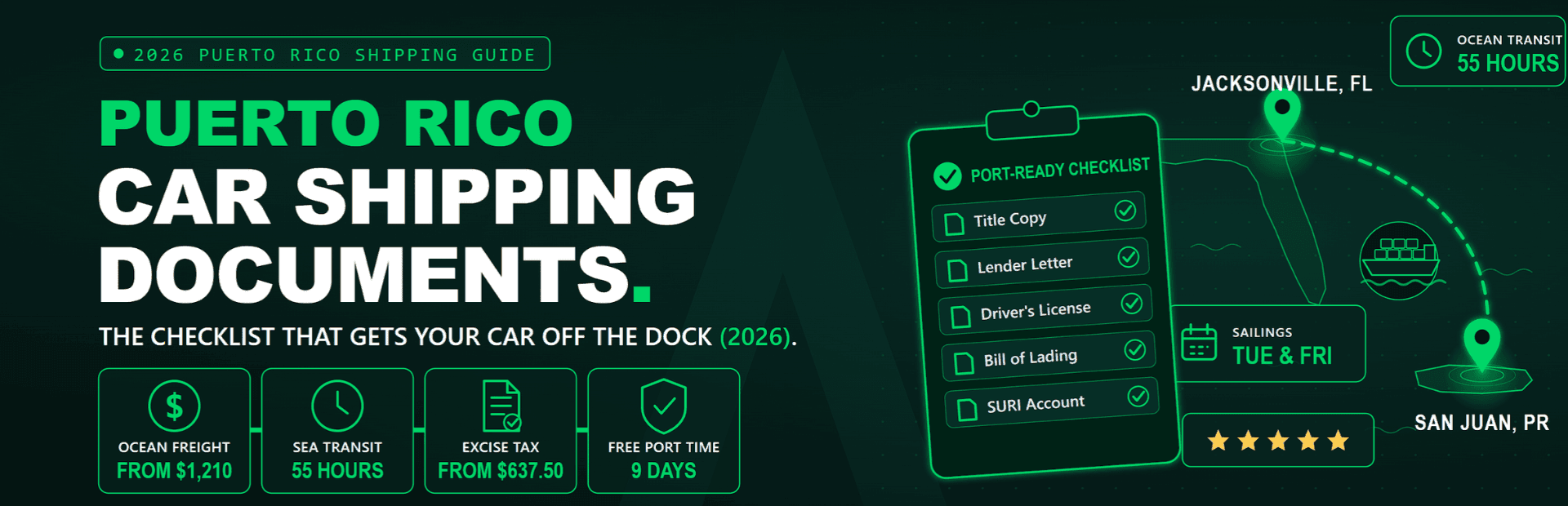
If you ship a car worth more than $44,890 to Puerto Rico, the island's Treasury Department (Hacienda) taxes every dollar above that line at 34%, according to Hacienda's vehicle excise tax table. You pay it at the port, before the car is released.
So freight is only half the plan. The other half is paperwork. A title copy, a lender letter, a SURI account, and a bill of lading decide whether your car leaves San Juan quickly or sits in storage.
This guide covers the Puerto Rico car shipping documents you need, in the order you'll need them.
Moving a car to the island? Get quotes for the truck ride to the Jacksonville port, compare verified carriers, and lock in a written price before your sailing date.
Is Shipping a Car to Puerto Rico Domestic or International?
It's domestic, with two extra steps. Puerto Rico is a U.S. territory, so U.S. citizens don't need a passport and there's no foreign import permit. But it isn't a normal state-to-state move either. Your car leaves the mainland with an export filing, and it arrives on the island owing a local excise tax.
The export filing happens quietly. TOTE Maritime's Vehicle Exportation Sheet asks you to list your car's value "for US Customs purposes." By signing it, you authorize the carrier to file Electronic Export Information with the U.S. Census Bureau under 15 CFR 30.3(f). You sign the form, and the carrier files it.
A customs inspection is a different matter. Crowley's Puerto Rico vehicle shipping FAQ says cars moving between Puerto Rico and the mainland don't need a U.S. Customs inspection. That's only required for foreign countries and the U.S. Virgin Islands.
Here's how the shipping a car to Puerto Rico requirements compare with a regular interstate move:
|
Step |
Shipping to another U.S. state |
Shipping to Puerto Rico |
|
How the car travels |
Truck, door to door or terminal |
Truck to a port, then a ship to San Juan |
|
Export filing |
None |
Electronic Export Information, filed by the ocean carrier |
|
Tax on arrival |
None at delivery |
Hacienda excise tax (arbitrios), paid before release |
|
Fuel rule |
Set by the truck carrier |
No more than ¼ tank (TOTE) |
|
Where you get the car |
Your door or a terminal |
The San Juan port terminal, after Hacienda clears it |
|
Registration |
The new state's DMV |
CESCO, run by Puerto Rico's DTOP |
Most car shipping to Puerto Rico from Florida runs through Jacksonville, where TOTE sails to San Juan twice a week. If you're new to how the truck side of the trip works, start with how car transport works and what it includes. For the bigger picture, our beginner's guide to domestic vs. international auto transport explains where island shipments fit.
The Core Puerto Rico Car Shipping Documents Every Owner Needs
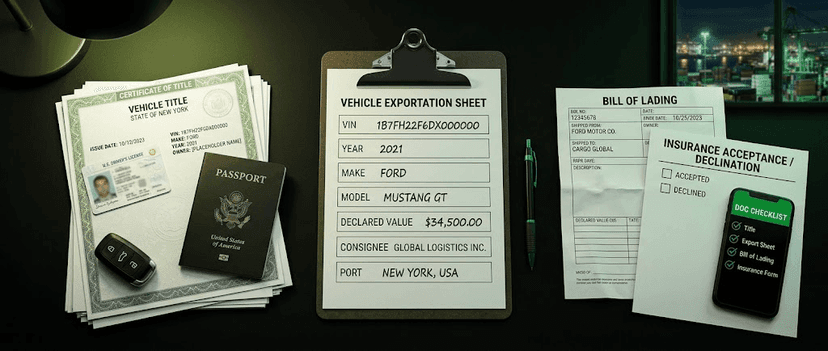
The documents needed to ship a car to Puerto Rico fall into two groups. First, proof that you own the car and proof of who you are. Second, the carrier's own forms, which you sign when you book. Miss either group, and the car can miss the ship.
Ownership and ID Documents
According to TOTE's Jacksonville to San Juan vehicle packet (September 2026), you send these to the carrier's documentation team before sailing:
-
A copy of the title, front and back. If the car is financed, send the lender's authorization instead.
-
A clear, enlarged copy of the owner's driver's license.
-
A signed letter of authorization if someone else is making the shipping arrangements or dropping the car off for you.
At drop-off, you bring a second set:
-
A copy of your booking confirmation
-
A state-issued driver's license or a passport
-
A copy of the vehicle registration or the bill of sale
TOTE warns that sending documents late can get your car rolled to a later sailing or held at the destination. A rolled sailing means extra days, and in San Juan, extra days can mean storage fees.
The letter of authorization matters more than people expect. It's how an adult child drops off a parent's car, or how a coworker handles drop-off while you fly ahead. If a family member is managing the move for an older driver, senior-friendly auto shipping can take the truck leg off their plate.
Carrier Forms You Sign at Booking
These forms catch first-time shippers off guard. None of them are hard, but each one asks for something you should have ready.
|
Form |
What it asks for |
Why it matters |
|
Vehicle Exportation Sheet |
Year, make, model, VIN, title number, declared value, and the shipper's EIN (non-U.S. citizens use a passport number) |
It's the basis for the export filing |
|
Insurance acceptance or declination |
Whether you buy coverage, and for how much |
It sets what the carrier owes if the car is damaged |
|
Social Security number disclosure |
The owner's SSN |
Hacienda requires it to release the car in San Juan |
|
Bill of lading |
Your shipment details and contract terms |
You need a copy to pay the excise tax at pickup |
The bill of lading for car shipping to Puerto Rico is more than a receipt. It's the contract, and Hacienda asks for it when you pay the tax. Save a copy on your phone and print another one.
Insurance is where people lose money. Under the bill of lading, TOTE's liability is limited to $500 unless you buy coverage. Its All Risks coverage costs $2.50 per $100 of insured value, and it's only available for vehicles 7 years old or newer. It also excludes marring, denting, chipping, and scratching. Another option is declaring a higher value for an extra 2% of that value, but TOTE notes that this isn't insurance and doesn't cover fire or acts of God.
Can You Ship a Financed or Leased Car to Puerto Rico?
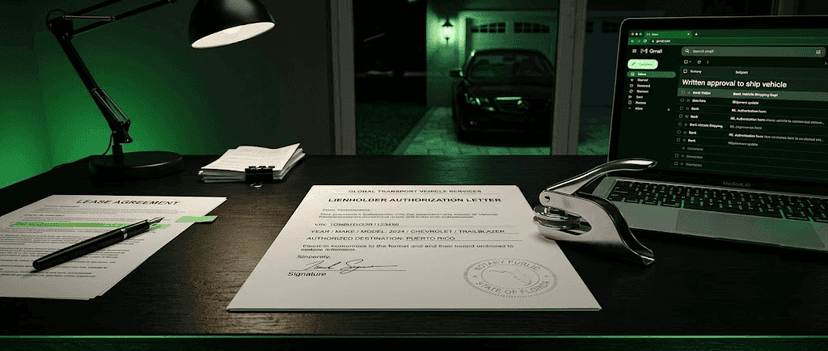
Yes, both. You just need written permission from whoever holds the title. That's the lender for a financed car and the leasing company for a leased one. Without that permission, the carrier has no title copy to accept.
How to Ship a Financed Car to Puerto Rico With a Lienholder Authorization Letter
To ship a financed car to Puerto Rico, you replace the title copy with a letter from your lender. TOTE's packet asks for "authorization from the Financial Institution" in place of the title. SIRVA's Puerto Rico customs guide goes further and lists a notarized letter from the lienholder that includes the car's VIN, model, and make.
A solid lienholder authorization letter for Puerto Rico should include:
-
The owner's full name, as it appears on the loan
-
The car's year, make, model, and full 17-character VIN
-
Clear permission to ship the vehicle to Puerto Rico
-
The lender's name, contact details, and an authorized signature
-
A notary stamp, if your carrier asks for one
Lenders set their own timelines, and some route these requests through a separate department. Call your lender first and ask two questions. How long does the lienholder authorization letter take? And how will the title be handled when you register the car in Puerto Rico? Get both answers before you pick a sailing date.
Ship a Leased Car to Puerto Rico Only With the Lessor's Written OK
The leasing company owns your car. You're renting it. Before you ship a leased car to Puerto Rico, read your lease for rules on taking the car off the mainland, then get the lessor's approval in writing.
Ask the lessor three things:
-
Does the lease allow the car to be kept in Puerto Rico?
-
Who sends the authorization letter to the carrier, you or them?
-
Will they release the title paperwork the island needs for registration?
Our guide on how to ship a leased vehicle covers the lessor conversation in more detail. If the car is part of a full household move, home relocation services can coordinate the truck pickup around your moving date.
Getting Your Car to Jacksonville: The Inland Leg and Port Drop-Off Rules
For most mainland owners, Jacksonville to San Juan car shipping starts with a truck. A car coming from Texas or New York rides a carrier to the port first, then boards the ship. TOTE sails from Jacksonville every Tuesday and Friday.
For a daily driver, open car shipping is the standard choice for this leg. Before you hand over the keys, confirm the trucking company's USDOT number and operating status on FMCSA's SAFER Company Snapshot. The ship is only as reliable as the truck that gets your car to it.
Car shipping to Puerto Rico from Florida comes with port rules that a regular delivery doesn't have. According to TOTE's packet, these are the rules that get cars turned away or charged extra:
-
Fuel: No more than ¼ tank of gas.
-
Loose items: Anything not physically attached to the car is not allowed. TOTE lists car seats, jumper cables, and toolboxes as examples.
-
Paperwork: Don't leave documents inside the car.
-
Drop-off window: Drop off no earlier than 7 calendar days before sailing. The cutoff is Friday at noon for a Tuesday sailing and Wednesday at noon for a Friday sailing.
-
Hours: Monday through Friday, 8:00 a.m. to 4:00 p.m.
-
Payment: Pay before drop-off by money order or card. No cash.
-
Recalls: Cars with an open fire-hazard recall are charged $100, unless you send proof the repair was done. You can check your VIN on NHTSA's recall lookup.
-
Port access: You need a TWIC card to reach the terminal. If you don't have one, the JAXPORT Access Control Center provides a free escort from the front gate. Arrive at least 30 minutes before the terminal closes.
These shipping a car to Puerto Rico requirements are easy to meet if you know them a week ahead. They're painful to learn at the gate.
TOTE Maritime stopped accepting electric vehicles and plug-in hybrids on August 1, 2025, citing fire and safety risks at sea. It still accepts mild hybrids that can't be plugged in. If you drive an EV, confirm with another ocean carrier before you book the truck.
For more island-specific prep, read our 7 tips for island car shipping.
How Long Does It Take and What Does It Cost to Ship a Car to Puerto Rico?
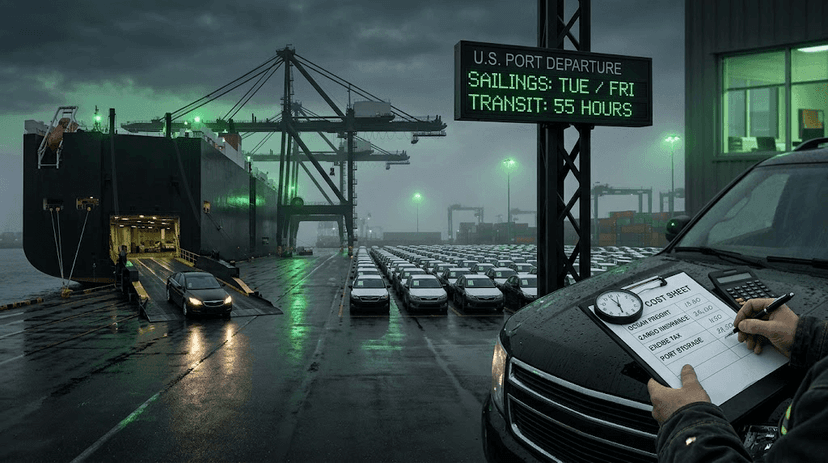
The ocean leg is fast. For Jacksonville to San Juan car shipping, TOTE lists a 55-hour transit time. So how long does it take to ship a car to Puerto Rico from start to finish? Add the truck ride to the port, the wait for the next sailing, and Hacienda's appraisal on arrival. Each of those depends on your route and timing.
|
Stage |
Time |
Source |
|
Truck to Jacksonville |
Depends on distance and pickup date |
Your truck carrier |
|
Port drop-off window |
Up to 7 days before sailing |
TOTE packet |
|
Sailing days |
Every Tuesday and Friday |
TOTE packet |
|
Ocean transit |
About 55 hours |
TOTE |
|
Hacienda appraisal |
No fixed time. Call the carrier before going to the terminal. |
TOTE packet |
|
Free time at the San Juan terminal |
9 calendar days |
TOTE packet |
So how long does it take to ship a car to Puerto Rico in practice? About two and a half days on the water, plus however long your truck leg, the sailing wait, and Hacienda's appraisal take. The ship is rarely the slow part.
If you're racing a cutoff, priority auto shipping can shorten the truck leg so the car reaches the port in time.
The cost to ship a car to Puerto Rico comes in pieces. TOTE's published rates for Jacksonville to Puerto Rico, updated October 2026, are below:
|
Cost piece |
Amount |
Source |
|
Ocean freight, up to 82" wide and 76" tall |
$1,210 |
TOTE rates page |
|
Ocean freight, up to 82" wide and 77" to 100" tall |
$1,310 |
TOTE rates page |
|
Larger vehicles |
Custom quote |
TOTE rates page |
|
Optional insurance (vehicles under 7 years old) |
$25 per $1,000 of declared value |
TOTE rates page |
|
Puerto Rico vehicle excise tax |
$637.50 minimum, rising with Hacienda's valuation |
Hacienda |
|
Open fire-hazard recall |
$100 |
TOTE packet |
|
Storage from day 10 |
$10/day for the first 5 days, then $15/day |
TOTE packet |
TOTE says its freight rate already includes bunker and environmental fees, port and terminal surcharges, and the export declaration it files. It doesn't include the truck ride to Jacksonville, which depends on distance.
Here's an example using those numbers. A five-year-old sedan, insured for $25,000 and valued by Hacienda at $25,000, costs $1,210 in freight and $625 for insurance. It owes about $4,021 in excise tax. That's about $5,856 before the truck leg and registration. On a newer car, the tax is often the biggest line on the bill.
Check before you book. See any broker's Transportvibe TrustScore and pricing accuracy, so you know the quote for your truck leg to Jacksonville will hold up at pickup.
Puerto Rico Vehicle Excise Tax (Arbitrios): What You'll Owe and How to Pay
The Puerto Rico vehicle excise tax, called arbitrios, applies to cars brought onto the island. It's based on Hacienda's taxable value for your car, not on what you paid. You pay it before the car leaves the port.
How Hacienda Calculates the Tax
Hacienda publishes this table for vehicles brought into Puerto Rico after October 31, 2014. The "taxable price" is Hacienda's own valuation of your car.
|
Hacienda's taxable price |
Excise tax owed |
|
Up to $6,170 |
$637.50 (minimum) |
|
$6,170 to $10,690 |
$637.50 + 10.2% of the amount over $6,170 |
|
$10,690 to $21,380 |
$1,098.00 + 19.6% of the amount over $10,690 |
|
$21,380 to $31,780 |
$3,188.35 + 23.0% of the amount over $21,380 |
|
$31,780 to $44,890 |
$5,575.15 + 27.2% of the amount over $31,780 |
|
Over $44,890 |
$9,253.10 + 34.0% of the amount over $44,890 |
Here's what that looks like at three valuations:
-
$8,000: about $824
-
$25,000: about $4,021
-
$50,000: about $10,991
Run a SURI vehicle excise tax estimate before you book. Hacienda's Puerto Rico car import tax calculator is inside SURI, Hacienda's online tax portal, under the services option for looking up vehicle information. You can search by VIN or by make, model, and year. Hacienda says the VIN gives the most accurate estimate.
Know the tool's limits. According to Hacienda's SURI guide, classic cars and current-model-year vehicles may not show a value, and you'll need to check those directly with Hacienda. If you're shipping a high-value car, budget for the 34% bracket early. Pair it with luxury and exotic car shipping for the truck leg.
How to Pay Arbitrios on a Car in Puerto Rico, Step by Step
Here's how to pay arbitrios on a car in Puerto Rico when it arrives with TOTE, based on the carrier's packet:
-
Create a SURI account before the car sails. TOTE recommends this to speed up release.
-
Track the ship on TOTE's customer portal using your booking number or VIN.
-
Call TOTE before you go to the terminal to confirm that Hacienda has finished appraising your car.
-
Pick up the Appraisal Certificate at the San Juan terminal.
-
Pay at the Hacienda office inside the terminal. It's open Monday through Friday, 7:30 a.m. to 4:00 p.m., except holidays. Bring your Social Security number, the Appraisal Certificate, and a copy of your bill of lading for car shipping to Puerto Rico. Hacienda accepts payment by ACH debit or credit card.
-
Collect two papers: the Autorización de Levante de Mercancía (the release) and the Certificación de Pago de Arbitrios (the tax receipt).
-
TOTE checks for any other holds, then sends you to the car yard.
You get 9 free days at the terminal. Storage charges start on day 10. TOTE doesn't notify you when the car arrives, so track the ship yourself.
Keep both Hacienda papers. You'll need them to register the car.
How to Register a Car in Puerto Rico From the US After It Clears the Port
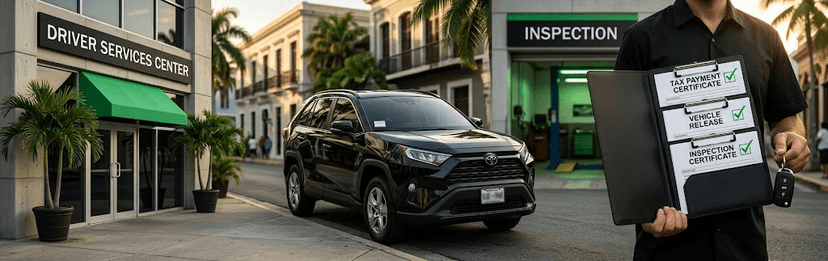
You register the car at CESCO, the driver services center run by Puerto Rico's Department of Transportation and Public Works (DTOP). Here's how to register a car in Puerto Rico from the US, based on the Fort Buchanan motor vehicle guide on Military OneSource:
-
Get a Puerto Rico driver's license. The guide says civilians should do this within 120 days of arriving.
-
Get a vehicle registration document at CESCO.
-
Have the car inspected at an authorized mechanic's garage. The guide puts the cost at about $11.
-
Bring your excise tax receipt. The guide notes that cars shipped from the mainland pay this tax, except for military personnel on orders.
-
Pay the registration fee at Hacienda, then take every paper and receipt back to CESCO.
-
Buy the registration sticker (marbete, linked to the AutoExpreso toll system) and activate it in the CESCO Digital app.
Insurance works differently on the island. According to the same guide, liability insurance is mandatory and covers up to $3,000 in property damage, at a cost of $99 per year for passenger vehicles. ACAA medical coverage is also mandatory. It's normally about $35 per year, covers bodily injury up to $25,000, and is paid along with registration. If you have private insurance, get a certificate from your insurer for the inspection.
Before the car ships, call your U.S. insurer. Ask whether your policy covers the car in Puerto Rico and for how long.
These steps come from a Department of Defense installation guide, not from DTOP itself, and fees can change. Confirm the current list at your CESCO office before you go. Military families can find the PCS side of this in military vehicle relocation.
Which Extra Documents Apply to Your Situation?
Everyone needs the documents above. Some owners need an extra paper or two on top of them.
|
Who you are |
Extra document or step |
Watch out for |
|
Moving for a job or school |
Nothing extra beyond the core list |
The 9-day free window at the terminal. Plan your flight so you can pay the tax and pick up the car in time. |
|
Financed car owner |
Lender's authorization letter in place of the title copy |
You still need to ship a financed car to Puerto Rico on the lender's timeline, so request the letter first |
|
Dealership |
Hacienda's excise tax declaration, filed through SURI as a merchant, with a commercial invoice, bill of lading, and vehicle appraisal |
Each vehicle is appraised and taxed on its own |
|
Snowbird |
Plan the paperwork for the trip back |
TOTE's San Juan to Jacksonville packet requires original documents and a Puerto Rico Police inspection before export, and a USDA hold on arrival in Jacksonville |
|
Classic or exotic owner |
Proof of value, if Hacienda asks |
A SURI vehicle excise tax estimate may show no value for a classic. TOTE's All Risks coverage only applies to cars 7 years old or newer, so arrange outside coverage. |
|
Car show organizer |
One full set of documents per car |
Ask Hacienda how show cars are taxed before you book. Don't assume an exemption. |
|
Active-duty military |
PCS orders |
Military OneSource's Fort Buchanan guide says active-duty members assigned to Puerto Rico can import one vehicle duty-free under the SCRA. Additional vehicles pay the full tax. |
|
Senior |
Signed letter of authorization |
A family member can drop off or pick up the car with that letter and their own ID |
|
Motorcycle owner |
Same title, ID, and Hacienda steps |
TOTE's rates page says it doesn't accept motorcycles. Check other ocean carriers, and run the VIN through Hacienda's Puerto Rico car import tax calculator, since the car table may not apply. |
For classic, exotic, and show cars, book enclosed vehicle shipping for the truck leg to Jacksonville. It keeps road debris and weather off the paint before the car ever reaches the port.
Your Puerto Rico Paperwork Plan in 5 Checks
Every delay in this process traces back to a missing paper or a missed window. Run these five checks before you book:
-
Title or permission letter in hand. Owners send a title copy. If you're financing, you need the lender's letter. To ship a leased car to Puerto Rico, you need the lessor's written OK.
-
Tax budgeted. Run a SURI vehicle excise tax estimate and add the result to your freight cost.
-
SURI account created before the car sails.
-
Car prepped for the port. ¼ tank or less, nothing loose inside, dropped off before the cutoff.
-
Both Hacienda papers saved for your CESCO visit.
If you only do one thing, gather every document before you book the sailing, not after. The ship moves in 55 hours. Your paperwork sets the pace for everything else. Get the documents needed to ship a car to Puerto Rico in order first, and the rest of the trip follows your schedule instead of Hacienda's.
Rather hand off the details? Tell us where your car is starting and when it needs to sail. We'll help you compare verified carriers for the trip to Jacksonville and lock a written price.