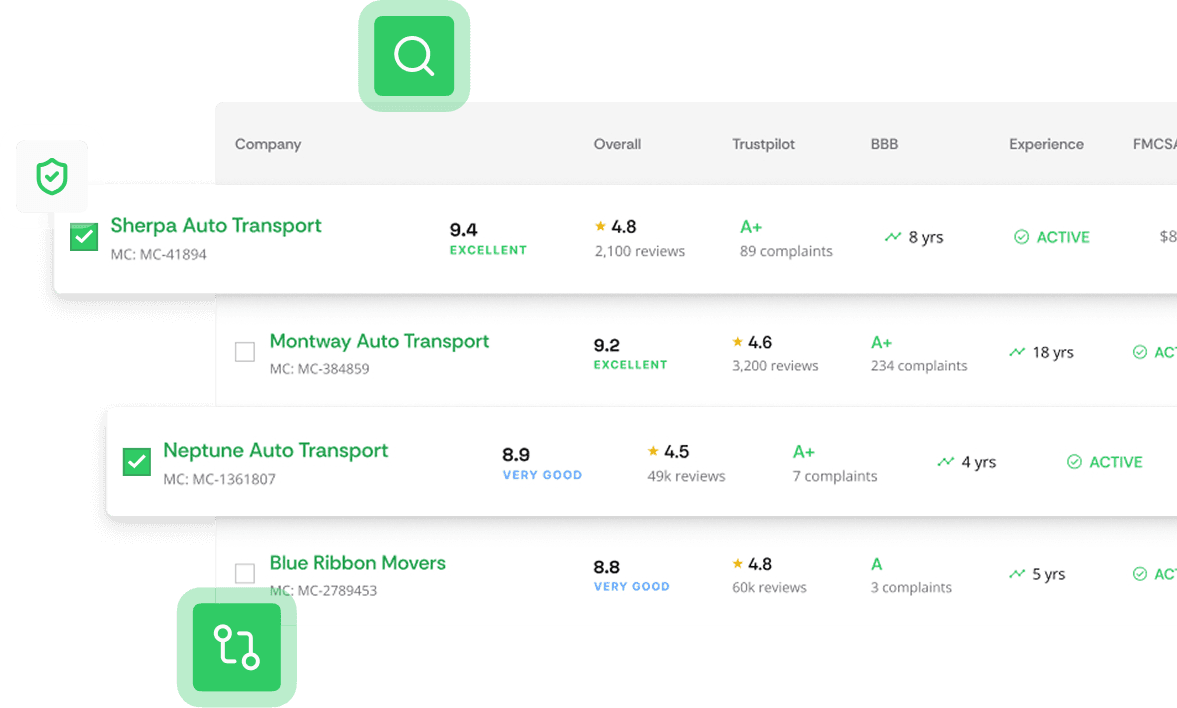

1. Spot the Red Flags
Fake five-star ratings are everywhere. So we built a vault of verified video reviews and stories from people who actually put their car on these trucks. Watch before you trust.
Verified reviews. Real carrier data. Every carrier checked against FMCSA
No hidden fees. No mystery driver showing up at your door.
We pull real data on thousands of vetted carriers and hand you a quote in about 60 seconds. You will know the price and the driver before you book, not after.

Car shipping usually feels like a guessing game. We cut that out. Here is the whole path, start to finish.
Fake five-star ratings are everywhere. So we built a vault of verified video reviews and stories from people who actually put their car on these trucks. Watch before you trust.
Put the top carriers next to each other. We show the things that decide whether your car arrives clean and on time: insurance limits, active DOT standing, real delivery windows. The numbers, nothing dressed up.
Tell us where the car is and where it needs to go. Our Advisor runs the numbers and points you to the carrier that fits your budget and your date.
Pick a carrier yourself, or let us run the whole thing. You get the same verified protection either way.
We checked thousands of providers to find the few who actually deliver. Every profile here is backed by real performance data, live insurance monitoring, and honest feedback from owners like you.

From downtown New York to the back roads of Nevada, we match you with carriers who already know your route. Coast to coast or one state over, your car stays inside a network of drivers we have checked.
Car transport in Florida, handled by vetted carriers.
Car transport in Alabama, handled by vetted carriers.
Car transport in New York, handled by vetted carriers.
Car transport in Illinois, handled by vetted carriers.
Car transport in California, handled by vetted carriers.
Car transport in Texas, handled by vetted carriers.
Car transport in Georgia, handled by vetted carriers.
Car transport in Arizona, handled by vetted carriers.
Car transport in Colorado, handled by vetted carriers.
Car transport in North Carolina, handled by vetted carriers.
Car transport in Ohio, handled by vetted carriers.
Car transport in Michigan, handled by vetted carriers.
Car transport in Pennsylvania, handled by vetted carriers.
Car transport in Virginia, handled by vetted carriers.
Car transport in Washington, handled by vetted carriers.
Car transport in New Jersey, handled by vetted carriers.
Car transport in Massachusetts, handled by vetted carriers.
Car transport in Tennessee, handled by vetted carriers.
Car transport in Missouri, handled by vetted carriers.
Car transport in Maryland, handled by vetted carriers.
Car transport in Minnesota, handled by vetted carriers.
Car transport in Indiana, handled by vetted carriers.
Car transport in Wisconsin, handled by vetted carriers.
Car transport in South Carolina, handled by vetted carriers.
Car transport in Louisiana, handled by vetted carriers.
Car transport in Kentucky, handled by vetted carriers.
Car transport in Oregon, handled by vetted carriers.
Car transport in Oklahoma, handled by vetted carriers.
Car transport in Connecticut, handled by vetted carriers.
Car transport in Iowa, handled by vetted carriers.
Car transport in Nevada, handled by vetted carriers.
Car transport in Arkansas, handled by vetted carriers.
Car transport in Mississippi, handled by vetted carriers.
Car transport in Kansas, handled by vetted carriers.
Car transport in Utah, handled by vetted carriers.
Car transport in Nebraska, handled by vetted carriers.
Car transport in New Mexico, handled by vetted carriers.
Car transport in West Virginia, handled by vetted carriers.
Car transport in Idaho, handled by vetted carriers.
Car transport in Hawaii, handled by vetted carriers.
Car transport in New Hampshire, handled by vetted carriers.
Car transport in Maine, handled by vetted carriers.
Car transport in Montana, handled by vetted carriers.
Car transport in Rhode Island, handled by vetted carriers.
Car transport in Delaware, handled by vetted carriers.
Car transport in South Dakota, handled by vetted carriers.
Car transport in North Dakota, handled by vetted carriers.
Car transport in Alaska, handled by vetted carriers.
Car transport in Vermont, handled by vetted carriers.
Car transport in Wyoming, handled by vetted carriers.
Shipping a car is not just finding a truck. It is timing the market and checking the driver. We watch thousands of active routes so your car moves on time, at the price we quoted.
Prices move with the season and with fuel costs. We track how many carriers are running each major route, so you can book when trucks are plenty and the price drops.
A DOT number is the floor, not the bar. We filter for carriers with a clean safety record and a 98% satisfaction rating. If we would not put our own car on their truck, you never see their quote.
We shut the door on vanishing deposits. Every shipment runs through insurance verification and secure payment steps. Your money and your car stay covered from pickup to drop-off.
Transportvibe has been picked up by national news outlets and trusted publications. They cite us for one reason: verified, checkable information about auto transport companies that helps people ship without getting burned.























Most people book a carrier and cross their fingers. That is a rough way to hand off a $40,000 asset. We do the vetting, auditing, and verifying so you are not playing detective with your own car.
LEARN MOREA door-to-door pickup on a narrow suburban street or a cross-country haul between big cities, we have the network for both. We do not just say nationwide. We make sure the carrier we assign actually knows your zip code.


Getting licensed is easy. Staying compliant is the hard part. We watch the Department of Transportation live database, so every driver in our network keeps active insurance and a clean record. Paperwork lapses, they are out.

The lowest quote is often the priciest once the surprise fees land. We put value ahead of cheap bait. You get one honest, all-in number that respects your budget and does not cut corners on your car's safety.
We cut out the sales noise. Use our data to find a carrier, book with a clear head, and join a group of shippers who value straight talk.

Do not settle for the first quote in your inbox. Line up carriers side by side and weigh price, insurance coverage, and real service quality from people who have been vetted.

Pick the carrier that hits your date and your budget. Open trailer or enclosed, we check the driver's credentials before they touch your keys.

Thousands of shippers keep this industry honest. Leave a real review and help the next person dodge the scams and find the drivers who do what they promise.
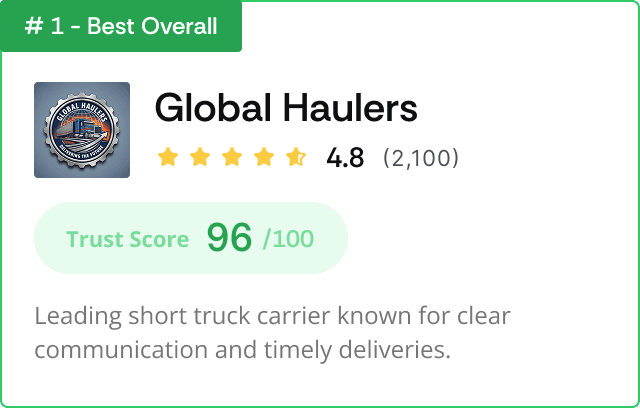
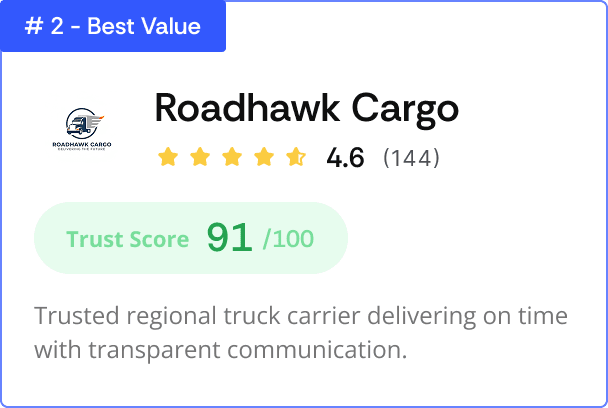
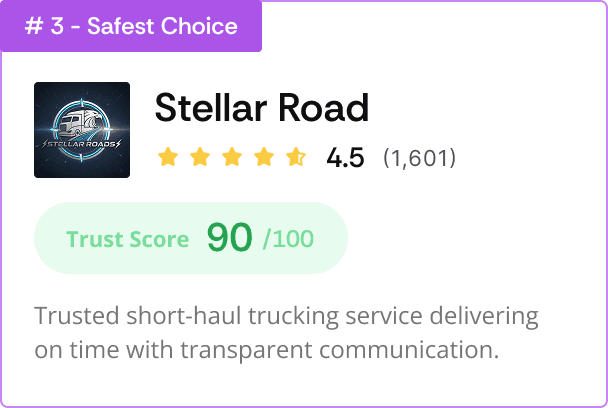

Tell us about your shipment, what matters most, and your budget. Transportvibe AI reads thousands of data points and hands back ranked picks with plain-English reasons.
Transportvibe Full Service runs the entire shipment for you, from picking the right company to confirming your car arrived.
Tell us about your move
Route, vehicle, timing, what you care about
We find the best fit
We match you with vetted companies
We handle booking
Negotiation, terms, and scheduling
We monitor everything
Live tracking, and we keep you posted
Your car arrives safely
Delivery confirmed, support if you need it

We put a spotlight on companies that quote fair and upfront. No hidden fees, no rate that balloons at the last minute. Our reviews flag the shippers who honor the number they gave you, and we check that carriers keep their pricing straight. Book knowing the quote is the quote.
Verified reviews from real shippers. Not bots, not paid placements.
All Reviews47,000+ verified reviews and counting
"Full Service assigned me an agent within minutes of paying, and my money stayed in escrow until I confirmed everything looked right at delivery. No back-and-forth with random carriers."
We are not a broker on the Compare and Advisor paths. Full Service is our licensed FMCSA brokerage.
Every listed company is checked against MC and DOT databases. A verification badge means real credentials, not a paid spot.
Every review goes through moderation. We catch the fakes, flag odd patterns, and protect what each rating is worth.
Real customers on camera, telling you how it went. Video is close to impossible to fake. That is the point.
Our Advisor shows its work. You see the reasoning, the tradeoffs, and the confidence level, not a black box.
Trust scores come from real review data across several categories. No company can buy a higher rating. Full stop.
Full Service comes with written service guarantees. We put promises in writing, because that is how trust actually works.
Your experience matters. Real reviews from real shippers help the next person choose better, and push this whole industry to be straight.
Leave a review : CA → NY
Leave a review : TX → FL
Leave a review : IL → AZ
Why your review matters
Guides and real-world tips to help you choose right before the truck shows up.

Federal law gives a motor carrier up to 120 days to pay, decline, or make a written settlement offer once you file a damage claim, and it has to acknowledge that claim in writing within 30 days ( 49 CFR §370.9 ). Most people never learn that until their car rolls off the truck with a fresh dent and the phone stops getting answered. That gap is what this guide closes. Knowing the damage claim response time in car shipping tells you exactly when a company owes you an answer, who actually pays, and what to do the second the silence starts. Shipping soon and want it handled right the first time? Get a free, no-pressure quote from carriers who put pickup, delivery, and claim terms in writing before your car ever moves. The Real Answer: How Long a Car Shipping Company Has to Respond to Your Damage Claim Here is the short version, up front, so you can act on it today. Once you file a written claim, the carrier has 30 days to acknowledge it and 120 days to pay it, deny it, or send a firm settlement offer in writing. If it still cannot resolve the claim after 120 days, it has to update you in writing every 60 days until it does. Those windows come straight from the federal claims rules that govern motor carriers ( 49 CFR Part 370 ). That is the legal backbone of the damage claim response time in car shipping. It is not a customer-service promise a company can bend. It is the rule, and every step of the auto transport damage claim process runs on these windows. Stage Who acts The window What starts the clock Acknowledge the claim Carrier 30 days The day they receive your written claim Pay, deny, or offer settlement Carrier / insurer 120 days Same filing date Ongoing status updates Carrier / insurer Every 60 days If unresolved past 120 days Two things trip people up. First, the clock does not start when your car gets damaged. It starts when you file a proper written claim . Every day you wait to file is a day the clock is not running for you. Second, the response window is separate from your car shipping insurance claim time limit, which is the deadline to file and something we cover below. Confuse the two and you can lose a real claim on a technicality. For a plain-English refresher on how a shipment moves from booking to doorstep, this car transport guide and this walk-through on how to choose the right auto transport service both help. If you want the full booking-to-delivery picture, start with auto transport from start to finish . For a dealership owner moving several units, the same 30 and 120-day windows apply to each unit, so track every claim on its own clock. Broker vs Carrier: Who Actually Pays for Car Damage During Transport This is the question that sends people in circles. You booked through a broker, but a carrier's driver did the actual hauling. So who pays for car damage during transport? The short answer: the carrier and its cargo insurance pay for damage that happens on the truck. The broker arranged the job. In most cases the broker does not carry the insurance that covers your paint and panels. Getting the auto transport broker vs carrier liability split right decides where you send your claim, and where you waste your time. Broker Carrier Role Arranges the shipment, matches you to a hauler Physically transports your car Carries cargo insurance? Usually no Yes, this is who pays You file your claim against The carrier (broker can assist) The carrier Escalation help Can push the carrier on your behalf The party legally on the hook What the Carrier Is Legally on the Hook For Under the Carmack Amendment, the interstate carrier is generally liable for loss or damage to your vehicle while it is in their care, from pickup to delivery ( Benesch Law overview ). That liability is why every legitimate carrier has to carry active cargo insurance and a valid operating authority. Before you book, confirm both. Most cars ship fine on open car shipping , and the coverage rules are the same whether the trailer is open or enclosed. This is exactly why the auto transport broker vs carrier liability distinction matters. You file against the party with the insurance, not the party who answered your first call. What the Broker Does, and Does Not, Cover A good broker earns its fee here. It can chase the carrier, help you assemble paperwork, and keep the file moving. What it usually cannot do is cut you a check from its own pocket, because it is not the insurer. Some brokers carry contingent cargo coverage, but that is a backstop with limits, not your primary path. The broker arranges. The carrier insures. The broker can advocate. The carrier pays. Contingent broker coverage exists, but treat it as a fallback, not the plan. That is who pays for car damage during transport in almost every case: the carrier's cargo insurance, with the broker in a support role. For a military family on PCS orders or a student relocating across the country through a door-to-door service , this is the part to nail down before signing. If your route crosses state lines, the same rules follow the truck whether you are shipping a car to another state or across the country. The Bill of Lading: Your Single Most Important Piece of Evidence If you remember one thing, remember this. The bill of lading is the document that wins or kills your claim. It is the inspection record both you and the driver sign at pickup and again at delivery, and its condition notes are the evidence a claim stands on. A careful bill of lading car shipping inspection is worth more than any argument you make later. Skip it, and you hand the company its easiest defense. The Delivery Inspection Checklist: Do This Before You Sign Do not rush this, even at a bad hour. Walk the whole car with the driver and your phone out. Use covered vehicle transport if your car warrants extra protection, but inspect every delivery the same careful way. Walk the car in one direction, roof to rockers, front to back. Check panels, bumpers, wheels, mirrors, and glass in good light. Look under the front lip and rear valance, where scrapes hide. Take timestamped photos and a slow video, all sides plus close-ups. Note any new damage on the bill of lading before you sign. Get the driver's name and the carrier's contact on the spot. That delivery inspection car shipping checklist takes ten minutes and protects thousands of dollars. If you loaded personal items, know the rules first, because packed belongings usually fall outside cargo coverage and can complicate a claim. "No Damage Noted on the Bill of Lading": Can You Still Claim? Yes, but it is harder. A no damage noted on bill of lading claim starts on your back foot, because the signed document says the car arrived clean. Harder is not the same as hopeless. What still helps: clear pickup photos that prove the damage was not there before, a fast written report, and the driver's own condition report auto transport records from the pickup end. The realistic play is speed and proof. The sooner you report a no damage noted on bill of lading claim and the stronger your pickup-versus-delivery photos, the better your odds. This is why the bill of lading car shipping inspection and the condition report auto transport paperwork both matter so much. They are the timeline of your car's condition, and a good delivery inspection car shipping checklist is what keeps that timeline honest. Seniors and anyone taking a late-night delivery, this is your moment to slow down, not speed up. Car Damaged During Transport? What to Do in the First 24 Hours Spotting fresh damage is a gut-punch. What you do in the next day decides how the claim goes. Here is car damaged during transport what to do, in order. Do not sign a clean bill of lading. Note the damage first. Photograph everything, all angles, close and wide, with timestamps. Refuse the "sign now, sort it out later" line. Once you sign clean, you have given away your strongest card. Report it in writing to both the carrier and the broker the same day. Log every call and message with names, dates, and times. Those are the photos needed for car shipping damage claim files that adjusters actually accept, and together with the signed delivery notes they are how you start proving car damage during shipping. A motorcycle owner should check the tie-down points and lower fork area first, because strap pressure and loading are where two-wheel damage usually shows. If you are weighing how a bike travels, open-air versus enclosed motorcycle shipping changes the risk profile. A classic or exotic owner should photograph original details up close, since proving car damage during shipping on a collector car often comes down to documenting what was factory-correct before pickup. Knowing car damaged during transport what to do in that first day is the whole difference between a paid claim and a denied one. How to File a Car Shipping Damage Claim, Step by Step Once you have documented the damage, filing is a process, not a phone argument. Follow the steps and the deadlines and you keep every advantage. This is how to file a car shipping damage claim without giving the company an easy out. Notify the carrier in writing that you are filing. Email creates a record. Request the carrier's official claim form and insurance details. Assemble your evidence: signed bills of lading, photos, and a repair estimate. State a specific dollar amount. A vague claim invites a vague answer. Submit within the filing window, then keep copies of everything. Follow up on a schedule and hold them to the 30 and 120-day rules. Step What you send The deadline that applies Notice Written notice of intent to claim As soon as possible after delivery Formal claim Claim form, photos, estimate, dollar figure Within the carrier's filing window Response Nothing, you wait Carrier owes an answer in 120 days The one deadline you cannot miss is the filing window. Under Carmack, a carrier cannot require you to file in less than 9 months, and cannot require a lawsuit in less than 2 years after a denial ( SNJ Legal ). Many bills of lading set the filing window right at that 9-month floor, so read yours. That is your real car shipping insurance claim time limit, and it is the answer to how long to file an auto transport claim: usually up to nine months, but confirm it in writing. When people ask how long to file an auto transport claim, nine months is the safe assumption, and your bill of lading is the final word. Filing a claim against an auto transport carrier is the same auto transport damage claim process whether you moved one car or a driveway full. Rules vary a little by state, so this state-by-state look at car shipping regulations is worth a scan. A dealership owner running several claims at once should log each on its own filing clock and its own response clock. Nine months is generous until it is not. The Documents That Make or Break Your Auto Transport Insurance Claim Adjusters stall claims for "missing information." Give them nothing to stall on. The auto transport insurance claim documents below are the full set that keeps a file moving. The signed bill of lading from both pickup and delivery. Timestamped photos and video from delivery, plus your pickup shots. A written repair estimate, or an appraisal for a high-value car. The carrier's insurance policy reference and claim form. Copies of every written notice and message you sent. Those are the auto transport insurance claim documents that turn a "we're reviewing it" into a real answer. Your delivery photos are the same photos needed for car shipping damage claim approval, and they are the backbone of proving car damage during shipping when a company pushes back. One number to plan around: the deductible. A car shipping insurance deductible claim only pays out above the carrier's deductible, so if the repair is small, the payout can be small or nothing. Get the repair estimate first. If it sits below the deductible, a car shipping insurance deductible claim may not be worth the paperwork, and knowing that early saves you a month of chasing. For a collector car, get a proper appraisal, not a body-shop guess, because the numbers are different and so is the coverage. When a Car Shipping Company Denies or Ignores Your Claim Denial and silence are common opening moves, not the final word. If a company goes quiet or says no, you have a clear ladder to climb. Here is what to do if car shipping company denies claim requests, or simply stops replying. Send a written follow-up with a firm response deadline. Ask for the denial reason in writing. A vague "denied" is not a real answer. Loop in the broker and have them push the carrier. File a complaint with the FMCSA National Consumer Complaint Database . Send a demand letter, then use small claims court for smaller amounts. For larger losses, talk to an attorney about a Carmack claim. That is what to do if car shipping company denies claim requests or simply stalls: climb the ladder, in writing, on the record. A car shipping company not responding to claim messages is often betting you will give up before the 120 days are gone. Do not. The regulation is on your side, and a documented paper trail changes the tone fast. If you are dealing with a car shipping company not responding to claim follow-ups, the written federal complaint is the step that tends to wake people up. This matters most for people who are far from the carrier when a claim goes cold. Snowbirds heading between Florida and Arizona often ship in one state and settle in another, so keep every record digital and keep filing a claim against an auto transport carrier on schedule even from a distance. If you booked through a broker, revisit that guide to choosing a service and lean on them to escalate. Companies Known for Handling Damage Claims Fairly, and How to Vet Any of Them Names help, but the skill you actually want is being able to vet any company yourself. Here are a few with strong claims and insurance reputations, then the method that works on all of them. AmeriFreight is known for offering gap coverage that can reimburse the carrier's insurance deductible, which is often the exact amount customers get stuck paying out of pocket ( AmeriFreight's coverage page ). For a deeper look, see this AmeriFreight review . American Auto Shipping is known for upfront pricing and a straightforward process, which tends to mean fewer surprises if a claim comes up. And Intercity Lines runs its own enclosed vehicle shipping fleet built around classic, exotic, and collector cars, usually with higher coverage limits and drivers trained for high-value work. For that crowd, this roundup of top enclosed car shipping services is a useful shortlist. The real skill is vetting. Do it the same way every time. Confirm active cargo insurance and a valid operating authority before booking. Read how the company answers its negative reviews, not the glowing ones. Ask for the claims process and the filing window in writing, before you sign. Ask directly about their damage claim response time in car shipping, and get the answer on paper. A classic-car owner in Texas shipping to a show, a snowbird, a first-time shipper, they all benefit from the same three minutes of homework. The company that answers claims questions clearly before your car moves is usually the one that answers them clearly after. What People Ask Us Most Before They File The quick-hit questions that come up again and again once a car shows up with damage. How Long Does A Car Shipping Company Have To Respond To A Damage Claim? Federal rules give the carrier 30 days to acknowledge your claim and 120 days to pay it, deny it, or make a written offer. After that, it has to update you every 60 days. What Happens If There's No Damage Noted On The Bill Of Lading But I Find Damage Later? You can still file, but it is harder, since your signed paperwork says the car arrived clean. Move fast and use your pickup photos to prove the damage was not there before. Who Pays For The Damage — The Broker Or The Carrier? The carrier and its cargo insurance pay for damage that happens on the truck. The broker only arranged the shipment, so you file against the carrier, not the broker. How Long Do I Have To File An Auto Transport Damage Claim After Delivery? Usually up to nine months. Under the Carmack Amendment, a carrier cannot make you file in less than nine months, but check your bill of lading for the exact deadline. What Can I Do If The Car Shipping Company Ignores Or Denies My Claim? Follow up in writing with a deadline, get the denial reason on paper, loop in the broker, and file an FMCSA complaint . For big losses, consider small claims or an attorney. Before You Sign, Know Your Clock Every part of this comes down to a decision you make at the curb, not in a courtroom. The response clock, the filing clock, and the deductible all reward the person who documents fast, files in writing, and holds the company to the 30 and 120-day rules. That is the whole of the damage claim response time in car shipping, and it is not complicated once you see the timeline. The single move that protects every driver, from the dealership owner to the senior to the motorcycle rider, is this: never sign a clean bill of lading you have not verified with your own eyes and your own camera. Do that, and most claims never turn into a fight. Ready to ship with a carrier that treats claims like a promise, not a problem? Request a free quote today and compare companies that put timelines, coverage, and response windows in writing before you book.

Nearly one in four crashed vehicles now gets written off. Total loss frequency hit a record 23.1% of claims in the latest CCC Crash Course report . Every one of those cars still has to go somewhere, and most cannot drive there on their own. That is where Non-Running Car Shipping Fees come in, and where the first quote jumps the moment you admit the car won't start. This guide breaks down what those fees cover, why a dead car costs more to move, how a carrier loads one, and what to budget in 2026. Totaled daily driver, salvage buy, stalled project, or non-running motorcycle, the logic is the same once you see it. Get a free, no-pressure quote built around your exact vehicle and its real condition, so you know the all-in number before you book. What "Non-Running" Actually Means to a Carrier (and Why It Costs More) Here is the part most people get wrong before they even request a quote. A carrier does not price your car by whether the engine turns over. It prices by how the car gets onto the trailer. So the real question behind does a non-running car cost more to ship is simpler than it sounds. Can the driver load it safely, and how much extra gear does that take. That is why "non-running" is not one thing. It is a spectrum, and where your car sits on it sets the fee. Condition What It Means Loading Method Fee Impact Runs but not safely Starts, but overheats, stalls, or fails inspection Drive-on with care Little to none Rolls, steers, and brakes Dead engine, but wheels turn and it stops Winch onto the trailer Modest surcharge No brakes or steering Wheels roll, but you can't guide or stop it Winch plus extra crew, or specialty load Higher surcharge Fully seized or salvage Won't roll at all, missing parts, heavy damage Forklift or specialized carrier Largest fee A car that rolls, steers, and brakes can be winched for a modest fee. One that won't do all three can force a forklift or a specialty load, and the charge climbs fast. The gap between those two situations is bigger than the gap between a running car and a rolling dead one. The hardest tier is worth naming early. Shipping a car with no brakes or steering changes the whole plan, because the driver cannot guide the car onto the ramps or stop it once it is moving. Salvage buyers and project-car owners live in this tier most often. It is also the honest starting point for the non-running car carrier requirements we cover further down, since the crew has to know what they are walking into. There is a broader reason these shipments keep growing. The average car on U.S. roads is now a record 12.8 years old, according to S&P Global Mobility . Older cars break down, get parted out, and change hands more often, which means more of them travel by truck instead of under their own power. If you are new to how any of this works, our guide on how car shipping works covers the basics before the non-running layer gets added on top. So does a non-running car cost more to ship than a running one? Yes, almost always. The size of that "more" is what the rest of this guide is about. Non-Running Car Shipping Fees: The Real Numbers in 2026 Let me be direct about the money, because vague ranges help no one. Non-Running Car Shipping Fees are really two numbers added together. Your normal transport rate for the route, plus an inoperable surcharge for the extra work. Put plainly, the cost to ship a non-running car is your standard rate with that surcharge stacked on top. The surcharge is tied to loading difficulty, not distance, which is why two cars on the same route can quote hundreds of dollars apart. On top of a standard rate, a rolling, steering, braking non-runner commonly adds somewhere in the low hundreds. A car that won't roll and needs a forklift can add several times that, and sometimes it needs a specialty carrier billed separately. These are practical ranges, not a fixed price list. The only number that counts is the one tied to your exact car and pickup spot, which is why a real quote beats any estimate on a page. The Winch Fee, Forklift Fee, and Other Add-Ons Most of the surcharge comes from one or two specific line items. Knowing them lets you read a quote instead of guessing at it. Fee Type When It Applies What Drives the Cost Winch fee Car rolls, steers, and brakes but won't drive Powered winch plus 20 to 30 extra minutes to load Forklift or specialty-load fee Car won't roll or steer, or has heavy damage Different equipment, more crew, often a terminal Non-standard pickup Tight driveway, gravel lot, behind a fence or gate Extra time and difficulty positioning the truck Storage Car isn't ready when the driver arrives Holding the vehicle until it can load The winch fee car shipping charge is the one most non-runners hit. It covers the truck's powered winch and the added time to pull a dead car up the ramps by cable instead of driving it on. It is the smallest of the add-ons for a reason. The car is still doing half the work by rolling and steering. The winch fee car shipping line is also the easiest to plan for, since almost any open carrier can do it. A forklift or ramp-truck fee is a different animal. It is bigger because it needs equipment the average car hauler does not carry, and the car often has to move to a terminal where that gear lives. How Much Extra a Dead Car Really Adds Here is the honest comparison. The inoperable vehicle shipping cost for the same car on the same route runs above what a running version would cost, and the spread depends entirely on the tier from the section above. A winch-ready non-runner sits near the bottom. A no-roll salvage car sits at the top. Rolls, steers, brakes: expect a modest winch surcharge on top of the base rate. No brakes or steering: expect a larger add-on, plus a possible move to a terminal. Won't roll at all: expect a forklift or specialty fee that can rival the base transport cost itself. The single biggest jump in inoperable vehicle shipping cost is not running versus non-running. It is rolling versus not rolling. That one factor decides whether a standard truck can take your car or whether you need special equipment. So when you ask how much extra to ship an inoperable car, the real answer starts with a different question. Does it roll. Two guides worth a look before you compare quotes. Our breakdown of hidden car shipping fees shows the charges that hide in the fine print, and how much it costs to ship a car in 2026 sets the baseline rate the surcharge stacks on top of. Read both and you will know how much extra to ship an inoperable car is fair versus padded. How a Carrier Loads a Car That Won't Start This is the section that makes every fee make sense. Once you see how the car gets on the trailer, the charge stops feeling like a random markup. How to ship a car that won't start comes down to one question. Can the crew get it up onto the deck safely. There are three real ways to do it, and your car's condition picks the method for you. Getting this right up front is most of what a smooth pickup takes, since loading a non-running car onto a carrier is where the whole shipment either goes clean or goes sideways. Winch Loading and Rollback Trucks The most common method for a dead car is a winch load. The driver hooks a powered steel cable to the frame and pulls the car up the ramps while it rolls. It is the cleanest way of loading a non-running car onto a carrier, as long as the car rolls freely, steers so it tracks straight up the ramp, and brakes so it can be stopped on the deck. This is the whole reason a rolling non-runner is cheap to load. The car is still steering and stopping itself. When a car is lower to the ground or the angle is tricky, a rollback truck for non-running car pickup solves it. The flatbed tilts down to meet the pavement, the car is winched onto the flat bed, and the bed levels back out. It is common for single-car moves, salvage pickups, and low-clearance vehicles that would scrape on standard ramps. The car rolls freely on all four tires. The tires hold air so the wheels turn under load. The steering is unlocked so the car tracks straight. Someone can release the parking brake or wheel lock. Miss one of those and a simple winch load turns into a bigger job. That is often the moment a rollback truck for non-running car gets called in, or the fee jumps to the next tier. Our walkthrough of auto transport from start to finish shows where loading fits in the larger process, from booking to the driver pulling away. Forklift Loading for No-Roll and Salvage Cars When the car won't roll or steer at all, the winch is off the table and forklift loading auto transport takes over. A forklift lifts the car bodily onto the trailer or into a container. This is how fully seized cars, salvage units with locked or missing wheels, and heavily damaged vehicles get moved. It costs more because it needs a machine the average hauler does not carry, more hands on site, and usually a terminal or yard with the right footprint. Forklift or specialty loading is the single biggest reason one non-running quote dwarfs another. It is equipment and labor, not padding. A quote that looks suspiciously low for a no-roll car usually means the company has not accounted for how it will physically lift the thing, and that gap tends to reappear later as a re-quote. This is also where shipping a car with no brakes or steering lands most often. No steering means no winch, because the car cannot be guided up the ramps. Once forklift loading auto transport is in play, the honesty of your description matters even more, which brings us to what the carrier needs from you. What the Carrier Needs From You: Requirements Before Pickup By now the mechanics of how to ship a car that won't start are clear. The last piece is on you, and it is the part people skip. The fastest way to blow up your own quote is to under-report the car's condition. Every set of non-running car carrier requirements starts with plain honesty about what the driver is going to find. Get this right and the price you were quoted is the price you pay. Tell every company these things before pickup, not when the truck is idling in your driveway. Does it roll on all four tires? Does it steer? Does it brake and hold on the ramp? Do the tires hold air? Is there a key, or none at all. Where exactly is it parked, and how tight is the access? Handle the key question directly, because it makes people panic for no reason. Shipping a dead car without keys is doable more often than owners expect. A carrier can still winch or forklift a car with no key, but the crew has to know in advance so they bring wheel dollies or schedule the right equipment. Spring it on them at pickup and you risk a refused load or a same-day re-quote. So put shipping a dead car without keys on the order from the start, right next to the roll-steer-brake answers that shape the rest of the non-running car carrier requirements. A car listed as "runs and drives" that won't start when the driver arrives is the number-one cause of a re-quote or a refused pickup. Drivers plan their whole route and equipment around what the order says. An honest "it won't start and won't steer" costs you a little more upfront and saves you a wasted trip. Service members have their own timing pressure here. If you are moving under orders and the car won't run, our military vehicle relocation service is built around PCS deadlines and the documentation that comes with them, so a non-running car does not derail a hard report date. Open, Flatbed, or Enclosed: Picking the Right Carrier for a Dead Car Most non-runners move fine on a standard open carrier. The decision shifts when the car is valuable, fragile, or something you would not leave in an open parking lot. That is the real question behind flatbed vs enclosed for non-running car transport. It is less about the engine and more about what the car is worth to you. Option How the Non-Runner Loads Relative Cost Best For Open multi-car carrier Winched onto an open deck Lowest Rolling daily drivers, salvage buys, budget moves Flatbed or rollback Winched onto a single tilting bed Middle Low-clearance cars, single-car pickups, tight sites Enclosed carrier Winched or forklifted, fully covered Highest Classics, exotics, restored or high-value builds For a rolling dead car with everyday value, open transport is the sane choice, and it pairs with open car shipping to keep the whole move affordable. The flatbed vs enclosed for non-running car question really only gets interesting at the top of the value range. That top range is where enclosed earns its price. Enclosed transport for inoperable cars is the only sane call for a non-running classic car transport job, a barn find, or a half-finished restoration you cannot risk on an open deck through highway grit and weather. If you organize a show or move a feature vehicle, this is not a luxury, it is protection. A non-running classic car transport move pairs careful winch or forklift loading with a fully covered trailer, which is exactly why those quotes sit at the top of the range. To see where the extra spend does and does not pay off, our breakdown of open vs enclosed transport cost lays it out plainly. The short version. For a daily non-runner, open is smart. For anything you would call irreplaceable, enclosed transport for inoperable cars is cheap insurance. Salvage and Project Cars: The Special Cases and What They Cost Two kinds of non-runners search differently and load differently, so they deserve their own section. Salvage cars and project cars. Salvage car shipping cost covers auction buys and totaled vehicles moving out of a Copart or IAA yard, often with damage that complicates the load. Wheels can be locked, panels can be crushed, and the car may not roll at all. Salvage cars ship heavily out of auction states like Texas , Florida , and Georgia , where the big yards cluster, so those lanes stay busy and competitive. A salvage car with body damage or missing wheels can push loading from a simple winch into forklift territory, and the fee follows the equipment. That is the recurring theme. Damage that stops the car from rolling is what moves the price, more than the salvage title itself. Because origin drives the ground leg on these moves, our Texas auto transport cost guide is a useful reference if your salvage car shipping cost starts from a Texas yard. Project cars are their own case. A project car shipping cost is usually about a car that is mechanically apart. No exhaust, no seats, sometimes no working brakes. It prices like a no-roll job even if the car "used to run" before the teardown. If you are hauling a build home, describe its current state, not its former one. A non-running motorcycle is a cousin of this problem. It loads differently again, usually crated or strapped to a pallet, and the motorcycle crowd should quote it as its own item rather than assume it rides like a car. Missing, locked, or seized wheels. No working brakes to hold it on the ramp. Loose parts and panels that need securing. Pickup from a home garage instead of a terminal. Each of those raises a project car shipping cost, and all of them trace back to the same root. Can it roll and be controlled. If cost is your sticking point, our guide to the cheapest way to ship a car applies to project and salvage moves too, as long as you are honest about the car's condition when you shop the rate. Enclosed protection is the one upgrade worth the money on a rare or half-restored build, and our enclosed vehicle shipping service is set up for exactly that kind of vehicle. How to Get an Accurate Non-Running Car Shipping Quote (and Not Get Re-Quoted) An accurate non-running car shipping quote lives or dies on how precisely you describe the car. Vague in, vague out. The companies that give you a firm number are the ones you told the whole truth to. Have this ready before you request a single quote. The exact condition tier. Rolls, steers, brakes. Or which of those it fails. Key or no key. Pickup surface and access. Paved driveway, gravel, gated lot, or auction yard. The vehicle's value, so open versus enclosed gets priced right. Whether it needs open, flatbed, or enclosed. A non-running car shipping quote that comes back far cheaper than the rest usually means the surcharge got left off, and it will reappear before delivery. That is not a deal. It is a delay waiting to happen. A fair non-running car shipping quote names the inoperable fee upfront and puts it in writing. If you want to sanity-check the base rate under that surcharge, weigh it against a realistic cost to ship a non-running car on your route rather than a bare-bones number with no equipment plan behind it. The other half of an accurate quote is trusting who gave it to you. Before a deposit leaves your account, confirm the company is a real, insured, authorized operator. Check the USDOT and MC number on the FMCSA SAFER company snapshot, then read recent reviews for the pattern of how the company handles problems, not just the star average. Weight the last year of reviews over anything older. A firm quote from a carrier you cannot verify is not worth much. Best Companies for Shipping a Non-Running Car in 2026 Now the part you came for. Not every hauler is set up to load a dead car, and fewer still handle the no-roll and salvage tier. The ones worth your money have real inoperable capability, they name the winch or forklift fee before you book, and they support you through the disclosure instead of springing a re-quote on pickup day. These four are ranked on reliability, inoperable capability, and verified customer feedback, not on who paid for placement. Montway is left off on purpose so strong, lesser-covered names get air. Verify any MC number free on FMCSA before you pay a cent. Company Best For Open / Enclosed / Heavy Standout Strength Bargain Auto Transport Budget movers with a rolling dead daily driver or salvage buy Open Straightforward inoperable quoting and low-cost winch loading Auto Transport 123 First-timers and seniors who want the process explained Open and Enclosed Responsive, single-contact support that walks you through the condition disclosure We Will Transport It No-brakes, no-steering, salvage, and forklift loads Open and Heavy-haul Equipment and network for the hard tier that won't roll Plycar Transportation Group Non-running classics, exotics, and project cars Enclosed specialist Premium enclosed handling and careful documentation for high-value builds Here is the honesty note. Every one of these has a one-star review somewhere. So does any company at scale. Read the pattern of how they answer problems, not the average alone. There is no single "best" here, only the best fit for your car's condition, its value, and your budget. Enclosed transport for inoperable cars narrows the field fast, which is why a specialist like Plycar earns its spot on a rare build, while a rolling salvage car on a budget points straight at the first two names. To build your own shortlist, match the carrier's equipment to your car's tier, confirm the FMCSA record, read recent reviews, and get the surcharge locked in writing. Our roundups of the most affordable car shipping companies and the best enclosed car shipping services are good starting points, one for the budget end and one for the high-value end. For collectors and exotic owners shipping something that won't start, our luxury and exotic car shipping service matches you to enclosed specialists who handle non-runners with care. What Non-Running Car Owners Ask Most A few quick, straight answers to the questions that come up once the reality of moving a dead car sets in. Does my auto insurance or the carrier's cargo coverage protect a non-running car during transport? The carrier's cargo insurance covers your non-running car while it rides the truck, not your personal auto policy. Ask for the certificate of insurance before pickup and confirm inoperable vehicles are included. Is it worth getting my car running before shipping just to skip the winch fee? Usually not. Getting the car to roll, steer, and brake matters far more than starting it, since that is what drops the inoperable surcharge. Only fix it if the repair costs less than the winch fee. Do I pay the winch or forklift fee upfront or when the car is delivered? It depends on the company. Most fold the winch or forklift fee into your total, with a deposit at booking and the balance due on delivery. Get the full amount in writing first. Can a carrier ship a non-running motorcycle the same way it ships a dead car? Not quite. A non-running motorcycle usually ships crated or strapped to a pallet, not winched like a car. Quote it as its own item so the carrier brings the right loading equipment. What happens if I list my car as running and it won't start when the driver arrives? Expect a re-quote or a refused pickup. The driver planned the equipment around your description, so a surprise non-runner means added winch fees or a rescheduled load. Disclose the real condition upfront. Making the Call on Your Non-Running Car Move Strip away the noise and shipping a dead car comes down to one honest sequence. Figure out the condition tier first, because rolling versus not rolling sets the fee more than distance ever will. Expect an inoperable surcharge on top of the base rate, and treat it as part of the budget from day one. Pick open for a budget non-runner and enclosed for a classic or a project you cannot replace. Disclose everything up front so the quote holds. And verify any company on FMCSA before you pay. The people with the smoothest non-running moves are simply the ones who described the car honestly, matched it to a carrier with the right equipment, and got the winch or forklift fee in writing before pickup. Do those three things and a car that won't start stops being a problem and becomes a scheduling task. Ready to see your real all-in number? Get a free quote built around your exact car, its condition, and your timing, so you can decide with facts instead of guesses.

Nearly 80% of the vehicles shipped across the U.S. in 2025 traveled under 1,000 miles, according to Super Dispatch's 2026 industry report . The Dallas-to-Chicago run sits right on that line at 925 road miles, which is exactly why Dallas to Chicago car shipping is one of the busiest, best-priced lanes in the country. More carriers mean more quotes. More quotes mean more confusion. This guide fixes that. You'll get the real 2026 price, the actual transit time, the open-versus-enclosed call, and the companies worth your phone call, whether you're moving for a job, heading north as a snowbird, or sending a show car to a Chicago event. Want a real number instead of a guess? Skip the guesswork and see exactly what your move costs. Get free, no-obligation Dallas to Chicago car shipping quotes from vetted carriers in about a minute, compare real prices side by side, and book only when the number actually feels right for you. How Much Does It Cost to Ship a Car From Dallas to Chicago in 2026? Here's the short answer for the people who scrolled straight here. In 2026, the cost to ship a car from Dallas to Chicago runs roughly $600 to $950 for open transport and $1,050 to $1,600 for enclosed on a standard sedan or small SUV. Those are current market quote ranges on the lane, not sticker prices, and the spread is real. Why such a wide gap? Because two honest quotes for the same car in the same week can still differ by a few hundred dollars. Carrier supply changes daily. A truck already headed north from Dallas with one open slot will quote low to fill it. A carrier you have to pull onto the route will quote high. That's the whole game. The lane at a glance: ~925 miles, most cars quoted between $600 and $950 open. A suspiciously low quote is the single most common warning sign of a re-quote later. Here is what the numbers look like by vehicle type. Vehicle Type Open Transport Enclosed Transport Sedan (Camry, Accord) $600 – $850 $1,050 – $1,400 Small / mid SUV (RAV4, Equinox) $650 – $950 $1,150 – $1,500 Full-size SUV or pickup truck $800 – $1,150 $1,350 – $1,700 Motorcycle $350 – $600 $500 – $850 If you want to see how this route compares to longer hauls, our breakdown of the cost to ship a car 2,000 miles shows how price per mile actually drops as distance grows. Dallas to Chicago is a mid-length lane, so you pay a bit more per mile than a coast-to-coast move but far less in total. What Actually Moves Your Dallas-to-Chicago Price Every quote is built from the same handful of levers. Learn these and you'll read a quote like a pro. Season and timing: Summer and early spring cost more. Flexible pickup dates cost less. Vehicle size and weight: A three-row SUV takes more trailer space than a Civic, so it costs more. Running or not: A car that won't start needs a winch. Add $100 to $200. Open vs enclosed: The biggest single lever, covered in its own section below. Exact ZIP codes: Downtown Chicago is harder for a full-size trailer than a flat suburban street. The cheapest way to ship a car from Dallas to Chicago is the combination of all of these: an open carrier, flexible dates, a running car, and pickup somewhere a big rig can actually turn around. One honest caution. The cheapest way to ship a car from Dallas to Chicago is not always the lowest number on the screen. A lowball quote that gets "adjusted" three days later, after your movers already left, costs you more in stress than the $75 you thought you saved. What It Costs to Ship an SUV, Truck, or Motorcycle Bigger vehicle, bigger price. It's about space and weight on the trailer, nothing more mysterious than that. The cost to ship an SUV from Dallas to Chicago usually lands $50 to $200 above a sedan for a mid-size crossover, and more for a full-size three-row. Shipping a truck from Dallas to Chicago follows the same logic. A half-ton pickup like an F-150 sits in the full-size row above. Lifted trucks, oversized tires, or camper shells push the cost to ship an SUV from Dallas to Chicago or a truck higher still, because the carrier loses room for another car on the deck. Rule of thumb: budget roughly $150 to $350 more for a full-size truck or three-row SUV than for a sedan on this route. Motorcycles ride on this lane too, usually crated or strapped to a specialized rack. If you're moving a bike alongside a car, ask whether one carrier can handle both. Our SUV and larger-vehicle shipping guide walks through how trailer space is priced, which is the same math whether you're shipping a truck from Dallas to Chicago or a big SUV. For the vehicle itself, our SUV and truck transport service page shows what's included. How Long Does It Take to Ship a Car From Dallas to Chicago? Direct answer first, because this is the second question everyone asks. How long does it take to ship a car from Dallas to Chicago? Typically 2 to 4 days of transit once the car is picked up, on a run of about 925 road miles . The part people miss is that transit time and pickup time are two different clocks. The two clocks: Pickup window is 1 to 3 days to get a carrier assigned and loaded. Transit time is the 2 to 4 days the car spends on the truck. Ask any company to quote both, separately. Here's the full timeline so you can plan your week. Stage Typical Timing What's Happening Booking to dispatch Same day to 2 days Your order is matched to a carrier heading north Pickup window 1 – 3 days Driver confirms a date and loads the car in Dallas In transit 2 – 4 days ~925 miles up through Oklahoma, Missouri, and into Illinois Delivery Scheduled call ahead Driver calls a few hours out to meet you The reverse trip runs on the same clock. Chicago to Dallas car shipping also takes about 2 to 4 days of transit, which matters if you're a snowbird timing a car north in spring and back south in fall. The one thing that can add a day to either direction is winter weather, and we cover the best time to book below. Whether you're planning Chicago to Dallas car shipping or the northbound leg, build in a little buffer around the pickup window rather than the transit itself. If your timeline is tight, an expedited car shipping service can lock a firm pickup date for a premium. Open vs Enclosed: Which Transport Type Fits Your Car? About 9 out of 10 cars on this lane move on an open carrier, the same double-decker trucks you see on the highway. For a daily driver, that's the right call. Open car transport Dallas to Chicago is cheaper, faster to book, and perfectly safe for a normal vehicle. Enclosed is different. It's a fully covered trailer, and it's for cars where a single stone chip off an Oklahoma highway is a real financial loss. Enclosed car shipping Dallas to Chicago is what collectors, exotic owners, and dealers moving high-value inventory choose. Factor Open Transport Enclosed Transport Typical cost (this lane) $600 – $950 $1,050 – $1,600 Protection level Exposed to weather and road debris Fully covered, climate-shielded Availability High, quick to book Lower, may wait a few days Best for Daily drivers, most cars Classics, exotics, low-mileage, show cars The open vs enclosed car transport cost difference on Dallas to Chicago is usually $400 to $650. That's the number to weigh. For a $22,000 commuter, open makes sense. For a numbers-matching classic or a car headed to a show, the open vs enclosed car transport cost gap is cheap insurance against a repaint. A quick word to the collector and the show organizer moving several cars at once. Enclosed, every time, and confirm the trailer has a liftgate rather than steep ramps if the car sits low. Our luxury and classic car shipping guide covers documentation and insurance for high-value moves in detail. If you've already decided, you can start on the right service page directly: open car shipping for the standard route, or ask about a covered trailer for anything special. Door-to-Door vs Terminal-to-Terminal on the Dallas-to-Chicago Lane Two ways to hand off the car, and the right answer changes once you factor in Chicago's streets. Door to door car shipping Dallas to Chicago means the driver picks up and delivers as close to your address as the truck can safely and legally get. Terminal to terminal car shipping Dallas to Chicago means you drop the car at a lot in the Dallas area and collect it from a lot in the Chicago area. Option How It Works Cost Best For Door to door Driver comes to you on both ends Standard, most common Almost everyone, especially seniors and busy movers Terminal to terminal You drop off and pick up at lots Can be lower per car Dealers moving several cars, anyone near a terminal Most people want door to door car shipping Dallas to Chicago, and it's the default on this lane. Here's the Chicago reality you should expect. Narrow one-way streets, permit-parking blocks, and low viaducts around 9 feet mean a 75-foot car hauler often can't reach your front door. So the driver asks to meet you at a nearby grocery lot or wide side street. That is normal and legal, not a bait-and-switch. Terminal to terminal car shipping Dallas to Chicago can save money if you're a dealer moving a batch or you happen to live near a terminal anyway. For a single household car, the small savings usually isn't worth the extra trip. You can compare both on our door-to-door car shipping service page. Driving It Yourself vs Shipping: Is the 925-Mile Haul Worth It? The question everyone asks quietly. Driving vs shipping a car from Texas to Illinois looks cheaper on paper, right up until you add everything up. Let's do the real math, not the fantasy version. It's about 925 miles and roughly 14 hours of nonstop driving, which nobody does in one shot. With the national average gas price at $4.09 a gallon as of August 2026 , a car getting 25 mpg burns about 37 gallons, or roughly $151 in fuel one way. Cost or Factor Drive It Yourself Ship It Fuel (~925 mi, 25 mpg) ~$151 Included in quote One hotel night $120 – $160 $0 Meals on the road $40 – $70 $0 Wear, mileage, depreciation ~925 mi added $0 Your time ~14 hrs behind the wheel Free to fly or work Risk Highway miles, weather, fatigue Carrier's insurance covers transit The honest total: driving pencils out near $300 to $400 in gas, a hotel, and meals, before you price 14 hours of your time or 925 miles of wear on the car. So when does driving win? When you'd actually enjoy the road trip, the car is old enough that mileage doesn't matter, and your time is genuinely free that week. Driving vs shipping a car from Texas to Illinois tips toward shipping the moment you're moving a second car, protecting a lease mileage cap, short on time, or handling a military PCS on orders. For most people, shipping smart beats driving once time is counted, which loops back to the cheapest way to ship a car from Dallas to Chicago being the smarter spend, not the drive. Our long-distance car shipping service is built for exactly this kind of run, and if you're relocating and buying on arrival, the guide to buying and shipping a car out of state is worth a read. Getting Ready: Prep, Paperwork, and How Payment Works A smooth pickup is 90% preparation. Do this part right and the driver is in and out in fifteen minutes with zero disputes later. How to Prepare Your Car for Pickup Knowing how to prepare a car for auto transport is what separates a clean handoff from a delivery-day argument. Run this checklist the day before. Wash it: A clean car lets you document real condition. Dirt hides scratches, and hidden scratches become "new damage" claims. Photograph every side, dated: Timestamps on your phone are your proof. Leave about a quarter tank of gas: Enough to load and unload, light enough to keep the car safe. Remove toll tags and all personal items: Loose belongings aren't covered and can shift in transit. Disable the alarm: and note any existing damage on the Bill of Lading before the truck leaves. Leave one key: for the driver and keep your spare. Those dated photos and a carefully checked Bill of Lading are the entire reason disputes get resolved in your favor. This is the single most important habit if you're a first-timer or shipping a car for an older parent. Our full car preparation checklist has a printable version, and it's the same regardless of route, so learning how to prepare a car for auto transport once serves you for life. Broker vs Carrier, Deposits, and How You Actually Pay Here's the part that confuses first-timers. The auto transport broker vs carrier question is simple once you see it. A broker books your move and finds the truck. A carrier is the truck and driver that actually hauls the car. Most quotes you get online come from brokers, and that is completely normal. Brokers have access to thousands of carriers, so they fill routes faster than any single trucking company could. Why does the auto transport broker vs carrier distinction matter to you? Because either way, you should verify the carrier's safety record before the car loads, not just the broker's marketing. We'll show you exactly how in the companies section. Now, car shipping deposit and payment. Here's how it works on a legitimate booking: A partial deposit books the order, often charged only once a carrier is assigned, not before. The balance on delivery, usually cash or certified funds to the driver, sometimes card to the broker. No large full-upfront payment. Anyone demanding 100% wired before pickup is a red flag. Get the total price in writing with the deposit and balance spelled out. Understanding car shipping deposit and payment up front is your best defense against the classic scam, and our how to spot car shipping scams guide covers the rest. When you're ready to book the actual move, our full-service car shipping page lays out each step. When to Ship: The Best Time of Year for Dallas to Chicago Timing changes both your price and your reliability on this north-south lane. The best time of year to ship a car on the Dallas-to-Chicago route is spring and fall, when the weather is mild, carrier supply is steady, and prices settle. Demand is the reason. Illinois took in 201,600 new residents from other states in 2024 , including about 18,200 from Texas alone, and most of those moves cluster in summer. When everyone moves at once, carriers charge more. Season by season, here's what to expect. Winter (Dec–Feb): Chicago snow and ice can add a day to transit, but rates dip because demand is low. Fine if your schedule is flexible. Spring (Mar–May): Snowbirds head north and the relocation season starts. Book a week or two early. Summer (Jun–Aug): Peak. Job moves, college moves, and family relocations collide. Highest demand and highest price. Fall (Sep–Nov): Snowbirds return south. A good balance of price and availability. The lever that beats haggling: booking 1 to 2 weeks ahead in peak season saves more than any single price negotiation with a carrier. Deciding on the best time of year to ship a car really comes down to your own flexibility. If you can move in April or October, do it. Snowbirds running cars both directions should book both legs early. Our snowbird car shipping service is set up for exactly that seasonal round trip. Best Auto Transport Companies for Dallas to Chicago in 2026 Now the payoff. A quick note on method first, because it matters. These picks are ranked on verified customer reviews, on-time performance on Texas-to-Midwest lanes, and clean federal safety records, not on who paid to be here. We've deliberately left the biggest household name off this list so strong, lesser-covered carriers get some air. And no matter who you choose, verify the company's MC number free before you pay a cent. Here are four of the best auto transport companies Dallas to Chicago has serving it in 2026. Company Best For Open / Enclosed Standout Strength eShip Transport Company First-timers, relocators, seniors Open + Enclosed Responsive single point of contact, no large upfront deposit, plain-English quoting Number 1 Auto Transport Dealers, multi-car and cross-country moves Open + Enclosed Long track record and a deep carrier network for predictable Midwest scheduling Nationwide United Auto Transport Students, military PCS, budget movers Open + Enclosed Competitive pricing with discount options and solid federal safety standing Bespoke Auto Logistics Classics, exotics, show cars, collector motorcycles Enclosed specialist White-glove covered transport with careful documentation for high-value cars into Chicago Now the honest part, because trust is built on it. Every one of these companies has a one-star review somewhere. So does every carrier at scale. Read the pattern of the responses, not the star average alone. A company that answers a bad review with a fix tells you more than a perfect score does. There is no single "best" among the best auto transport companies Dallas to Chicago offers, only the best fit for your car, your budget, and your timeline. Here's how to verify any of them yourself, in two minutes: Cross-check the company's USDOT and MC number on the free FMCSA SAFER database . Read the most recent reviews, not just the top-rated ones. Match the carrier type to your vehicle. A collector car belongs on an enclosed vehicle shipping trailer, not an open deck. Get the full price locked in writing before you pay the deposit. Do that, and you'll pick a good carrier from the best auto transport companies Dallas to Chicago has, or from anywhere else, with confidence. The Questions Every Dallas to Chicago Shipper Asks Quick, straight answers to the things people ask us most before booking a car on this lane. Can I leave personal belongings in my car when shipping from Dallas to Chicago? Legally, no. Carriers aren't licensed to haul household goods, and personal items in a car during auto transport aren't covered by insurance. Keep the car empty, or leave a few small items low in the trunk at your own risk. Is my car insured while it's on the truck between Texas and Illinois? Yes. Every licensed carrier must carry cargo insurance that covers your car in transit. Always ask for the certificate of insurance before pickup, and check that the coverage limit matches your vehicle's value on the Texas to Illinois route. Do I have to be there in person for pickup in Dallas or delivery in Chicago? Not necessarily. You can assign a trusted adult to release or receive the car and sign the Bill of Lading. Just tell your carrier in advance who that person is for pickup in Dallas or delivery in Chicago. Can you ship a non-running car on the Dallas to Chicago route? Yes, but tell the broker up front. A non-running car needs a carrier with a winch and costs about $100 to $200 more. Confirm it rolls, brakes, and steers, since a fully dead car needs special equipment. What happens if my car is damaged during Dallas to Chicago car shipping? Note it on the Bill of Lading at delivery and photograph it before the driver leaves. Then file a claim against the carrier's cargo insurance. Those dated pickup photos you took in Dallas are your proof. Making the Call on Your Dallas-to-Chicago Move Pull it all together and the decision is simpler than it looked at the top of the page. Know your range, roughly $600 to $950 open and $1,050 to $1,600 enclosed. Pick open unless the car is special. Book door to door unless a Chicago street forces a nearby handoff. Ship in spring or fall if your calendar allows it. And whoever you call, verify them on the federal database before money changes hands. That's the whole playbook for Dallas to Chicago car shipping, and it's the same logic that protects you on any lane. You've got the full picture now, the cost, the timeline, the transport types, and the vetting steps. The last move is the easy one. You've seen the full picture, so take the easy last step. Get your free, no-pressure Dallas to Chicago car shipping quotes now, compare vetted carriers on both price and timing, and lock in the right truck for your move this week before rates climb.

Did you know, Hawaii has about 88 registered vehicles for every 100 residents, one of the higher rates in the country ( ValuePenguin ). Here is the part that surprises new arrivals. The islands connect to the mainland only by sea, so nearly every one of those cars crossed the Pacific on a ship. That single fact is what makes Hawaii Car Shipping different from any mainland move. You are booking ocean freight, not a driver with a trailer. Prices, timelines, and prep rules all change because of it. This guide covers real costs by route, how Matson and Pasha compare, what it takes to reach each island from shipping a car to Honolulu to the neighbor islands, and the paperwork waiting on arrival. Want a real number for your exact route and island? Get a free, no-pressure quote and compare verified carriers side by side before you commit a single dollar. How Hawaii Car Shipping Actually Works: It Is A Two-Leg Ocean Move Forget the mainland picture of on9-13e truck driving your car door to door. A Hawaii move has two legs. First, your car gets to a West Coast port. Then it rides an ocean vessel across the Pacific. Understanding that split is the key to every cost and timing decision below. The mainland leg is normal auto transport. A carrier picks up your car and delivers it to the departure port. The ocean leg is where the real money and time sit. That is also why booking direct with an ocean line looks cheap on paper but leaves you handling the mainland drive and both port visits yourself. Most first-timers do not realize the whole system runs through a handful of West Coast ports, not from any city you like. If you want the full walkthrough of the moving parts, this guide on how car shipping works lays out the basics before you add the ocean layer. RoRo Vs Container Car Shipping To Hawaii You have two ways to cross the water. RoRo vs container car shipping Hawaii comes down to how your car sits on the vessel. Method How It Ships Best For Relative Cost RoRo (roll-on/roll-off) Driven onto the vessel deck Standard cars, lowest price $ Shared Container Loaded with other vehicles Extra protection, flexible $$ Sole-Use Container Your car alone, sealed Classic, exotic, high-value $$$ RoRo is the default and the cheapest. The container costs more but shields the car from open-deck exposure. For a deeper breakdown of the trade-offs, see this comparison of RoRo vs container shipping . The right pick in the RoRo vs container car shipping Hawaii debate depends on the value of what you are moving. Port-To-Port Vs Door-To-Door Port-to-port is the budget path. You drop the car at the mainland port and pick it up at the Hawaii port. Door-to-door adds a broker who handles the mainland drive to and from your address. You pay for that convenience, but for seniors, busy families, or anyone without a spare day for port runs, it is often worth it. What It Really Costs To Ship A Car To Hawaii By Route Here is the money section. Rates move with origin, island, vehicle size, and season, so treat these as verified ranges, not promises. For a West Coast departure, a sedan runs about $1,500 to $2,100 and an SUV or truck about $1,800 to $2,500 ( Hawaii Guide ). From the Midwest, add roughly $500. From the East Coast, expect $2,500 to $3,600 because your car crosses the whole country before it ever sees water. Origin Region Sedan / Compact SUV / Truck West Coast ( California , Washington , OR) $1,500 – $2,100 $1,800 – $2,500 Midwest $2,000 – $2,800 $2,300 – $3,200 East Coast $2,500 – $3,200 $2,800 – $3,600 The cost to ship a car to Hawaii from California is the benchmark most people compare against, and for good reason. Long Beach and Oakland are the main Matson departure ports, so a car already near them skips the priciest part of the trip. If you want to ship a car from Los Angeles to Hawaii, you are starting at the low end of the range. Plan to ship a car from Seattle to Hawaii and the car routes down to a California port first, which adds mainland miles before it sails. Choosing open transport for the mainland leg keeps the cost to ship a car to Hawaii from California down further, and you can read how open car shipping works before you book. Two things move your quote the most: distance to the port and vehicle size. A lifted truck or a three-row SUV costs more than a compact on every route. This piece on how vehicle size and weight impact cost explains why, and the 2026 cost breakdown puts Hawaii numbers next to mainland ones. How Long Does It Take To Ship A Car To Hawaii Short answer: budget two to four weeks door to door, and book earlier than you think you need to. The transit clock has two parts. There is booking lead time before your car sails, then the ocean crossing itself. From the vessel sail date, Matson lists typical transit of 9 to 24 days to Honolulu and 33 to 45 days to the neighbor islands that receive cargo by barge ( Matson ). So the honest answer to how long does it take to ship a car to Hawaii is that the island you pick matters as much as the port you leave from. Booking lead time is where people get burned. A Matson car shipping appointment is required. Port staff cannot book you on arrival, and a booking stays valid for 90 days, which gives you room to plan. In summer PCS season and around the holidays, appointment slots fill fast, so lock yours early. If speed is the priority, priority auto shipping on the mainland leg trims the front half of the timeline. For a fuller look at what drags out a move, see these car shipping time reasons . The full answer to how long does it take to ship a car to Hawaii always includes that booking window, not just the sailing days. Matson Vs Pasha: Choosing Your Ocean Carrier Two ocean lines move almost every car to Hawaii. Matson and Pasha are the carriers, not brokers, and picking between them usually comes down to which port is closest to you. The Matson vs Pasha car shipping choice is really a geography question. Carrier Mainland Ports Hawaii Ports Served Matson Long Beach, Oakland Honolulu, Kahului, Hilo, Kawaihae, Nawiliwili Pasha Hawaii San Diego, Oakland Honolulu, Kahului, Hilo, Kawaihae The Matson vs Pasha car shipping decision rarely turns on price alone. It turns on convenience. Whichever line sits closest to your car and your destination island usually wins. Protecting the car on the ocean leg matters too, and both lines offer enclosed options through covered vehicle transport . For the deeper Hawaii port and pricing map, this guide on Hawaii car transporting ways and port locations is worth a read. Matson Car Shipping Rates And The Drop-Off Appointment Matson quotes by route and vehicle, and payment is due at booking. You reserve online, get a booking number, then bring it to the port with your ID, registration or title, and a lienholder letter if the car is financed ( Matson ). Matson car shipping rates are published per lane, which makes them easy to sanity-check against a broker quote. Do not skip the Matson car shipping appointment step. Without a confirmed booking, the gate turns you away. When Pasha Makes More Sense Pasha sails from San Diego, which is the better call for Southern California owners south of the Los Angeles ports. If you plan to ship a car from Los Angeles to Hawaii, compare both lines, since Oakland and Long Beach may still edge out San Diego on total cost. Owners farther north who want to ship a car from Seattle to Hawaii will route down to a California port either way, since neither line loads Hawaii autos from Tacoma. Shipping To Each Island: Honolulu, Maui, The Big Island, And Kauai Oahu is the hub. Honolulu Harbor takes direct sailings and handles the most volume, so shipping a car to Honolulu is usually the fastest and cheapest island option. The neighbor islands are where the details matter. Island Receiving Port Direct Or Via Honolulu Oahu Honolulu Direct Maui Kahului Direct on some sailings Big Island Hilo / Kawaihae Often via Honolulu Kauai Nawiliwili Often via Honolulu Shipping a car to Maui is straightforward on lines that call at Kahului directly. Shipping a car to the Big Island can route through Honolulu first, which adds days. Shipping a car to Kauai through Nawiliwili works the same way. When a car transships through Honolulu, you pay for the extra handling and you wait longer. If you are moving with the seasons, seasonal car relocation covers the snowbird angle, and this guide to car shipping in Hawaii goes island by island. First-timers should also skim these island car shipping tips before booking. Inter-Island Car Shipping In Hawaii: Moving A Car Between The Islands Already in Hawaii and moving from Oahu to Maui? Bought a truck on the Big Island and need it on Kauai? That is a different service. Inter-island car shipping Hawaii runs on a barge, not the trans-Pacific vessels. Young Brothers handles the inter-island barge out of Honolulu's Pier 39. A standard sedan runs about $500 to $800 one way between Oahu and Maui, Kauai, or the Big Island, and a pickup or SUV about $600 to $900, with pickup on the other side in 3 to 7 days ( How To Live In Hawaii ). Book the reservation two to three weeks ahead, longer in summer. Inter-island car shipping Hawaii follows the same empty-car rule as the ocean crossing. Drive to the pier with your registration and proof of insurance, hand over the keys, and collect the car at the destination. Whether it is shipping a car to Maui for a new job, shipping a car to the Big Island for a move, or shipping a car to Kauai for a fresh start, the process is the same. Motorcycle owners can look at open-air motorcycle shipping for inter-island bike moves. The unique island rules are covered well in this piece on the challenges of shipping to Alaska or Hawaii , and the Young Brothers review breaks down real costs. Prepping Your Car And What You Can Legally Pack Inside Hawaii prep is stricter than a mainland move, and two rules trip people up at the gate. First, fuel. Your tank must be at a quarter or below. Vessels reject any car over that line until the fuel is siphoned ( Car Shipping Hawaii ). Second, personal items. The car must be empty. Only the spare tire, jack, jumper cables, and child safety seats are allowed, and every compartment gets inspected at the gate. So can you ship personal items in your car to Hawaii? Officially, no, and it is not worth the risk of a delay or a denied load. That answer catches a lot of movers off guard, which is why we spell it out in can you ship a car with belongings and again in this piece on packing items in car transport . The short version of can you ship personal items in your car to Hawaii is to plan on shipping your household goods separately. Here is how to prepare a car for shipping to Hawaii, step by step: Wash the car and photograph every panel for a condition record Drop the fuel to a quarter tank or less Remove all personal items, toll tags, and loose electronics Disable the alarm and note any leaks Bring the spare key and your booking number to drop-off That checklist is the core of how to prepare a car for shipping to Hawaii. For a classic, exotic, or collector car, add a sealed crossing through enclosed vehicle shipping so the ocean air never touches it. The Cheapest Way To Ship, Plus Shipping From Hawaii Back To The Mainland The cheapest way to ship a car to Hawaii is not a secret discount code. It is a stack of small choices that add up. Go port-to-port and skip door-to-door handling Choose RoRo over a container Use open transport on the mainland leg Start from the West Coast port closest to your car Book off-peak, away from summer and the holidays Do all five and the cheapest way to ship a car to Hawaii becomes obvious. Each lever shaves real dollars, and the cheapest way to ship a car guide plus these seven ways to ship cheaply show the same logic on mainland routes. The return trip surprises people. The cost to ship a car from Hawaii to mainland is not always a mirror of the trip over. Vessel space, direction of demand, and which island you leave from all shift the price, and neighbor-island departures cost more than leaving from Honolulu. Military families rotating out should price the cost to ship a car from Hawaii to mainland early and look at military vehicle relocation for PCS support. Never assume the return equals the outbound quote. After It Lands: Registering Your Car In Hawaii The car arrived. You are not done. Registration is the step people forget, and the clock is short. New residents have 30 days to register a vehicle brought from another state, and a Hawaii safety inspection has to come first ( Hawaii License Plate ). Knowing how to register a car in Hawaii after shipping before the car lands saves you a scramble. Bring these to your county motor vehicle office: Out-of-state title and current registration Bill of lading or shipping receipt showing the arrival date Stamped State of Hawaii Form G-27 Proof of Hawaii no-fault insurance A passed Hawaii safety inspection certificate Initial out-of-state transfers cannot be done online, so plan an in-person visit. That is the real answer to how to register a car in Hawaii after shipping, and the state-by-state guide to shipping regulations covers how Hawaii compares to other states. Who Actually Ships Cars To Hawaii Well Booking Matson or Pasha yourself works if you like handling the mainland drive and both port visits. Most people would rather hand the whole chain to one coordinator. A good Hawaii broker arranges the mainland pickup, the ocean booking, and the paperwork in one thread. Four premium, high-support names worth a quote: Sherpa Auto Transport , known for locked-in pricing and steady communication, a fit for first-timers who hate surprise fees Corsia Logistics , a boutique operation with hands-on service, good for classic and high-value cars SGT Auto Transport , strong tracking and a large carrier network for flexible timing Ship A Car Direct , a damage-free focus and clear claims process for cautious owners Before you pay any deposit, verify the company. Check the DOT and MC number on the FMCSA SAFER system so you know you are dealing with a licensed operator, not a fly-by-night. Dealers moving inventory to the islands should look at dealer vehicle transport solutions for volume moves. For a fuller lineup, compare the top 5 Hawaii car shipping companies and read the Sherpa review before you decide. Still Wondering? Hawaii Car Shipping Questions Answered A quick rundown of the real-world things Hawaii movers check before they book, from insurance to fuel rules to port drop-offs. Is it cheaper to ship my car to Hawaii or just buy one after I move? Shipping usually wins if your car is paid off and reliable. Island dealer prices run high. For a clean commuter, the cost to ship a car to Hawaii from California often beats buying local. Does my regular auto insurance cover the car while it's on the ocean vessel to Hawaii? Usually not. Personal auto policies rarely cover ocean transit. Your carrier provides basic marine insurance during the crossing, but confirm the coverage limit and buy extra for a high-value car. Do I have to empty the gas tank before shipping my car to Hawaii? Not empty, but close. U.S. Coast Guard rules require a quarter tank or less. Part of how to prepare a car for shipping to Hawaii is draining fuel before drop-off, or the vessel rejects it. Can I track my car while it's crossing to Hawaii, and who do I call if it's delayed? Yes. Matson and Pasha give you a booking number to track your car online. If it's delayed, call your broker first, then the ocean line. Delays on inter-island car shipping Hawaii usually mean the next barge. Do I need to be there in person to drop the car off and pick it up at the port? For port-to-port, yes. You or an authorized person must drop off and pick up with ID and the booking number. Door-to-door skips the port runs, so a broker handles both ends for you. Making The Call On Your Hawaii Move Strip away the noise and Hawaii Car Shipping comes down to a few clean choices. Start from the West Coast port closest to your car for the best price. Pick RoRo to save, or an enclosed container if the car is worth protecting. Match your carrier to your island, Matson or Pasha, based on which ports are nearest. Book the appointment weeks ahead, especially in summer. Empty the car, drop the fuel to a quarter tank, and line up your Hawaii safety inspection so registration is ready the week the car lands. Get those five right and you ship to any island without overpaying or scrambling. Ready to move? Compare real quotes from verified Hawaii carriers in a few minutes, match the right port and island to your budget, and book with confidence.

Every winter, roughly one million seasonal residents move into Florida, lifting the state's population by about 5% ( Florida Realty Marketplace ). A good share come from Texas, and plenty would rather not spend 19 hours behind the wheel to get there. That is where Dallas to Miami car shipping comes in. It is one of the most-traveled auto transport lanes in the country, which means steady carrier supply and fair pricing once you know what to look for. This guide breaks down the real 2026 cost, how long the move takes, open versus enclosed, and which carriers actually earn their spot on this route. No fluff, no scare tactics. Want an exact figure for your car and travel dates? Get a free, no-pressure quote for your Dallas-to-Miami move in under two minutes and compare real carrier prices side by side. What Dallas to Miami Car Shipping Costs in 2026 Here is the short answer most people are looking for. Shipping a standard car from Dallas to Miami runs $959 to $1,419 for open, door-to-door service, over a distance of about 1,311 miles ( moveBuddha ). That is the range to expect for a typical sedan or small SUV in normal conditions. Price is not one fixed number. It moves with your car, your timing, and the type of trailer. The good news is that this lane sees heavy truck traffic in both directions, so you rarely pay a "dead-head" penalty the way you might on a rural route. Open vs. Enclosed Price on This Lane Transport Type Typical 2026 Price Range Average Transit Best For Open carrier $959 - $1,419 3 - 8 days Daily drivers, SUVs, dealer inventory Enclosed carrier Roughly $1,350 - $2,200 3 - 8 days Exotics, classics, low-clearance, high-value cars Enclosed runs 30% to 60% more than open on the same route, because those trailers carry far fewer cars and cost more to operate ( FreightWaves ). You are paying for a covered ride and fewer cars sharing the truck, not a gimmick. For a full cost breakdown by trailer type, see this guide on open vs. enclosed transport cost . What Moves Your Price Up or Down A few levers do most of the work on your final number: Vehicle size and weight. A half-ton truck or three-row SUV takes more deck space and fuel than a compact, so it costs more. Running vs. non-running. A car that does not start needs a winch and extra labor, which adds to the quote. Pickup flexibility. A wide window helps a dispatcher slot you into an existing load. A hard date costs more. Season. Winter southbound demand into Florida is the single biggest swing on this lane. Open vs. enclosed. Covered transport is the largest optional add-on. Metro access in Miami. Tight streets or gated communities can push a driver toward a nearby meeting spot. Most of these are within your control. If your dates are loose and your car is a standard runner, you land near the low end. Texas shippers can also review the wider Texas auto transport cost guide before booking. Ready to move a car out of the state? Open car shipping is the default choice for most drivers leaving Texas . How Long Dallas to Miami Auto Transport Takes Dallas to Miami car shipping time usually runs 3 to 8 days door to door. The drive itself covers about 1,313 miles and takes close to 19 hours nonstop ( Travelmath ). A carrier does not drive it straight through, though, so plan around two clocks instead of one. The first clock is the pickup window. That is the time between booking and a truck actually loading your car, usually one to five days depending on your flexibility and price. The second clock is road time, which for this lane is short. Once your car is on the truck, it is often in Miami within two to four days. Service Level Pickup Window Time in Transit Total Door-to-Door Standard 1 - 5 days 2 - 4 days 3 - 8 days Expedited 1 - 2 days 2 - 3 days 3 - 5 days If your delivery timing is tight, say the price and the date up front so the dispatcher can find the right load. For a deeper look at what causes hold-ups, read why car shipping times vary . The reverse Miami to Dallas car shipping trip works the same way, with the same window logic. Open vs. Enclosed: Which Fits Your Car This is where most people overthink it. The choice is simpler than it looks once you match the trailer to the car. When Open Transport Is the Right Call Open carriers are the workhorses of this industry. They haul seven to ten cars at once, which spreads the cost and keeps your price down ( FreightWaves ). Open auto transport Dallas to Miami is the right pick if your car is: A daily driver, sedan, or standard SUV Dealer or fleet inventory moving on a budget A replaceable vehicle where a little road dust is no big deal Your car rides exposed to weather, the same way it did driving off the dealership lot. For the vast majority of shippers, that trade-off is worth the savings. See a side-by-side rundown in this open vs. enclosed car shipping breakdown. When Enclosed Is Worth Paying For Enclosed trailers carry one to six cars behind solid walls. That is the move for anything you would not want caught in a Gulf Coast rainstorm. Enclosed car shipping Dallas to Miami makes sense for: Exotics and supercars headed to a Miami show or buyer Classic and collector cars with original paint Low-clearance or modified vehicles that need lift-gate loading Any high-value car where the extra few hundred dollars buys peace of mind Miami is a magnet for high-end vehicles, so exotic car transport Miami demand is real and specialists know the route well. If your car falls in this group, enclosed vehicle shipping is worth the premium every time. Seasonal Rates and Hurricane Season on the Florida Leg Timing may be the most underrated cost factor on this whole route. Two Florida-specific cycles hit at once, and both affect your price and your wait. The first is the snowbird cycle. Roughly one million seasonal residents flow into Florida each winter, and a large wave shows up in December and January. Southbound trucks fill fast in the fall, which pushes seasonal car shipping rates Florida shippers pay up in peak months. The pattern flips in spring, when the same crowd heads north. The second is hurricane season, which runs June through November. This does not make shipping unsafe. It affects scheduling. A named storm can pause pickups and deliveries in affected areas for a few days, so build in buffer time if you ship in late summer or early fall. Season / Months Demand Direction Price Impact Booking Tip Fall (Sep - Nov) Heavy southbound Rising into peak Book 2 - 3 weeks early Winter (Dec - Feb) Peak southbound Highest of the year Lock dates, stay flexible Spring (Mar - May) Heavy northbound Elevated northbound Reverse-lane rates ease Summer (Jun - Aug) Lighter both ways Lowest, watch storms Cheapest window, add buffer If your dates can flex, the summer shoulder is often the cheapest time to move a car south, storms aside. Snowbirds planning a seasonal move should read the snowbird car shipping guide and these seasonal shipping tips before locking a date. A dedicated seasonal car relocation service can also handle the round trip for repeat travelers heading to Florida . Delivery Options: Door-to-Door, Terminal, and the Miami Port Question How your car actually changes hands matters more in a dense metro like Miami than on an open highway. Most carriers offer door to door car shipping Miami service, which means the driver comes as close to your address as the truck can safely reach. In practice, a full-size car hauler cannot always fit down a narrow street or through a gated community. When that happens, the driver asks to meet at a nearby parking lot, like a shopping center. That is normal, not a bait and switch. Door to door car shipping Miami is still the most convenient option for almost everyone. Terminal-to-terminal is the other choice. You drop the car at a lot and pick it up at one near Miami. It can shave a little off the price, but you handle both ends yourself, and storage fees add up if you are late for pickup. For most people, the door service is worth it. Compare real providers in this list of the best door-to-door car shipping services . One honest correction, because it confuses a lot of first-timers. A domestic Dallas-to-Florida move does not use the Miami seaport. Searches for car shipping to Miami port point to international, overseas transport. If your car is staying in the United States, it rides on a truck the whole way, and the port never enters the picture. Best Car Shipping Companies for the Dallas to Miami Route Here is the part everyone scrolls for. A quick note on how to read it, though. Match the carrier to your car and timeline, not just the sticker price. And whoever you pick, verify their DOT and MC numbers yourself using the free FMCSA company lookup . It takes 30 seconds and it is the best scam filter there is. The four below are premium, well-reviewed brokers with strong support reputations. Prices shift with season and vehicle, so treat these as a shortlist to quote, not a ranking set in stone. Company Stands Out For Open / Enclosed Best-Fit Reader Corsia Logistics Boutique, hands-on communication Both First-timers, seniors, anyone who wants a real person Ship A Car Direct Documentation and damage-free track record Both Cautious owners who want everything in writing SGT Auto Transport Volume and live shipment tracking Both Tight timelines, relocations, dealers Reliable Carriers Enclosed specialist for high-value cars Enclosed Exotic, classic, and show cars headed to Miami For daily drivers and relocations, any of the first three will handle Texas to Florida car transport quotes cleanly. For a Ferrari or a numbers-matching classic, Reliable Carriers and other enclosed specialists offer luxury and exotic car shipping built for the job. Chasing the cheapest car shipping Texas to Florida rate is fine, but read the reviews first. The lowest quote often means a car that sits for days waiting on a truck. For a current, vetted set of names, see the best car shipping companies for 2026 and this guide on how to choose an auto transport company . Not sure which of these car shipping companies Miami FL drivers trust fits you? Quote a few and compare. How to Book: Dallas Pickup to Miami Delivery, Step by Step Once you know the cost and the timing, booking is straightforward. Here is the path from quote to keys in Miami: Get three quotes. Use the same car details and dates on each so you compare apples to apples. Verify the carrier. Check the DOT and MC number and read recent reviews. Confirm insurance. Ask for the carrier's coverage limits in writing before you sign. Set your pickup window. A wider window means a better price and faster assignment. Prep the car in Dallas. Wash it, remove personal items, leave a quarter tank of gas, and note any existing damage. Inspect at pickup. Walk the car with the driver and photograph it. Both of you sign the bill of lading. Track the move. Stay reachable by phone in case the driver needs to coordinate the Miami handoff. Inspect at delivery. Compare the car to your pickup photos before you sign off. Note anything new on the bill of lading right away. That inspection step is the one people skip and later regret. Photos protect you. For sharper quote strategy, read this guide to mastering car shipping quotes , and dodge the usual traps with these 10 car shipping mistakes to avoid . Have your car details and dates ready? Request your Dallas-to-Miami quote now and lock in a verified carrier before peak snowbird season tightens up the trucks. Which Setup Fits Your Situation No single answer fits every reader, and that is the point of a route guide. Here is how the pieces come together by who you are. Your Situation Recommended Transport Why Snowbird Open, book early for winter Peak southbound demand, price rises fast in December Job or school relocation Open, expedited if dates are tight Balances cost with a firm delivery window Dealership owner Open, multi-car booking Volume pricing on daily inventory Exotic or classic owner Enclosed specialist Covered ride protects paint and value Car-show organizer Enclosed, coordinated delivery Multiple high-value cars on a schedule Military PCS Open, ask about discounts Many carriers offer service pricing Senior Open, hands-on broker Simple, well-supported booking matters most Motorcycle owner Specialized open or enclosed Bikes need proper crating and tie-downs Military families moving on orders can dig into the military car shipping guide , and students heading to a Miami campus should read the college car shipping guide . Service members can also book a dedicated military vehicle relocation service built around PCS timelines. What Dallas-to-Miami Shippers Ask Most Quick, straight answers to the questions that come up most before booking this route. How much does it cost to ship a car from Dallas to Miami in 2026? Most drivers pay $959 to $1,419 for open, door-to-door Dallas to Miami car shipping in 2026. Enclosed transport for exotic or classic cars runs about 30 to 60 percent higher. How long does Dallas to Miami auto transport take? Dallas to Miami auto transport usually takes 3 to 8 days door to door. The pickup window runs one to five days, and time on the road adds another two to four days. Is open or enclosed better for shipping a car to Miami? Open transport fits most daily drivers and costs less. Enclosed car shipping to Miami is the better call for exotic, classic, or low-clearance vehicles that need protection from weather and road debris. Should I avoid shipping to Florida during hurricane season? No need to avoid it. Hurricane season car shipping to Florida is safe, but a named storm can delay pickup or delivery, so build a few buffer days into your schedule. Can I ship a non-running or modified vehicle from Dallas to Miami? Yes. Most carriers ship non-running or modified vehicles using a winch or lift-gate. Expect an added fee, and tell your broker upfront so they bring the right equipment. Making the Call on Your Dallas-to-Miami Move Strip it all down and the decision runs on three levers. Cost, timing, and transport type. Open service at $959 to $1,419 covers most cars and most people. Enclosed is the call for anything rare or high-value. Book early if you are moving in peak winter, and give yourself buffer room in hurricane season. If your car is a standard runner and your dates are flexible, you have real leverage on this lane. If it is an exotic or a classic, spend the extra few hundred dollars and ship it enclosed. Either way, get three quotes, verify the carrier, and photograph the car at both ends. That is how Dallas to Miami car shipping goes from stressful to routine. Ready to move? Compare verified Dallas-to-Miami carriers and get your free quote today, then book with confidence knowing exactly what you will pay and when your car arrives.

More than 72% of the nation's freight by weight moves by truck, according to the American Trucking Associations . When your car ships across the country, an open carrier is almost always the one doing the work. Often, it's a small direct fleet you've never heard of. This US Star Trucking LLC review looks at one of those fleets. Knoxville, Tennessee based. USDOT 3910639. MC 1443432. A direct carrier that runs long-haul open transport out of the Southeast. You'll see what the FMCSA data actually says, what real customers report on Trustpilot and BBB, what a long-haul open move should cost, and three broker alternatives if the lane doesn't match your route. Before you sign the dispatch email, get a free Transportvibe quote and see what fair pricing looks like for your route. Who US Star Trucking LLC Is: A Tennessee Open Carrier Built for Long-Haul Auto Transport US Star Trucking LLC is registered with the FMCSA out of 9111 Cross Park Drive, Knoxville, Tennessee. USDOT number 3910639. MC number 1443432. Business phone (865) 312-6670. BBB opened their file on June 29, 2021, and the business itself has been operating since January 1, 2018. That puts the company at eight years old under its current name. The website markets US Star Trucking as a company with "over 10 years in operation." BBB records show eight. A small gap. Read the marketing with that in mind. Here's what the paperwork actually confirms. US Star Trucking holds active operating authority. They own their trucks. They employ or contract their drivers. When you book with US Star Trucking LLC auto transport directly, no broker sits between you and the driver on your dispatch call. Most Tennessee car shipping companies you find on Google are brokers, not carriers. They take your booking, then dispatch the load to a carrier like US Star Trucking. The carrier is the one that shows up with the trailer. A quick fact sheet: Legal name: US Star Trucking LLC Headquarters: 9111 Cross Park Dr # 1013, Knoxville, TN 37923 USDOT number: 3910639 MC number: 1443432 Business type: Direct carrier (LLC, incorporated July 28, 2021) Service focus: Long-haul open car transport, motorcycles, and heavy equipment across all 50 states Website: usstartruckingllc.com If you're new to the difference between a carrier and a broker, our full auto transport guide walks through it. To spot broker behavior on the first phone call, this rundown of the 5 signs you're dealing with a car transport broker is a fast read. The distinction matters because it changes how you communicate, how you pay, and how you file a damage claim later. FMCSA Snapshot: What US Star Trucking's DOT and MC Numbers Actually Show Before you trust any carrier with a $25,000 vehicle, verify the paperwork yourself. FMCSA runs a free public database called SAFER. Type in the USDOT number and you'll see the carrier's operating status, insurance filing, and inspection history in about ten seconds. It's the best trust signal available for any auto transport company. Open safer.fmcsa.dot.gov , enter USDOT 3910639, and read four fields: Operating status: should read "Active" or "Authorized for Property." Anything else is a red flag. Power units and drivers: shows fleet size. Small direct carriers usually run between 1 and 10 power units. Out-of-service percentages: the roadside inspection failure rate. National averages sit near 20% for vehicles and 5% for drivers. Below the average is a good sign. Crash and inspection counts: look at the last 24 months for a real read on how the fleet is running today. This is how to check a car carrier safety rating in under sixty seconds. The same steps work for any USDOT number, not just US Star Trucking's. The MC number is the interstate operating authority. It confirms the carrier can legally haul cars across state lines for hire. On the FMCSA license and insurance tab, you can see the current insurance filing (usually a BMC-91 form for cargo liability). Auto transport carriers must carry at least $100,000 in cargo coverage on top of $750,000 in public liability. Confirm both are on file and active before pickup. That's the piece most shippers skip. One note on the US Star Trucking site. Their FAQ page lists "ICC-MC #206532 ," which doesn't match the MC 1443432 shown on the FMCSA record. When numbers don't match, trust FMCSA. That's the database that governs what a carrier can legally do. Time-sensitive shippers who need priority auto shipping still need to run the same DOT and MC check before dispatch. The service tier changes. The verification standard doesn't. What Customers Actually Say: BBB, Transportvibe, and Third-Party Reviews Breakdown The picture across platforms isn't uniform. That's the honest starting point. Here's what shows up when you pull the numbers: Platform Rating Review Volume Signal BBB B (Not Accredited, 1 alert) 88 complaints filed Cautious Transportvibe 4.04 / 5 1,214 reviews Solid Google 4.7 / 5 2,756 reviews Strong TransportReviews.com 4.8 / 5 1,556 reviews Strong BirdEye 4.7 / 5 2,845 reviews Strong Read that side by side. On four operational review platforms, the average sits between 4.04 and 4.8 across a combined 8,000+ reviews. On BBB, the picture tightens. Grade B. Eighty-eight complaints on record over BBB's rolling reporting window. One published alert on the profile. Not accredited. Both reads are true at the same time. Here's how to reconcile them. Positive US Star Trucking reviews on Google, TransportReviews.com , and BirdEye consistently mention three things: quotes that matched the final price, drivers who showed up on schedule, and communication that stayed steady through transit. Kevin T on the BBB profile itself writes: "I have used this company twice moving a car from Florida to California. Both times the quote given before transporting was the final price paid." Carl N wrote: "Smooth transaction. Very satisfied." Izreon Rivera's Google review describes shipping three cars from California to Illinois and calling it "a phenomenal experience." The critical side is also visible. Derrick W's BBB review opens with a line worth reading twice: "I understand there have been many complaints about US Star Trucking over the years, and some of those concerns may very well have been valid. However, I also believe that every company deserves a second chance." A customer acknowledging the complaint pattern in their own review is a signal. US Star Trucking complaints on BBB tend to cluster around pickup window slippage and slower-than-expected damage claim resolutions. This US Star Trucking LLC Trustpilot review reads both sides at face value. Booking with them isn't a coin flip, but the BBB record is worth knowing before you sign. For a longer look at how BBB, Google, and other review sites weigh differently, this comparison of review platforms helps you read all five scores in context. If you're moving out of state, our home relocation services page covers what to check when the car is one piece of a bigger move. What US Star Trucking LLC Actually Hauls: Routes and Load Sizes Direct carriers don't cover every route. They run specific lanes based on where they can find return loads and drivers with available hours. Knowing US Star Trucking's active lanes matters more than knowing the company name. Their site claims service to all 50 states plus international, but the FMCSA power unit count and the review pattern point to a smaller regularly-run map. How Many Cars Fit on Their Open Carrier The driver rolls up in Knoxville with a two-level, ten-car open trailer. That's the standard long-haul rig. Some routes use 7-car, 8-car, or 9-car configurations depending on the driver's assigned equipment. US Star Trucking's fleet falls in this range. Ten cars is the standard maximum for a long-haul open carrier. Your specific slot depends on more than trailer size: Vehicle length and weight Top-load vs bottom-load position (matters if you own a low-clearance classic or exotic) Pickup and drop-off sequence on the driver's route Ground clearance for lowered vehicles For a deeper look at how these rigs are loaded and secured, this guide to how a car carrier truck handles multi-vehicle transport shows the mechanics behind what you see at pickup. Long-Haul Routes US Star Trucking Actively Runs Kevin T's BBB review names the lane he ran twice: Florida to California. Izreon Rivera's Google review names another: California to Illinois. Multiple published customer stories point to the same pattern. Nashville auto transport carriers usually run east-west and Knoxville-based fleets follow suit. Their strongest lanes are Tennessee to California , Tennessee to Texas , Tennessee to Florida , and Tennessee to the Northeast. Route Approx. Distance Typical Transit Route Match for US Star Trucking Knoxville to Los Angeles 2,180 mi 7-9 days Strong Nashville to Dallas 665 mi 3-4 days Strong Memphis to Miami 995 mi 4-5 days Strong Florida to California (customer-verified) 2,600 mi 7-9 days Strong Knoxville to New York City 720 mi 3-4 days Moderate Tennessee to California car shipping is one of the highest-demand westbound lanes in the country, especially October through December when snowbirds head west. Book early on that lane. Rates climb fast when demand tightens. If open transport is what you need, open car shipping is the service page to bookmark . What Long-Haul Open Transport With US Star Trucking Costs US Star Trucking doesn't publish a public rate card. No direct carrier does. Rates come from two places: the load-board offer a broker accepts on your behalf, and the direct quote you get if you call (865) 312-6670. Kevin T's review is the most useful data point on pricing accuracy: "Both times the quote given before transporting was the final price paid." That's not universal (BBB complaints show some pricing disputes exist), but multiple published reviews echo it. Quote-holding-to-final-price is one of the strongest positive patterns in US Star Trucking's review record. Here's the honest pricing shape based on verified industry data for open carrier long-haul shipments: Route Distance (mi) Typical Open Carrier Rate Per-Mile Cost Knoxville to Los Angeles 2,180 $1,050 to $1,450 $0.48 to $0.66 Nashville to Dallas 665 $500 to $700 $0.75 to $1.05 Memphis to Miami 995 $650 to $900 $0.65 to $0.90 Knoxville to New York City 720 $550 to $750 $0.76 to $1.04 Rule of thumb: open carrier car shipping cost runs roughly $0.50 to $0.75 per mile on routes over 1,500 miles. Shorter routes cost more per mile because the driver still carries fixed costs, fuel, hours, and deadhead miles spread over fewer paid miles. Four factors push US Star Trucking's rate up or down: Season. Westbound to California in October costs more than eastbound in April. Snowbird migration drives the swing. Vehicle size. SUVs, pickups, and dually trucks add 15 to 30% over sedan rates because they take up more trailer space. Pickup flexibility. Rigid dates cost more than a 3 to 5 day window. Return-load probability. If the driver can fill the trailer on the way back, the outbound rate drops. For a deeper cost comparison between open and enclosed transport, this open vs enclosed pricing breakdown is worth a look. Timing matters too. If you can wait for shoulder season, this guide to the best time of year to ship a car in the US has month-by-month advice. Snowbirds who move a car twice a year can bundle both directions with seasonal car relocation and lock better rates than booking one-way each time. Insurance and Damage Claims: What Happens If Something Goes Wrong Every open carrier operating legally must carry cargo insurance. The FMCSA minimum is $100,000 in cargo liability. US Star Trucking's insurance filing is on record with FMCSA and covers damage that happens in transit. Open transport insurance coverage pays for damage caused by the carrier during pickup, transit, or delivery. It doesn't cover pre-existing damage, personal items left inside the vehicle, or acts of nature outside the driver's control. A hailstorm on I-40 is the classic example. Read the policy summary before pickup. Picture the delivery moment. The driver pulls into your Nashville driveway, drops the ramp, and rolls your SUV off the top deck. You circle the car. New scuff on the rear bumper. Was that there at pickup? If you signed a clean Bill of Lading at pickup without documenting existing damage, you'll spend the next month trying to prove which side of the trip caused it. The Bill of Lading is the single most important document in this whole process. Here's the car shipping damage claim process in five clean steps: Document at pickup. Photograph every existing dent, scratch, and wheel scuff. Note each one on the Bill of Lading before the driver leaves your driveway. Inspect at delivery. Before you sign, walk the car in daylight. Any new damage must go on the BOL before your signature. Once you sign clean, the claim gets much harder to prove. Notify the carrier in writing. US Star Trucking's claim window is typically 15 to 30 days from delivery. Use email, not phone, so you have a paper trail. Get repair estimates. Two written estimates from licensed body shops is the standard. Follow up. Keep every email. If the claim stalls, escalate to the insurer named on the BMC-91 filing. Photograph the BOL front and back. Keep the copy. For a deeper walk-through of what's covered and what isn't, our full car shipping insurance guide covers the details. The US Star Trucking BBB profile shows past complaint outcomes on that same page as the 88 complaints and B rating. Look at how the carrier responded to damage complaints specifically, not just the total complaint count. Some complaints resolved cleanly. Others didn't. Read a handful before booking. If your vehicle is high-value or fragile, enclosed vehicle shipping carries higher insurance limits and a lower damage rate. Worth the price gap for classics, exotics, and luxury sedans. Carrier vs Broker: Why Booking US Star Trucking Direct Feels Different A carrier moves cars. A broker sells you a booking and dispatches to a carrier. Both are legitimate businesses. They serve different needs. Here's the split, side by side: Factor Direct Carrier (like US Star Trucking) Broker Communication One point of contact (the carrier) Broker relays messages to the driver Pricing Usually 5 to 15% lower than broker rates Includes a broker margin Route flexibility Limited to the carrier's active lanes Broad, any lane the broker can dispatch Damage claim path Direct with the carrier's insurer Broker helps route it, insurer still pays Booking speed Slower if lanes don't match Faster on almost any lane Payment terms Often cash or check at delivery Broker takes card upfront, pays carrier later Picture a Miami dealer moving a fresh trade-in to their Nashville rooftop lot. They need it there by Friday. They call US Star Trucking directly, book the load into the driver's next northbound run, and pay the driver cash on delivery. No broker margin. No portal fees. One conversation, one price. Now picture a first-time shipper in Portland, Oregon trying to move a car to Tampa in three days. Portland to Tampa isn't a Knoxville-based carrier's active lane. Booking directly won't work. A broker with a national network will find a carrier that already has a truck heading east. Broker wins here. Book a direct car shipping carrier like US Star Trucking when: Your route matches their active lanes (Tennessee to CA, TX, FL, or the Northeast) You have 3 to 5 day pickup flexibility You want one phone number for the whole move You'd rather skip the broker margin Book a broker instead when: Your route sits off the carrier's lane map You need pickup in 24 to 48 hours You want backup options if the first carrier cancels You prefer paying by card upfront For a fuller comparison of the two pricing models, this breakdown of broker vs carrier pricing explains where the margin sits and why it exists. Dealers who move inventory in volume usually build direct-carrier relationships and skip the broker layer. If that's your business model, dealer vehicle transport solutions is set up for exactly that pattern. Carrier vs broker auto transport comes down to route and timing. Best Open Car Transport Companies If US Star Trucking Doesn't Fit Your Route US Star Trucking is one carrier with defined lanes and an eight-year operating record. When those lanes don't match your route, or when the BBB complaint pattern makes you want a broker with a deeper support layer, a broker with a strong carrier network is the smart play. Three names worth a quote (Montway is intentionally left out here, since it serves as an industry benchmark rather than a fresh recommendation): Company HQ Best For Review Signal Sherpa Auto Transport Roswell, GA Southeast-origin routes with an upfront "price lock" Strong Trustpilot base, 4.7+ average AmeriFreight Peachtree City, GA Budget-conscious long-haul open transport A+ BBB grade with high review volume Mercury Auto Transport Pompano Beach, FL Family-run broker with transparent pricing since 2007 Solid mixed reviews across BBB and Trustpilot Which one fits best depends on what you value most. Sherpa Auto Transport works well when you want the quoted price to hold from booking to delivery. Their Price Lock model catches surprise increases before they hit your card. Georgia-based, so they know Southeast lanes. AmeriFreight is the pick if you want the lowest reasonable rate for long-haul open transport and can flex on pickup timing. Their carrier network is deep. Also Georgia-based, which pairs cleanly with Tennessee-origin moves. Mercury Auto Transport suits you if you want to talk to a real person on a direct phone line rather than a portal. Family-owned since 2007, Florida-based, and known for keeping the same booking agent from quote to delivery. These three make a fair-comparison set against US Star Trucking on the same lane. Plenty of other strong brokers exist too. For a broader checklist of what to verify on any carrier or broker before you book, this guide to the 7 key factors for choosing the best vehicle shipper is worth ten minutes. If your vehicle is a classic or exotic, factor in trailer type too. Luxury and exotic car shipping usually means enclosed only, which changes the broker set entirely. Best open car transport companies aren't a single ranking. They're the ones whose lane map matches your specific move. Straight Answers to What Shippers Search Most About US Star Trucking The five queries that fill Google search bars right after "US Star Trucking LLC review" hits enter. Is US Star Trucking LLC a legit auto transport carrier? Yes. US Star Trucking LLC holds active FMCSA authority under USDOT 3910639 and MC 1443432. BBB rates them B with 88 complaints on file, so verify their current record yourself before booking. How do I check US Star Trucking's DOT number and MC number on FMCSA? Go to the FMCSA SAFER site, enter USDOT 3910639, and review operating status, insurance filing, and out-of-service percentages. The same tool confirms MC 1443432 on the license and insurance tab. What does open carrier car shipping with US Star Trucking cost from Tennessee to California? Expect roughly $1,050 to $1,450 for a sedan on Knoxville to Los Angeles, based on industry rates near $0.48 to $0.66 per mile. Snowbird season from October to December pushes rates higher. How do I file a damage claim if my car arrives damaged with US Star Trucking? Note new damage on the Bill of Lading before signing at delivery. Email US Star Trucking within their 15 to 30 day claim window with photos, two body shop estimates, and the BOL copy. Is US Star Trucking a broker or a direct carrier? Direct carrier. US Star Trucking owns its trucks and holds motor carrier authority under MC 1443432. Brokers can still dispatch loads to them, so you might arrive at their trailer through a broker booking. So, Should Your Car Ride With US Star Trucking LLC? Book US Star Trucking LLC directly if: Your route matches their active Tennessee-origin lanes (to CA, TX, FL, or the Northeast) You have 3 to 5 day pickup flexibility You want direct communication with the carrier and no broker in the middle You'd rather pay the carrier at delivery than a broker upfront You're comfortable reviewing the BBB complaint history yourself and forming your own view Book Sherpa, AmeriFreight, or Mercury instead if: Your route sits off US Star Trucking's active lane map You need pickup in under 48 hours You want backup carrier options if the first one falls through The B grade and 88 complaint count on BBB weighs heavier for you than the 4.7 Google average Military families relocating on PCS orders have specific rules and timing constraints. Military vehicle relocation is set up to handle those. Whichever option matches your move, don't skip the FMCSA check at USDOT 3910639. Verify the DOT number, the MC number, and the insurance filing before you hand over the keys. That single step catches most of the risk in this industry.

Dallas is one of the five most popular car-shipping destinations in the United States, according to ConsumerAffairs . That tells you something before you even get a quote. The 781-mile run east to Atlanta is a lane carriers know cold, and a well-traveled route usually means more trucks, better availability, and fairer pricing. If you are weighing Dallas to Atlanta car shipping, three questions really matter. What does it cost? How long does it take? Who can you trust with your car? This guide answers all three with current numbers, not guesses. You get real price ranges, honest transit windows, the open-versus-enclosed call, and a short list of carriers worth a phone call. Get a free quote for your exact vehicle and dates before you book, so you compare real prices instead of guessing . How Much It Costs to Ship a Car From Dallas to Atlanta in 2026 Here is the direct answer. Shipping a car the 781 miles from Dallas to Atlanta runs about $962 to $1,551 on a standard open carrier, based on FreightWaves route data . Where you land in that range depends on your vehicle, the season, and how far ahead you book. Do the quick math and that works out to roughly $1.23 to $1.99 per mile. That sounds steep next to a cross-country move, and it is. Short and medium hauls always cost more per mile than long ones. National car shipping rates run anywhere from 53 cents to more than $2.30 per mile, so a 781-mile trip sitting near the higher end is normal, not a rip-off. Here is a working estimate by vehicle and carrier type. Treat these as starting points, then confirm with live quotes. Vehicle Type Open Carrier (est.) Enclosed Carrier (est.) Notes Sedan $950 – $1,250 $1,300 – $1,750 Lightest, cheapest to move SUV / Crossover $1,050 – $1,400 $1,450 – $1,900 Size and weight add cost Pickup / Truck $1,150 – $1,550 $1,550 – $2,050 Lifted or oversized costs more Motorcycle $500 – $800 $700 – $1,100 Needs a carrier that hauls bikes A few things push your car shipping Dallas to Atlanta cost up or down. Vehicle size and weight. Open versus enclosed. Whether the car runs (a non-running vehicle usually adds a few hundred dollars for the winch). Your pickup timing. And how early you lock the booking. One honest note on how much to ship a car from Dallas to Atlanta. The cheapest quote is not always the real price. Lowball numbers get used to win your deposit, then the price climbs when no driver takes the load. Compare a few Texas quotes side by side and look for the one that holds. For a wider breakdown of what drives price nationwide, this 2026 car shipping cost guide is worth a read. How Long Dallas to Atlanta Car Shipping Takes Most cars on this lane deliver in about 2 to 7 days once they are picked up, based on the same FreightWaves route data cited above. That window covers the drive plus the normal stops a hauler makes along the way. The part people forget is the pickup window. Your car does not roll the second you book. A carrier has to be routed to your address first, which usually takes 1 to 3 days after you confirm. So plan the full timeline as pickup window plus transit days, not a single delivery date. Anyone who promises an exact hour is guessing. What stretches the clock on how long to ship a car from Texas to Georgia: Carrier availability out of the Dallas-Fort Worth metro Weather across the I-20 corridor through Louisiana, Mississippi, and Alabama Federal hours-of-service limits that cap how far a driver goes each day Holiday and peak-season demand, which thins out open trucks If you are moving for a job or a school start date, book a week or two ahead and give the dispatcher a pickup range instead of one rigid day. Flexibility on your end almost always buys you a faster, cheaper match. For more on why timelines move, TransportVibe breaks it down in this guide on car shipping time . Open vs Enclosed Transport on the Texas to Georgia Run This is the first real fork in the road, and it comes down to price versus protection. About 90% of all shipped cars travel on open carriers, and enclosed transport typically costs 30% to 60% more, according to FreightWaves . For most people, open is the obvious pick. For a few, it is the wrong one. Here is how to tell which camp you are in. If you want the full side-by-side, this open vs enclosed breakdown covers it in depth. When Open Carrier Is the Right Call Open transport is how the industry moves the vast majority of vehicles. Your car rides on a two-level trailer, exposed to weather and road spray, the same way the cars on any dealership hauler travel. It is safe, it is proven, and it costs less. Open car transport Dallas to Atlanta is the right call for: Standard sedans, SUVs, and crossovers Budget-focused movers who want the best price Dealership owners moving inventory in volume Students and relocators shipping a daily driver You give up nothing but a little exposure to dust and rain on a mostly dry southern route. That is why open shipping wins for most readers. You can see how the service works on the open car shipping page. When Enclosed Is Worth the Premium Some cars should never ride in the open air. Enclosed car shipping Dallas to Atlanta puts your vehicle inside a covered trailer, shielded from weather, road debris, and prying eyes. You pay more for that wall. Sometimes it is worth every dollar. Enclosed makes sense for: Classic, exotic, and luxury vehicles Show cars headed to an event Low-clearance builds that need lift-gate loading High-value or rare vehicles where a single chip matters Motorcycles that want full weather protection If your car is irreplaceable or the paint alone is worth more than the shipping bill, book enclosed and sleep well. Details are on the enclosed vehicle shipping page, and collectors can also check this guide to shipping exotic cars safely . Door-to-Door vs Terminal-to-Terminal Delivery in Atlanta The second fork is about where your car gets picked up and dropped off. Most people never knew this was a choice. In a sprawling, traffic-heavy metro like Atlanta, it changes both your price and your day. Door-to-Door: Simplest for Most People Door-to-door auto transport Atlanta means the carrier comes to your address in Dallas and delivers as close to your Atlanta door as the truck can safely reach. No terminals, no extra trips, no juggling. It is the default for a reason. This option fits seniors who do not want to drive to a lot, busy relocators, and military members on a tight PCS window moving between Texas posts and Georgia bases. One thing to expect. A full-size car hauler cannot fit down every street inside the Perimeter. If you live on a narrow road, the driver may ask to meet at a nearby wide lot or shopping center. That is normal and keeps your car safe. Terminal-to-Terminal and Atlanta Access Realities Terminal to terminal car shipping Atlanta means you drop your car at a storage lot and pick it up from another lot near the destination. It can shave money off the bill and suits dealerships moving several units or budget shippers with flexible schedules. The trade-off is real in Atlanta. I-285 congestion, express-lane rules, and dense in-town streets mean terminals sit outside the core, so you may drive a while to reach one. Factor that time and fuel into the savings before you decide. For many single-car moves, door-to-door still wins once you count the round trip to a terminal. Who Actually Ships This Route: Students, Military, and Relocators This lane stays busy in both directions, and knowing who is on it helps you plan your own move. College student car shipping Atlanta is a real seasonal wave. Georgia Tech, Emory, Spelman, Morehouse, and Georgia State pull students from all over Texas, and plenty of families ship a car down for August move-in. When the semester ends, the same families book Atlanta to Dallas car shipping to bring the car home. If that is you, quote both legs early, because August and May are peak windows. Here is who else runs this route and what each one needs: Students and parents want the cheapest reliable option and flexible dates Military families on PCS orders need a firm pickup window tied to a report date, usually door-to-door Job relocators want delivery timed to land near their moving truck Snowbirds and second-home owners care about seasonal timing, and some want enclosed for a collector car One point people miss. The reverse direction is a separate quote. Atlanta to Dallas car shipping can price differently by season and truck availability, so if you plan a round trip, ask about both directions when you ship car Texas to Georgia and back. Timing your booking around the calendar also helps, and this guide on the best time of year to ship a car shows where the savings hide. Driving It vs Shipping It From Dallas to Atlanta Let me be straight. This is a closer call than a cross-country move. The drive down I-20 is about 781 miles, roughly 11 to 12 hours behind the wheel. You can do it in one long day or a comfortable two. So is shipping actually worth it? Run the numbers. AAA pegs the average cost to own and operate a new vehicle at $11,577 a year in 2025, with fuel alone near 13 cents per mile, per AAA's Your Driving Costs report . Those per-mile costs do not vanish just because you are the one driving. Factor Driving It Yourself Shipping It Fuel (781 mi) ~$100 – $130 Included in quote Hotel + food (1–2 days) ~$185 – $370 $0 Time off work 1–2 days None Wear and mileage 781 miles added Zero added miles Return flight (one-way) ~$120 – $300 Not needed Realistic total ~$500 – $900+ ~$962 – $1,551 On pure dollars, driving can edge out shipping if you were making the trip anyway and do not need to fly back. But once you add a return flight, a day of lost pay, and 781 miles of wear on your car, the gap closes fast. The cheapest car shipping Dallas to Atlanta option (open carrier, flexible dates, booked early) often beats a solo drive on total value, not just convenience. And because carriers run the I-20 corridor constantly, open pricing on this lane stays competitive. Insurance, FMCSA Verification, and Not Getting Burned Every legitimate carrier must carry cargo and liability insurance. That does not mean every policy covers everything. Ask for the certificate of insurance before pickup, read what it actually protects, and confirm the limits. If you are shipping a high-value car, ask whether your own auto policy fills any gap. Before you hand over a deposit, verify the company. It takes five minutes and saves you from the worst brokers. Confirm an active USDOT and MC number Check current insurance is on file Get a written condition report with photos at pickup Understand the claims process before you need it You can look up any carrier's safety and authority record for free on the FMCSA SAFER system . A quote that comes in far below every other bid is a warning sign, not a win. For the full playbook on coverage, read this guide to car shipping insurance , and learn the common tricks in this piece on car shipping scams . Best Dallas to Atlanta Car Shipping Companies in 2026 There is no single best company for this lane. There is a best fit for your car, your budget, and your timeline. The four below earn a spot for support quality and route reliability, not for paying to rank. All four handle Texas pickups and Georgia delivery well. Company Best For Carrier Options Support Style Notes Ship A Car Direct First-timers and seniors Open + Enclosed High-touch, no upfront deposit Damage-Free Guarantee, clear communication Corsia Logistics Classic, exotic, show cars Leans Enclosed Boutique, single point of contact Great for high-value and low-clearance builds Mercury Auto Transport Relocations and military PCS Open + Enclosed Large carrier network Strong for tight timelines out of Texas Cross Country Car Shipping Snowbirds and dealerships Open + Enclosed Reliable door-to-door Solid multi-vehicle and seasonal support Use these as a starting shortlist, not gospel. To vet any car shipping company in Atlanta GA on your own, match the carrier type to your vehicle, confirm the FMCSA record, read recent reviews, and get the final price locked in writing. When you compare quotes, weigh the support and the guarantees, not only the number at the bottom. What People Ask Before Shipping Dallas to Atlanta A few questions come up on almost every call about this route. Here are quick, straight answers to the ones shippers search most. Can I leave personal items in the car when shipping from Dallas to Atlanta? Keep it light. Most carriers allow up to 100 pounds in the trunk, but personal items are not covered by cargo insurance and can trigger extra fees or delays at pickup. Do I have to be there in person for pickup in Dallas or delivery in Atlanta? Someone must be there, but it does not have to be you. A trusted adult can hand over the keys, sign the inspection report, and receive the car on your behalf. How far in advance should I book Dallas to Atlanta car shipping? Book one to two weeks ahead for the best rate and pickup window. During peak summer moving season or the holidays, give yourself even more lead time to lock a truck. Is it cheaper to ship to an Atlanta suburb instead of inside the Perimeter? Often yes. Suburbs like Marietta or Alpharetta give trucks easier access than dense in-town streets, so door-to-door delivery outside the Perimeter can cost a little less. Can a carrier ship a non-running car on the Dallas to Atlanta route? Yes, but tell the broker upfront. A non-running vehicle needs a winch or forklift to load, which usually adds a few hundred dollars to your final quote. Making the Call on Your Dallas to Atlanta Move Boil it all down and the decision is short. Pick open transport unless your car is rare or valuable, then pay for enclosed. Choose door-to-door unless a dealership move or a tight budget points you to a terminal. Book ahead of your move date. And verify the carrier before a single dollar changes hands. Here is the 30-second recap: Budget move → open carrier, flexible dates Valuable or classic car → enclosed, no debate Tight timeline (PCS, job start, move-in week) → confirm the pickup window in writing Round trip → quote Atlanta to Dallas car shipping separately Dallas to Atlanta car shipping is a well-run lane with fair pricing when you plan ahead and compare a few honest quotes. Get at least three, check each carrier's record, and pick the one that answers the phone and holds its price. That is how you land your car in Atlanta without the stress.

Florida's snowbird population swells by more than 1 million residents every winter, based on published figures from the University of Florida Bureau of Economic and Business Research . Many of them own two, three, or four vehicles that need to travel alongside them. That's where a multi-stop car shipping broker earns its fee. This ADL Logistics LLC Review looks at whether the Miami-based broker actually delivers on multi-vehicle routes, or if it's just another middleman with a slick website. We pulled data from BBB, Trustpilot, Google, Yelp, and FMCSA records. No hype. No paid placement. Just a straight read. Ready to compare Florida auto transport brokers side by side? Get free multi-vehicle quotes through Transportvibe and see how ADL stacks up against verified alternatives. Who Is ADL Logistics LLC? ADL Logistics LLC is a Florida-based auto transport broker built around multi-vehicle and multi-stop routes. Here's who they are and where they fit in the broker world. The Basics Company facts. Where they operate, how they're structured, and what makes them a broker rather than a carrier. ADL Logistics LLC operates out of Miami, Florida . The company is a licensed auto transport broker, not a carrier, which means it books vehicles with third-party carriers rather than owning the trucks. Their marketing centers on multi-stop and multi-vehicle jobs, a niche that most general brokers don't lean into. Quick snapshot: Headquarters: Miami, Florida Type: Auto transport broker MC Number: 924892 USDOT Number: 2783456 Focus: Multi-stop delivery routes, multi-vehicle jobs Coverage: 48 contiguous states What Sets ADL Apart in the Florida Broker Space Why ADL's positioning matters in a state full of auto transport brokers, and who typically benefits. Florida holds one of the largest concentrations of auto transport brokers in the country. Most of them chase the same single-vehicle jobs. ADL Logistics carved out a lane by focusing on customers with more than one car to move at a time. That includes snowbirds with two or three vehicles, dealers picking up from auctions across state lines, and families relocating with a fleet. If you're comparing options across the state, our roundup of the best Florida car shipping companies covers the full field. ADL Logistics Florida broker positioning is the story worth reading here. Take away the multi-stop specialty and you have a standard broker profile with average reviews. ADL Logistics MC Number, USDOT, and License Verification Every legit broker needs FMCSA authority. Here's ADL's registration data and how to check it yourself before booking. ADL's Registered FMCSA Credentials The exact registration numbers ADL holds, and what to look for on the FMCSA record. Two numbers matter when you're vetting an auto transport broker: ADL Logistics MC number: 924892 USDOT number: 2783456 Both should show active status when you look them up. If either is inactive, revoked, or missing, that's a red flag. ADL's registration lists broker authority for property, which is the correct classification for arranging vehicle shipments. How to Verify an Auto Transport Broker License Yourself The FMCSA process for checking broker authority, bond status, and complaint history in under two minutes. The FMCSA broker authority lookup is free and public. Anyone can run it. Here's the process: Open the FMCSA SAFER Company Snapshot . Enter either the USDOT or MC number. Check for active status under "Operating Authority Information." Confirm the broker holds a $75,000 surety bond on file. Scan recent complaint records. The $75,000 auto transport broker bond requirements come from federal law. Congress set the figure under the MAP-21 Act of 2012, and every broker must maintain it. If a broker can't show a current bond, they aren't legally allowed to operate. That's the baseline. Anything less is a scam. Knowing what a real broker looks like beats guessing. Our guide on 5 key signs you're dealing with a car transport broker walks through the tells that separate legit operators from fly-by-night booking sites. What Customers Say About ADL Logistics LLC A pull-together of real ADL Logistics car shipping reviews across BBB , Trustpilot , Google, and Yelp, with the patterns worth noting. ADL Logistics car shipping reviews appear across four main platforms. Each tells a slightly different story, and the differences matter. Review Platform Overview Platform Rating Snapshot (2026) What Customers Praise Most Common Complaint BBB Check current profile Responsive communication, honest quotes Occasional pickup delays Trustpilot Public reviews Follow-through on multi-vehicle jobs Price adjustments closer to pickup Yelp Fort Lauderdale profile Willingness to handle unusual routes Small complaint volume, mixed reads Google Business profile Direct dispatch communication Rare but present billing disputes For anyone deciding which review site to trust, we broke that down in comparing user experiences across BBB, Trustpilot, and Transportvibe . Short version: no single platform tells the full story. Cross-check three or more. The ADL Logistics BBB rating is your first stop. BBB tracks unresolved complaints, response time, and how the company handles disputes. Their official BBB profile is where you should verify current standing before booking. Ratings shift monthly, so what you see today matters more than any static snapshot from a review article, including this one. Across all four platforms, the pattern is clear. Customers who booked ADL for multi-vehicle jobs tend to leave positive reviews. Customers who booked single-car shipments tend to be less impressed. That fits the specialty. It also tells you where the fit works. How ADL Handles Multi-Stop Delivery Routes This is ADL's core specialty. Here's how the process actually works and who's using it. How Multi-Vehicle Car Shipping Quotes Work Through ADL The quoting flow when you're shipping more than one car in a single job. Multi vehicle car shipping quotes work differently from single-car bookings. Most brokers price each vehicle independently and then bundle them. ADL prices the route as a whole, factoring in pickup order, drop-off sequence, and truck capacity. The process usually looks like this: Submit vehicle details (year, make, model, condition) for each car Provide all pickup and drop-off addresses Receive one quote covering the whole route Confirm a pickup window (typically a 2-5 day range) Track dispatch through email or phone updates Multi vehicle car shipping quotes tend to save 10 to 20% per vehicle compared to booking separately, especially when pickups cluster in the same region. Not always. Depends on carrier availability and route direction. For most multi-vehicle jobs on open trailers, the open car shipping service is the standard route. It's the cheapest option per vehicle and fits about 95% of daily-driver shipments. Enclosed makes sense only for high-value cars, which we'll cover later. Who Actually Uses Multi-Stop Shipping Real personas who benefit from a multi-stop broker like ADL. Snowbird car shipping Florida customers are the biggest use case. Someone with a Cadillac in Fort Lauderdale and a Jeep in New York needs both cars moved twice a year. Booking two separate carriers doubles the cost and doubles the coordination headache. Other regular users: Small dealerships buying inventory from multi-state auctions Families relocating with 2 or 3 personal vehicles Car show organizers moving 4 or more classic vehicles for events Military members during PCS moves with multiple household vehicles College parents shipping a student car alongside their own Motorcycle owners bundling a bike with a daily driver The complete guide to snowbird car shipping covers the seasonal side of this in more detail. Timing, cost swings, insurance coverage during storage. Anyone considering ADL for a seasonal move should read that first, then request a quote with clear route data in hand. Pricing, Fees, and What You Actually Pay ADL Broker fees, carrier costs, and how the invoice breaks down when you ship through ADL. Auto transport broker fees explained is one of the most searched questions in this space, and for good reason. Brokers don't move cars. Carriers do. So what are you paying the broker for? The short answer: dispatch, coordination, insurance verification, and dispute resolution. That's the service. Component What It Covers Who Charges It Booking deposit Reserves the job, credited toward total Broker (ADL) Balance on delivery Paid to driver upon successful drop-off Carrier Fuel surcharge Route-specific fuel adjustment Carrier Cargo insurance Covers vehicle in transit Carrier's policy Coordination fee Multi-stop routing logistics Broker (sometimes bundled) Typical broker fees fall between 10% and 15% of the total shipment cost. If a broker is charging more, you're overpaying. Our full breakdown of how broker vs carrier pricing differs and why covers exactly where each dollar goes. Car shipping broker vs carrier pricing matters because carriers rarely advertise directly to consumers. A broker is often the only way to book, especially for multi-vehicle routes. So the fee isn't a markup for nothing. It's the cost of access. Watch out for hidden costs. Our guide on hidden car shipping fees walks through the ones most buyers miss. Inoperable-vehicle surcharges. Oversized cargo fees. Expedited pickup premiums. Storage fees at closed terminals. Any of these can show up on the final invoice if you don't ask upfront. Where ADL Logistics Fits Best (And Where It Doesn't) An honest read on who should book with ADL and who should look elsewhere. Some brokers try to be everything. ADL isn't one of them. That's a good thing when you know the fit. Best fit for: Snowbirds with 2 or more vehicles moving between Florida and northern or western states Small dealerships doing regular multi-vehicle auction pickups Families relocating with 2 to 3 personal cars Multi-car college shipments Anyone shipping 3 or more vehicles in a single job with flexible timing Not the best fit for: Single-vehicle jobs (dedicated single-quote brokers usually win on price) Exotic or high-value classic vehicles (specialist enclosed carriers are the safer call) Military PCS with strict deadline requirements (a dedicated PCS-focused broker fits better) Emergency same-day pickups (multi-stop routing takes coordination time) If you're shipping something high-value, an enclosed vehicle shipping service makes more sense than any general broker booking. Enclosed trailers protect against weather, road debris, and prying eyes. That's the layer of protection classic and exotic owners need. For readers moving between Florida and Arizona , one of the most common snowbird corridors, ADL's model fits well. Long haul. Multiple vehicles. Flexible timing. A note on limits. Transportvibe hasn't run a first-hand shipment test with ADL yet. This review pulls from public data, customer reviews, and FMCSA records. If you've shipped with them recently, adding your review to the platform helps other customers make better decisions. Three Florida Brokers Worth Comparing to ADL Logistics Three alternative Florida auto transport brokers to check quotes against before locking in ADL. Not every reader will land on ADL as the right fit. Here are three Florida auto transport brokers worth pulling quotes from at the same time. Broker Best For Notable Feature FMCSA Authority Sherpa Auto Transport Locked-in pricing seekers Price Lock Promise, no post-booking changes Verified active AmeriFreight Military, students, seniors Multiple discount categories, referral bonuses Verified active SGT Auto Transport High-volume multi-vehicle jobs Established dispatch across all 48 states Verified active Sherpa Auto Transport stands out for one thing. They guarantee the quote you receive is the price you pay. No last-minute increases as the pickup approaches. That's rare in this industry. Theirtra full review breaks down where the guarantee applies and where it doesn't. AmeriFreight works well for readers who fit into a discount category. Military, first responders, college students, and seniors all get automatic rate reductions. Their multi-car discount stacks with the others, which can matter when the total ships four or more vehicles. SGT Auto Transport handles higher volume than most independent brokers. If you need three or more cars moved and want a broker with the dispatch team to handle it, they're a strong option. Their turnaround on multi-stop routes tends to run faster than smaller shops. For a wider list, our roundup of the 10 best car shipping companies with convenient shipping experience covers additional options across the country. The best car shipping brokers for multiple cars often come from that list. Comparing three or four Florida car shipping companies reviews at once beats relying on any single quote. Rates swing based on route direction, seasonal demand, and current carrier availability. A quote from January means little in July. Is ADL Logistics LLC Legit? Red Flags and Green Lights A direct yes or no answer to the biggest question, with the evidence that supports it. Is ADL Logistics legit? Yes, based on public records. The company holds active FMCSA broker authority, carries the required surety bond, and maintains verifiable review profiles across four platforms. That's the short version. Here's the full picture. Green lights: Active USDOT (2783456) and MC (924892) authority $75,000 broker surety bond on file with FMCSA BBB profile active with response history Public reviews across BBB, Trustpilot, Google, and Yelp Consistent business identity across all platforms Yellow flags to check yourself: Volume of any unresolved BBB complaints in the past 12 months Pattern of pickup delays or last-minute price changes in recent Trustpilot reviews Response quality when handling complaints publicly on any platform ADL Logistics complaints do exist. Every broker has them. The right question isn't whether complaints exist. It's whether the company addresses them, how quickly, and whether the same issues keep repeating. That's what BBB tracks, and that's what the ADL Logistics BBB rating reflects month to month. For readers shipping to or from Texas , where broker fraud reports run higher than the national average, verifying every credential twice before booking is worth the ten minutes. The FMCSA broker authority lookup is the single best tool for that check. What Shippers Ask Before Booking ADL Logistics Real questions readers search for when vetting a Florida multi-stop broker like ADL, answered short and straight. Is ADL Logistics LLC a broker or a carrier? ADL Logistics LLC is a licensed auto transport broker, not a carrier. They arrange shipments through third-party carriers rather than owning trucks. Their FMCSA broker authority under MC 924892 confirms the classification. How much does ADL Logistics charge for multi-vehicle shipping? ADL doesn't publish flat rates. Multi-vehicle car shipping quotes depend on route length, pickup order, vehicle types, and season. Expect the broker fee to sit between 10% and 15% of total shipment cost. What is the MC number for ADL Logistics LLC? The ADL Logistics MC number is 924892. Their USDOT number is 2783456. Both can be verified through the FMCSA SAFER Company Snapshot before you book. How long has ADL Logistics been in business? Based on FMCSA registration records, ADL Logistics LLC has held active broker authority for several years under MC 924892. Check the SAFER Company Snapshot directly for the exact registration date. Does ADL Logistics ship classic or exotic cars? ADL Logistics can book classic or exotic car shipments through their carrier network. They don't specialize in enclosed transport though. For high-value vehicles, an enclosed shipping specialist offers stronger protection. The Bottom Line on ADL Logistics A straight-talk summary of when ADL earns your booking and when to keep shopping. ADL Logistics LLC is a legitimate Miami-based broker with real specialty in multi-vehicle and multi-stop delivery routes. If you're a snowbird moving two or three cars, a small dealer picking up from auctions, or a family relocating with a fleet, ADL is worth a quote. Their FMCSA credentials check out. Their reviews show a track record. Their pricing sits in the normal broker range. They aren't the right call for single-vehicle jobs, exotic cars, or shipments with tight deadlines. That comes down to fit. Read the current BBB rating yourself. Pull three quotes minimum before booking. Verify every carrier ADL assigns to your job through SAFER before you sign anything. That's how any broker deal should work, regardless of the name on the invoice. Ready to see what a multi-vehicle Florida route actually costs? Compare quotes from top brokers through Transportvibe's seasonal car relocation service and pick the option that fits your route, timing, and budget.
We don’t just move vehicles — we manage every detail.
Our 31-point checklist is the same system used by professionals to ensure smooth, damage-free delivery.
1/10 Steps Completed
Compare trusted companies, get AI-powered
recommendations, or let Transportvibe handle everything.