
Complete · 8 chapters · Updated November 12, 2026
How to Ship a Financed Car Without Upsetting Your Lender
Everything you need to ship a car you still owe money on, from the lienholder authorization letter to the out-of-state title transfer and the bill of lading you sign on delivery day.
Everything you need to ship a car you still owe money on, from the lienholder authorization letter to the out-of-state title transfer and the bill of lading you sign on delivery day.
The foundation
What Makes Shipping a Financed Car Different
A paid-off car and a financed car look exactly the same on a trailer. The driver doesn’t care who holds the loan. The difference shows up before pickup and after delivery, when your lender, your insurer and your new state’s DMV all want a say. Financed car shipping is a paperwork job more than a trucking job. Before you learn how to ship a financed car, you need five terms that decide who signs what and who gets paid if something goes wrong.
Lienholder
The bank, credit union or finance company that lent you the money. It has a legal claim on the car until the loan is paid off. The lienholder rarely talks to the carrier, but it controls the title, and the title controls your registration in a new state.
Financed vs Leased
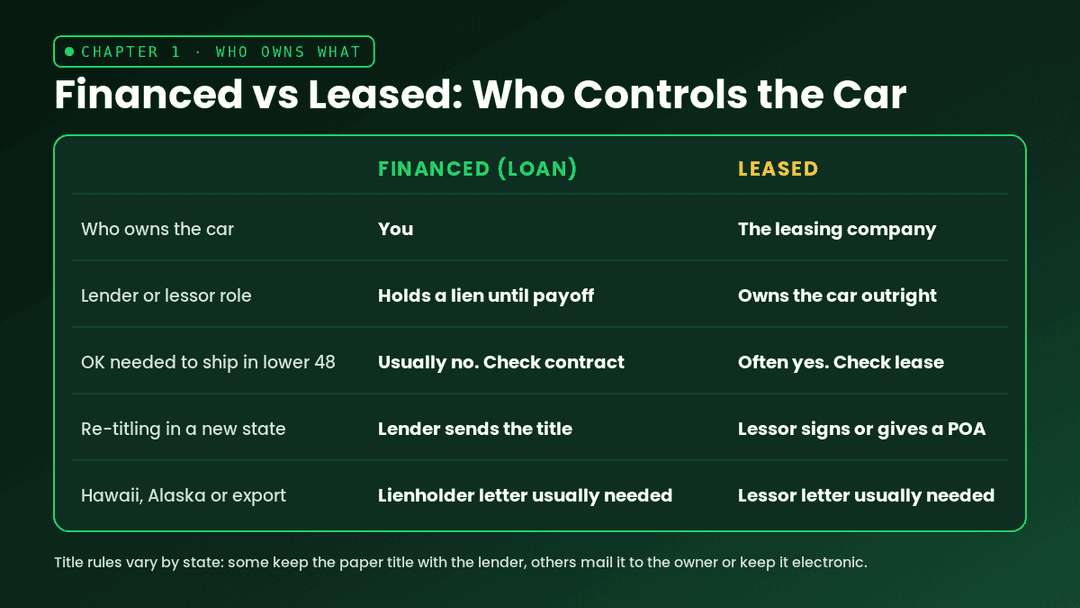
On a loan, you own the car and the lender holds a lien. On a lease, the leasing company owns it and you pay to use it. That’s why shipping a leased car often needs the lessor’s sign-off, while a financed car usually doesn’t. Our guide on how to ship a leased vehicle covers the lease side step by step.
Title Holder
Who keeps the paper depends on your state. In some states, you’ll see the car title held by lender until the last payment clears. Others mail it to you with the lender listed, or keep it as an electronic record. Either way, the title can’t move to a new state without the lender’s help.
Lienholder Permission
A written OK from your lender to take the car somewhere specific. For a move inside the lower 48, carriers rarely ask for lienholder permission to move a car. Shipments to Hawaii, Alaska or overseas usually need it as a formal letter.
Loss Payee
The party named on your insurance policy to get paid if the car is totaled or badly damaged. On a financed car, that’s your lender. If your own insurer ends up paying for transit damage, the check may carry both your name and the lender’s.
WHY THIS MATTERS FOR YOUR DECISION.
Carriers will pick up a financed car without a second look. The trouble starts later. Moving out of state with a car loan starts three clocks at once: the carrier’s pickup window, your lender’s title processing time and your new state’s registration deadline. Get the order wrong, and you could have a car in your driveway that you can’t legally register. Know these five terms, and you’ll know which call to make first.
The most important decision
Choosing a Carrier Your Lender Would Approve Of
0 of 5 doneYour lender will probably never ask which carrier you hired. It still has a stake in the answer. Until the loan is paid off, the car on that trailer is the lender’s collateral, and you’re the one who has to make it whole if something breaks. A cheap quote from a company with thin coverage moves that risk straight onto your loan balance. Twenty minutes of checking before you book keeps that from happening.
Run These 5 Checks on Every Carrier or Broker You Consider
Look Up Their DOT and MC Numbers
Interstate carriers need a USDOT number, and brokers need operating authority with an MC number. Plug both into the FMCSA SAFER Company Snapshot and confirm the status shows as authorized. Brokers must also carry a $75,000 surety bond or trust fund. A company that dodges this request has already told you what you need to know.
Ask for the Insurance Certificate
Get the carrier’s certificate of cargo insurance in writing. Check the dollar limit against what your car is worth and what you still owe on it. Car shipping insurance from the carrier is separate from your own policy, and it’s the one you claim against first when the driver causes damage.
Match the Trailer to the Car and the Contract
Open car shipping covers most daily drivers and costs less. Enclosed vehicle shipping runs about 40–60% more and keeps road debris off the paint. On a loan, the choice comes down to the car’s value. On a lease, think about the turn-in inspection, since you’ll pay for chips and dings when you hand the car back.
Ask How They Handle the Bill of Lading
The bill of lading is your receipt and your damage record in one. A good driver walks around the car with you at pickup and again at delivery, noting every scratch. Ask whether they use a digital inspection with photos. If damage isn’t written on that document at delivery, getting paid later gets much harder.
Get the Pickup Window and Price in Writing
Ask whether the quote is a firm price or an estimate that can change. Get the pickup window in writing too. On a financed car, timing matters more than usual, because your lender’s title paperwork and your new state’s registration deadline are already running. A carrier who misses pickup by a week can push you past that deadline.
Check any broker's pricing accuracy score
Enter a broker name to see their Transportvibe TrustScore and pricing accuracy metric before you contact them.
The numbers
Clearing the Move With Your Lender
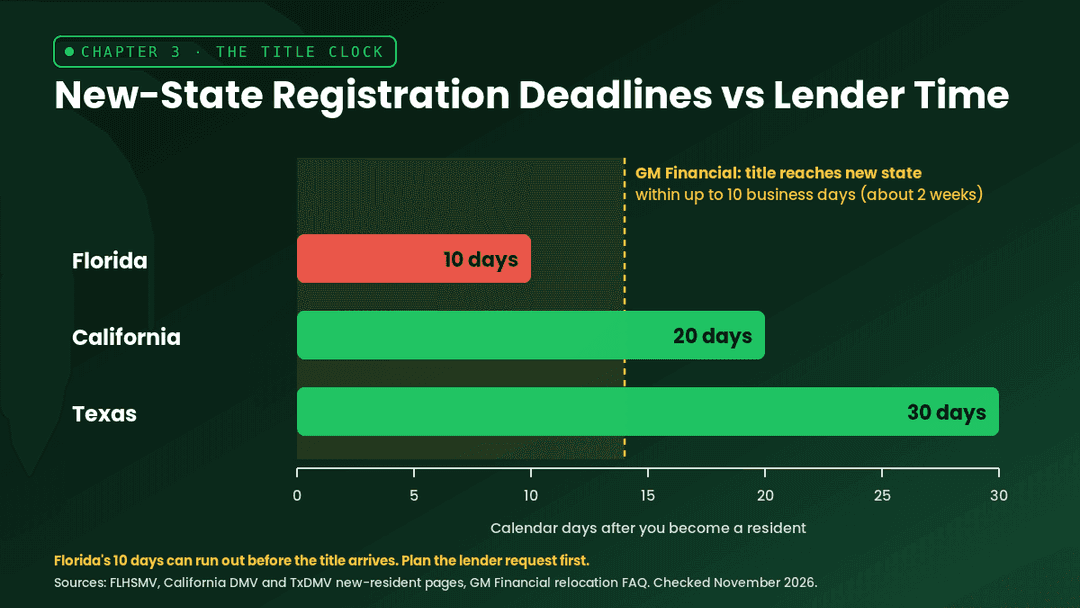
Call your lender before you call a carrier. That order feels backward, but the lender controls the one thing a truck can’t deliver: your title. To register a financed car in a new state, the DMV usually needs that title, and only the lender can send it. California gives new residents 20 days to register, Texas gives 30 and Florida gives just 10. Your lender works on its own clock. Learning how to ship a financed car mostly comes down to starting that clock early.
Financed car, moving within the lower 48
You own the car. Carriers won’t ask for the lender’s OK, but your contract may require notice of a new address.
Read the contract, then update your address with the lender before pickup.
Leased car, moving within the lower 48
The leasing company owns the car and has to sign off on re-titling it in your new state.
Ask the lessor for its out-of-state process. Toyota Financial Services, for example, uses a State Transfer request and a limited Power of Attorney.
Shipping to Hawaii, Alaska or overseas
Ocean carriers and export rules usually require a signed letter from the lienholder.
Request a lienholder authorization letter early. For exports, federal rules want letterhead, the VIN, contact numbers, an original signature and a date, presented at least 72 hours before export.
Loan payoff is close
Changing states near payoff can slow the title release. GM Financial warns about this on its relocation page.
Ask the lender whether to pay off first or move first, and get the timing in writing.
THE ONE REQUEST TO SEND FIRST.
File a lender relocation request the day you know your new address. GM Financial takes this through a Relocation Request Form and says the title reaches your new state’s motor vehicle office within 10 business days, with tracking. Other lenders handle it through your online account or a phone call. Ask where they’ll send the title, how long it takes, and whether they need anything from your new DMV first. Write down the name of the person you spoke with. If the title runs late, that note proves you asked on time.
What should your route actually cost?
Get a data-backed price estimate — so you know the market rate before you contact any broker.
Preparation
What to Do Before the Truck Arrives
0 of 7 doneThe 48 hours before pickup are when you build your evidence. On a financed car, that evidence protects two parties: you and the lender that still has a claim on the car. If something gets damaged, your photos and records are what the carrier’s insurer, your own insurer and maybe your lender will all look at. Someone with a paid-off car can afford to be a little loose here. You can’t.
RE-CONFIRM YOUR INSURANCE AND GAP COVERAGE 24 HOURS BEFORE PICKUP.
Call your insurer and confirm your comprehensive and collision coverage stays active through delivery day. Then call your gap insurance provider and ask one thing: does the policy still apply if the carrier’s insurer, not yours, pays for a total loss? Policies differ, so get the reply in writing. A hole in your coverage is cheap to fix the day before pickup and expensive to find after the car comes off the trailer damaged.
Check Your Broker One Final Time Before Pickup Day
FMCSA status can change. Run a final check 24 hours before pickup, especially if you booked more than 2 weeks ago.
Photograph the Car in Daylight, All Four Sides Plus All Four Corners.
This is your before-condition record. Shoot it the morning of pickup, not days earlier. The photo files log the date and time on their own.
Photograph the Odometer and Dashboard.
One clear shot of the mileage and the warning lights. On a lease, that number matters at turn-in. On any financed car, it proves the car left your driveway with no dash warnings showing.
Keep Your Title and Loan Papers Out of the Car.
A domestic carrier doesn’t need your title or loan contract. Keep copies with you, along with your lender’s phone number and account number, in case a question comes up mid-shipment.
Update Your Garaging Address With Your Insurer.
Your insurer prices your policy on where the car lives. Tell them the new address and the date the car arrives there. A policy tied to the wrong state can cause trouble if you need to file a claim.
Remove Personal Items and Toll Tags.
Carrier insurance usually doesn’t cover belongings left inside the car. Take out anything of value. Pull the toll transponder too, or it may charge you for every booth the truck rolls through. Some carriers allow a small amount in the trunk, so confirm before you leave anything in.
Keep the Fuel Tank Around a Quarter Full.
Carriers commonly ask for this. A full tank adds weight, and some drivers will ask you to burn off extra fuel before loading.
Confirm the Pickup Window and the Driver.
Message the carrier the day before to confirm the date, the time window, and the driver’s name and phone number. A driver you can reach directly makes pickup day much smoother.
The most important day
Pickup Day and the Bill of Lading
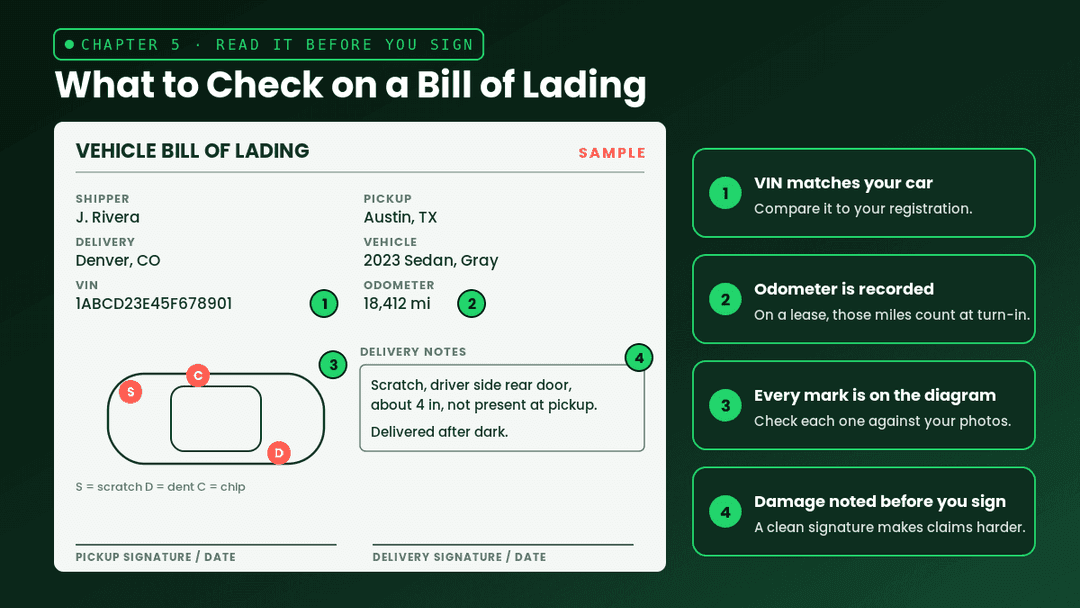
Pickup day is short. The paperwork you sign in those few minutes follows the car all the way to delivery. The bill of lading (BOL) is the inspection report and receipt the driver fills out when taking your car. On a financed car, it’s also the first document anyone asks for if the car arrives damaged: the carrier’s insurer, your insurer, and maybe your lender as loss payee. Every chip and scratch belongs on it. If it isn’t written down, it didn’t happen, as far as a claim is concerned.
Bill of LadingThe official receipt and condition report for your car, completed at pickup and again at delivery. Damage that shows up at delivery but isn’t on the pickup BOL points to transit damage, and that supports your claim. You sign it as the shipper. Your lender doesn’t sign anything, and the driver doesn’t need your title.
Never do this.
Never sign the pickup BOL before the inspection is finished and you’ve checked it against your own photos. Never sign a blank or half-filled BOL. Never hand the driver your title or loan papers, because a domestic carrier has no use for them. And never let a driver rush you. This document is your protection for the whole trip, and on a car you still owe money on, a weak BOL can leave you paying for damage on top of your loan.
Walk the Car With the Driver, Panel by Panel
Go around the car together. The driver marks condition on the BOL. You check each mark against your photos and point out anything missed: a chip in the windshield, curb rash on a wheel, a scuff on the bumper. Say each one out loud and make sure it lands on the page.
Read Every Line Before You Sign
The BOL records the pickup date, the car’s condition, and the pickup and delivery addresses. Many also include the odometer reading. Check that the VIN matches your car and the delivery address is your new home. On a lease, make sure the mileage is right, since that number matters at turn-in. If anything is off, stop and call the company you booked with before you sign.
Keep a Copy of Everything
Photograph the signed BOL before the driver pulls away, and email it to yourself. Drivers don’t always hand over a copy. Store it with your pickup photos and your insurance and lender contacts, so the whole record sits in one place if you ever need to file a claim.
While it moves
What to Expect While Your Car Is in Transit
A cross-country move usually takes 7 to 10 days once the car is loaded. Shorter routes move faster, but no carrier drives a straight line from your door to the drop-off. They run a full truck on a multi-stop route. On a financed car, the thing to watch during those days is the calendar. Your new state’s registration deadline keeps running while the car is on the road, so transit time is the best window you’ll get to sort out the paperwork.
Why Transit Takes Longer Than DrivingA full 75-foot car hauler serves several customers on one run. The driver picks up across one region, then delivers across another. Your car may sit on the trailer near your new home while the driver finishes other stops first. That part is normal. A carrier that goes silent while it happens is a different story.
What good communication looks like in transit: The company you booked with should reach out on its own if there’s a delay of more than 24 hours. If you’ve heard nothing for 3 or more days and can’t reach anyone, escalate it. When you book, ask for a mid-transit check-in so silence doesn’t leave you guessing.Use the Transit Days to Get Ahead of the DMVWhile the car is on the truck, knock out the steps that usually stall a move with a car loan:1. Track the title. Ask your lender whether the title has gone out to your new state and request the tracking number.2. Book the DMV visit. Many offices run on appointments, and open slots can be weeks out.3. Switch your insurance. Get your policy written for the new state so you have proof of coverage ready at the counter.4. Keep paying the loan. Update your mailing address with the lender so a statement doesn’t get lost in the move and turn into a late payment.
What to do if you can’t reach your carrier.
If 2 tries over 24 hours get no reply, call the driver directly using the number on your BOL. If nobody answers after 48 hours, file a complaint with FMCSA and contact your state attorney general’s consumer protection office. If the delay could push you past your registration deadline, call the DMV and ask what it accepts as proof the car and title are on the way. Keep your booking paperwork and insurance details handy, because the first thing anyone asks is what you shipped and what coverage was in place.
The finish line
Delivery Day: Inspect Before You Sign
0 of 4 doneDelivery day runs on the same rule as pickup day. Don’t sign the delivery bill of lading until you’ve inspected the car yourself and compared it to your pickup photos. This step matters even more than pickup, because it’s the moment your right to a damage claim gets locked in or lost. On a car you’re still paying off, a missed scratch is money out of your pocket on top of the loan.
Inspect the Car in Daylight if You Can.
Damage is much harder to see in low light. If the truck shows up after dark, ask the driver to wait while you get proper lighting, or write “delivered after dark, inspection limited” on the BOL before you sign.
Compare Against Your Pickup Photos and BOL.
Work through your photos panel by panel, corner by corner. Check the odometer against the pickup reading too. A big jump means someone drove the car, and on a lease, those miles count against you. New marks that aren’t in your photos or on the pickup BOL are potential claims.
Note Any New Damage on the Delivery BOL Before Signing.
Write it down specifically: “Scratch on driver’s side rear door, about 4 inches, not present at pickup.” Then photograph the damage with the truck in the background so the location and timing are clear.
Don’t Pay Surprise Fees Without Written Approval.
If the driver asks for more than the agreed balance, call the company you booked with before you hand over anything. Any change to the price should come to you in writing. Cash demands at the curb are a common pressure tactic.
Once you sign a clean delivery BOL, a claim gets much harder.
Your signature says the car arrived in the condition written on that page. On a financed car, that costs you twice: an unrecorded scratch becomes your repair bill, and on a lease it can come back as a charge at turn-in. A claim for damage you find later is still possible, but it’s a much harder fight. Take your time before you sign.
After it's done
What to Do After Delivery
The truck is gone, but a financed car still has two loose ends: any damage claim and your new registration. What you do in the first 48 hours after delivery decides how cleanly both close, and it helps the next person who ships the same route.
File a Damage Claim Right Away if You Need One
Federal law lets interstate carriers set a deadline for damage claims, but it can’t be shorter than 9 months after delivery. Don’t spend that time. Send the company you booked with your delivery BOL notes, pickup photos and delivery photos within days. Our guide to car insurance claims in transit walks through each step.
Loop In Your Lender on Any Payout
If your own insurer pays for repairs or a total loss, the check may be made out to both you and your lender, since the lender is the loss payee. Call the lender before you deposit anything and ask how it handles endorsements. If the car is a total loss, this is also when you call your gap insurance provider.
Finish Your Out-of-State Title Transfer
Bring proof of insurance, your ID and the car itself if your new state requires a VIN inspection. Confirm the lender has sent the title, and check that the new title lists the lender correctly. Once it’s done, send your new registration details to the lender so its records match.
Leave a Review on Transportvibe
Share the price you were quoted, the price you paid, and how the pickup and delivery windows held up. It takes about 3 minutes, and your review helps us improve future versions of this guide.
Just shipped? Tell us how it went.
Leave a verified review. It takes 3 minutes.
Your review helps us improve future versions of this guide.
Shipped a car? Tell us what actually happened.
Your review helps us improve future versions of this guide.
Ready to ship?
Get quotes from verified, TrustScore-ranked brokers
Only TrustScore 70+ brokers with active FMCSA records · 90 seconds
Only TrustScore 70+ brokers with active FMCSA records receive your details
Rather not manage any of this?
Let Transportvibe Full Service Handle the Shipping Side
We choose the broker, lock the price in writing, and manage any claim for you.
- We pick the broker for your route and vehicle
- Price locked in writing before pickup
- We manage any damage claim for you
- We call you within 2 hours of your request
Still Paying It Off? What Shippers Ask Us Most
The chapters above cover the core steps. These are the side situations that come up again and again when there’s a loan or lease on the car.
No. Carriers price a shipment by route, vehicle size, trailer type and season. The loan never shows up in the quote, and the carrier usually doesn’t know it exists. Any extra cost comes from your side of the paperwork, like a lender fee for a lienholder letter on an island or export move.
It can be, once you count lease miles. Autotrader puts typical overage charges at 15 to 25 cents a mile, so a 2,500-mile drive could add roughly $375 to $625 if it pushes you past your allowance. If you have plenty of miles left, the math shifts, so check your remaining allowance before you decide.
Yes. Any adult you trust can meet the driver, walk the car and sign the bill of lading. Give the carrier their name and phone number in advance, and make sure they have your pickup photos so they can compare at delivery.
Usually not, if you aren’t changing your legal residence, like a college semester or a winter away. Rules differ by state, so check the DMV where you’re staying. Tell your insurer where the car will be kept and check your loan contract for any clause about keeping the car out of state for long periods.
Call the lender and ask what it needs to approve the move. Most restrictions come with a process, like written notice or an updated address. If the lender won’t work with you, your options are paying off the loan or refinancing with a lender that’s fine with your new state.
Yes. The new lender pays off the old loan, and the lien moves to the new lender. Wait until your new registration is done if you can, since juggling a refinance and an out-of-state title transfer at the same time can slow both down.
Usually not for an existing loan, but ask. Some credit unions limit membership by location or employer, and moving can change which services you can use. The loan itself normally stays in place as long as you keep paying.
Yes, but the payoff comes first. The buyer’s money, or yours, pays off the loan, the lender releases the lien, and then the title can go to the buyer. Lien release times vary by lender and state, so agree in writing on whether the car ships before or after the clean title arrives.
Sometimes. Under the Servicemembers Civil Relief Act, you can end a vehicle lease for PCS orders from the continental U.S. to a post outside it, including Hawaii and Alaska, or for a deployment of 180 days or more. A move between two states in the lower 48 doesn’t qualify, so in that case you’d ship the leased car like anyone else.
The same thing that happens any other time: late fees and possible credit damage. A move is when statements get lost, so set up autopay or update your address with the lender before the truck arrives. Repossession rules are set by your contract and state law, and a car in transit isn’t exempt.