
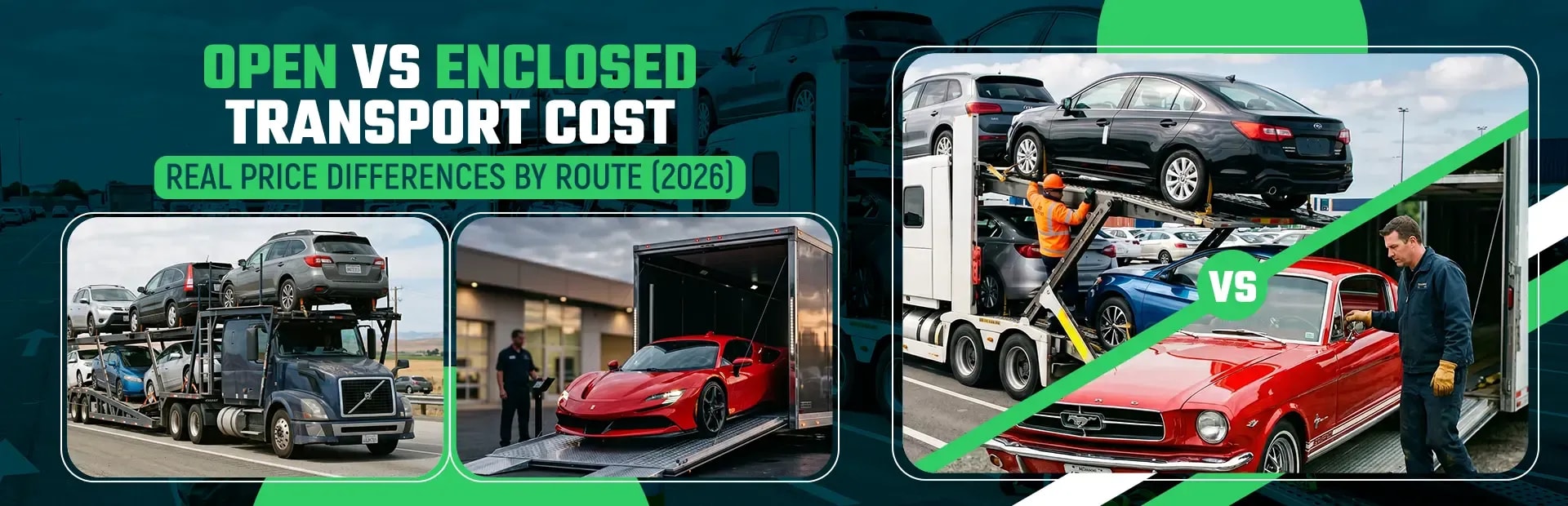
Shipping a car across the country often comes down to one question: how much extra is a roof worth? Open car transport trailer shipping is the industry standard for daily drivers, but for high-value assets, enclosed car transport cost becomes the primary factor in your decision.
Whether you are moving a vintage Porsche or a standard sedan, the price gap isn't just about the equipment. It involves the specific route, the value of the cargo, and the level of protection required from road debris and weather. This guide breaks down the real math behind these choices in 2026. We help you understand why a short haul differs so much from a cross-country trek and how to spot the hidden variables that drive up your final bill.
Before you book a carrier, it is vital to verify their credentials through official channels. You can look up specific FMCSA Company Data at the FMCSA search portal to ensure your provider is fully licensed and compliant with federal safety regulations. This simple step protects your investment before the wheels ever touch the ramp.
Ready to move? Get an instant, transparent price for your specific route and vehicle type. Request your free shipping quote here to see the best rates for open and enclosed transport today.
What Open and Enclosed Transport Actually Cost in 2026
When you book a move, you are choosing between two distinct methods. Car shipping open transport involves a dual-deck trailer carrying up to ten vehicles, fully exposed to rain, sun, and road debris.
Open car transport trailer setups are the backbone of the industry because they are efficient. You share the space and the fuel bill with other customers, which keeps your individual price point low.
In contrast, an enclosed carrier uses a hard-sided or curtain-sided trailer to shield your vehicle. These typically haul only two to six cars, providing a private, clean environment that eliminates weather risks.
Your transport cost calculation isn't a static figure. The final number shifts based on your specific route, the size of your vehicle, and current market demand in 2026.
|
Transport Type |
Average Cost (Short Haul <500 mi) |
Average Cost (Cross-Country) |
Typical Surcharge % Over Open |
|---|---|---|---|
|
Open Transport |
$450 – $750 |
$1,200 – $1,700 |
Baseline |
|
Enclosed Transport |
$700 – $1,100 |
$1,800 – $2,600 |
30% – 60% |
Enclosed transport typically costs 30% to 60% more than open for the same route. If your open quote is $1,000, expect to pay $1,300 to $1,600 for the added protection of a lid.
Several variables will push your cost of transporting car to another state up or down. You need to account for these specific factors before signing a contract:
-
Vehicle Dimensions: Shipping a standard sedan is the baseline, but an oversized SUV or a large Rv transport cost will be higher due to the space they occupy on the deck.
-
Delivery Flexibility: Choosing door-to-door service is convenient, but using terminal-to-terminal drops can sometimes lower the transportation cost per mile.
-
Seasonal Spikes: If you move during the "snowbird" season or mid-summer, demand surges. This often spikes the car transport cross country cost significantly.
-
Fuel and Insurance: Diesel prices dictate fuel surcharges. Additionally, your auto transport insurance cost might increase if you opt for high-limit gap coverage.
Understanding the transportation cost per mile helps you spot a fair deal. In 2026, open shipping averages $0.40 to $0.75 per mile, while enclosed averages $0.75 to $1.20 per mile.
Rates naturally compress on longer hauls. While the cost to transport car 200 miles might have a higher per-mile rate, the total is lower than a 2,000-mile journey where the efficiency of the long haul kicks in.
To get the most accurate pricing for your specific zip codes, check out our comprehensive guide on 2026 car shipping costs. This will help you avoid the common pitfalls of hidden shipping fees that often catch first-time shippers off guard.
What the Enclosed Premium Actually Buys
The extra money pays for how your car gets on and off the truck. Enclosed drivers often use hydraulic lift gates and soft straps instead of steep ramps. That's why enclosed is the go-to for low-clearance sports cars and non-running vehicles.
It also buys you a roof during the worst months:
- Winter: snow, road salt and ice stay off the paint.
- Spring: pollen season won't coat the car in yellow film.
- Heavy rain and hail season: no water or hail damage.
Custom modifications are another reason to go enclosed. Body kits, lowered suspensions and custom paint are the parts you least want sitting in the open on a cross-country run.
Open still wins on speed. There are far more open carriers on the road, so you'll usually get a faster pickup and can book on short notice. Enclosed carriers are scarcer, so give yourself more lead time.
And on short hauls, open makes even more sense. Your car spends less time exposed, so there's less chance of road debris or a storm doing damage.
Cost by Vehicle Type — Cars, Motorcycles, RVs, and More
Pricing logic in the transport world is rarely uniform. When you move beyond the standard sedan, you enter specialized territory where the weight, value, and dimensions of your cargo dictate the final invoice.
Exotic and Classic Car Transport Cost
If you own a high-value asset, you almost always choose a protected environment. Exotic car transport cost reflects the specialized care required for low ground clearance and delicate paint finishes.
The enclosed car transport cost is a necessary investment here. Beyond just weather protection, it addresses carrier liability concerns and provides the peace of mind you need when moving a six-figure vehicle.
|
Vehicle Type |
Open Transport Cost Range |
Enclosed Transport Cost Range |
Recommended Method |
|---|---|---|---|
|
Exotic/Supercar |
$900 – $1,400 |
$1,400 – $2,500 |
Enclosed |
|
Classic/Vintage |
$800 – $1,300 |
$1,300 – $2,200 |
Enclosed |
|
Luxury Sedan |
$600 – $1,100 |
$950 – $1,600 |
Enclosed |
Pro Tip: Shipping a Ferrari or Porsche cross-country enclosed typically runs $1,400–$2,500. Most specialized carriers won't even offer an open trailer option for these vehicles due to the risk.
Motorcycle Transport Cost
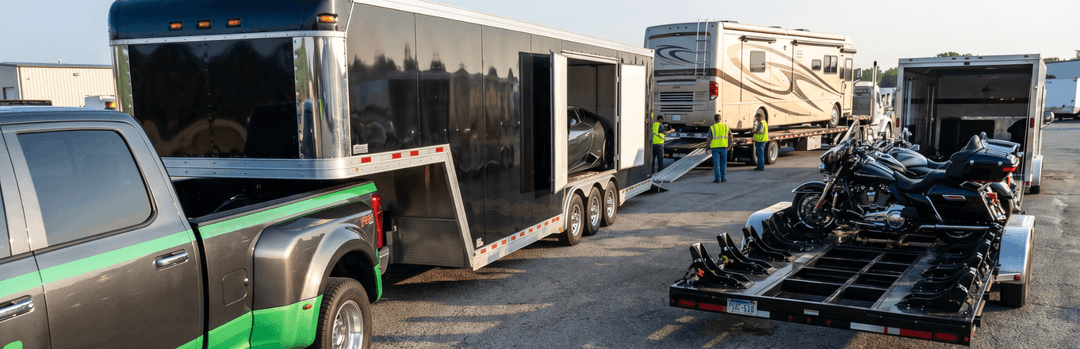
Moving a bike involves a different logistical footprint. Your motorcycle transport cost varies depending on whether the bike is crated, strapped to a pallet, or placed in a shared specialized trailer.
When calculating motorcycle transport costs, you'll find that while the price is lower than a car, the complexity of securing a two-wheeled vehicle adds specific labor charges to the quote.
-
Crating Requirements: Professional crating provides the best protection but adds to the total transportation insurance cost.
-
Trailer Type: You can choose between open motorcycle-specific trailers or fully sheltered, multi-bike enclosed units.
-
Load Consolidation: Sharing space on a consolidated load is the most budget-friendly way to manage your move.
-
Service Area: Pickup in a rural "dead zone" will always cost more than a shipment starting in a major metro hub.
Average motorcycle transport cost sits between $300–$700 for under 500 miles and $600–$1,200 for cross-country moves. Enclosed options usually add a flat $150–$300 to the bill.
RV and Mobile Home Transport Cost
RVs and mobile homes operate on an entirely different plane of logistics. Most Rv transport cost quotes are for "drive-away" services, where a professional driver physically operates your rig to the destination.
The cost to transport mobile home units is significantly higher because it involves "oversize load" permits and specialized heavy-haul equipment. These are not standard "car moves"—they are industrial logistical projects.
|
Vehicle/Unit Type |
Common Transport Method |
Average Cost |
Key Regulatory Factor |
|---|---|---|---|
|
Class A/C RV |
Drive-away / Tow-away |
$1.50 – $3.50/mile |
Driver CDL Requirements |
|
Travel Trailer |
Tow-away |
$1.25 – $2.50/mile |
Hitch/Weight Rating |
|
Mobile Home |
Heavy Haul Trailer |
$1,000 – $5,000+ |
State Oversize Permits |
Important Note: A cost to transport mobile home typically starts at $1,000 and can exceed $5,000 depending on size and distance. For RVs, drive-away services average $0.30–$0.50 per mile plus fuel and travel expenses.
If you are planning a specialized move, check out our guide to motorcycle shipping options or read our expert RV transport reviews to find a vetted carrier.
How Route and Distance Change the Price Equation
Distance acts as the primary lever for your quote, but route density is the secret weight on the scale. High-traffic lanes like Los Angeles to NYC are surprisingly affordable because carriers can fill a trailer in hours.

When you move off the beaten path, the transportation cost per mile climbs. Carriers charge more for "deadhead" miles—the distance they drive empty to reach your driveway in a low-density area.
|
Route |
Distance |
Open Avg. Cost |
Enclosed Avg. Cost |
Price Per Mile (Open) |
|---|---|---|---|---|
|
NYC → Miami |
~1,280 mi |
$850 |
$1,250 |
$0.66 |
|
LA → Chicago |
~2,015 mi |
$1,050 |
$1,600 |
$0.52 |
|
Dallas → Seattle |
~2,100 mi |
$1,150 |
$1,750 |
$0.55 |
|
Local Haul |
~200 mi |
$450 |
$700 |
$2.25 |
You might notice that the cost to transport car 200 miles feels disproportionately high compared to a long haul. This isn't a mistake; it's a reflection of carrier overhead that doesn't shrink just because the trip is short.
-
Minimum Fees: Every carrier has a "hook fee" or base operating cost that must be covered regardless of the odometer reading.
-
Lack of Competition: Fewer drivers hunt for short, off-lane stubs, giving those who do more leverage over the price.
-
Fixed Costs: The time spent loading, securing, and unloading your vehicle is the same whether the driver goes 50 miles or 500.
-
Route Difficulty: Local door-to-door moves in tight residential areas add complexity that highway-to-highway runs avoid.
A car transport cross country cost for an open trailer averages $900–$1,400. The same 2,500-mile route enclosed runs $1,300–$2,200. Interestingly, the per-mile gap narrows once you cross the 1,500-mile mark.
Performing a precise transport cost calculation requires looking at the base rate plus fuel surcharges and vehicle size adjustments. Because these variables shift daily, you should check the FMCSA Company Data of any high-bidding carrier to ensure you aren't overpaying for basic service.
Ultimately, the only way to benchmark your specific route is to get at least three competing quotes. You can start comparing top-rated carriers right now to see how your zip codes affect the bottom line.
Why the Gap Widens in Peak Season and on Rural Routes
Summer and winter are peak periods, and enclosed rates climb faster than open rates when demand spikes. Rural and less-traveled routes have fewer enclosed carriers running them, so enclosed can be harder to book out there.
The service differs too. Enclosed transport often means fewer vehicle transfers and true door-to-door delivery. Open shipments may use terminal drop-off and pickup, and the truck loads and unloads more cars along the way.
Four Car-and-Route Scenarios
How the choice plays out on 4 common moves:
- A 2017 Toyota Camry going from Chicago, Illinois to Miami, Florida: ship open. It's a daily driver and doesn't need the extra cover.
- A 1969 Mustang headed to a car show in Las Vegas, Nevada: ship enclosed. Show cars need to arrive clean.
- A Tesla Model S going from California to New York in January: enclosed is the safer call. Winter salt and ice are hard on paint.
- A 2015 Honda Civic that needs cheap, fast delivery to Texas: open is your best bet.
Your real gap depends on your car and your route. Get quotes for both open and enclosed on the same dates so you see the actual difference before you pick.
Specialty Shipping — Hawaii, International, and Container Transport
Some moves require more than just a highway and a trailer. When your destination is overseas, the standard rules for an open car transport trailer no longer apply.
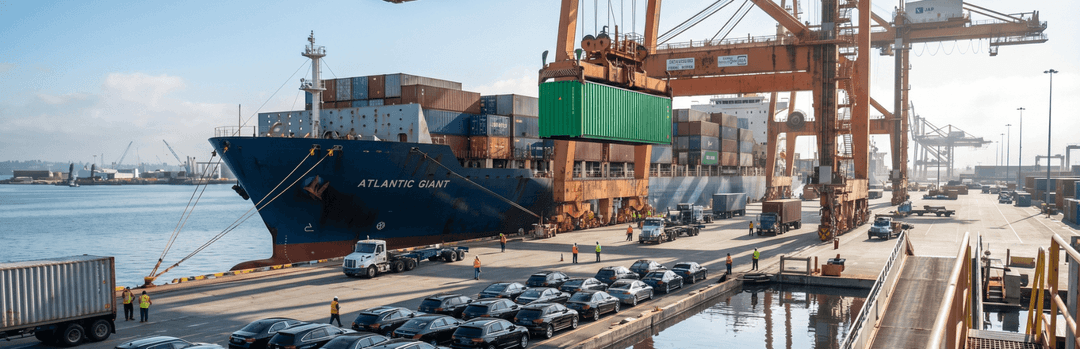
Whether you are looking into the cost to transport a car to Hawaii or a global move, you are transitioning into the world of maritime logistics. This is where container transport costs become the primary variable in your budget.
|
Route/Method |
Base Shipping Cost |
Additional Fees |
Typical Transit Time |
Open/Enclosed Equivalent? |
|---|---|---|---|---|
|
Mainland to Hawaii |
$1,000 – $1,500 |
Port/Handling |
7 – 14 Days |
RoRo (Open) |
|
US to Europe (Shared) |
$1,200 – $2,500 |
Customs/VAT |
21 – 40 Days |
Container (Enclosed) |
|
US to Europe (Solo) |
$3,500 – $5,500 |
Duties/Brokerage |
14 – 30 Days |
Container (Enclosed) |
If you are calculating the cost to transport car to Hawaii, you need to understand exactly what your quote covers. It is rarely a simple door-to-door flat rate.
-
Port Handling: Fees at major exit points like Los Angeles, Seattle, or Oakland.
-
Ocean Freight: Your choice between Roll-on/Roll-off (RoRo) or secure containerized shipping.
-
Island Logistics: Port fees in Honolulu or smaller neighbor islands once the ship docks.
-
Compliance: Strict vehicle inspections and quarantine checks required by state law.
-
Ground Transport: Getting the vehicle from the destination port to your final address.
Shipping a standard car to the islands via RoRo runs $1,000–$1,500. Choosing a container will cost you $1,500–$2,500 but offers the ultimate protection—it is the maritime equivalent of an enclosed trailer.
For international moves, container transport costs depend on whether you share a 40ft unit (LCL) or book a dedicated 20ft container. A solo container can easily run $2,000–$5,000 before you even touch import duties.
Specialty logistics also includes the watercraft sector. A professional boat transport cost is calculated differently, focusing on boat length, beam width, and trailer weight.
Expect to pay $1 to $4 per mile for professional overland boat hauling. If your vessel is an oversize load, those rates climb quickly due to pilot car requirements and permit costs.
To navigate these complex routes, you should verify a carrier's DOT and MC number before booking. For more island-specific advice, read our complete guide to Hawaii car shipping to avoid common port delays.
Insurance, Hidden Costs, and What Your Quote Actually Covers
The biggest mistake you can make is assuming a signed contract means your vehicle is fully protected. Your auto transport insurance cost is often baked into the quote, but carrier liability and full replacement value are worlds apart.
Understanding the fine print of your transportation insurance cost ensures you aren't left holding the bag if a stray rock or a loading mishap occurs during transit.
|
Coverage Type |
What It Covers |
Typical Limit |
Who Provides It |
Avg. Additional Cost |
|---|---|---|---|---|
|
Cargo Insurance |
Transit damage/theft |
$100K – $250K |
The Carrier |
Included |
|
Gap Insurance |
Deductible/Overages |
Varies |
Third-party Broker |
$50 – $150 |
|
Enclosed Premium |
High-value protection |
$500K+ |
Specialized Carrier |
Part of shipping fee |
Before you hand over your keys, you must vet the carrier’s coverage to protect your investment. A low-ball quote often hides inadequate protection.
-
Cargo Limits: Most carriers have a total cargo limit of $100,000 to $250,000 for the entire trailer, not per vehicle.
-
Open vs. Enclosed Terms: Some policies exclude "acts of god" like hail or wind-blown debris on open trailers.
-
Gap Coverage: If your car is worth more than the carrier's per-vehicle limit, you need an add-on policy to bridge the difference.
-
Documentation: Your condition report is your only weapon in a dispute. Take high-resolution photos at both pickup and delivery.
-
Claim Voidance: Disputes often arise over "pre-existing" damage. Ensure the Bill of Lading is detailed and signed by both parties.
Adding comprehensive auto transport insurance cost for a vehicle valued at $50,000 typically adds $100–$300 to your bill. For high-end assets, an agreed-value policy is non-negotiable.
Beyond insurance, "hidden" fees can inflate your cost of transporting car to another state. Fuel surcharges in 2026 are currently hovering between 5% and 15% of the base rate, depending on diesel fluctuations.
Other triggers for extra charges include inoperable vehicle fees—usually $100 to $300 for the extra winch labor—and rural delivery surcharges for addresses located far from major interstates.
When calculating your final transport cost calculation, always factor in the quote, the insurance gap, and potential destination fees. Interstate moves over 1,000 miles remain the sweet spot for getting the best value for your dollar.
To ensure your carrier is legitimate, always check their DOT and MC number on the federal database. You can also read our deep dive into how car shipping insurance works to learn how to file a claim correctly if the worst happens.
Your Burning Questions Answered
Moving a vehicle across state lines or oceans involves many moving parts. We have gathered the most common queries shippers ask when trying to balance their budget with the safety of their investment.
What Is The Average Cost To Transport Car 200 Miles In 2026?
For a short 200-mile haul, you should expect to pay between $350 and $600. While the distance is short, carriers still face fixed costs for loading and fuel, which keeps the price from dropping lower.
How Does The Car Transport Cross Country Cost Change During Winter?
The car transport cross country cost often spikes during winter due to dangerous weather and high demand from snowbirds. Expect to pay 15% to 25% more for popular southern routes during the peak moving months.
Can You Explain The Typical Container Transport Costs For International Moves?
Container transport costs for shipping overseas generally range from $1,500 to $5,000. This price depends on whether you choose a shared container to save money or a dedicated unit for maximum protection of a high-value vehicle.
What Factors Impact The Final Motorcycle Transport Costs?
Your motorcycle transport costs are driven by the weight of the bike and the type of trailer used. Crated shipping in an enclosed unit is the safest choice, typically costing between $400 and $1,200 depending on total distance.
Is The Auto Transport Insurance Cost Included In My Initial Quote?
Most reputable quotes include a base level of cargo protection. However, a specialized auto transport insurance cost for high-value vehicles may be extra. Alway verify carrier data to see their official cargo limit before signing.
Choosing the Right Protection for Your Investment
Deciding between an open car transport trailer and an enclosed car transport cost depends entirely on your vehicle's value and your personal risk tolerance. For standard daily drivers, the open method is the most practical and cost-effective default. However, for high-value assets, the extra protection of a roof is a strategic choice.
The 30% to 60% premium for enclosed shipping is statistically worth it for vehicles valued over $50,000. When you consider the exotic car transport cost, the math on potential paint restoration or weather damage quickly justifies the higher upfront price.
Before you commit, always secure three quotes to benchmark the transportation cost per mile. Verify the carrier's transportation insurance cost limits and walk through their condition report process to ensure you are fully protected. Remember that specialty projects, like the cost to transport car to Hawaii or an Rv transport cost, follow separate pricing structures and require niche expertise.
Get an transparent price for your move today. Get a Quote from our network of licensed carriers and compare open and enclosed options for your specific route.