




Shipping a truck or SUV cross country means moving more than just a vehicle; you are moving significant weight and volume. Suv shipping cost and the cost to ship truck across country depend largely on how much space the vehicle occupies on a carrier. According to recent 2026 data from Kelley Blue Book, shipping a standard vehicle 1,000 miles averages around $1,020, but larger models quickly push those figures higher.
Because heavy vehicles consume more fuel and limit a trailer's total capacity, your shipping truck cost will naturally sit above the baseline for sedans. Whether you are searching for how much does it cost to ship a truck or checking truck shipping cost for a cross-country move, understanding these physical variables is the first step toward an accurate budget.
Planning a move? Find out exactly what your vehicle costs to ship and get a transparent, no-obligation quote tailored to your vehicle's specific dimensions.
Why Vehicle Size and Weight Are the Biggest Pricing Factors in Auto Transport
Think of an auto carrier like an airline cargo hold. Space is finite and weight is strictly regulated. When you look at your truck shipping cost, you aren't just paying for the distance; you’re paying for the "real estate" your vehicle occupies on that trailer.
A compact sedan is easy to stack. A lifted Ford F-150 is a different story. Because that pickup consumes more physical volume and adds significant weight, it limits how many other cars the driver can take. This direct impact on the carrier’s bottom line is why a truck and a sedan never cost the same to ship.
How Carriers Calculate Your Slot
Carriers must balance every load to stay within federal safety limits. A standard 8-car open carrier has a gross vehicle weight rating (GVWR) of 80,000 lbs, a limit set by the FMCSA to protect American infrastructure.
When your vehicle is oversized, it doesn't just take one slot; it functionally "kills" the space around it. If your shipping by truck cost seems high, it’s likely because your vehicle's height or length prevents another car from being loaded above or behind it.
To get an accurate truck shipping costs estimate, you need to account for these specific physical traits:
-
Overall Length: Bumper-to-bumper measurements determine how many units fit on a deck.
-
Height: Essential for large SUVs and lifted trucks; tall vehicles often cannot fit on the lower deck of a carrier.
-
Width: Dually trucks or wide-body kits may require specialized trailers or wide-load permits.
-
Curb Weight: Heavier vehicles reach the 80,000-lb federal limit faster, forcing the carrier to leave slots empty.
Baseline Price Comparison by Vehicle Category
Understanding the cost to ship truck or SUV models requires looking at the technical specs. Here is how different classes typically impact your final invoice:
|
Vehicle Type |
Avg. Curb Weight |
Surcharge vs. Sedan |
Notes |
|
Compact Sedan |
2,800–3,200 lbs |
Baseline (0%) |
Standard slot, no issues |
|
Midsize SUV |
3,800–4,500 lbs |
+10–15% |
SUV shipping cost base |
|
Full-Size SUV |
5,000–6,200 lbs |
+20–30% |
Often billed as truck-class |
|
Standard Pickup |
4,500–5,500 lbs |
+15–25% |
Bed length affects price |
|
Heavy-Duty (Dually) |
6,500–8,000 lbs |
+30–50% |
Requires specialized carrier |
|
Electric Vehicle |
4,000–6,000 lbs |
+15–25% |
High weight; Tesla shipping cost |
|
Semi Truck (Bobtail) |
15,000–20,000 lbs |
Specialized Only |
Semi truck shipping costs |
Federal bridge laws are unforgiving. A single heavy-duty pickup can consume 10% of a carrier’s total weight capacity alone. This is exactly why the cost to ship a truck cross country includes a weight premium—the driver is literally losing the ability to carry other freight.
If you are moving a heavy vehicle, it's wise to review our guide on how car shipping works to see how these logistics play out behind the scenes. Whether you're worried about how much does it cost to ship a semi truck or a standard 4x4, the weight is always the anchor of the price.
Before you book, make sure you understand the hidden car shipping fees that often stem from inaccurate weight reporting. Checking your vehicle’s official DOT data can also help you verify if a carrier is legally equipped to handle your specific heavy load.
SUV and Truck Shipping Costs: What to Expect by Vehicle Class
Shipping rates aren't pulled from thin air. This section breaks down the actual market ranges for SUVs, pickups, and even heavy-duty semis. Whether you are moving across state lines or shipping to the islands, the pricing logic shifts based on the steel you're moving.
SUV Shipping Cost — Midsize to Full-Size
If you’re budgeting for an SUV shipping cost, your vehicle’s height and weight are the primary dials on the price tag. A compact crossover takes up roughly the same "slot" as a sedan, but a full-size SUV often demands a premium because it’s heavier and harder to clear on a multi-deck trailer.
|
SUV Class |
Short Haul (<500 mi) |
Cross-Country (2,000+ mi) |
Hawaii |
|
Compact SUV (RAV4, CR-V) |
$350–$550 |
$900–$1,300 |
$1,200–$1,600 |
|
Midsize SUV (Explorer, Highlander) |
$450–$650 |
$1,100–$1,500 |
$1,400–$1,900 |
|
Full-Size SUV (Tahoe, Expedition) |
$600–$850 |
$1,300–$1,900 |
$1,700–$2,400 |
|
Lifted/Modified SUV |
Add $150–$400 |
Add $200–$500 |
Carrier-dependent |

Why lifted vehicles cost more:
-
Height Clearance: Most standard trailers have a 7-foot ceiling per level. A lifted SUV frequently exceeds this.
-
Slot Displacement: Because of their height, these vehicles often must sit on the bottom deck, which can block another spot entirely.
-
Carrier Restrictions: Many enclosed carriers simply won't touch a lifted vehicle because the ramp angles are too steep or the roof is too low.
Truck Shipping Cost — Standard, Heavy-Duty, and Semi
Your truck shipping cost usually mirrors that of a full-size SUV, but the bed length can be a wildcard. A standard half-ton pickup, like an F-150, is widely accepted by most carriers. However, once you move into long beds or heavy-duty territory, you are paying for the extra linear footage on the deck.
|
Truck Type |
Cross-Country Estimate |
Hawaii Estimate |
Notes |
|
Half-Ton Pickup (Std Bed) |
$1,000–$1,500 |
$1,500–$2,000 |
Most common shipping truck cost |
|
Half-Ton Pickup (Long Bed) |
$1,100–$1,700 |
$1,600–$2,200 |
Bed length adds ~10–15% |
|
Heavy-Duty (F-250, Ram 3500) |
$1,300–$2,000 |
$1,800–$2,600 |
Cost to ship truck weight surcharge |
|
Dually Pickup |
$1,500–$2,300 |
$2,000–$3,000 |
Extra width may require permits |
|
Bobtail/Semi Truck |
$2,500–$5,000+ |
$4,000–$7,000+ |
Requires flatbed or lowboy |
When you look at the cost to ship a truck cross country, remember that a long-bed dually isn't just heavy; it's wide. Drivers often have to adjust their entire load sequence just to fit one wide-body truck.
If you're moving a vehicle to the Pacific, how much cost to ship a truck hawaii depends heavily on port fees and current barge availability. It’s a specialized route that requires a carrier experienced in port logistics. You can check our guide to car shipping Hawaii for a deeper look at those specific island costs.
Semi Truck Shipping Costs: A Different Category
You cannot ship a semi truck on a standard car hauler. It won't fit. Semi truck shipping costs are in a league of their own because they require specialized equipment like lowboys or removable gooseneck (RGN) trailers.
Whether you need to know how much does it cost to ship a semi truck or the shipping by truck cost for a fleet, these are quoted as custom jobs. Factors like axle configuration and whether the truck is a "bobtail" (just the cab) determine the final price.
Industry Fact: Moving a semi truck cross-country typically costs between $3,000 and $7,000+. If the truck is non-operational, expect to pay an additional $500–$1,500 for winching and specialized heavy-duty loading equipment.
For those looking into large-scale logistics, it's worth checking the FMCSA Company Data to ensure your chosen heavy-haul carrier is fully compliant with federal safety standards. You can also explore our expert heavy haulers US review to find the right team for the job.
Electric Vehicle Shipping — Tesla and EV-Specific Cost Considerations
Shipping an electric vehicle isn't the same as moving a traditional gas car. The massive battery packs in EVs add substantial weight—a Tesla Model Y weighs roughly 4,400 lbs, whereas a similar internal combustion crossover weighs closer to 3,500 lbs.
This weight gap directly impacts your Tesla shipping cost. Carriers must account for the extra load, which often leads to a handling premium due to specific battery safety protocols and transport requirements.
Why EVs Demand a Different Strategy
When you ship an EV, you aren't just paying for the space; you’re paying for the specialized logistics required to move heavy, high-tech machinery safely.
-
Battery Weight: The added tonnage reduces the carrier's total capacity for other vehicles.
-
State of Charge (SOC): Most carriers require batteries to be between 20–30% for safety during transit.
-
Enclosed Preference: Many owners choose enclosed transport to protect sensitive electronics and high-value finishes.
-
Clearance Issues: The low center of gravity and aerodynamic underbodies on EVs can make ramp loading more technical.
Tesla Shipping Cost Estimates by Route
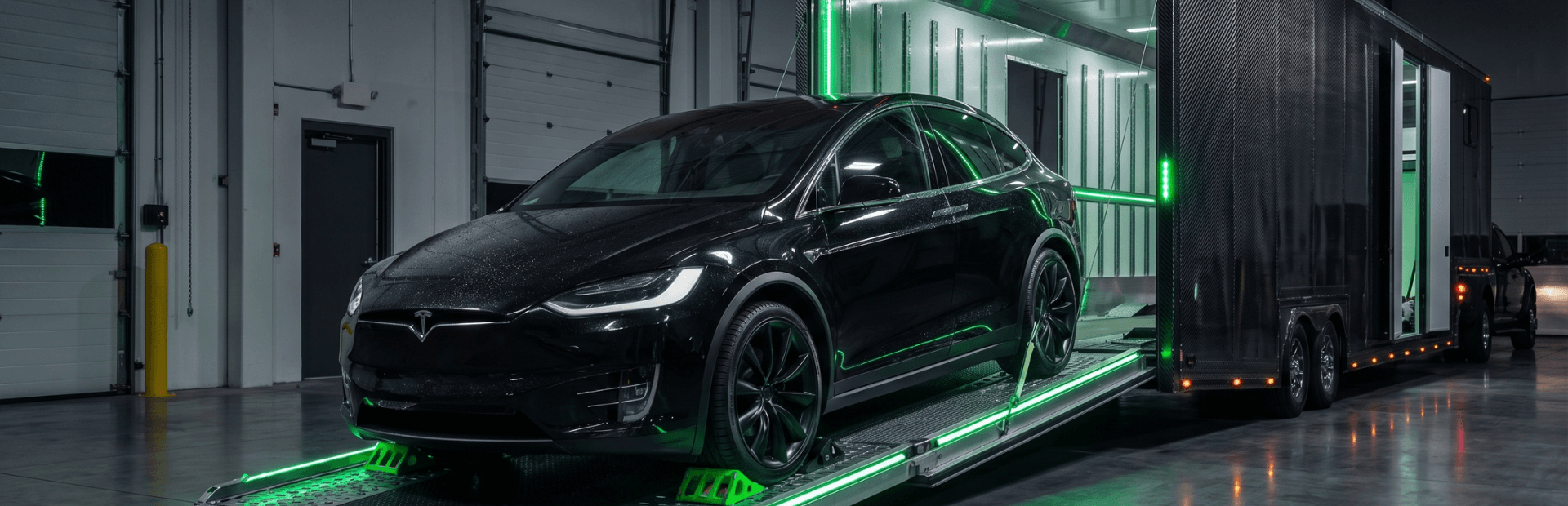
If you are looking at the cost to ship tesla phoenix to tacoma, you can expect the weight of the specific model to dictate the final quote.
|
Tesla Model |
Curb Weight |
Open (Short Haul) |
Open (Cross-Country) |
Enclosed (Cross-Country) |
|
Model 3 |
~3,900 lbs |
$500–$750 |
$1,000–$1,400 |
$1,400–$2,000 |
|
Model Y |
~4,400 lbs |
$550–$800 |
$1,100–$1,500 |
$1,500–$2,100 |
|
Model X |
~5,400 lbs |
$650–$950 |
$1,300–$1,800 |
$1,800–$2,500 |
|
Cybertruck |
~6,800 lbs |
$800–$1,200 |
$1,500–$2,200 |
$2,200–$3,200 |
For long-distance moves, especially those involving heavy models like the Model X or Cybertruck, check our 7-step guide to navigate the electric car shipping process to avoid common logistical hurdles.
Electric Car Shipping: US to Canada
Moving an EV across the border involves more than just a long drive. Electric car shipping us to canada requires navigating customs brokerage fees and strict battery transport regulations set by Transport Canada.
Expect to add $300–$800 for border processing and compliance documentation. For more details on international logistics, see our beginner’s guide to domestic vs. international auto transport.
Before finalizing your shipment, ensure your carrier is properly vetted through the FMCSA Company Data portal to confirm they are authorized for heavy EV transport.
Open vs. Enclosed Transport — How Vehicle Type Changes the Equation
Open transport is the backbone of the American auto shipping industry; roughly 90% of all vehicles move on these multi-car trailers. It is the most cost-effective way to handle a standard sedan or a typical suv shipping cost because the service is frequent and widely available.
However, when your vehicle’s height, weight, or value exceeds the norm, the math changes. Enclosed transport offers a protective "box" that shields your asset from road debris and weather, but you will pay a 30% to 60% premium for that peace of mind.
For most, open transport is fine, but certain vehicle profiles make enclosed shipping a mechanical necessity rather than a luxury.
-
Lifted or Modified Trucks: These often have wider stances or aftermarket parts that are more vulnerable during the tight loading process of an open carrier.
-
High-Value SUVs: If you are moving a luxury full-size SUV where the paint job alone costs thousands, the extra protection is an insurance policy.
-
Low-Clearance EVs: Many electric vehicles have sensitive underbodies; enclosed trailers often use hydraulic lift gates to prevent ramp scraping.
-
Collector Trucks: When moving a vintage pickup across the country, exposure to salt and gravel isn't worth the savings.
Cost Comparison: Open vs. Enclosed by Vehicle Type
The truck shipping costs or EV rates you see will vary significantly based on which trailer type you choose. Here is how the cross-country premiums usually shake out:
|
Vehicle Type |
Open (Cross-Country) |
Enclosed (Cross-Country) |
Premium |
|
Standard Sedan |
$800–$1,100 |
$1,200–$1,600 |
~45% more |
|
Midsize SUV |
$1,000–$1,400 |
$1,500–$2,000 |
~43% more |
|
Full-Size SUV/Truck |
$1,200–$1,800 |
$1,800–$2,600 |
~44% more |
|
Tesla/EV |
$1,100–$1,600 |
$1,600–$2,400 |
~50% more |
|
Semi Truck (Bobtail) |
N/A (Flatbed Only) |
N/A |
Specialized |
If you are debating between these two, our deep dive on open vs. enclosed car shipping can help you decide if the extra spend is justified.
Practical Guidance for the American Shipper
Unless you are shipping a vehicle valued over $40,000, a heavily modified rig, or a low-slung EV, open transport is almost always the rational choice. The nearly 50% jump in price for enclosed rarely makes sense for a daily driver.
Save the enclosed spots for vehicles where the cost of a single rock chip exceeds the shipping premium itself. If you're still unsure, check our 7 key factors for choosing the best vehicle shipper to see how to vet carriers for either service.
Before signing any contract, verify the carrier's insurance and authority through the official FMCSA website. This ensures that whether you choose open or enclosed, your heavy-duty asset is legally protected.
How to Reduce Your Shipping Cost Without Cutting Corners
You can't change the physical dimensions of your vehicle to lower your truck shipping cost, but you can control the logistics. Smart planning allows you to move heavy assets without paying a premium for poor timing.
By pulling specific levers, you can reduce the shipping truck cost significantly. It’s about working with the carrier’s schedule rather than forcing them to work around yours.

Practical Cost-Reduction Levers
If you want to lower the cost to ship truck or SUV models, follow these veteran moves:
-
Book in Advance: Securing your spot 2–4 weeks out typically saves 10–20% compared to urgent, last-minute bookings.
-
Terminal-to-Terminal: Opting for terminal drop-offs instead of door-to-door service can save $100–$300, especially in major metro areas.
-
Off-Peak Timing: Shipping during January-February or September-October often yields lower truck shipping costs due to higher carrier availability.
-
Empty the Cabin: Removing personal items isn't just about safety; added weight violates FMCSA regulations and can drive up your quote.
-
The Power of Three: Always get at least 3 quotes. Rates for the cost to ship a truck cross country can vary by 25% between reputable companies.
What to Avoid When Chasing a Lower Quote
Don't let a low price tag blind you to the risks. Cutting the wrong corners can lead to expensive headaches.
-
Under-Declaring Value: Never lower the declared value to save on insurance; if a claim arises, you will be left undercompensated.
-
The Bottom-Feeder Quote: Avoid the absolute cheapest bid unless you have verified their FMCSA Company Data and read authentic reviews.
-
Hidden Fees: Ensure your quote is "all-in." Confirm that fuel surcharges and insurance are included so you don't face a bait-and-switch at delivery.
Quick Decision Framework
Use this table to see where you can realistically save on your next shipment:
|
Situation |
Recommended Option |
Expected Savings |
|
Shipping a working pickup |
Open transport, book 3 weeks out |
15–25% vs. last-minute |
|
Large SUV, flexible timeline |
Terminal drop-off, off-peak timing |
$150–$400 |
|
Tesla cross-country |
Enclosed, verified EV carrier |
Worth the premium |
|
Semi truck or dually |
Request flatbed RFQ from 3+ specialists |
Rates vary widely |
If you’re moving a heavy-duty vehicle, check our guide to car carrier truck multi-vehicle transport to understand how drivers group loads to save you money. For those on a strict budget, our list of the most affordable car shipping companies is a great place to start your search.
Always verify the legitimacy of your provider by performing a DOT and MC number check before paying a deposit.
Navigating Your Top Transport Logistics Queries
Moving a heavy vehicle involves complex variables. Here are the clear, direct answers to the most common questions we hear from shippers regarding size, weight, and specific routes.
How Much Does It Cost To Ship An Suv?
The suv shipping cost typically ranges from $800 to $2,000. Your final price depends on whether you have a compact crossover or a full-size model, as larger dimensions require more dedicated space on the carrier.
What Is The Average Suv Shipping Cost?
For a 1,000-mile move, the average suv shipping cost sits around $1,100. Heavier SUVs or those with aftermarket roof racks or lift kits will naturally push this average higher due to increased weight and height.
How Much Does It Cost To Ship A Truck Across The Country?
The cost to ship truck across country usually falls between $1,200 and $1,800. Distance is the primary driver here, but the bed length and total curb weight play massive roles in the final carrier quote.
What Is The Typical Shipping Truck Cost?
A typical shipping truck cost for regional moves is $500–$900, while long-haul trips exceed $1,200. Because trucks are heavier than sedans, carriers charge a weight premium to stay within federal 80,000-lb gross weight limits.
How Much Does It Cost To Ship A Truck To Hawaii?
When asking how much cost to ship a truck hawaii, expect to pay $1,800 to $3,000. This includes overland transport to a West Coast port and the subsequent barge transit to the islands.
How Much Does It Cost To Ship A Semi Truck?
Determining how much does it cost to ship a semi truck requires a custom quote, but expect $3,000 to $7,000+. These require specialized lowboy trailers and often fall under "oversized" load regulations.
What Is The Average Cost Of Shipping By Truck?
The shipping by truck cost averages $1.00 to $1.50 per mile for standard pickups. Larger heavy-duty models or semi truck shipping costs are significantly higher due to specialized equipment and increased fuel consumption.
How Much Does It Cost To Ship A Tesla From Phoenix To Tacoma?
The cost to ship tesla phoenix to tacoma usually ranges from $900 to $1,300. The route’s 1,400-mile distance and the Tesla’s high curb weight make it more expensive than shipping a traditional sedan.
Is There Free Shipping When You Install A Tesla Charger?
If you are wondering how much cost to install tesla charger free shipping, Tesla occasionally offers promotions, but standard shipping fees usually apply to hardware. Installation costs are separate and handled by local certified electricians.
How Much Does It Cost To Ship An Electric Car From The Us To Canada?
For electric car shipping us to canada, expect to pay $1,500 to $2,500. This includes transport fees, customs brokerage, and documentation for battery safety compliance required by both nations' border agencies.
Master Your Budget for Heavy Vehicle Logistics
Vehicle size and weight are not arbitrary numbers; they directly dictate how much carrying capacity your shipment consumes on a trailer. Whether you are calculating the SUV shipping cost for a family move or the cost to ship truck inventory for a dealership, the physical footprint remains the primary driver of your final quote.
To keep your truck shipping costs manageable, remember that heavy-duty pickups and large SUVs generally demand a 20–50% premium over sedans. For specialty moves, such as electric car shipping US to Canada or arranging semi truck shipping costs, specialized carriers and extra documentation are non-negotiable requirements.
Getting at least three quotes and booking 2–4 weeks in advance are the most effective ways to lower the cost to ship a truck cross country without sacrificing safety.
Ready to see how your vehicle’s dimensions affect the rate? Get your free car shipping quote today—compare licensed carriers and secure a transparent rate for your next move.