



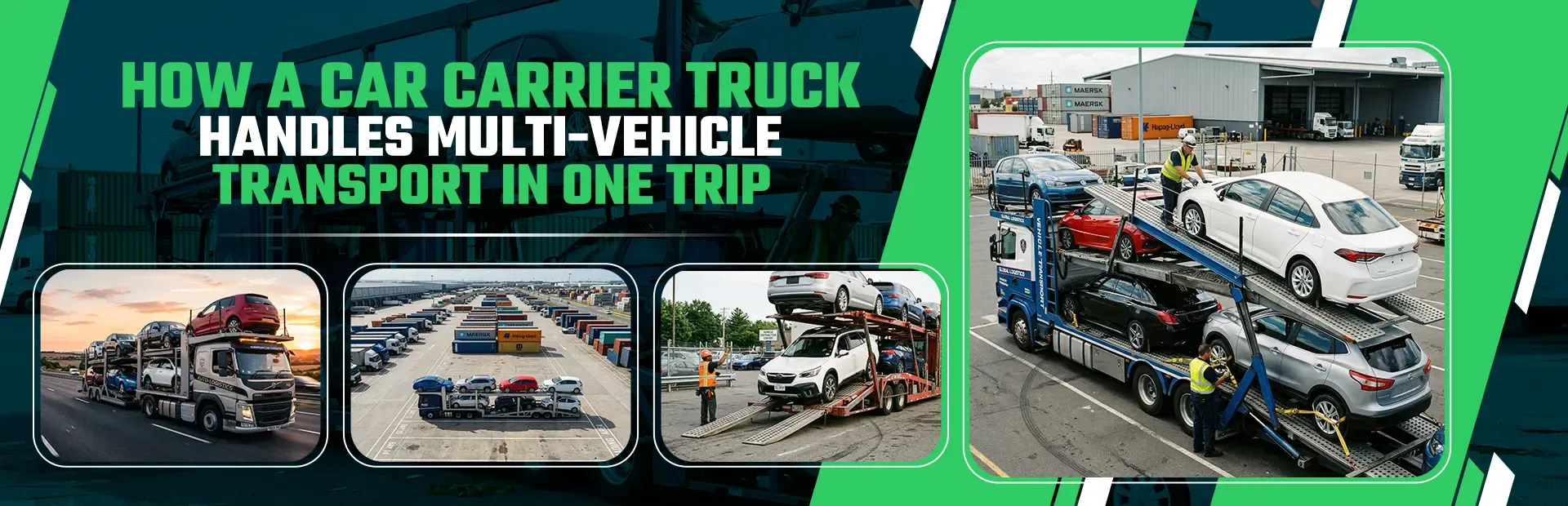
You see them on every major highway, those massive skeletons of steel loaded with sedans and SUVs.
A car carrier truck is the backbone of the American auto industry, moving millions of vehicles from factories to driveways every year. But how does a single truck that carries cars manage to haul 8 to 10 full-sized vehicles across state lines without a scratch?
Whether you are curious about a car carrier truck for sale for your own fleet or just wondering what are the trucks that carry cars called, the mechanics of multi-vehicle logistics are fascinating. In this guide, we break down how car carrier trucks balance weight, maximize space, and keep the economy moving.
Need to move your vehicle? Get a professional quote from the most reliable carriers in the industry. Our transparent pricing ensures your car arrives safely and on time, every single trip.
What Is a Car Carrier Truck and How Is It Built to Carry Multiple Vehicles?
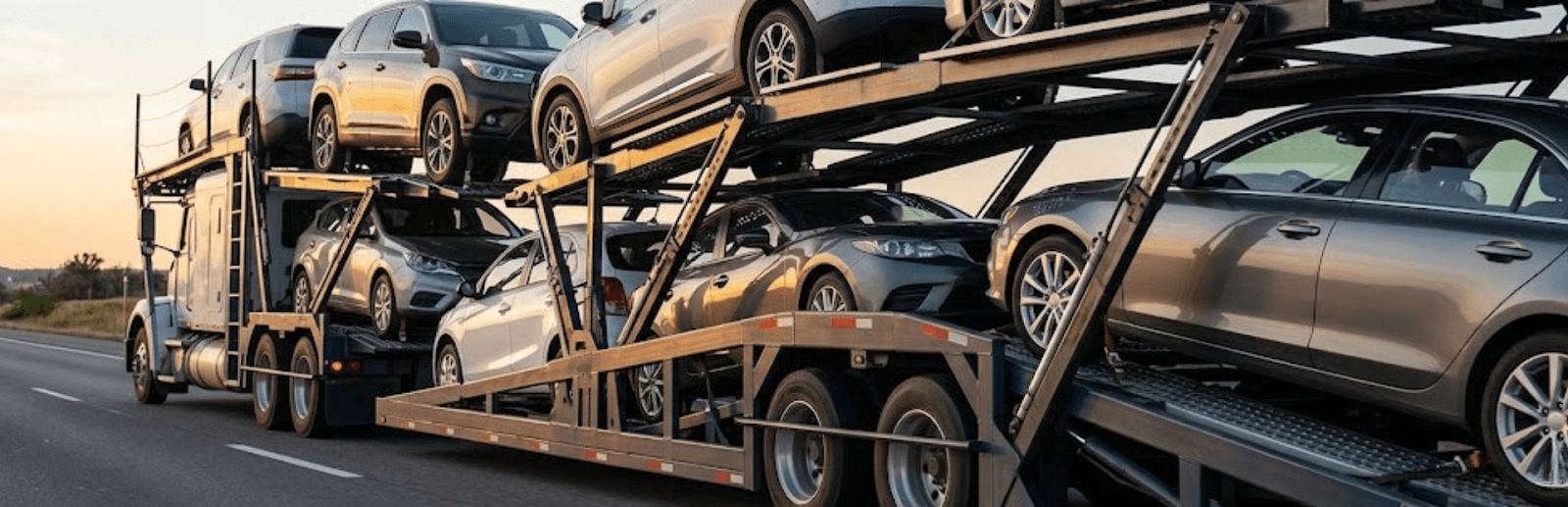
When you see a car carrier truck on the I-95, you are looking at a masterpiece of specialized engineering designed to move the American economy. These car carrying trucks are the primary link between manufacturers and dealerships, acting as the heavy lifters of the domestic auto transport industry.
Unlike a standard dry van, a car carrier truck for sale today is built with a skeletonized frame to minimize weight while maximizing the number of vehicles it can haul. The secret lies in the hydraulic ramps and multi-level decks that allow a driver to stack sedans and SUVs with inches of clearance.
These trailers use extendable arms to create custom angles, ensuring that trucks that carry cars can fit a mix of vehicle heights in a single load.
Design-wise, you generally choose between two main types of car carrier trucks depending on the value of the cargo:
-
Open Car Carriers: These are the most common trucks that carry cars called "open" because the vehicles are exposed to the elements.
-
Enclosed Car Carriers: These feature hard-sided walls to protect luxury or classic cars, though they typically have a lower capacity than open rigs.
Understanding the difference in open vs enclosed car shipping helps you decide which equipment is right for your specific vehicle’s protection.
According to FMCSA regulations, these units must adhere to strict federal weight and size limits to ensure highway safety.
Most car carrying trucks are capped at a gross vehicle weight of 80,000 pounds, which dictates whether the driver can fit seven heavy EVs or ten light compacts.
The trailer design matters as much as the tractor because it must maintain a low center of gravity to prevent tip-overs during tight turns. Whether it is a matchbox car carrier truck in a playroom or a massive truck carrying cars on the turnpike, the physics of balance remains the same.
Even a disney cars mack truck hauler carry case or a car carrying truck toy mimics the specialized "staged" loading sequence used by real professionals.
In the real world, the car carrier truck toy hot wheels version we played with as kids is much simpler than the high-tech enclosed vehicle shipping systems used for exotic relocations.
How Car Carrier Trucks Load, Stack, and Secure Vehicles for Safe Transport
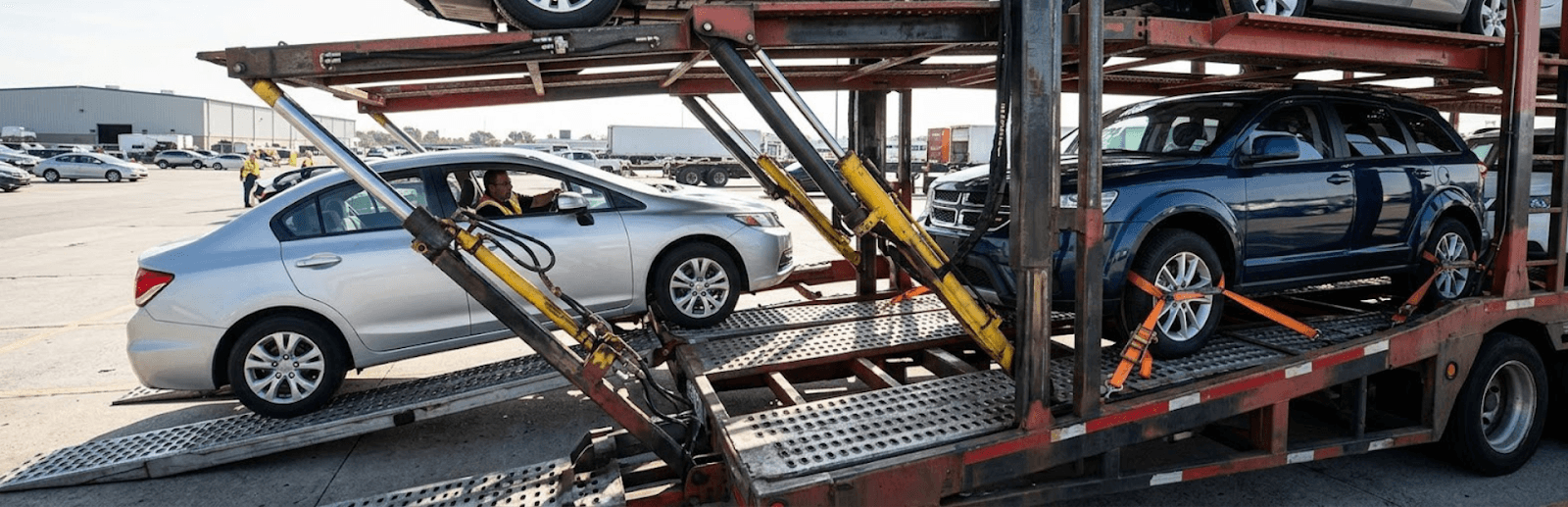
Loading a car carrier truck is a high-stakes game of Tetris where the pieces weigh several tons each.
Professional drivers must calculate clearances and weight distribution before the first vehicle even touches the ramp.
Whether it is a heavy-duty rig or a car carrying truck toy, the principles of balance and sequence are what keep the load stable.
Loading Process: From Ground to Upper Deck
The process begins by lowering the rear ramps of the car carrier truck to create a gentle incline for the vehicles.
Drivers typically back the cars onto the truck that carries cars to ensure the heaviest part—the engine—is positioned correctly for wind resistance.
For non-running vehicles, a specialized winch system pulls the car up, a method often detailed in a how to ship a non-running vehicle guide. The hydraulic systems are the real stars here, allowing the driver to tilt the upper decks at precise angles. This tilting creates enough "headroom" to tuck a sedan’s hood under the rear bumper of the car in front of it.
You might have seen this layout on a hot wheels car carrier truck or a lego city race car and car carrier truck, but the real-world execution requires incredible precision. The loading order is vital; heavier SUVs always go on the lower decks or over the axles to maintain a low center of gravity.
If a driver miscalculates the "stack," the truck carrying cars could become top-heavy, leading to dangerous swaying on the highway.
Understanding how car shipping works starts with recognizing that every inch of space on that trailer is carefully utilized.
How Vehicles Stay in Place During the Haul
Once the vehicles are positioned on the car carrier trucks, the "tie-down" phase begins to prevent any shifting.
Most modern carriers use high-test nylon over-the-tire straps, which provide a secure grip without metal-on-metal contact. This is a major upgrade from the old-school chain systems that you might find on an older car carrier truck for sale.
Wheel chocks are also used as a secondary fail-safe, ensuring the trucks that carry cars don't experience "load creep" during sudden braking. This level of security is much more advanced than the plastic clips on a disney cars mack truck hauler carry case or a toy car carrier truck.
Proper weight distribution across the tractor and trailer axles is required by law to avoid hidden car shipping fees or fines at weigh stations.
According to FMCSA safety protocols, drivers must perform a "walk-around" inspection within the first 50 miles of a trip.
They check every strap and ratchet to ensure the vibrations of the road haven't loosened the hold on the car carrying trucks.
You can verify a carrier's commitment to these safety checks by viewing their FMCSA Company Data before booking your shipment.
How Many Cars Can One Carrier Truck Actually Transport in a Single Trip?
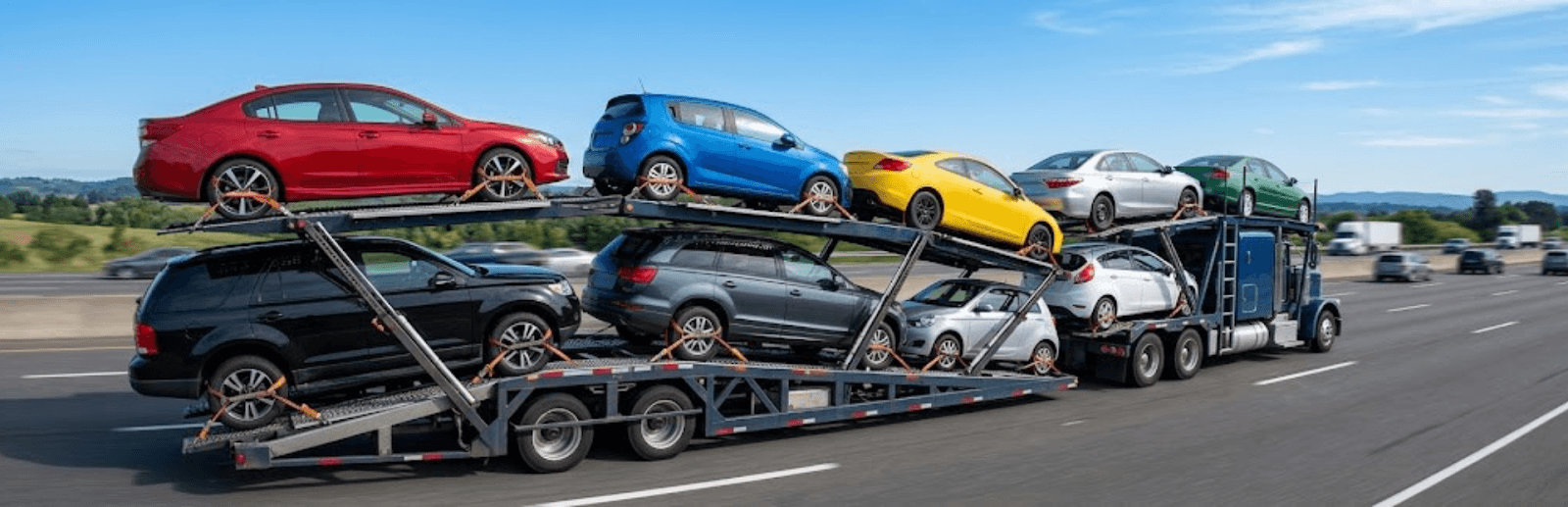
If you have ever been stuck behind a car carrier truck on the highway, you probably tried to count the vehicles perched on its decks.
The truth is, the capacity of trucks that carry cars is not a fixed number; it is a delicate balance of physics and federal law.
Generally, a standard open car carrier truck can transport between 7 and 10 vehicles in a single haul. In contrast, enclosed car carriers typically handle only 4 to 6 vehicles because their solid walls limit the creative "stacking" allowed by open frames.
Several factors dictate exactly how many car carrier trucks can legally fit on a trailer before hitting the road:
-
Vehicle Size: A car carrying truck loaded with compact sedans will hold more units than one carrying full-sized pickups.
-
Weight Limits: The FMCSA strictly enforces an 80,000-pound gross vehicle weight limit for most commercial trucks that carry cars called "Class 8" vehicles.
-
Route Regulations: Certain states have height restrictions for bridges and overpasses that might force a driver to leave an upper deck spot empty.
When you start adding SUVs, dually trucks, or oversized vans to the mix, the total load count drops significantly. A single lifted Ford F-150 might occupy the physical space and weight allowance of two Toyota Corollas, reducing a 9-car capacity down to 7 or 8.
For a real-world example, imagine a driver moving a "mixed load" from a dealership in California to Texas.
They might secure three heavy luxury SUVs on the bottom deck and five lighter sports cars or sedans on the top to keep the center of gravity low.
Whether it is a professional rig or a lego city race car and car carrier truck set, the goal is always to maximize the "staged" positions without exceeding safety limits.
If you are looking for a car carrier truck for sale, you must consider these factors that determine your car shipping quote and daily operating capacity.
The Logistics Behind Planning a Multi-Vehicle Transport Route
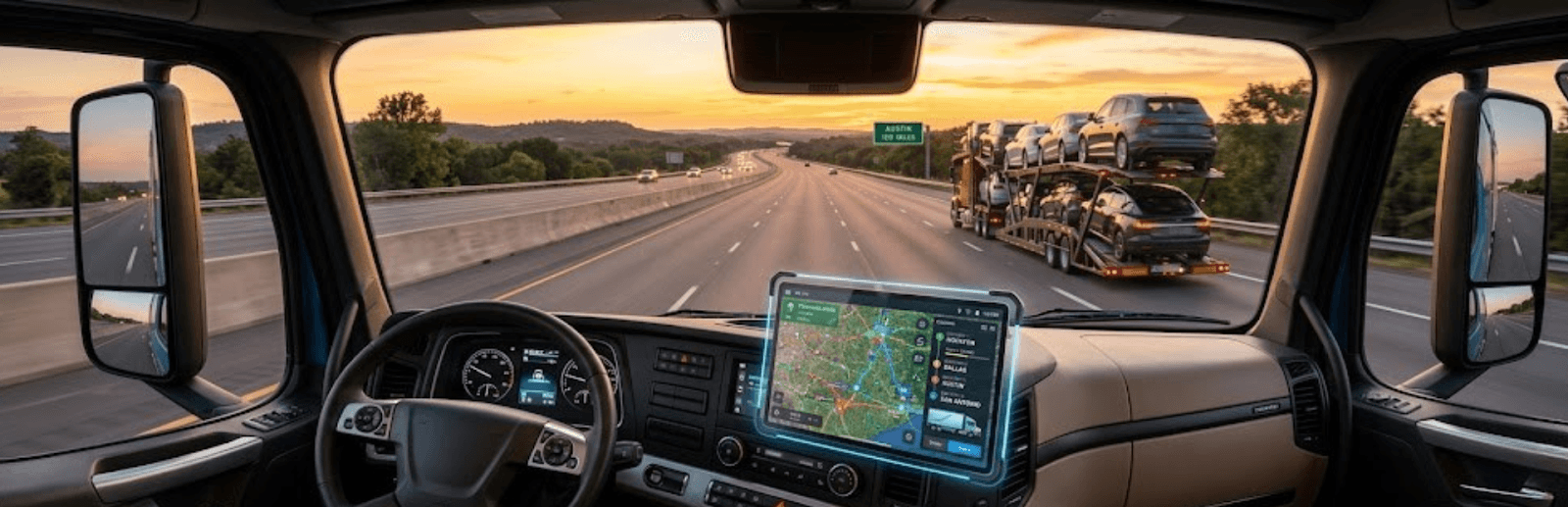
Planning the journey for a car carrier truck is far more complex than just putting a destination into a GPS.
When you are moving nearly a dozen vehicles at once, every mile involves a calculation of clearance, weight, and timing.
Whether it is a heavy-duty car carrying truck or a hot wheels car carrier semi truck layout, the route must be as efficient as the loading.
Route Planning and Legal Load Requirements
Dispatchers spend hours mapping out paths for car carrier trucks to avoid low-clearance bridges and weight-restricted rural roads. Because trucks that carry cars are often 13 to 14 feet tall, a single "low clearance" sign can turn a profitable trip into a logistical nightmare.
You have to consider state-by-state guide to car shipping regulations because what is legal in Florida might require special permits in New York.
If a truck carrying cars exceeds standard width or height due to oversized modified vehicles, the carrier must pull special "Oversize Load" permits. These strict rules are why professional car carrying trucks stay on designated "truck routes" overseen by the FMCSA.
Delivery Sequencing: How Each Car Gets to the Right Destination
A car carrier truck rarely has just one stop; it is usually a rolling puzzle of multi-drop deliveries.
Drivers must load the truck that carries cars so that the vehicle for the first stop is the easiest to unload without moving five others.
This "Last-In, First-Out" logic is essential for terminal-to-terminal vs. door-to-door efficiency. If the order is wrong, the driver wastes hours reshuffling car carrier trucks at a rest stop just to reach one sedan.
Modern carriers use advanced ways to track car during shipping using GPS and digital manifests.
Whether you are watching a matchbox car carrier truck move across a floor or a real car carrier truck for sale on the highway, timing is everything.
Common Challenges Car Carrier Truck Drivers Face on Multi-Vehicle Hauls

Operating a car carrier truck is worlds away from driving a standard semi; it requires an incredible level of spatial awareness and constant vigilance. Navigating a 75-foot truck carrying cars through tight urban streets or under low-clearance bridges is a high-stakes balancing act where inches matter.
Real-World Road Hurdles
-
Vertical & Horizontal Clearances: Low-hanging tree limbs and "low clearance" overpasses are constant threats. Unlike a flatbed, an upper-deck car carrying truck load can sit 14 feet high, making a wrong turn into a residential area a recipe for disaster.
-
Extreme Weather Stability: High winds act like a sail against the side of car carrier trucks, threatening the stability of the entire load. In states like Colorado, ice can turn a routine trip into a dangerous situation where a loaded truck needing 4 seconds to stop on dry pavement suddenly needs 10+ seconds.
-
Mechanical Strain: A car carrier truck loaded to its 80,000-pound limit puts immense stress on the braking system. Continuous downhill grades can lead to "brake fade" if the driver doesn't manage gears perfectly.
-
Concentrated Tire Load: Tire blowouts are more frequent due to the massive weight focused on specific trailer axles, a reality far more serious than a flat on a car carrier truck toy.
Expert Solutions & Proactive Strategies
-
Precision Route Planning: Use truck-specific GPS tools that account for height and weight restrictions. Experienced drivers cross-reference these with traditional motor carrier atlases to avoid being led into a "no-truck" zone.
-
Load Securement Audits: Follow the FMCSA "walk-around" protocol. Stop and re-torque tie-down straps within the first 50 miles and every 150 miles thereafter to ensure the truck that carries cars hasn't shifted during vibration.
-
Preventive Maintenance (PM) Cycles: Implement a "Tier A" safety inspection every 5,000 miles. Focus specifically on the hydraulic lines for the ramps and air bellows, as "ozone cracks" in older rubber can lead to sudden air leakage and breakdown.
-
Weather Buffering: Always add "buffer days" to your schedule during winter. It is better to communicate a delay to a customer than to risk a multi-million dollar trucking cars load in a blizzard. You can check a carrier's safety record via FMCSA Company Data to see how they prioritize these safety standards.
Understanding these car shipping insurance nuances is vital, as it protects you if the driver encounters one of these real-world highway hurdles. Whether you are dealing with a real car carrier truck for sale or just curious about what are the trucks that carry cars called, respect for the driver's expertise is the first step in a successful transport.
Expert Insights into Auto Hauling Logistics
Moving multiple vehicles at once is a complex operation that often sparks technical questions. Here we address the common curiosities about the mechanics and terminology of the car shipping industry.
What are the trucks that carry cars called in the professional industry?
Most pros call them auto transporters or car haulers. You might also hear "stinger-steered" units, which refer to a specific hitch style that allows for the extra vehicle capacity you see on modern open-deck trailers.
Can a car carrier truck for sale be operated without a CDL?
No. While you can technically buy the equipment as an investor, federal law requires a Class A Commercial Driver's License to operate any loaded truck that carries cars exceeding the 26,001-pound weight threshold.
How does a hot wheels car carrier truck differ from real-world loading?
Toy models use fixed plastic slots, but real car carrying trucks utilize advanced hydraulics. Drivers must manually calculate the "rake" or angle of each deck to ensure enough clearance for rooflines and low-profile bumpers.
What are the trucks called that carry cars for specialized racing teams?
In racing, these are usually called "transporters" or "haulers." Unlike standard open rigs, these are typically high-end enclosed units that feature built-in workshops and luxury vehicle shipping features to protect expensive track equipment.
Are toy trucks that carry cars a reliable way to understand weight distribution?
Only loosely. Real-world auto transport weight limits are governed by the bridge formula, requiring drivers to spread the load across specific axles to avoid infrastructure damage, a factor plastic toys don't have to navigate.
Mastering the Art of Multi-Vehicle Logistics
From the moment a car carrier truck lowers its ramps to the final delivery, the process is a masterclass in American engineering. Whether you are curious about a car carrier truck for sale or simply wondering what are the trucks called that carry cars, understanding these mechanics is vital for a smooth move.
These car carrying trucks balance extreme weight and tight clearances to ensure every vehicle arrives in showroom condition. When choosing a provider, look for those who prioritize FMCSA compliance and transparent loading protocols. By recognizing the skill behind a truck carrying cars, you can book your transport with total confidence.
Ready to move your vehicle? Get a Quote from our team of experts. We provide transparent pricing and reliable service for every car carrier truck shipment across the country.