

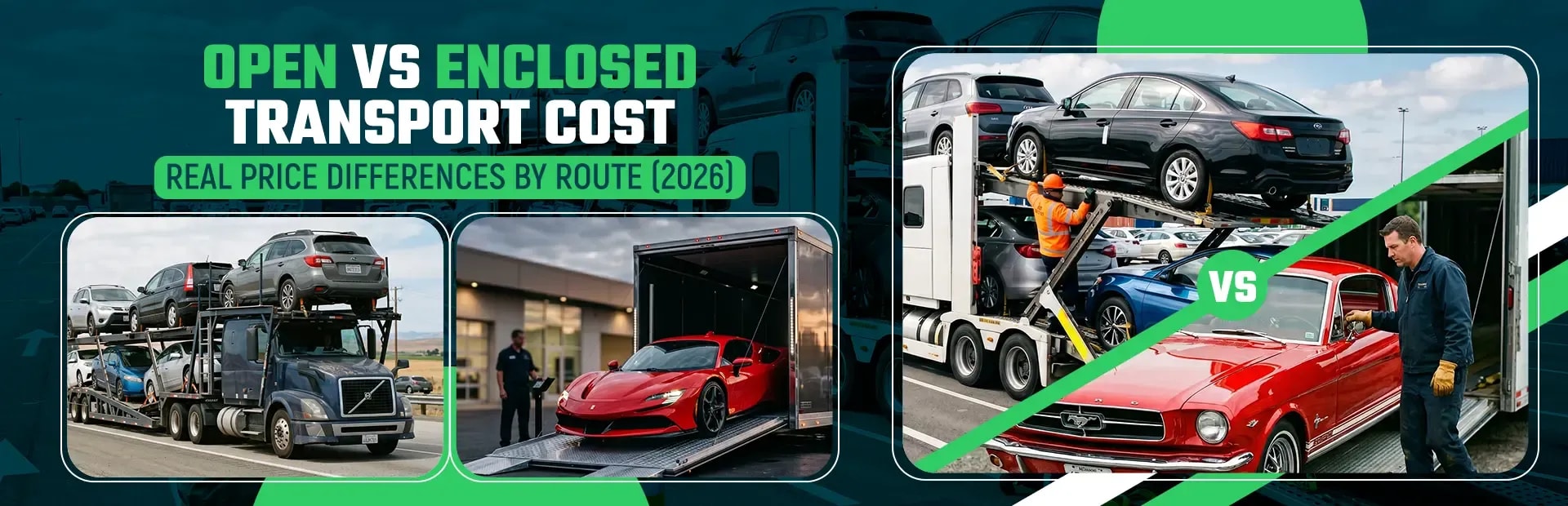
Shipping a car across the country often comes down to one question: how much extra is a roof worth? In open vs enclosed car shipping, the answer is usually 40% to 60% more for enclosed. Move.org's October 2026 averages put open at $914 a shipment and enclosed at $1,342.
Whether you're moving a vintage Porsche or a standard sedan, the gap depends on more than the trailer. Your route, your car's value and how much protection it needs all move the number. Below are the real 2026 prices, what the extra money buys, and which cars need it.
Ready to move? Get a free quote for your route and see open and enclosed prices side by side before you book anything.
Open vs Enclosed Car Shipping Cost in 2026
When you book a move, you're choosing between two trailer types. Open transport puts your car on a two-level trailer that usually carries 7 to 9 cars, exposed to rain, sun and road debris.
Open trailers are the backbone of the industry because they are efficient. You share the space and the fuel bill with other customers, which keeps your individual price point low.
An enclosed carrier uses a hard-sided or soft-sided trailer to shield your car. These usually haul 2 to 6 cars, so each car carries more of the trip's cost. That's the main reason enclosed costs more.
Your price isn’t a fixed figure. The final number shifts based on your specific route, the size of your vehicle, and current market demand in 2026.
|
Open |
Enclosed |
Enclosed premium |
|
|---|---|---|---|
|
Average shipment |
$914 |
$1,342 |
About 47% |
|
Average per mile |
$1.89 |
$2.82 |
About 49% |
Source: Move.org, October 2026. Averages for a running 2025 Toyota Camry booked one week ahead.
Enclosed car shipping typically costs 40% to 60% more than open for the same route. If your open quote is $1,000, expect about $1,400 to $1,600 for enclosed.
|
Route |
Miles |
Open |
Enclosed |
|---|---|---|---|
|
Greensboro to Charlotte, North Carolina |
94 |
$404 |
$612 |
|
Dodge City, Kansas to Roswell, New Mexico |
435 |
$873 |
$1,253 |
Several variables can push your price up or down. You need to account for these specific factors before signing a contract:
-
Vehicle Dimensions: Shipping a standard sedan is the baseline, but an oversized SUV or pickup costs more because it takes up more space on the deck.
-
Delivery Flexibility: Choosing door-to-door service is convenient, but using terminal-to-terminal drops can sometimes lower your price.
-
Seasonal Spikes: If you move during the "snowbird" season or mid-summer, demand surges. This often raises cross-country prices significantly.
-
Fuel and insurance: diesel prices drive fuel surcharges, and high-limit gap coverage adds to the bill.
Per-mile rates fall as distance grows. On Move.org's routes, open transport drops from about $4.30 a mile on the 94-mile local move to about $0.46 a mile from San Diego to Boston.
Ask every company for a line-item quote, so extra fees show up before you sign instead of at delivery.
What the Enclosed Premium Actually Buys
The extra money pays for how your car gets on and off the truck. Enclosed drivers often use hydraulic lift gates and soft straps instead of steep ramps. That's why enclosed is the go-to for low-clearance sports cars and non-running vehicles.
It also buys you a roof during the worst months:
- Winter: snow, road salt and ice stay off the paint.
- Spring: pollen season won't coat the car in yellow film.
- Heavy rain and hail season: no water or hail damage.
Custom modifications are another reason to go enclosed. Body kits, lowered suspensions and custom paint are the parts you least want sitting in the open on a cross-country run.
Open still wins on speed. There are far more open carriers on the road, so you'll usually get a faster pickup and can book on short notice. Enclosed carriers are scarcer, so give yourself more lead time.
And on short hauls, open makes even more sense. Your car spends less time exposed, so there's less chance of road debris or a storm doing damage.
Which Cars Need Enclosed Car Shipping
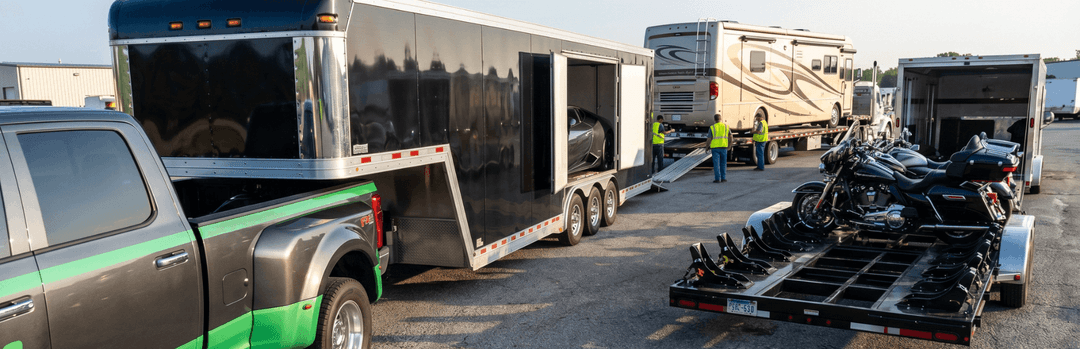
Your car's value, build and clearance decide whether enclosed is worth paying for. Use this as a starting point.
|
Car |
Best fit |
Why |
|---|---|---|
|
Daily driver or commuter car |
Open |
Lowest price, fastest pickup |
|
New or luxury car |
Either |
Enclosed if a paint chip would hurt resale |
|
Classic or vintage car |
Enclosed |
Paint and trim are hard to replace |
|
Exotic or low-clearance car |
Enclosed |
Lift gates instead of steep ramps |
|
Modified or show car |
Enclosed |
Body kits and custom paint stay covered |
For a classic or exotic, add 40% to 60% to your open quote to estimate the enclosed price. Then get a real enclosed quote with your exact model, since low-clearance cars may need a lift-gate trailer.
If you've settled on enclosed, our ranking of the best enclosed car shipping services compares carriers that specialize in it. For a daily driver, see the best open carrier auto transport services.
Open vs Enclosed Prices on Popular Routes
Distance sets the base price, and route density decides how far it drops. Busy lanes like California to New York stay affordable because carriers fill a trailer fast.
The table below shows open and enclosed prices for a standard sedan on four common routes, taken from Transportvibe’s route pages. Click any route to see city-by-city prices.
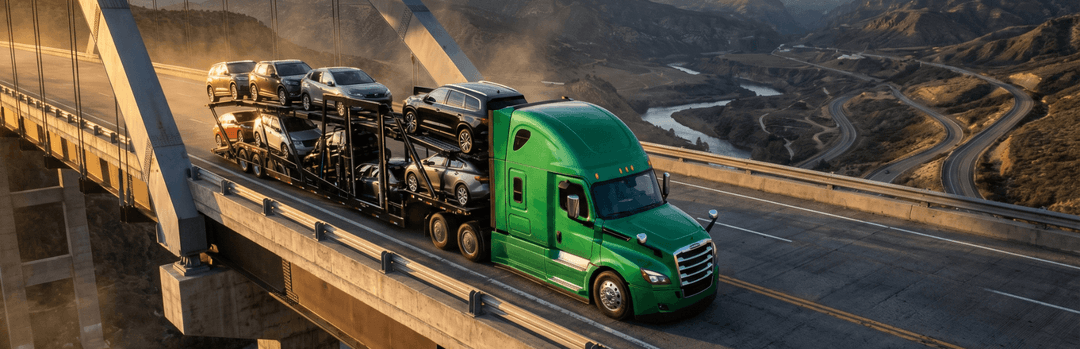
When you move off the beaten path, the price per mile climbs. Carriers charge more for deadhead miles, the distance they drive empty to reach a pickup in a low-density area.
|
Route |
Distance |
Open Transport |
Enclosed Transport |
Transit After Pickup |
|---|---|---|---|---|
|
1,000–1,470 miles |
$750–$1,200 |
$1,100–$1,925 |
2–5 days |
|
|
1,150–1,510 miles |
$825–$1,225 |
$1,200–$1,950 |
2–6 days |
|
|
1,350–1,960 miles |
$900–$1,400 |
$1,300–$2,250 |
3–7 days |
|
|
2,620–3,120 miles |
$1,300–$1,850 |
$1,875–$2,950 |
5–10 days |
A 200-mile trip can feel expensive next to a long haul. That's carrier overhead, and it doesn't shrink just because the trip is short.
-
Minimum Fees: Every carrier has a "hook fee" or base operating cost that must be covered regardless of the odometer reading.
-
Lack of Competition: Fewer drivers hunt for short, off-lane stubs, giving those who do more leverage over the price.
-
Fixed Costs: The time spent loading, securing, and unloading your vehicle is the same whether the driver goes 50 miles or 500.
-
Route Difficulty: Local door-to-door moves in tight residential areas add complexity that highway-to-highway runs avoid.
Shipping a car cross-country on an open trailer runs about $1,300 to $1,850 on the California to New York route, while enclosed transport on the same route runs $1,875 to $2,950. The per-mile price drops on these long hauls, because fixed costs like loading and dispatch are spread across more miles.
The only way to benchmark your route is to compare 3 to 5 quotes for both open and enclosed on the same dates.
Why the Gap Widens in Peak Season and on Rural Routes
Summer and winter are peak periods, and enclosed rates climb faster than open rates when demand spikes. Rural and less-traveled routes have fewer enclosed carriers running them, so enclosed can be harder to book out there.
The service differs too. Enclosed transport often means fewer vehicle transfers and true door-to-door delivery. Open shipments may use terminal drop-off and pickup, and the truck loads and unloads more cars along the way.
Four Car-and-Route Scenarios
How the choice plays out on 4 common moves:
- A 2017 Toyota Camry going from Chicago, Illinois to Miami, Florida: ship open. It's a daily driver and doesn't need the extra cover.
- A 1969 Mustang headed to a car show in Las Vegas, Nevada: ship enclosed. Show cars need to arrive clean.
- A Tesla Model S going from California to New York in January: enclosed is the safer call. Winter salt and ice are hard on paint.
- A 2015 Honda Civic that needs cheap, fast delivery to Texas: open is your best bet.
Your real gap depends on your car and your route. Get quotes for both open and enclosed on the same dates so you see the actual difference before you pick.
Want your own numbers? Get a free quote for both open and enclosed on your exact dates, then compare them line by line.
Insurance, Hidden Costs, and What Your Quote Actually Covers
The biggest mistake is assuming a signed contract means your car is fully covered. The carrier's cargo insurance is usually part of the price, but it pays up to the policy limit, not your car's full value.
Federal rules don't require car haulers to carry cargo insurance, so reputable carriers carry it by choice. Check these before you hand over the keys:
-
Coverage limit: ask for the certificate of insurance and confirm the limit covers your car's value.
-
Deductible: find out what you'd owe on a claim.
-
Exclusions: some policies leave out acts of God like hail, which matters most on an open trailer.
-
Gap coverage: if your car is worth more than the carrier's limit, ask about an add-on policy or check with your own insurer.
-
Documentation: photograph the car at pickup and delivery, and make sure every existing mark is on the Bill of Lading before you sign.
Hidden costs show up on the same paperwork. A non-running car usually adds $150 to $300 for winch labor, and an address far from an interstate can add a rural surcharge. Ask for a line-item quote so both show up before you book.
To make sure the carrier is legitimate, check its DOT and MC number on the federal database. Our car shipping insurance guide explains how to file a claim if something goes wrong.
Choosing Between Open and Enclosed Car Shipping
Choosing between open and enclosed transport comes down to your car's value and how much risk you're willing to carry. For daily drivers, open is the practical default. For classic, exotic, low-clearance or show cars, the roof is worth paying for.
In open vs enclosed car shipping, the premium usually runs 40% to 60%. If a paint chip or a hailstorm would cost more to fix than that, go enclosed.
Before you commit, compare 3 to 5 quotes for both trailer types on the same dates. Check each carrier's insurance limit, and walk through the condition report at pickup.
Get a transparent price for your move today. Get a quote and compare open and enclosed options for your exact route before you commit to anything.