



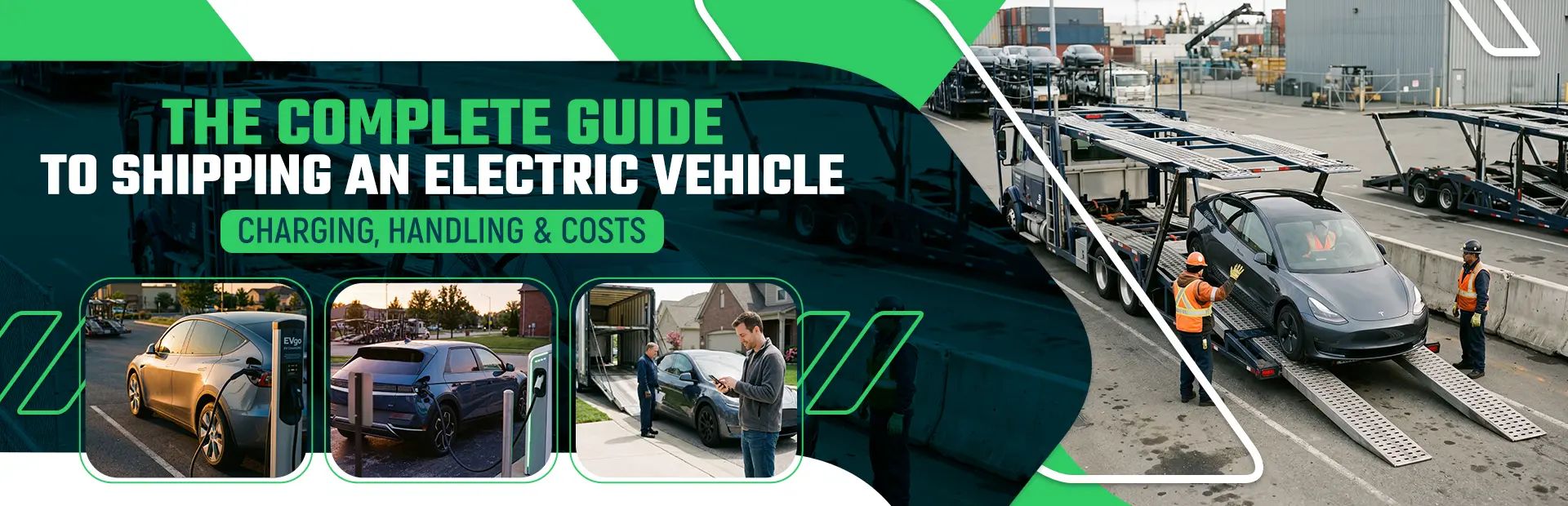
Imagine sitting in your driveway, watching a carrier pull away with your brand-new Tesla, only to realize you never checked the battery level requirements for electric vehicle shipping. Most owners assume moving an EV is just like hauling a gas-guzzler, but the reality hits at the port or the loading ramp. You might find your EV shipping services cancelled last minute because your state of charge was too high for safety regulations or too low for the driver to maneuver.
Shipping an EV often catches people off guard because electric car transport service involves managing specific weight distributions and strict lithium battery car shipping regulations. This guide clears the fog by providing a clear roadmap for handling, battery prep, and navigating the specialized logistics required to move your vehicle safely across the country or overseas.
Need a hand with your move? Get a free quote from our vetted EV auto transport companies to ensure your vehicle is handled by specialists who understand electric car requirements.
Why Shipping an Electric Vehicle Is Different from Shipping a Regular Car
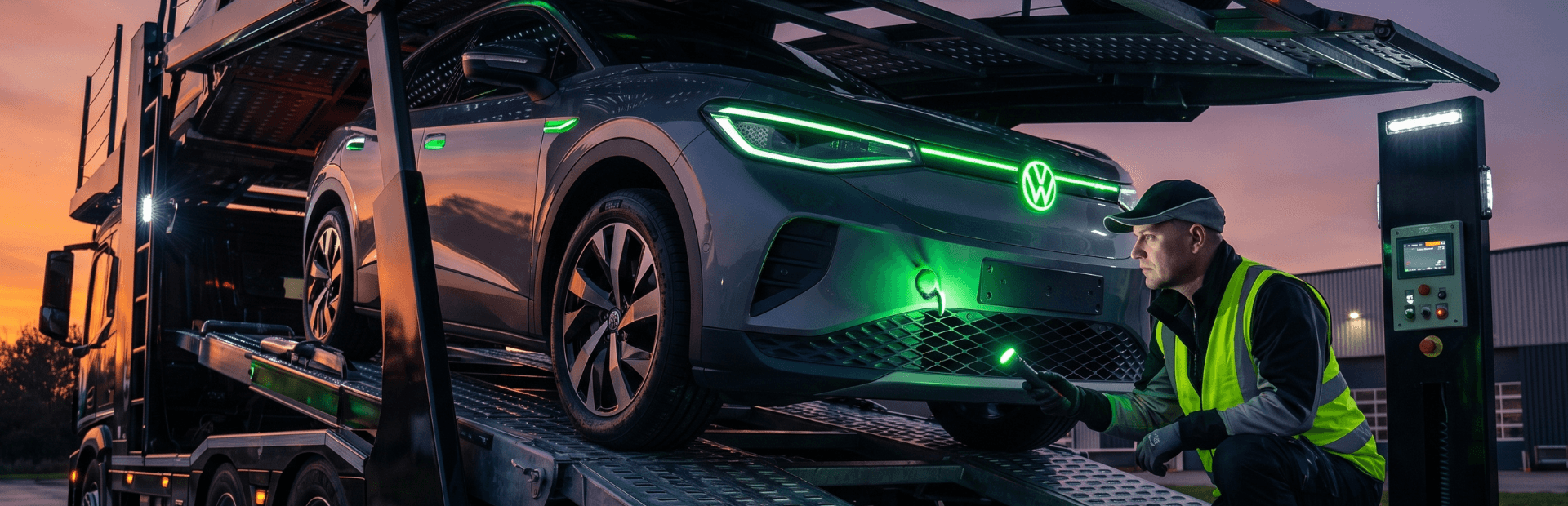
You might think shipping an EV is just like hauling a gas-powered car, but that assumption often leads to last-minute surcharges or outright rejections. The reality is that electric vehicle shipping involves navigating a specialized logistics framework that traditional vehicles simply don't face.
The primary reason for this shift is the high-voltage lithium battery pack sitting under the floorboards. In the eyes of carriers and port authorities, these batteries aren't just fuel—they are classified as hazardous cargo. Because of strict lithium battery car shipping regulations, carriers must follow specific loading and safety protocols to mitigate fire risks, which changes how they classify, load, and even insure your vehicle.
When you look for EV shipping services, the price often reflects the sheer mass of the vehicle. EVs are notoriously heavier than their internal combustion engine (ICE) counterparts, primarily due to the density of the battery packs. This extra weight creates several hurdles for a standard electric car transport service:
-
Massive Battery Weight: Battery packs typically add 400 to over 1,000 lbs to the vehicle’s curb weight.
-
Deck Weight Limits: Many multi-car carriers have strict "per-slot" weight limits to maintain the trailer's structural integrity and meet federal axle weight laws.
-
Specialized Equipment: Heavier models like the Rivian R1T or the GMC Hummer EV often exceed the capacity of standard open trailers, requiring a dedicated flatbed or a door-to-door EV transport service with reinforced ramps.
Exceeding these limits isn't just a safety issue; it's a legal one. In the United States, federal law limits a semi-trailer’s total weight to 80,000 lbs. If a carrier loads ten EVs that each weigh 1,000 lbs more than a standard sedan, they risk heavy fines at weigh stations. This is why many best electric vehicle shipping companies charge a premium for "heavy" slots or limit the number of EVs they will take on a single trip.
You should also be aware that standard auto transport insurance sometimes has "fine print" regarding battery damage. Because an EV battery is the most expensive component of the car, some policies may exclude or strictly limit coverage for internal electrical failures during transit. Before you book with EV auto transport companies, always verify if their cargo insurance specifically covers the battery pack.
Global EV sales crossed 17 million units in 2024 (IEA, 2025), yet fewer than 40% of traditional auto carriers have updated their dedicated EV handling protocols to manage these unique weight and safety demands.
If you are planning to ship electric car internationally, you'll likely face the EV shipping container vs RoRo (Roll-on/Roll-off) debate. While RoRo is often more affordable electric car shipping, new 2026 regulations now mandate a "30% state of charge" rule for all lithium-powered vehicles on vessels. Failing to meet this can result in your car being grounded at the port.
To avoid these pitfalls, it's vital to work with an international EV logistics company that knows how to navigate these evolving rules. You can find more tips on vetting providers in our guide on choosing a vehicle shipper or get a jump start by grabbing EV transport quotes online to compare current market rates.
EV Shipping Methods: Container vs RoRo vs Open Carrier
When you decide to move your vehicle, the method you choose depends on your budget, the distance, and how much sleep you want to lose over potential weather exposure. If you are moving domestically, you’ll likely stick to the road, but for those who need to ship electric car internationally, the debate always narrows down to a face-off between Container and RoRo shipping.
Container Shipping for Electric Vehicles
Container shipping involves placing your vehicle inside a sealed 20ft or 40ft metal box. For electric vehicle shipping, you can choose between sole-use (just your car) or shared containers. I generally recommend sole-use for EVs because it eliminates the risk of contact damage to the sensitive, low-clearance battery housings from other poorly secured cargo.
A container acts like a mobile garage, protecting your investment from the corrosive salt air of the Pacific or Atlantic. It is the gold standard for international EV logistics company operations because it allows for granular control over how the vehicle is blocked and braced.
When the container is your best bet:
-
You are moving a high-value model like a Tesla Model S Plaid, Porsche Taycan, or Lucid Air.
-
Your route involves extreme weather or high-humidity tropical zones.
-
Your EV has aftermarket aero kits or incredibly low ground clearance that makes ramps risky.
-
You are moving on long-haul routes, such as the US to Australia or Europe to Southeast Asia.
RoRo Shipping for Electric Vehicles
Roll-on/Roll-off (RoRo) is exactly what it sounds like: your car is driven onto a massive specialized vessel, similar to a multi-level parking garage on water. It is the backbone of how to ship an electric car overseas because of its efficiency. However, for EV owners, there is a catch: the "30% Rule."
Due to fire safety protocols, most RoRo terminals and vessel operators—monitored by the FMCSA for safety standards—now require EVs to arrive with a battery charge between 20% and 30%. If you show up with a full charge, you might be turned away at the dock.
|
Factor |
RoRo |
Container |
|
Cost |
Lower |
Higher |
|
Weather Protection |
Minimal |
Full |
|
Fire Risk Management |
Moderate |
Better Controlled |
|
Route Availability |
Wide |
Selective |
|
Turnaround Time |
Faster |
Slower (Loading/Unloading) |
|
Best For |
Standard EVs, budget-conscious |
High-value or modified EVs |
For moves within the United States, affordable electric car shipping almost always translates to an open car carrier. These are the two-level trailers you see on the interstate every day. While your car is exposed to the elements, it is the most cost-effective way to get from point A to point B.
Most EV auto transport companies offer both open and enclosed options. While an everyday Nissan Leaf or Chevy Bolt is perfectly fine on an open rack, I’d suggest checking out our enclosed vehicle shipping guide if you’re worried about road debris hitting your paint. Most best electric vehicle shipping companies will suggest enclosed transport for any vehicle valued over $70,000 to ensure total peace of mind.
If you are still weighing the pros and cons of these methods, you can get EV transport quotes online to see the actual price gap between a shared container and a standard open carrier.
How Much Does It Cost to Ship an Electric Vehicle?
When you start looking for EV transport quotes online, the first thing you'll notice is that the numbers look a bit different than they do for a standard sedan. Because of the specialized nature of electric vehicle shipping, your final bill reflects the extra weight and regulatory hurdles involved in moving a high-voltage battery.
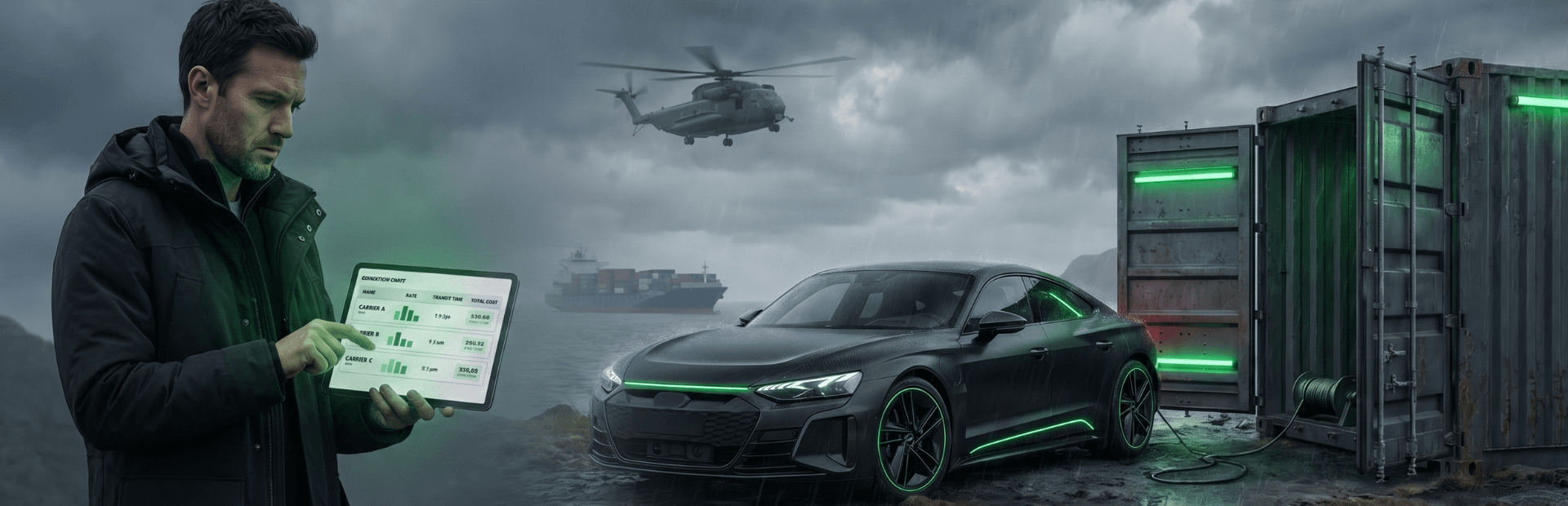
For moves within the United States, here is a breakdown of what you can expect to pay for a standard electric car transport service:
|
Route |
Open Carrier |
Enclosed Carrier |
|
Under 500 miles |
$400 – $700 |
$700 – $1,100 |
|
500 – 1,500 miles |
$700 – $1,100 |
$1,100 – $1,800 |
|
Cross-country (1,500+ miles) |
$1,000 – $1,600 |
$1,600 – $2,500 |
Note: Expect an EV surcharge of $100–$300 depending on the specific carrier and the curb weight of your vehicle.
If you need to ship electric car internationally, the logistics become significantly more complex. The cost to ship electric vehicle internationally is influenced heavily by the method you choose—whether it’s the budget-friendly RoRo or the premium security of a container.
|
Route |
RoRo (Approx.) |
Container (Sole Use, Approx.) |
|
US to UK |
$1,200 – $2,000 |
$2,500 – $4,500 |
|
US to Australia |
$1,800 – $3,000 |
$3,500 – $6,000 |
|
US to UAE |
$1,500 – $2,500 |
$3,000 – $5,500 |
|
US to Japan |
$1,400 – $2,200 |
$3,000 – $5,000 |
Keep in mind that these are base rates. Your final price will fluctuate based on current fuel surcharges, port fees, and the specific customs duties of your destination.
Why EVs Carry a Premium Price Tag
You might wonder why EV shipping services cost more than shipping a traditional car. It isn't just a "tech tax"—there are tangible operational costs that best electric vehicle shipping companies must account for:
-
Heavy Battery Packs: The sheer weight of the battery often pushes the car into a higher weight class, triggering surcharges.
-
Safety Protocols: Terminals require extra labor to verify battery health and state-of-charge levels.
-
Insurance Premiums: Because lithium batteries are classified as hazardous, carriers often pay higher premiums to cover potential risks.
-
Import Duties: Some countries apply heavy taxes on imported EVs, sometimes reaching over 100% of the vehicle's value.
Pro Tip: Shipping a Tesla Model 3 from Los Angeles to London via RoRo typically runs $1,500–$2,200 before customs. Opting for a container can push the total landed cost past $5,000 once port handling and duties are tallied.
To get the most accurate EV transport quotes online, you must be specific. Generic tools often give you a baseline for gas vehicles and then hit you with a "surprise" markup later. Always specify your exact model and battery size to ensure you are dealing with affordable electric car shipping that won't change at the last minute.
If you're still curious about the moving parts of the process, check out our guide on how car shipping works or look at our 2025 car shipping cost breakdown for more context. You can also verify a carrier's legitimacy by checking their FMCSA Company Data before signing any contract.
EV Shipping Regulations: Lithium Batteries, Charge Levels & Legal Requirements
Most guides gloss over the legalities, but if you ignore lithium battery car shipping regulations, your vehicle won't even make it past the port gates. The reason is simple: lithium-ion batteries are classified as "dangerous goods" because they can experience thermal runaway—a self-heating cycle that causes intense, difficult-to-extinguish fires.
Because of this risk, international bodies like the International Maritime Organization (IMO) treat EVs as hazardous cargo. While you don't need to be a chemist to ship electric car internationally, you do need to understand that your car is treated differently than a gas vehicle the moment it touches a ship or a plane.
The Golden Rule: The 30% Charge Limit
The most critical rule you’ll face with EV shipping services is the state of charge (SoC). Most RoRo (Roll-on/Roll-off) terminals and vessel operators strictly mandate that your battery be at 30% or less. This isn't a friendly suggestion; it is a safety requirement to minimize the energy available in the event of a cell failure.
Some container shipping lines are a bit more flexible, allowing up to 50%, but you must confirm this with your international EV logistics company before the tow truck arrives. If your car shows up with an 80% charge, the terminal can—and often will—refuse to load it, leaving you with a massive bill for storage and redelivery.
Key Regulatory Bodies and Rules
Navigating the legal landscape requires knowing who sets the rules. Here is a breakdown of the authorities governing your electric vehicle freight service:
|
Regulatory Body |
Rule Relevant to EV Shipping |
|
IMO (Maritime) |
Classifies EVs as dangerous goods if batteries are damaged or overcharge thresholds. |
|
IATA (Air) |
Extremely strict; full EVs are rarely shipped by air due to high battery mass. |
|
SOLAS |
Requires a formal declaration of your EV as cargo with specific battery specs. |
|
US DOT |
Governs road transport; requires a battery condition declaration for domestic hauls. |
|
Customs |
Varies by country; covers import permits, duties, and safety homologation. |
Essential Paperwork for Your EV
To ensure a smooth handoff to EV auto transport companies, you need your paperwork in order long before the ship sails. You should have:
-
Original vehicle title and registration.
-
A battery specification sheet (you can get this from your manufacturer).
-
A Dangerous Goods Declaration (required for all sea freight).
-
An export customs declaration and an import permit for the destination country.
-
An insurance certificate that explicitly covers lithium battery-related transit damage.
International Hurdles and Restrictions
Be aware that some countries have very specific "homologation" or safety requirements. For example, Australia has strict Australian Design Rules (ADR), and the EU requires specific type approvals for cars not originally manufactured for their market. If you are looking for the best electric vehicle shipping companies, choose one that has handled these specific routes before.
Failure to check these details can result in your car being impounded or sent back at your expense. Always verify the latest rules by checking DOT and an MC number of your carrier to ensure they are authorized for hazardous material transport. You can also read our guide on international car shipping costs to see how these regulations impact your bottom line.
How to Choose the Right EV Auto Transport Company
Don't assume every carrier with a trailer knows how to handle a high-voltage battery. The gap between a general auto shipper and the best electric vehicle shipping companies often comes down to their internal protocols and insurance fine print.

An EV-capable carrier understands that your car has a low center of gravity and a sensitive underbody housing the battery. They won't treat it like a 1998 sedan. They will have specific loading approaches for low-clearance vehicles and, crucially, an insurance policy that covers lithium battery-related damage rather than just cosmetic bodywork.
Questions to Ask Before You Book
Before committing to any EV shipping services, you need to put the broker or carrier on the spot. If they can't answer these questions clearly, keep looking:
-
Do you have a written protocol specifically for electric vehicle shipping?
-
What is the exact battery charge level you require at the time of pickup?
-
Does your cargo insurance policy explicitly cover lithium-ion battery damage?
-
Have you successfully transported this specific EV model (e.g., Rivian, Lucid, or Tesla) before?
-
Is a door-to-door EV transport service available for my specific route?
-
What is your contingency plan if the vehicle is flagged at a port due to charge level issues?
Delivery Logistics: Door-to-Door vs. Terminal
Choosing how your car is picked up and dropped off affects both the cost and the safety of your battery. For most EV owners, the fewer hands on the car, the better.
|
Factor |
Door-to-Door |
Terminal-to-Terminal |
|
Convenience |
High |
Lower |
|
Cost |
Higher |
Lower |
|
Charge Management |
Easier to control |
More handoffs, higher risk |
|
Risk of Damage |
Lower (fewer transfers) |
Higher (frequent moving) |
|
Recommended for EVs? |
Yes |
Not ideal |
When hunting for affordable electric car shipping, don't let a low price blind you to a bad provider. A "cheap" quote often hides a lack of expertise. Be wary if a company has no mention of EV-specific handling on their website or if their quote tool doesn't ask for your specific battery size or vehicle weight.
Always verify that the company has a valid license number—check the FMCSA Company Data for U.S. carriers. If they cannot provide proof of insurance that includes hazardous material or lithium battery coverage, that is an immediate deal-breaker.
Your Final Pre-Booking Checklist
To ensure your EV transport quotes online turn into a successful delivery, follow this final checklist:
-
Written Confirmation: Get the charge level requirements and the final price in writing.
-
Insurance Check: Secure a copy of the insurance certificate before the car is loaded.
-
Credential Search: Verify the carrier's DOT and MC numbers to ensure they are active and authorized.
-
Specific Reviews: Look for feedback from other EV owners—their experience with battery handling is more relevant than a general review.
If you’re still narrowing down your options, take a look at our top 10 best car shipping companies to see who currently leads the pack in specialized handling. Making the right choice now prevents a logistical nightmare later.
The EV Shipping Knowledge Base
You have the roadmap, but specific logistics often trip up even the most prepared owners. Here are the final details you need to master your move.
How To Ship An Electric Car Overseas Without Clearing Out Your Savings?
Consolidated container shipping is usually the best balance of safety and cost. By sharing a container with other vehicles, you split the heavy port fees while keeping your battery protected from the elements and high-humidity salt air.
What Is The Cost To Ship Electric Vehicle Internationally If I Choose A Premium Carrier?
For a high-end EV, expect to pay between $3,500 and $6,000 for sole-use container service to major ports. This premium ensures specialized blocking, bracing, and an international EV logistics company that handles all hazardous material paperwork on your behalf.
Are There Specific Lithium Battery Car Shipping Regulations For Non-Running Evs?
Yes, and they are strict. Most carriers and vessels will not accept a non-running EV if the battery is damaged or completely discharged. Fire risk protocols require the battery to be stable and "vent-free" before it can be loaded.
Which Are The Best Electric Vehicle Shipping Companies For Cross-Country Moves?
The top-tier providers are those who offer an enclosed door-to-door EV transport service and carry specialized cargo insurance. Always check our guide on choosing a vehicle shipper to verify their track record with heavy, low-clearance electric models.
How Can I Get The Most Accurate Ev Transport Quotes Online?
Avoid generic calculators. Ensure the tool asks for your specific model and trim level, as weight varies significantly between battery sizes. You can get a precise quote here to see how your vehicle’s mass affects the final price.
Mastering Your Electric Vehicle Move
Shipping an EV isn't fundamentally difficult, but it is different. Success comes down to acknowledging that your car isn't just another sedan—it is a heavy, high-voltage machine that requires a specialized electric car transport service. Between navigating lithium battery car shipping regulations and accounting for the extra weight of a battery pack, the key is preparation rather than guesswork.
Your choice of EV shipping services should be a balance of vehicle value and risk tolerance. Whether you opt for a door-to-door EV transport service or the EV shipping container vs RoRo route, remember that safety protocols like the 30% charge rule are absolute. Arriving at the terminal with a full battery is the fastest way to have your shipment refused.
The best electric vehicle shipping companies will always ask for your specific model and battery size before providing EV transport quotes online. If a carrier doesn't care about those details, they likely aren't equipped to handle your car. Take the time to vet your provider, confirm your insurance, and ensure your electric vehicle shipping experience is as smooth as the drive itself.
Plan your next move with confidence. Get a Quote to compare rates from vetted EV auto transport companies that specialize in safe, reliable electric vehicle logistics across the country and overseas.