



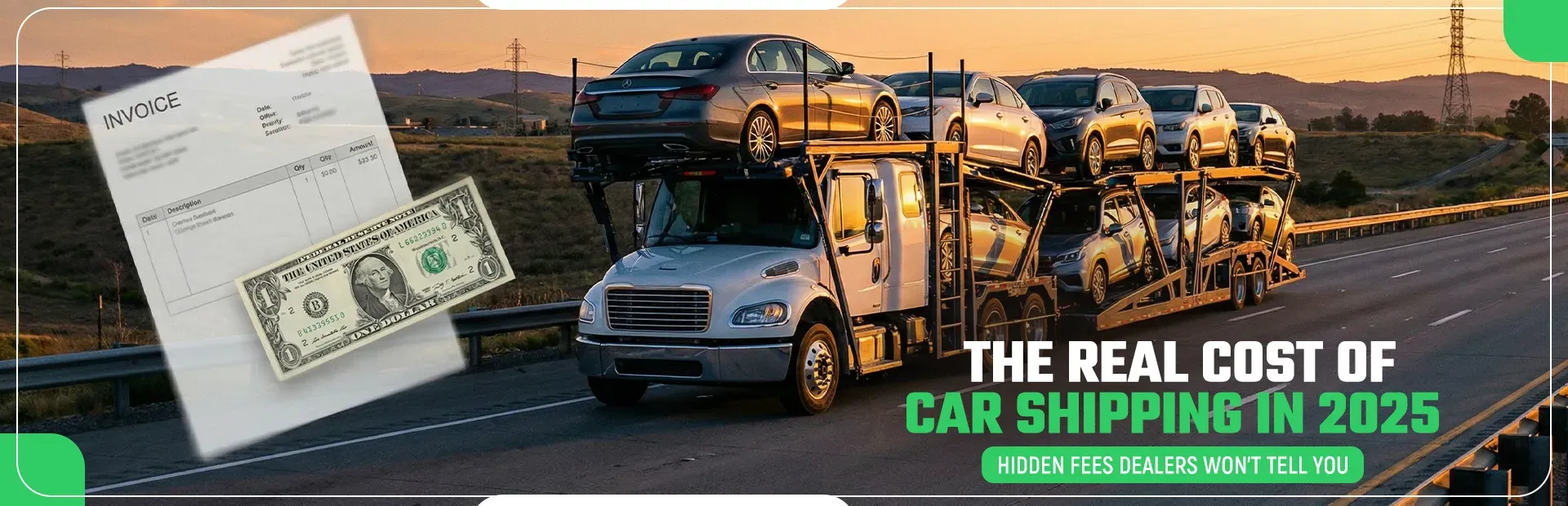
Average car shipping cost in 2026 is $0.60–$2.00 per mile for open transport, $1–$2 per mile for enclosed. A 1,000-mile shipment typically runs $700–$1,400. While most focus on the initial quote, that number is rarely final. Hidden auto transport expenses can add hundreds to your bill if you don't understand the market. Use the calculator below for a route-specific estimate and follow our guide to find the cheapest way to ship a car.
[CALC] — Calculator embed (dev places it here)
The results from our car shipping cost calculator above provide a baseline for your budget. However, auto transport is a dynamic market. To understand why your estimate looks the way it does, you must look at the driver economics and logistics behind the scenes.
What Is the Average Car Shipping Cost in 2025?
When you look for auto transport quotes USA, the distance is the biggest factor determining your final price. The car shipping cost per mile changes dramatically depending on whether you are moving your car across town or across the country.
The typical cost of vehicle shipping in 2025 ranges from about $600 to $2,000. However, to truly understand the car transport service rates, you need to break it down by mileage. This gives you a clear picture of the actual average cost to move a car.
The general rule is simple: the shorter the trip, the higher the shipping cost per mile.
- Short Distance (0–500 miles): For a short-haul trip, like moving your car interstate, expect to pay the highest per-mile rate. This distance has an average price to move car interstate between $1.40 and $2.00 per mile. Your total cost typically falls between $550 and $800.
- Medium Distance (500–1500 miles): As the mileage increases, the carrier can spread their fixed costs over a longer route. The rate drops significantly to between $0.85 and $1.20 per mile. You look at a total cost of roughly $800 to $1,200.
- Cross-Country Car Shipping Prices (1500+ miles): This is where you see the lowest per-mile rate. For long distance car shipping prices, expect to pay between $0.60 and $0.85 per mile. Total car relocation cost usually lands between $1,200 and $1,800.
You can see that a long haul trip, even with a higher total, is much more efficient for the carrier. Use a cross-country car shipping calculator to see this difference clearly. We look at open transport averages here, which are the most common rates.
| Distance | Average Cost Range (Open Carrier) | Price Per Mile |
| Short (0–500 mi) | $550 – $800 | $1.40 – $2.00 |
| Medium (500–1500 mi) | $800 – $1,200 | $0.85 – $1.20 |
| Long (1500+ mi) | $1,200 – $1,800 | $0.60 – $0.85 |
These numbers provide a solid estimate of your car shipping cost. But remember, these are just starting points. The type of carrier you choose completely changes the final quote. For instance, enclosed vs open car shipping cost is a major decision point.
We encourage you to read more about maximizing your value, especially by understanding the quotes you receive.
Learn the 5 essential questions to ask before hiring a car transport company. Knowing the factors that drive these vehicle delivery rates helps you secure a better deal.
Ready to find a top-rated, reliable service for your move? Discover trusted companies and read honest, verified customer reviews to make a confident decision about your next vehicle shipment. Find Your Transport Company Now!
What Affects Car Shipping Cost In 2026
You now know the car shipping cost per distance—but why do auto transport expenses still vary so wildly between companies? The quick answer is that pricing depends on four core logistical elements. These elements determine the carrier's effort and cost, which they pass to you. Understanding them helps you find the most affordable auto transport quotes.
Route, Location, and Demand
The route dictates your overall car relocation cost. Shipping between major US cities, like New York to Miami, is often cheaper per mile because these are high-demand, high-volume lanes.
- Urban vs Rural: Moving a car to or from a rural area increases the rate. Carriers charge more because the driver must detour from major highways, consuming extra time and fuel for a single vehicle delivery.
- Distance: This is the primary driver of cost. Shorter trips (under 500 miles) have higher per-mile rates ($1.40–$2.00) because fixed costs like loading and labor are spread over fewer miles.
- Seasonality: Car transport service rates fluctuate dramatically throughout the year based on "snowbird" migration and moving seasons.
| Season | Typical Price Trend | Demand Driver |
| Summer (May–Sept) | Highest (+15% to 25%) | Peak family relocation and student moves. |
| Winter (Dec–Feb) | Moderate (Excluding Snowbird routes) | Bad weather delays and low general demand. |
| Spring/Fall | Moderate/Lowest | Optimal booking windows with balanced demand. |
Vehicle Type and Size
The size and weight of your vehicle directly impact your car shipping cost. Simply put, bigger cars mean higher fuel consumption and take up more valuable space on the trailer.
- Cost of Shipping SUV vs Sedan: Shipping a standard sedan is the most economical choice. Larger vehicles, like SUVs, trucks, or vans, often cost $100 to $300 more than a sedan for the same route.
- Condition: Inoperable or non-running vehicles require specialized equipment like a winch, adding a $150 to $300 surcharge to the final price.
- Fuel Surcharge: Carriers adjust rates based on current diesel prices. In 2026, many companies include this in an all-inclusive quote to avoid bait-and-switch tactics.
Carrier Type and Protection
Your choice of carrier determines the level of protection and is a major auto transport expense.
- Enclosed vs Open Car Shipping Cost: Open auto transport is the industry standard and the cheapest way to ship a car long distance. Enclosed shipping protects your vehicle from road debris and weather. It adds 40% to 60% to the cost but is necessary for luxury, classic, or customized cars. Find out if enclosed vs open car shipping is worth the extra price for your vehicle.
Pickup and Delivery Flexibility
Your personal convenience has a price tag. Carriers prefer flexibility to optimize their route planning and fuel consumption.
- Door-to-Door: This premium service means the carrier attempts to get as close to your exact address as legally and safely possible. It is the most convenient option but costs more.
- Terminal-to-Terminal: This is usually cheaper, but you deliver and pick up your car from a central hub. This option works best if you need flexible dates and are comfortable driving to and from the terminal.
When you use a car shipping cost estimator, you must consider these four factors. They are the keys to understanding the true nationwide auto transport pricing.
How Much Does Car Shipping Cost Per Mile?
Understanding your car shipping cost per mile is the key to mastering nationwide auto transport pricing. While the total price is higher for longer journeys, the core principle of affordable auto transport is the economy of scale.
The Economy of Scale: Long Routes are Cheaper Per Mile
Is cost per mile cheaper on long routes? Yes. This is a crucial concept to grasp. A long-haul carrier has fixed operational expenses—labor, administration, and initial loading—regardless of whether they drive 300 miles or 3,000 miles.
- Shorter Routes: The fixed costs are spread over fewer miles, resulting in a higher per-mile rate (e.g., $1.50 to $2.00/mile for 500 miles).
- Longer Routes: The fixed costs are absorbed over thousands of miles, dramatically reducing the per-mile rate (e.g., $0.50 to $0.75/mile for 2,500 miles). This is why cross-country car shipping offers a lower rate per mile than shipping within state lines.
To illustrate this, here is an average breakdown of car transport service rates per mile for standard open carrier service:
| Distance Range (Miles) | Cost Per Mile (Approx.) | Total Cost Example |
| 0 - 500 | $1.40 - $1.95 | $560 - $975 |
| 501 - 1,500 | $0.90 - $1.35 | $900 - $2,025 |
| 1,500+ | $0.50 - $0.75 | $1,200+ |
The Impact of Pickup/Delivery Flexibility
Beyond the mileage, your choice of delivery service significantly alters the price. This brings us back to the level of convenience you are willing to pay for.
- Door-to-Door: This is the most popular method for vehicle delivery. It is convenient but can be slightly more expensive. The carrier gets your car as close as legally possible to your specified addresses.
- Terminal-to-Terminal: This service is generally $100 to $200 cheaper as the carrier delivers to a central hub, avoiding the extra time and fuel required for residential routes. This is one of the cheapest ways to ship a car long distance.
Car Shipping Cost Estimator Accuracy
To get an initial baseline for your car relocation cost, you can use one of the many car shipping cost estimator tools available online. But how accurate are they?
- Accuracy is High for Estimates: These tools are typically accurate for providing a reliable range based on distance, vehicle type, and the current fuel market.
- Final Quotes Differ: They cannot factor in carrier availability on your specific dates, unique routing challenges, or last-minute demand spikes. Always compare at least three car shipping quotes before booking to secure the best rate.
Door-To-Door Vs Terminal-To-Terminal Cost Difference
The cost difference between door-to-door and terminal shipping is a significant factor for budget-conscious movers. Door-to-door car shipping is the industry standard for convenience, where the carrier picks up and delivers as close to your specific address as safely possible.
Terminal-to-terminal service is generally $100–$200 cheaper. By dropping your vehicle at a central metro hub, you eliminate the driver’s need to navigate narrow residential streets, saving them time and fuel. For example, a 1,500-mile move might cost $1,200 door-to-door but only $1,000 if you use terminals. However, you must factor in potential storage fees at the terminal, which can kick in after 24–48 hours and erase your savings.
How Accurate Are Instant Car Shipping Estimates?
If you are wondering how accurate are instant vehicle shipping estimates, the answer is they are excellent for establishing a baseline but rarely represent a final contract. Most car shipping calculator usa tools use historical data and current fuel averages to give you a range.
The accuracy is high for the "estimate," but the final quote from a broker may differ because an automated tool cannot see real-time carrier availability or sudden weather disruptions on your specific route. To get a locked-in price, a human broker often needs to verify the details with an actual driver. Use the instant estimate to see if you're in the right ballpark, then get at least three personalized quotes for a firm number.
How Much Does It Cost to Ship SUVs vs. Sedans?
The answer to “Does vehicle size affect auto transport expenses?” is a resounding yes. The physical dimensions and weight of your vehicle are among the most significant factors influencing your final car shipping quote.
The Premium for Larger Vehicles
Transport carriers operate under strict weight and space limits. A smaller vehicle, like a standard compact car (sedan or hatchback), is the industry’s base rate.
- Compact Cars (Sedans/Hatchbacks): These vehicles are the cheapest way to ship a car because their size allows the carrier to maximize the number of vehicles per load, leading to lower costs for everyone.
- SUVs and Trucks: Larger and heavier vehicles, such as an SUV, trucks, and oversized vehicles (e.g., dually trucks or large vans), occupy more surface area and add more weight to the load.
This reduced efficiency—fewer cars per truck and higher fuel consumption—translates directly into a higher price for the customer. Expect to pay an additional $100 to $300 over the price of a standard sedan for auto transport services.
Vehicle Delivery Rates by Size (2025)
The size differential remains consistent whether you are arranging shipping within state lines or planning an expensive cross-country car shipping journey. The percentage increase for a larger vehicle applies across all distances.
| Vehicle Type | Size Differential (Approx.) | Open Transport Average |
| Sedan/Coupe | Standard Base Rate | $0.60–$1.50 per mile |
| Mid-Size SUV/Small Truck | 15%–25% Increase | $0.70–$1.80 per mile |
| Full-Size SUV/Large Truck | 25%–40% Increase | $0.80–$2.00 per mile |
Cost of Shipping Oversized Vehicles
For vehicles like lifted trucks, customized vans, or those with significant modifications, the vehicle delivery rates can rise further. These oversized vehicles might require special placement on the trailer and may limit the carrier’s route options due to bridge and tunnel restrictions.
Always be upfront about your vehicle’s exact dimensions when requesting your car relocation cost to avoid unexpected fees. For those shipping valuable or modified vehicles, consider the enhanced protection of enclosed auto transport.
How Much Do Car Haulers Make Per Shipment?
Understanding how much do car haulers make helps clarify why shipping costs are what they are. On a typical multi-car trailer, the total "gross" pay for a driver on a cross-country route might be $7,000 to $10,000. However, the driver's profit is much lower after expenses.
-
Fuel: Diesel is the largest expense, often consuming 30%–40% of the gross pay.
-
Broker Margin: Brokers typically take 10%–20% of the total price to handle sales, insurance vetting, and customer service.
-
Driver Pay: After fuel, insurance, maintenance, and terminal fees, a car hauler might net $1,500 to $3,000 per week.
-
Maintenance: The wear and tear on specialized trailers is extreme, requiring high reserves for repairs.
When your car shipping cost calculator shows a price that feels high, remember it is funding a complex operation involving high-risk labor and expensive machinery.
Why Does Shipping A Car Cost More In Winter?
Seasonal pricing patterns are distinct in auto transport. While summer is busy, winter presents unique logistical hurdles that drive up costs.
-
Weather Delays: Snow and ice slow down transit times, meaning carriers can complete fewer trips per month.
-
Snowbird Demand: In early winter, routes from the North to the South (like New York to Florida) see massive demand spikes, often increasing prices by 20% or more.
-
Hazardous Conditions: Drivers may charge a premium for the added risk and difficulty of loading vehicles in freezing or snowy conditions.
How To Lock In A Car Shipping Price (And Avoid Bait-And-Switch)
To ensure your car shipping calculator usa estimate doesn't balloon at the last minute, you must follow these actionable steps:
-
Insist on an All-Inclusive Quote: Do not accept quotes that mention "potential fuel surcharges" or "additional fees" later.
-
Read the Cancellation Policy: Reputable brokers usually offer a full refund if they haven't assigned a carrier yet.
-
Check the MC/DOT Numbers: Verify the company’s legal authority before paying a deposit.
-
Get it in Writing: Ensure the "locked price" guarantee is explicitly stated in your contract.
What’s the Cheapest Way to Ship a Car Long Distance?
The cost of long-distance car shipping is a primary concern for anyone relocating across state lines. Fortunately, a few strategic decisions can significantly lower your overall car relocation cost. It boils down to maximizing efficiency for the auto transport company, which in turn offers you better rates.
The Foundation of Savings
The most impactful choices relate to timing and location. By optimizing these factors, you can tap into the most budget-friendly options available in the auto transport market.
| Savings Strategy | Description | Typical Impact |
| Book in Advance | Avoid last-minute, expedited service fees by scheduling your shipment 2-4 weeks ahead of your first available ship date. This gives brokers ample time to secure a carrier on their regular route. | Avoids $100–$300+ in premium fees. |
| Flexible Pickup Dates | Carriers prioritize filling their trailers efficiently. Offering a flexible date range (e.g., 3-5 business days) allows them to slot your vehicle into the most cost-effective route, lowering your vehicle shipping price. | Can save 10–20% on the total quote. |
Optimize Your Service Type
The next major area for savings is how and where your vehicle is picked up and delivered. Convenience comes at a price, so a small sacrifice in time can translate into tangible savings on your car shipping quote.
To reduce the carrier's logistical overhead, consider this key alternative:
- Choose Terminal-to-Terminal over Door-to-Door: While door-to-door car shipping offers maximum convenience, carriers prefer terminal-to-terminal service. By dropping off and picking up your vehicle at a major metro terminal, you eliminate the need for the driver to navigate residential streets, saving fuel and time. This efficiency is passed on to you.
To learn more about the pros and cons, see our guide on Door-to-Door vs. Terminal-to-Terminal Auto Shipping.
The Non-Negotiable Step: Compare Quotes
No single car transport company has the lowest rate for every single route. To secure the most affordable car shipping rate, you must embrace comparison shopping.
- Compare Multiple Car Shipping Cost Estimators: Utilize free online car shipping quote calculators from at least three different, reputable auto transport providers. This helps you establish a realistic market price for your specific route and avoids falling for quotes that are suspiciously low (a common sign of hidden fees). Comparing rates from multiple sources is the definitive way to ensure you are getting the best deal on your cross-country shipment.
These combined strategies—from smart timing to choosing an efficient service method—are the best practices for minimizing your car transport service expenditure.
What Hidden Auto Transport Expenses Should You Know About?
A common question for customers seeking long distance car shipping is: Are there costs not included in quotes?
The unfortunate truth is that some less transparent companies use low initial car shipping quotes to lure you in, only to apply unexpected surcharges later. Being aware of these potential hidden fees is crucial to getting an accurate and final vehicle shipping price.
Surprising Charges Based on Your Vehicle and Location
Certain characteristics of your vehicle or the pickup/delivery location can trigger legitimate, yet often undisclosed, fees. Reputable auto transport brokers will always confirm these details upfront to prevent unexpected bills.
- Non-Operable Vehicle Fee: If your car is inoperable, meaning it cannot be driven, it requires special equipment—a winch—for safe loading. This extra labor and equipment typically incurs an additional charge of $150–$300.
- Oversized Vehicle Surcharge: Quotes are generally based on standard sedans. If you are shipping a large truck, full-size SUV, or a vehicle with non-standard modifications (like a lift kit), it occupies more space on the carrier, resulting in a higher auto transport fee.
- Rural Location/Inaccessibility Fee: Carriers operate most efficiently on major highways and in metropolitan hubs. If your chosen address for door-to-door car shipping is in a remote, rural area or on a street inaccessible to a large carrier truck, the driver may charge an accessibility fee.
Fees Related to Time, Policy, and Payment
Beyond the physical logistics, other charges can arise from scheduling decisions or company policies, directly affecting your total car transport service expense.
| Hidden Charge | What It Is | How to Avoid It |
| Expedited Service Fee | A premium charge for rush-shipping your vehicle or guaranteeing an exact pick-up/delivery date. | Book your shipment at least two weeks in advance. |
| Fuel Surcharge | An added charge intended to offset volatile diesel prices, often applied after the booking. | Only work with companies that guarantee all-inclusive pricing. |
| Storage Fees | Charged in terminal-to-terminal transport if you fail to pick up your vehicle from the terminal within the allowed grace period (usually 24–48 hours). | Communicate closely with the terminal and your driver. (For guidance on this, check out our piece on Choosing a Car Shipper.) |
| Cancellation Fee | A penalty if you cancel your shipment after a carrier has been assigned or dispatched. | Carefully review the company's cancellation policy before booking. |
To avoid these pitfalls, always insist on an all-inclusive car shipping quote that details every potential charge, ensuring complete transparency for your cross-country car shipping needs.
Top Considerations When Booking Auto Transport
Here are some of the most common queries and essential details to ensure a smooth vehicle shipping experience, so you have all the necessary information before booking.
How much does it cost to ship a car in 2026?
The average cost ranges from $600 to $2,000, with per-mile rates between $0.50 and $2.00 depending on distance. Short trips are more expensive per mile ($1.40–$2.00), while cross-country moves offer better efficiency at $0.50–$0.85 per mile.
What's the cheapest way to ship a car?
The cheapest method is using an open carrier with terminal-to-terminal delivery. Booking 2–4 weeks in advance and being flexible with your pickup and delivery dates can also save you 10%–20% on the total quote.
Why does shipping a car cost more in winter?
Winter shipping is affected by hazardous weather and the "snowbird" migration, which causes demand to skyrocket on South-bound routes. Drivers face slower transit times and higher risks, leading to seasonal price increases.
How do I lock in a car shipping price?
Request an all-inclusive, written quote from a reputable broker and avoid "bait-and-switch" low-ball offers. Ensure the contract covers fuel and insurance without hidden surcharges, and check the company's cancellation policy before paying a deposit.
How accurate are instant car shipping estimates?
These tools are highly accurate for providing a reliable price range based on mileage and vehicle type. However, they cannot account for real-time carrier availability or specific route demand on your exact travel dates, which may lead to slight adjustments in the final quote.
Making the Right Call on Your Auto Transport Service
Choosing the right auto transport service boils down to a clear understanding of your vehicle's needs and the logistics of your move. Whether you opt for cost-effective open carrier transport or the premium protection of enclosed shipping, knowing the difference between a broker and a carrier ensures a transparent process.
For a stress-free experience, always confirm details like insurance coverage, personal item restrictions, and the estimated time frame for your long distance car shipping. We are committed to providing you with reliable service and transparent pricing for your upcoming relocation. Get a quote today!