
The quote came in $400 under everyone else's. The rep was friendly, the website looked real, and the deposit was only $250.
Three weeks later, no truck has shown up. The phone number rings out. The website is gone.
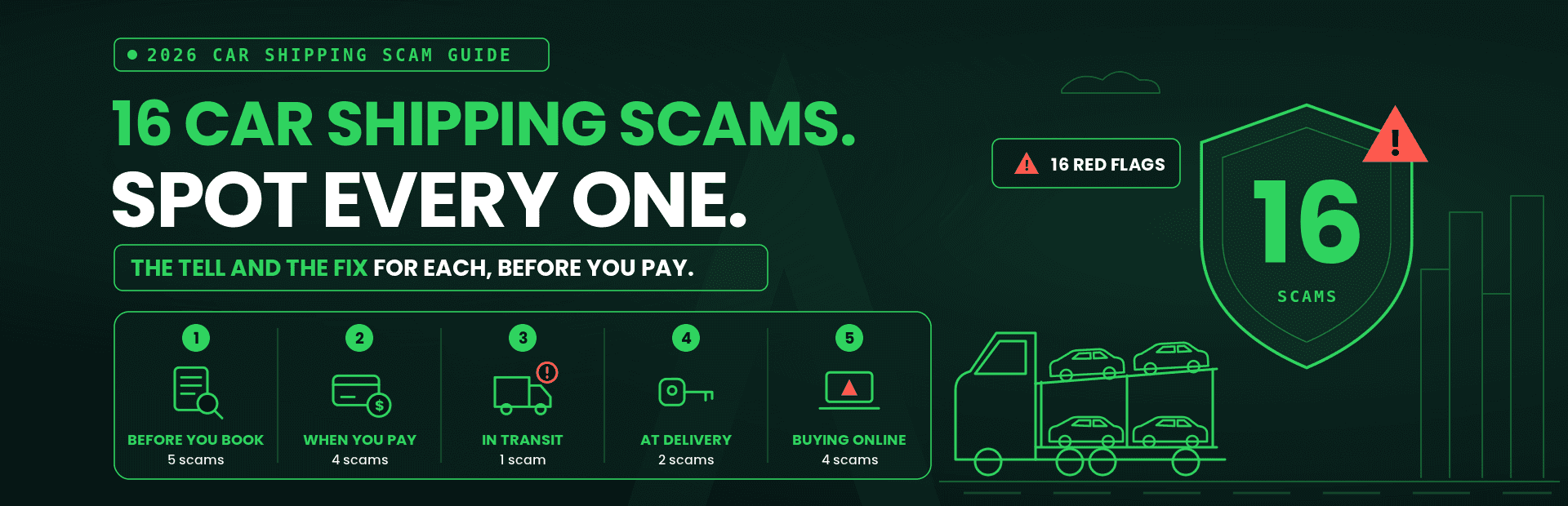
That's one of the most common car shipping scams, and it's only one of 16. Some start with a cheap quote. Some start with a phishing text. Some start with a car listing that was never real. This page lists every pattern we track, grouped by when it hits you: before you book, when you pay, during transit, at delivery, and when you buy a car online.
Each scam gets the same three things. How it works, the tell, and your move.
Not sure about a company you're already talking to? Get quotes from verified companies on your route and compare them against the number you were given before you pay a deposit.
All 16 car shipping scams at a glance
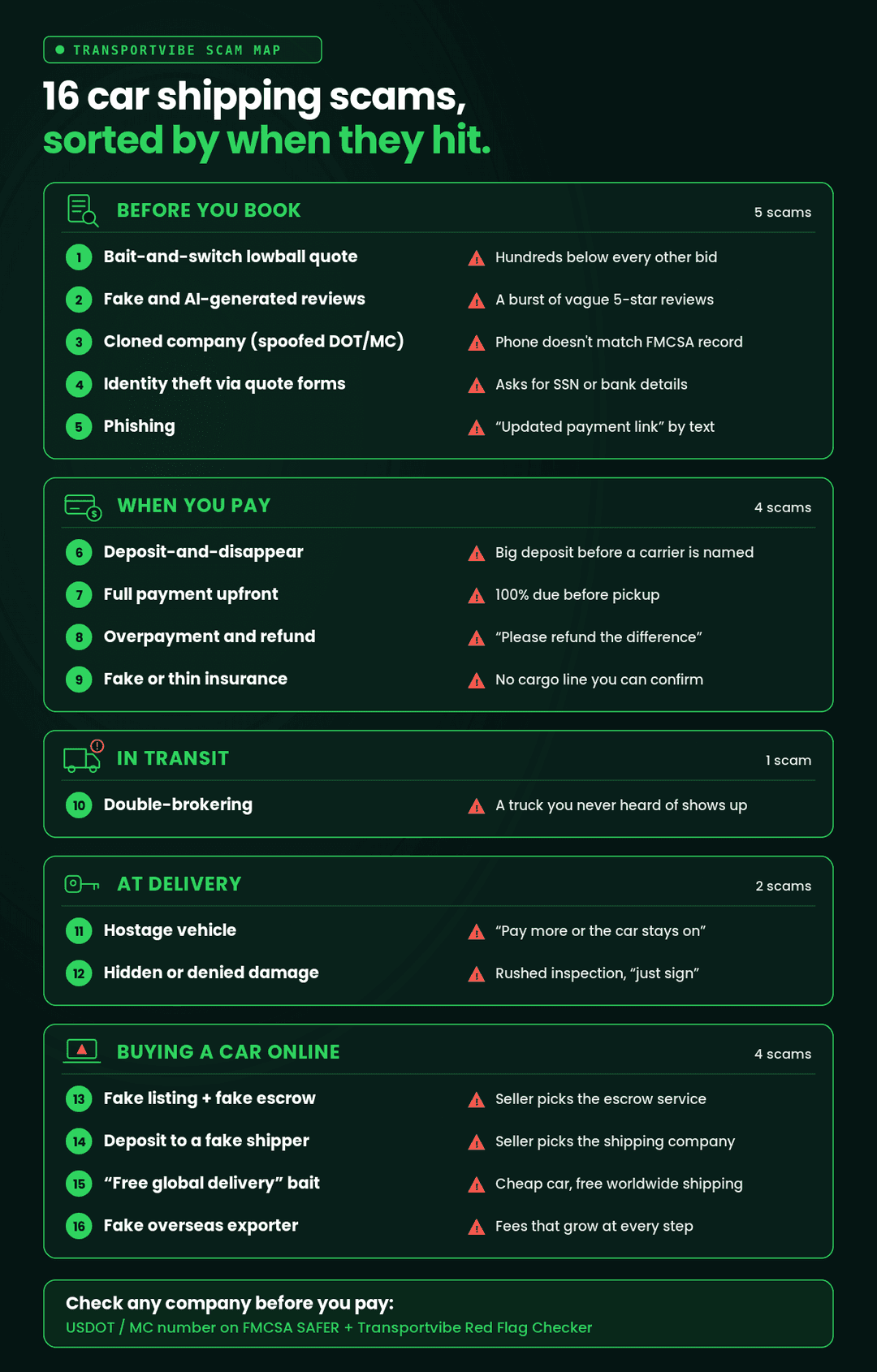
Every scam below follows the same rule: get money or personal data from you before you've had a chance to check. What changes is the timing. Some hit at the quote, some at payment, some on delivery day, and some before you've even bought the car. Find the row that matches where you are now, then jump to that scam for the fix.
|
# |
Scam |
When it hits |
The tell |
|---|---|---|---|
|
1 |
Bait-and-switch (lowball quote) |
Before you book |
Quote far below every other bid |
|
2 |
Fake and AI-generated reviews |
Before you book |
Dozens of 5-star reviews in the same week |
|
3 |
Cloned company (spoofed DOT and MC) |
Before you book |
Phone or email doesn't match the FMCSA record |
|
4 |
Identity theft through quote forms |
Before you book |
Quote form asks for SSN or bank details |
|
5 |
Phishing |
Before you book or pay |
"Updated payment link" from an unknown sender |
|
6 |
Deposit-and-disappear (phantom broker) |
When you pay |
Big deposit before a carrier is assigned |
|
7 |
Full payment upfront |
When you pay |
100% due before pickup |
|
8 |
Overpayment and refund schemes |
When you pay |
"Accidental" overpayment, "please refund the difference" |
|
9 |
Fake or thin insurance |
When you pay |
Certificate you can't confirm with the insurer |
|
10 |
Double-brokering |
During transit |
A truck or driver you never heard of shows up |
|
11 |
Hostage vehicle at delivery |
At delivery |
"Pay more or the car stays on the truck" |
|
12 |
Hidden or denied damage |
At delivery |
Driver rushes the inspection or refuses to note damage |
|
13 |
Fake listing plus fake escrow |
Buying a car online |
Seller insists on an escrow service you've never heard of |
|
14 |
Deposit to a fake shipping company |
Buying a car online |
Seller picks the shipper for you |
|
15 |
"Free global delivery" bait |
Buying a car online |
Luxury car, low price, free international shipping |
|
16 |
Fake overseas exporter |
Buying a car online |
"Customs" and "clearance" fees that keep coming |
Before you book: scams that start with a quote
1. Bait-and-switch (the lowball quote)
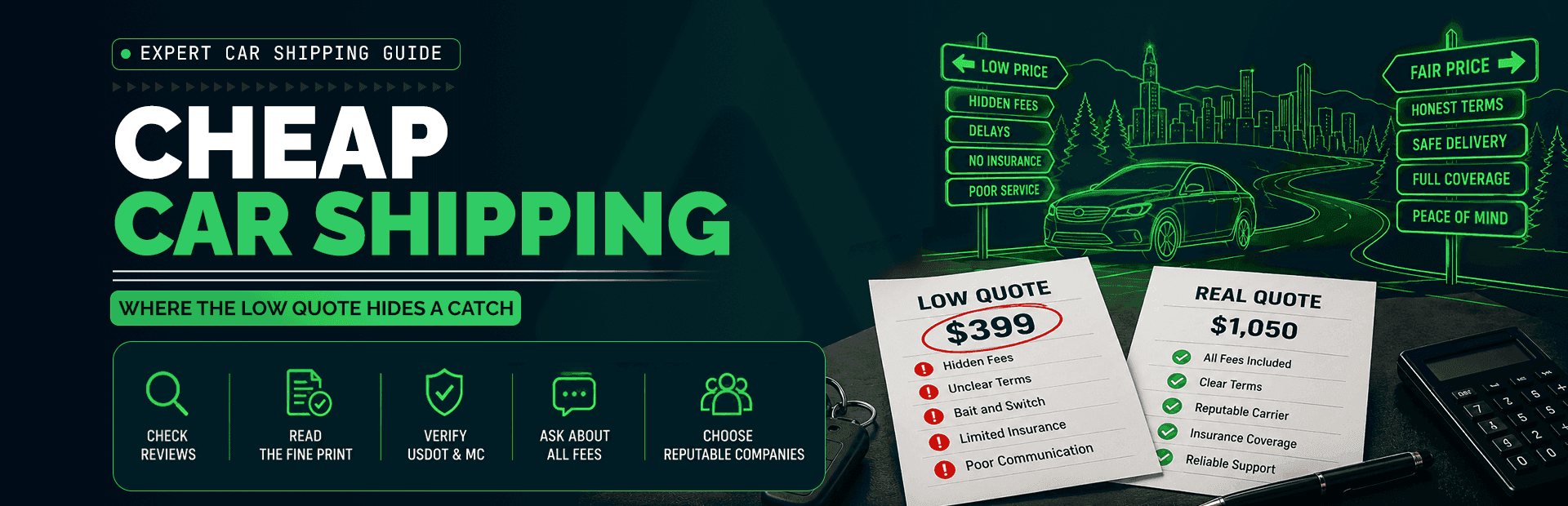
A broker quotes far under the market to win your booking. Then no carrier accepts the job at that price. Days later the call comes. "The market moved." "Your car is bigger than listed." The new price is hundreds higher, and your move date is close.
The tell: one quote sits hundreds below every other bid, and the contract calls the price an "estimate" or "subject to carrier acceptance." A quieter version stacks fees instead. "Processing," "listing" and "special handling" charges show up after you sign. A fair quote bundles the standard costs and lists any extras up front.
Your move: compare 3 to 5 quotes for the same dates and toss the outlier. Ask in writing whether the price can change before pickup. Our full breakdown of the lowball quote bait-and-switch walks through the script word by word.
2. Fake and AI-generated reviews
A brand-new company buys or generates dozens of glowing reviews to look established. AI makes them cheap and fluent. The Federal Trade Commission's rule banning fake reviews, finalized in August 2024, covers AI-generated reviews too, but enforcement is slow, and fake reviews still go up.
The tell: a burst of 5-star reviews in the same week, all vague, all praising the same thing. Real reviews name routes, drivers and problems.
Your move: sort reviews by "newest" and "lowest." Read the 1-star and 2-star ones. Check that review dates line up with how long the company has held its operating authority.
3. Cloned company (spoofed DOT and MC)
Scammers copy a real, licensed company: the name, the logo, and the USDOT and MC numbers. The record checks out on the federal database, because it belongs to someone else. Only the phone number and email are theirs.
The tell: the phone, email or address you were given doesn't match the contact details on the company's federal record.
Your move: look up the USDOT or MC number on the FMCSA SAFER Company Snapshot. Call the phone number listed there, not the one in the email, and ask if they're handling your shipment.
4. Identity theft through quote forms
Some "quote" sites exist only to collect personal data. A real car shipping quote needs your route, vehicle, dates and a way to contact you. A fake form also asks for your Social Security number, driver's license, date of birth or bank details.
The tell: a quote form that asks for anything beyond route, vehicle, dates and contact details.
Your move: close the tab. Read the privacy notice before you submit any form. A legit marketplace tells you who receives your details. Transportvibe, for example, shares a quote request with up to 3 companies and lets you opt out.
5. Phishing
A text or email looks like it's from your broker. "Your carrier is assigned. Confirm your booking here." "Payment failed, use this updated link." The link goes to a lookalike site that takes your card number or login.
The tell: an unexpected link, a payment method change, or a sender address that's one letter off from the real company.
Your move: don't click. Call the company on a number you already have, or one from its federal record, and ask if the message is real. A real broker won't change payment details by text.
When you pay: scams that take your money
6. Deposit-and-disappear (the phantom broker)
The company takes a deposit, never assigns a carrier, and goes quiet. Sometimes it resurfaces with a "cancellation fee" that eats the whole deposit. Sometimes the website and phone just die.
The tell: a large deposit due at booking, before any carrier is named, paid by wire, Zelle, Cash App, crypto or gift card.
Your move: pay nothing until a carrier is assigned, and pay by credit card. Our guide to the car shipping deposit scam covers the refund terms to read before you pay.
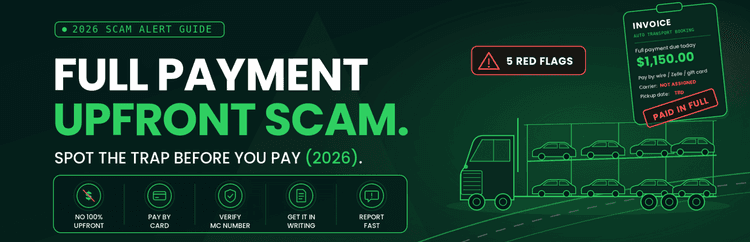
7. Full payment upfront
The company asks for 100% of the price before pickup. Once it has your money, you have no leverage. If no truck comes, you're chasing a refund from a company that may not exist next month.
The tell: "Pay in full today to lock the rate," often with a countdown.
Your move: a fair deal is a small deposit after a carrier is assigned, with the balance at delivery. Our breakdown of the full payment upfront scam shows what a fair payment schedule looks like.
8. Overpayment and refund schemes
This one hits sellers and shippers. A "customer" or "broker" sends a check or payment for more than the agreed amount, then asks you to send back the difference. The original payment bounces days later. You're out the refund you sent, and your bank wants its money back.
The tell: an overpayment you didn't ask for, followed by urgency to refund it fast, often by wire or gift card.
Your move: never refund an overpayment until the original payment has fully cleared. Ask your bank, don't trust "available funds." The FTC calls this a fake check scam, and the bank can reverse a deposit weeks later.
9. Fake or thin insurance
The company sends a Certificate of Insurance that's fake, expired, or covers liability only. Liability pays for damage the truck does to other people. Cargo coverage is what pays for your car. A certificate with no cargo line, or a tiny limit, leaves you uncovered.
The tell: a certificate with no cargo line, policy dates that don't cover your shipment, or an insurer you can't reach.
Your move: call the insurance company listed on the certificate yourself. Confirm the policy is active, the dates cover your trip, and the cargo limit covers your car's value.
At pickup and in transit: scams when the keys change hands
10. Double-brokering
Your broker passes the job to another broker, who may pass it again, often to a carrier using a stolen or borrowed identity. Nobody you hired is responsible, and nobody's sure whose insurance applies if something goes wrong.
The tell: the truck that shows up has a different company name than the one you were told, or the driver has never heard of your broker.
Your move: before pickup, get the assigned carrier's name and USDOT number in writing and check it on SAFER. Match it against the truck's door and the driver's paperwork at pickup. If it doesn't match, don't hand over the keys.
Watch for the worst version, a theft dressed up as a pickup. The truck has no company markings, the driver won't show ID, rushes or skips the inspection, or asks to meet somewhere other than the agreed address. Don't release the car until you've seen ID, proof of insurance and a signed Bill of Lading.
At delivery: scams that wait until the end
11. Hostage vehicle at delivery
The car arrives, and the driver won't unload it unless you pay more than the contract says. Sometimes it's a new "fuel" or "storage" fee. Sometimes it's double the balance in cash.
The tell: a price demand that isn't in your written contract, made only once the car is on your street.
Your move: keep the signed contract on your phone. Call the broker while the driver is there. If the demand doesn't match the contract and nobody fixes it, call local police, then file a complaint with FMCSA. Paying a disputed amount by card leaves a record you can dispute later.
12. Hidden or denied damage
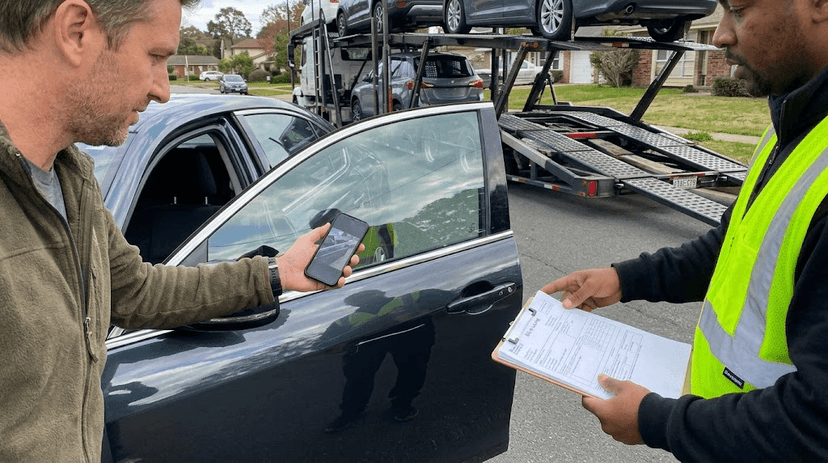
The driver rushes the delivery inspection, does it in the dark or the rain, or refuses to write new damage on the Bill of Lading. Once you sign clean, the damage becomes your problem.
The tell: pressure to sign fast, or "just sign here, we'll sort damage out later."
Your move: inspect in good light, with your pickup photos side by side. Write every new mark on the Bill of Lading in detail and have the driver sign next to it. Don't sign a clean report to make the driver happy.
Buying a car online: scams where the shipping is the bait
These four target people buying a car from a private seller or an online listing. The car shipping part is how the scammer takes the money.
13. Fake listing plus fake escrow
A car is listed below market. The seller can't meet, often citing a deployment, a divorce or a move. They suggest an "escrow service" that will hold your money and ship the car. The escrow website is fake. The car never existed. The FBI has warned about this pattern for years.
The tell: the seller chooses the escrow company, and payment has to go by wire transfer or gift cards.
Your move: don't use an escrow service the seller picks. Find one yourself, check that it's licensed, and inspect the car (or have a mechanic inspect it) before any money moves.
14. Deposit to a fake shipping company
The seller says the car is already with "their shipping company." You pay that company a deposit to release and deliver the car. The shipping company's website is new, its USDOT number belongs to someone else or doesn't exist, and the car never moves.
The tell: the seller insists on a specific shipper and won't let you choose your own.
Your move: choose and pay the shipper yourself, after you've confirmed the car and the seller are real. Run the shipper's numbers on SAFER before you pay anything.
15. "Free global delivery" bait
A luxury or classic car is listed well under market with "free worldwide shipping." The free shipping hooks you. Then come the deposits: a "reservation fee," "export insurance," "port charges." The car isn't real, or isn't for sale.
The tell: a price that looks like a mistake, plus free international delivery on a vehicle that costs thousands to ship.
Your move: treat free international car shipping as a warning sign. Ask for the VIN and run a history report. Then compare the price with similar cars before you pay any fee.
16. Fake overseas exporter
A "trading" or "export" company offers to buy or ship US cars overseas, or to import one for you. Each step brings another fee. Customs clearance, port storage, compliance certificates. The fees keep coming, and the car never arrives.
The tell: fees that grow at every step, paid to personal accounts or by wire, with documents you can't verify.
Your move: check the company's business registration and freight licensing in its own country, and confirm port and customs costs with the port or a licensed customs broker yourself. Never pay a fee because a document "requires" it until you've confirmed that document is real.
The 15-minute check that stops most car shipping scams
Run every company through this before you pay anything:
-
Look up the USDOT and MC number on SAFER. Status should read active and "authorized for hire," not revoked or out of service, and the name should match.
-
Look up the business in its home state's Secretary of State registry, then search the street address on a map. A house or a virtual office is a warning sign.
-
Call the phone number on the federal record, not the one in the email.
-
Get 3 to 5 quotes for the same dates. Toss any that sit hundreds below the rest.
-
Read the payment terms. No deposit before a carrier is assigned, and never 100% upfront.
-
Pay by credit card, never wire, Zelle, Cash App, crypto or gift cards.
-
Confirm insurance with the insurer itself, including the cargo limit.
-
Get the assigned carrier's name in writing before pickup, and match it at the truck.
-
Inspect at pickup and delivery and write everything on the Bill of Lading.
Licensed brokers also have to keep $75,000 in financial security with FMCSA. That's a floor, not a refund guarantee, because every claim against the broker shares it.
Already got scammed? Do this first
Move fast. Most recovery options have deadlines.
-
Call your bank or card issuer today. Ask them to stop pending payments and flag the account.
-
Paid by credit card? The Fair Credit Billing Act gives you 60 days from the statement date to dispute the charge in writing.
-
Card or account used without your permission? The Electronic Fund Transfer Act caps your loss at $50 if you report it within 2 business days. A payment you approved yourself usually isn't covered.
-
Sent a wire? Call both the sending and receiving banks right away. Once the scammer withdraws it, it's usually gone.
-
Save everything: quotes, contracts, texts, emails and receipts. Screenshot the website before it disappears.
-
Report it to FMCSA's National Consumer Complaint Database, the FTC, your state attorney general, and the FBI's Internet Crime Complaint Center (IC3). If your car was taken, file a police report too.
One last trap. "Recovery" services that promise to get your money back for a fee are often run by scammers working the victim list. Skip them.
Ship your car without the guesswork
Every scam on this page needs one thing from you: money sent before you've checked. Run the SAFER lookup, call the number on the federal record, and keep your payment on a credit card until a real carrier is assigned. Do those three, and most car shipping scams fail before they start.
Want quotes you don't have to second-guess? Compare quotes from verified companies on your route. Only TrustScore 70+ companies with active FMCSA records receive your request.