



A record 11.2 million American households now own an RV, a number that has climbed about 26% over the past decade. That is a lot of motorhomes and trailers parked in driveways. And sooner or later, plenty of those owners hit the same wall. The rig needs to be somewhere else, and driving a 40-foot coach across three states is not the plan.
That is the whole job of rv transport companies. They pick up your motorhome, travel trailer, or 5th wheel and deliver it, so you never touch the wheel. This guide covers what shipping actually costs, the ways to move a rig without driving it, how permits and insurance work, and four companies worth a real look.
Want a real number for your rig? Get a free RV shipping quote and see honest pricing for your exact motorhome or trailer in minutes.
What RV Transport Companies Actually Do (And When You Need One)
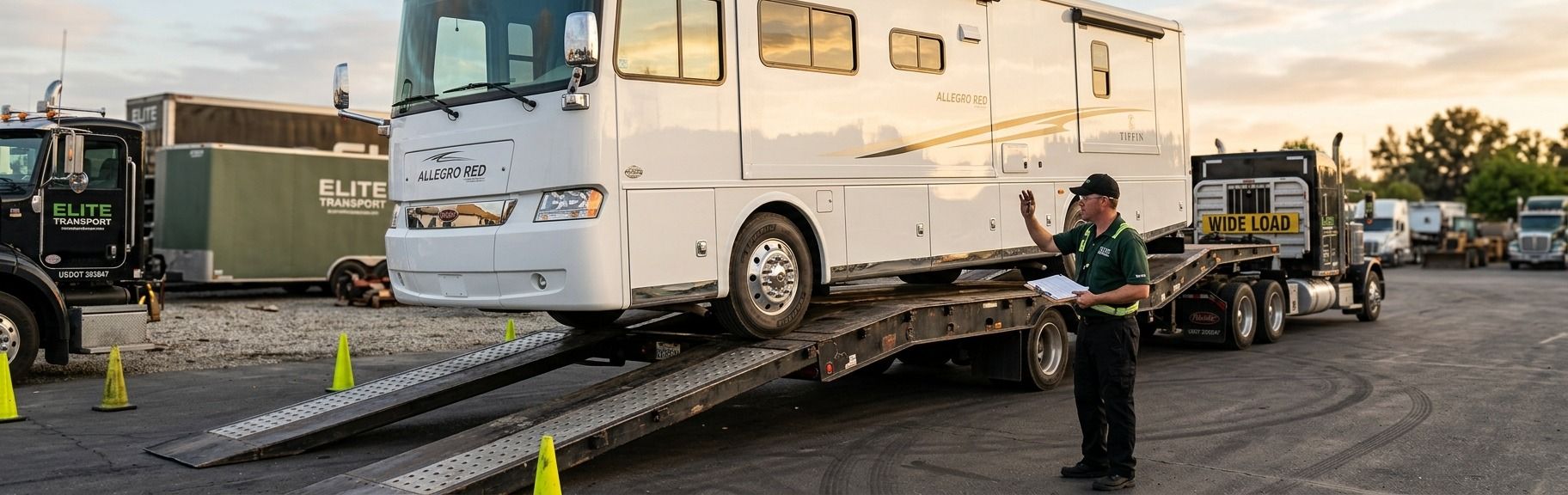
Strip away the jargon and the service is simple. A transport company shows up, secures your RV, hauls or drives it to the destination, and hands you the keys. Some own the trucks. Some arrange a truck for you. More on that split later.
The umbrella term you will see is rv relocation services, and it covers everything from a cross-town move to a coast-to-coast haul.
Here is who actually books this:
-
People relocating for a job or school who cannot caravan two vehicles at once
-
Snowbirds shuttling a rig between summer and winter bases
-
Buyers picking up an RV from an out-of-state dealer, auction, or private seller
-
Seniors and first-timers who are not comfortable piloting an oversize vehicle
-
Owners of a non-running or half-finished project RV that cannot move on its own
The size reality is the reason all of this exists. Many Class A motorhomes run 30 to 45 feet and weigh 15,000 to 30,000 pounds. That pushes them straight into oversize-load territory in most states. Snowbirds running a rig from Florida up north, or the reverse, deal with this every season, which is why seasonal car relocation exists as its own service.
How Much RV Transport Costs (Per Mile And By Rig Type)
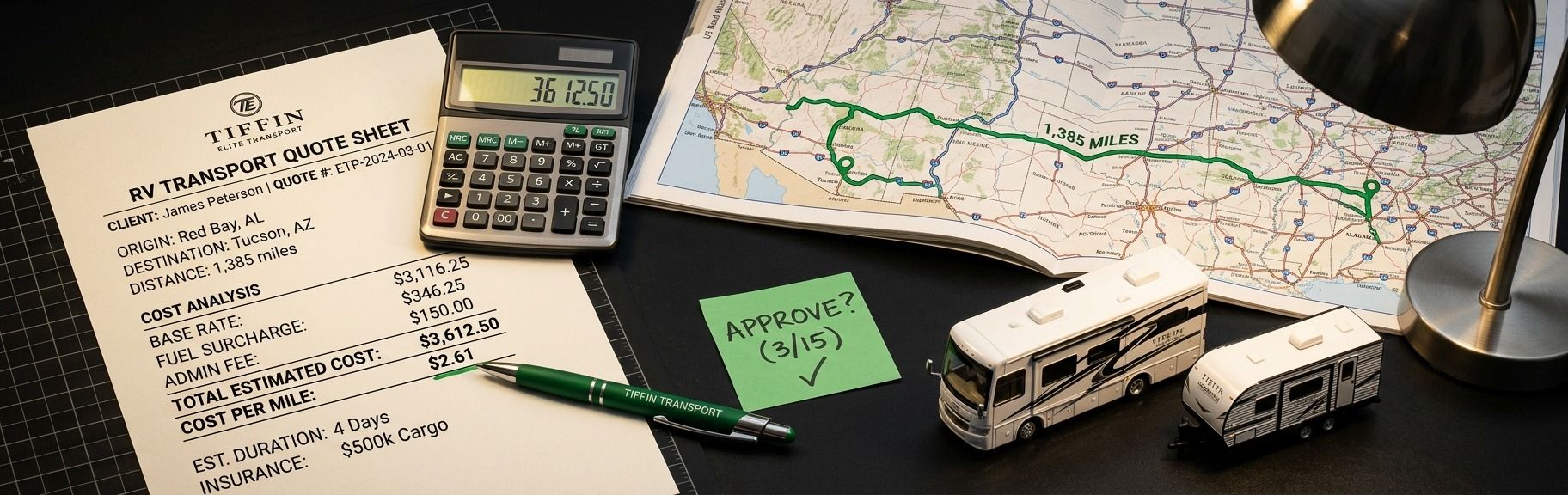
This is the question everyone opens the tab for. So let us give you real ranges, with sources, not a shrug.
RV Transport Cost Per Mile Explained
The rv transport cost per mile moves with distance, size, weight, height, method, and season. The rule of thumb is boring but true. Short moves cost more per mile. Long moves cost less per mile.
Industry pricing for 2026 puts the average around $3 per mile, ranging from roughly $1.50 to $6 depending on the rig. Method matters just as much. A drive-away with a professional driver tends to run $1 to $2 per mile. Flatbed or tow hauling, where the RV rides on a carrier and adds zero miles to the odometer, runs closer to $2 to $4 per mile.
Quick answer: Shipping an RV in 2026 averages about $3 per mile. A 1,500-mile move commonly lands between $2,500 and $4,000, while a Class A on the same route can reach $8,000.
For cross country rv shipping cost, the spread is wide because rig type drives it. That is the next piece.
Cost By RV Class And Trailer Type
A pop-up camper and a diesel pusher are not the same job, and the price says so. The class a motorhome transport cost sits at the top. The travel trailer shipping cost sits near the bottom. Enclosed rv transport cost runs higher still, and most people only pay for it on high-value or vintage rigs.
|
RV Type |
Typical Length / Weight |
Est. Cost Per Mile |
Notes On Method |
|
Pop-Up / Small Camper |
Under 20 ft / 1,500–4,000 lbs |
$1.00–$2.00 |
Usually towed |
|
Travel Trailer |
20–35 ft / 5,000–11,000 lbs |
$1.50–$3.50 |
Tow-away is standard |
|
5th Wheel |
25–40 ft / 7,000–20,000 lbs |
$2.00–$3.00 |
Needs gooseneck hitch |
|
Class C Motorhome |
20–33 ft / 10,000–13,000 lbs |
$2.00–$4.00 |
Drive-away or haul |
|
Class A Motorhome |
30–45 ft / 15,000–30,000 lbs |
$4.00–$6.00 |
Drive-away common |
These are 2026 ballpark figures pulled from current RV transport rate guides. Your quote will shift with route and season.
Weight and dimensions drive the bill more than most owners expect. If you want the mechanics behind that, this breakdown of how vehicle size and weight impact shipping cost is worth the read. And if you are torn on protection level, the open versus enclosed cost comparison lays out when the upgrade is worth it.
Most rigs ship on standard open car shipping style carriers or open flatbeds, which keeps the price sane.
Ways To Move An RV Without Driving It Yourself
If you searched how to transport an RV without driving it, this is your section. There are three real ways to do it, and picking the right one is mostly about your rig.
Drive-Away Service
An RV drive-away service sends a licensed, insured driver to your door. They climb into your motorhome and drive it to the destination under its own power. This is the go-to for running Class A and Class C coaches.
The upside is cost. Drive-away is often the cheapest route for a drivable rig, since nobody needs a giant trailer. The honest trade-off is simple. Those miles and that engine wear land on your RV, not a carrier's deck. For an owner who cannot or would rather not drive, an RV driveaway service turns a dreaded three-day trip into a phone call. That is a real relief for seniors or first-time owners, which is exactly what senior-friendly auto shipping is built around.
Tow-Away And Flatbed Hauling
Tow-away hitches the RV behind a truck and pulls it. This is the standard play for a travel trailer or a 5th wheel, and it keeps the travel trailer shipping cost reasonable.
Flatbed and step-deck hauling loads the RV onto a carrier so it never rolls on its own tires. This is the route for anything non-running, low-clearance, vintage, or fragile.
Quick decision guide:
-
Drivable motorhome on a tight budget, go drive-away
-
Travel trailer or 5th wheel, go tow-away
-
Non-running, vintage, or low-clearance, go flatbed
Broker Vs Carrier: Who You Are Actually Hiring
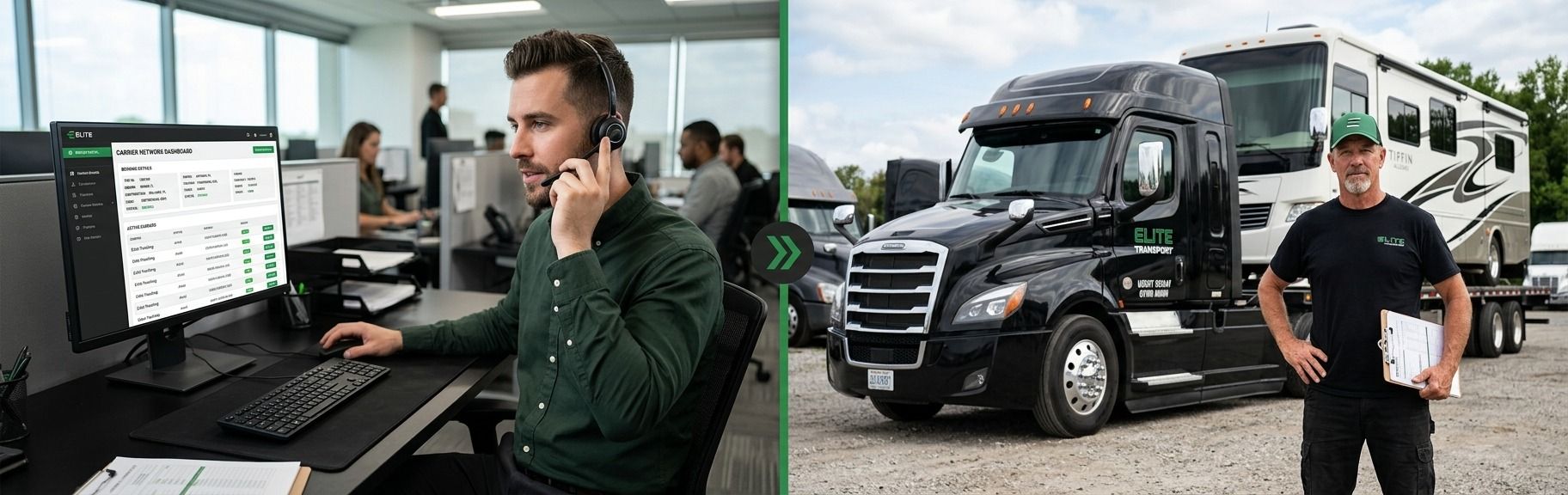
This one trips people up, and it costs them money. The RV transport broker vs carrier question comes down to who owns the truck.
A carrier owns the equipment and employs the driver. You hire them, they haul it. A broker does not own trucks. They tap a network of carriers and match one to your rig and route. Neither is a scam. But you should know which one you are paying and why two quotes look different.
Here is the honest split on the rv transport broker vs carrier trade-off:
-
Broker. Wide network, easier to place odd rigs or tough routes, more availability. You sit one step removed from the actual driver.
-
Carrier. Direct line to the person hauling your RV, sometimes cheaper. Limited to their own routes and truck schedule.
If you want the money side spelled out, this guide on how broker and carrier pricing differs is a clear read.
One rule, no exceptions. Before you book anyone, confirm they have active operating authority and real insurance. You can check any mover's DOT and MC number for free through the FMCSA SAFER company snapshot. Two minutes there can save you a wrecked week.
Permits, Insurance, And The Legal Stuff Nobody Explains
RV transport is not car shipping with a bigger truck. The size crosses legal lines, and that changes the paperwork.
Oversize Load Permits For RV Transport
Once a rig passes a state's limits on width, height, length, or weight, it needs a permit. That is what oversize load permits for RV transport means in practice. Some routes also require escort vehicles or daylight-only travel for the widest loads.
A good carrier handles all of it. But confirm it is included in writing, because oversize load permits for rv transport are priced state by state, and the fees stack up on a long haul. A Texas to Arizona run can cross multiple permit zones, and every state you pass through has its own rulebook. The FMCSA sets the federal frame that carriers operate under, and states layer their own oversize rules on top.
RV Transport Insurance Coverage
Check the RV transport insurance coverage before you sign, not after something goes wrong. Every legitimate carrier holds a cargo policy, but the limits vary a lot. A $40,000 travel trailer and a $300,000 Class A are not covered the same way.
For high-value or collectible rigs, ask about enclosed transport or supplemental coverage, since a standard cargo limit may not touch the full value. That is when enclosed vehicle shipping earns its higher price.
Now the limit worth admitting. Most RV transport insurance coverage protects the RV itself, not the personal belongings inside it. Empty the valuables and secure loose gear before pickup. For the full picture on what policies do and do not cover, this auto transport insurance guide is a solid reference.
Shipping A Non-Running Or Project RV

This is a smaller crowd with a real problem, so let us be specific. Non-running RV transport covers any rig that will not start, steer, brake, or roll.
Carriers treat "inoperable" as a spectrum, and the price follows it. A rig that rolls and steers but will not start is easier than one with locked brakes and flat tires. Because of that, non-running RV transport almost always rides on a flatbed with a winch, and the winch or special-loading surcharge is normal, not a rip-off.
Tell the company these things upfront, before they quote:
-
Does it roll, brake, and steer on its own?
-
Any flat tires, dead battery, or fluid leaks?
-
What is the ground clearance and the condition of the tow points?
Vague answers here lead to a driver showing up with the wrong equipment and a rescheduling fee. If you want the full workflow, this step-by-step guide to shipping a non-running vehicle walks through it. For enclosed protection on a fragile project rig, covered vehicle transport is the safer call.
Four RV Transport Companies Worth A Real Look
Ground rule first. These picks are based on RV specialization and track record, not on who paid for a spot. Always cross-check any name against fresh rv shipping company reviews before you sign a thing.
|
Company |
Best For |
Method Strength |
Why It Made The List |
|
Horizon Transport |
Drivable motorhomes |
Drive-away and tow-away |
North America's largest RV transporter, moves roughly 80,000 vehicles a year |
|
Heavy Haulers |
Oversize and heavy rigs |
Flatbed and step-deck |
Handles permits and escort logistics for the big stuff |
|
Nationwide United Auto Transport |
Door-to-door moves |
Open and enclosed |
Ships RVs and oversize loads nationwide |
|
National RV Transport |
Long-distance relocations |
Multiple methods |
Dedicated RV mover built around rv relocation services |
One thing owners miss. Not every hauler is set up for a gooseneck or 5th-wheel hitch, so confirm you are working with a genuine 5th wheel transport company when that is your rig. Reading real RV shipping company reviews on the exact route you need tells you more than any marketing page ever will.
Not sure which mover fits your rig and route? Compare vetted, insured RV transporters in one place and skip the guesswork on oversize loads. Get expedited RV shipping help.
How To Get An Accurate RV Transport Quote

A quote is only as good as the details behind it. Give a company the wrong numbers and the "final" price changes at pickup. So arm yourself first.
An online rv transport quote calculator is a fine starting point for a rough estimate. Just treat it as a starting point. An rv transport quote calculator cannot see current road conditions, seasonal demand, or how full the lanes are this week, so the human quote that follows is the one that counts. This explainer on how a shipping cost calculator works shows what those tools can and cannot factor in.
Have these ready before you request pricing:
-
Year, make, model, and class of the RV
-
Exact length, height, and weight
-
Running or non-running status
-
Flexible or fixed dates, since flexible windows save real money
One last piece of hard-won advice. The lowest quote is often the one that leaves your load sitting unassigned for weeks, because no driver will take it at that rate. For a fair cross country RV shipping cost, a realistic market price moves your rig faster than a lowball ever will.
What RV Owners Ask Us Most Before Shipping
Quick, straight answers to the questions that come up most when people start planning an RV move.
How much does it cost to ship an RV across the country in 2026?
Cross-country RV shipping in 2026 averages about $3 per mile. A 1,500-mile move usually runs $2,500 to $4,000, while a large Class A motorhome on the same route can reach $8,000.
Can I ship an RV that doesn't run or start?
Yes. Non-running RV transport is common. The rig rides on a flatbed with a winch, and a small loading surcharge applies. Just tell the carrier upfront if it won't roll, brake, or steer.
Is it cheaper to drive my RV myself or hire a transport company?
Driving it yourself looks cheaper until you add fuel, lodging, tolls, and engine wear. For long hauls, a drive-away or tow-away service often costs about the same with none of the stress.
Do RV transport companies handle the oversize load permits for me?
Most do. Reputable carriers arrange oversize load permits for RV transport, plus any required escorts. Always confirm permits are included in your written quote, since fees are charged state by state.
Does RV transport insurance cover the belongings inside my rig?
Usually not. RV transport insurance coverage protects the vehicle itself, not personal items inside it. Remove valuables and secure loose gear before pickup. For high-value rigs, ask about enclosed transport or supplemental coverage.
So, What Should You Actually Do?
Strip it all down and the decision is not complicated.
-
Nail your rig's specs and running status first. Everything flows from that.
-
Pick your method. Drive-away for a running motorhome, tow-away for a trailer, flatbed for anything that will not roll.
-
Verify authority, insurance, and permits in writing before you pay a deposit.
-
Pull three quotes and compare on value, not just the smallest number.
RVs are big, heavy, and unfamiliar to drive for most people. That is not a weakness. It is just the reason RV transport companies exist. Match the right method to your rig, hire a mover who specializes in oversize loads, and the whole thing turns from a white-knuckle road trip into a delivery you barely think about.
Ready to move your rig the easy way? Start your free RV transport quote now and get matched with insured carriers built for oversize loads.