



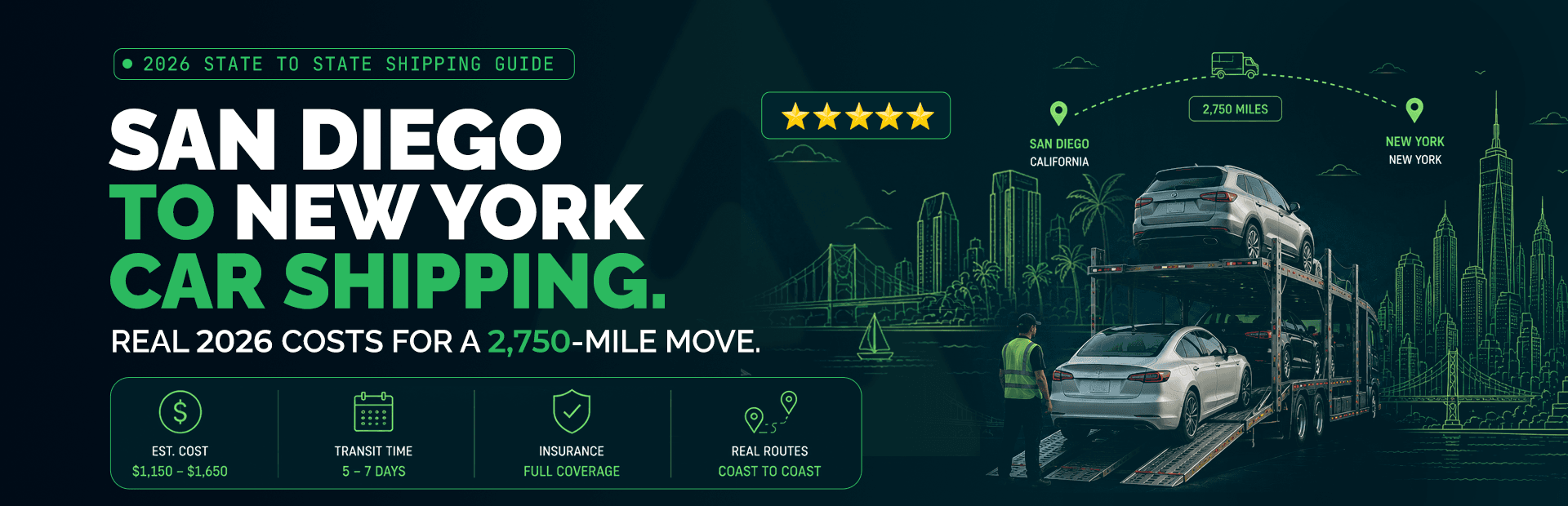
New York and California share an exit problem. In United Van Lines' 2025 National Movers Study, both states landed among the nation's top three outbound markets, with 58% of tracked household moves in each state heading out rather than in.
If you're one of the people behind that number, sending a car from San Diego to New York without driving all 2,750 miles yourself isn't a niche situation. It's one of the most common cross-country moves in the country, just without a clear price tag attached yet.
This guide breaks down what San Diego to New York car shipping actually costs, how long it takes, and what to check before you hand your keys to anyone.
Get a real number for your move. Compare vetted quotes for your San Diego to New York shipment before you book a single carrier.
San Diego to New York Car Shipping Cost: What You'll Actually Pay
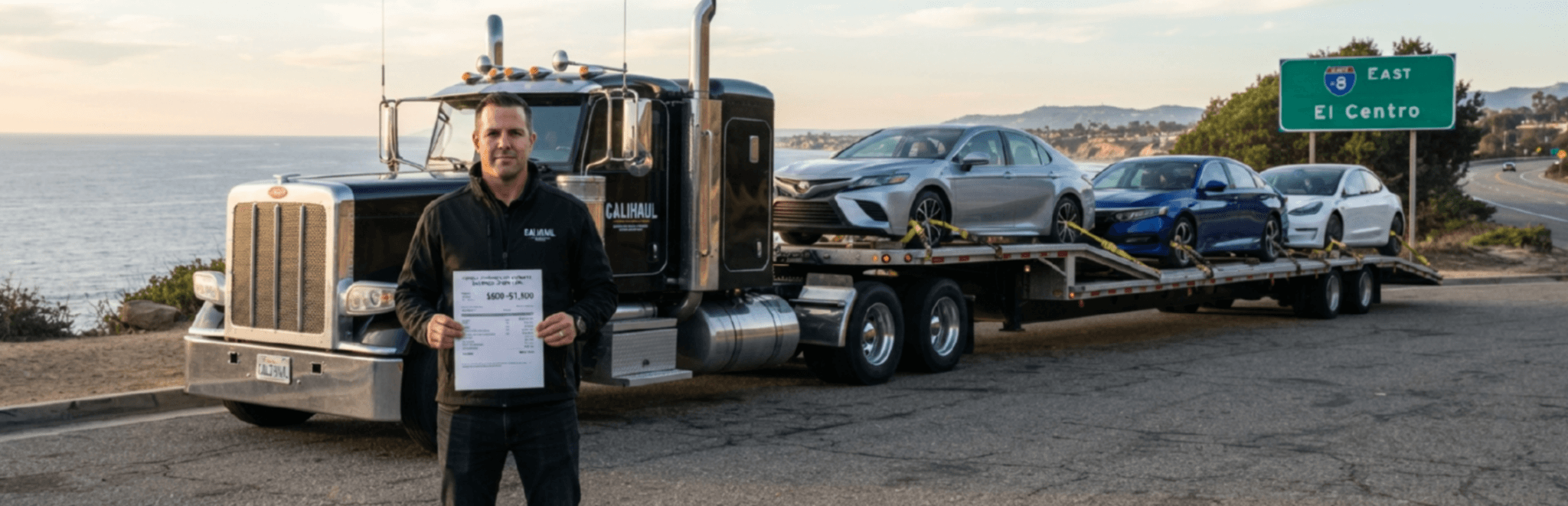
A coast-to-coast run like this one typically lands between $800 and $1,500 for open transport, with enclosed running well above that.
Distance drives most of the price on a route this long, but it doesn't drive it the way people expect. According to moveBuddha's 2026 car shipping cost data, the average vehicle shipment nationally runs $500 to $1,200, while a full coast-to-coast move like San Diego to New York typically falls in the $800 to $1,500 range on an open carrier. That's a wider band than a short regional hop, but the per-mile rate is actually lower, since a 2,750-mile route fits neatly into a carrier's cross-country schedule in a way a 300-mile detour doesn't.
That $800 to $1,500 figure is the closest verified benchmark available for the "average cost to ship a car 3,000 miles" question, since San Diego to New York sits right at that distance band.
Vehicle size, season, and how far out you book all move that number within the range, more than the exact mile count does. A sedan booked three weeks out in the spring sits near the bottom. A non-running SUV booked five days before a winter pickup sits near the top.
The cheapest way to ship a car on this route comes down to two levers: choosing open transport over enclosed, and staying flexible on your pickup date instead of demanding a specific day. Both matter more than which broker you pick.
How Long Does It Take to Ship a Car From San Diego to New York?
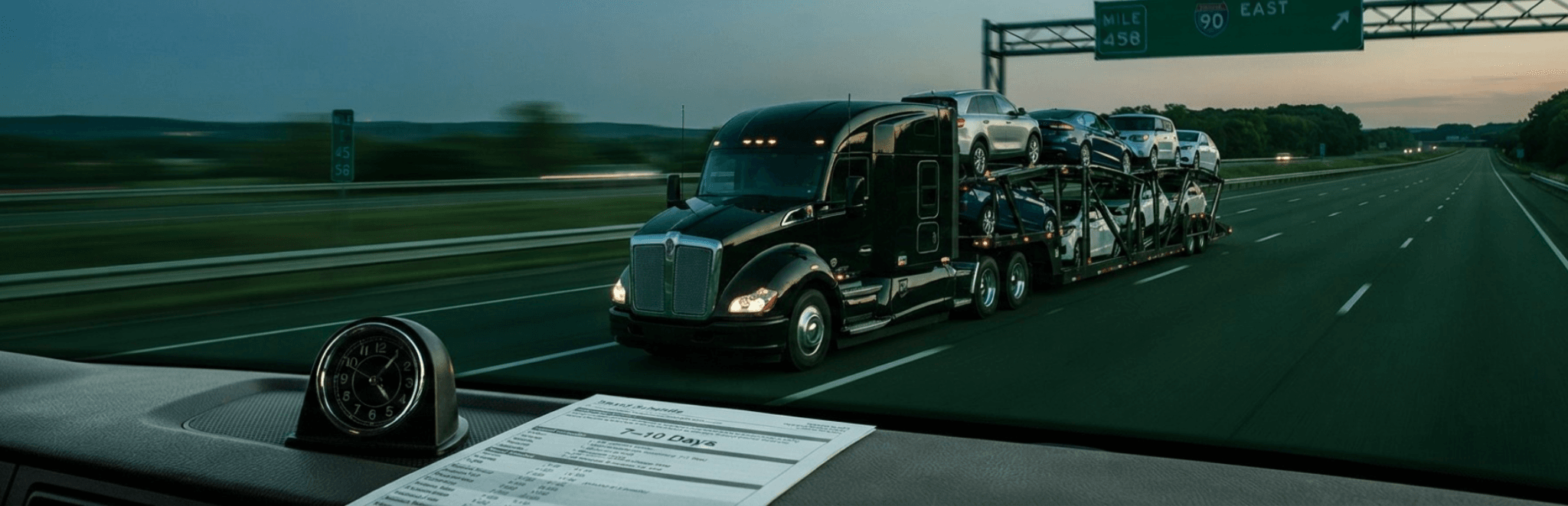
Plan on seven to ten days after pickup, not a straight highway sprint.
Transit on this lane typically runs seven to ten days once a carrier picks up your vehicle, according to Sherpa Auto Transport's 2026 shipping-time guide, which cites that same window for coast-to-coast and East Coast to West Coast moves specifically. That's not a dedicated driver going point to point. Multi-vehicle carriers load and unload other cars along the way, usually running a northern corridor through Nevada, Utah, and the Midwest before dropping into the Northeast.
|
Factor |
Effect on Timeline |
|
Season |
Winter weather on the northern route can add days. Spring and fall move fastest |
|
Pickup flexibility |
A wider pickup window gives dispatch more carrier options, which speeds assignment |
|
Open vs. enclosed |
Enclosed trailers hold fewer vehicles, so assignment can take longer |
|
Terminal vs. door-to-door |
Terminal drop-off can shave a day or two off total time |
The seven-to-ten-day window covers the drive itself. Add a few days on either end for a carrier to actually get assigned to your shipment, especially if your pickup dates aren't flexible.
Is It Cheaper to Ship Your Car or Drive It Cross Country?
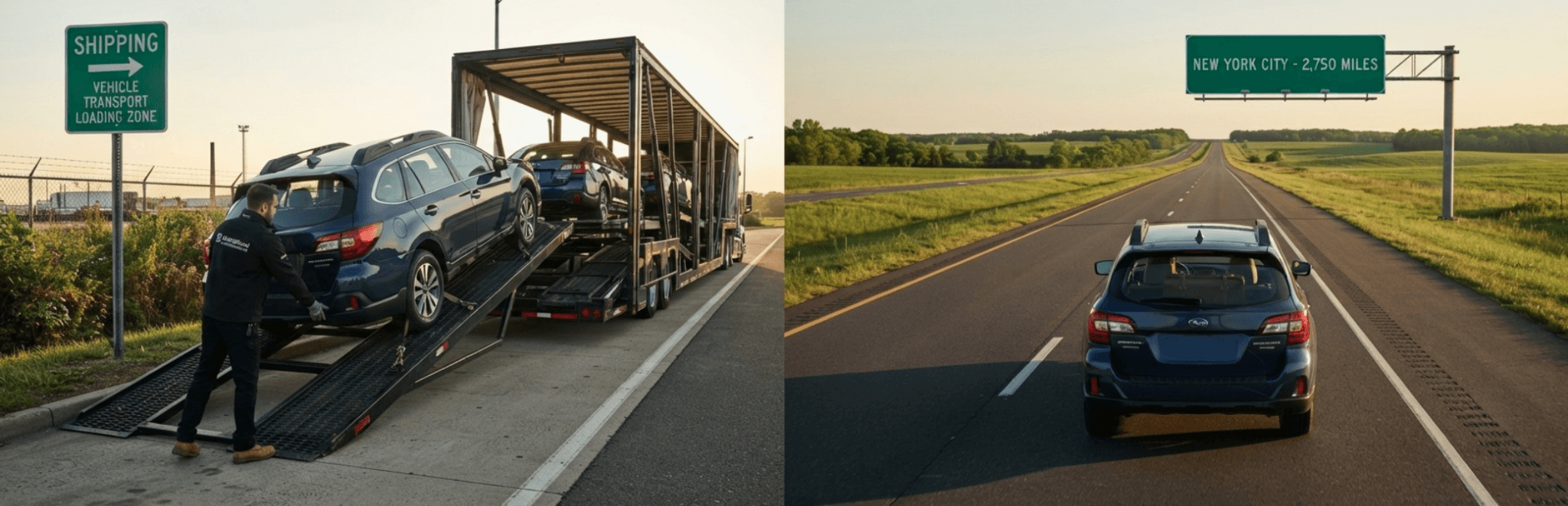
For most single-driver trips, shipping wins once gas, food, lodging, and time are all counted.
Driving 2,750 miles yourself isn't free, even before you account for your own time. Gas, meals, several nights of lodging, and the wear a cross-country trip puts on a vehicle all stack up against a shipping quote that looks expensive in isolation but often isn't once you add up the alternative.
MoveBuddha's comparison of driving versus shipping a car puts it plainly: hiring a transport company is usually more cost-effective for longer distances, once fuel costs, driving time, and wear and tear on the vehicle are factored in. Shipping also removes the physical risk of a multi-day solo drive across unfamiliar highways.
Driving still makes sense in specific cases: if you're making the cross-country trip anyway for other reasons, want to see family along the way, or need to time your own arrival with the car's. Outside of those, shipping is the more cost-effective default on a route this long.
Open vs. Enclosed, and Door-to-Door vs. Terminal-to-Terminal
Two separate choices, and you can mix and match them based on what you're shipping.
These decisions don't have to move together. You can choose enclosed with terminal-to-terminal, or open with door-to-door. What you're shipping and how much hands-on time you have should drive each choice separately.
Open vs. Enclosed Car Shipping Cost Difference
Enclosed typically costs about 50% more than open, and it's worth it for a smaller group of shippers.
Open transport is the standard choice, and it's what most quotes on this route will default to. MoveBuddha's open vs. enclosed breakdown puts the premium plainly: enclosed transport costs "often close to 50% more" than open, in exchange for full protection from road debris and weather.
On a 2,750-mile run through winter conditions in the Rockies or Midwest, that protection means more to classic car owners, exotic car owners, and anyone shipping a vehicle that can't be easily repaired if a rock chip or road salt does damage along the way. For a standard daily driver, open transport is the practical default.
Compare the two service pages directly: open car shipping covers the standard option, and enclosed vehicle shipping covers what you get for the added cost.
Door-to-Door vs. Terminal-to-Terminal Car Shipping
Door-to-door costs more but saves a trip. Terminal-to-terminal saves money if a hub sits near either end of your move.
Door-to-door shipping means the carrier picks up and delivers at your actual addresses, which is worth the added cost for seniors, anyone shipping solo, or anyone without easy access to a terminal near San Diego or New York. Terminal-to-terminal asks you to drop off and pick up at a designated lot, which trims cost but adds a drive on both ends.
MoveBuddha's guide to the cheapest way to ship a car names open transport with terminal-to-terminal delivery as the most budget-friendly combination available, though it comes with longer wait times and less convenience. Dealers moving inventory near a metro terminal often take this option. Individual shippers without easy terminal access usually don't.
Shipping SUVs, EVs, and Non-Running Vehicles on This Route

Vehicle type changes your price more than most people expect before they get a quote.
Not every vehicle ships the same way or at the same price, and this route is long enough that those differences add up.
How Much Does It Cost to Ship an SUV Cross-Country?
SUVs and trucks cost more than sedans because they take up more deck space, not because of some flat surcharge.
MoveBuddha's published rate table shows the size gap clearly even at shorter distances: a compact car runs $600 on open transport at 500 miles, while an SUV on the same route runs $700. At 1,000 miles, that gap holds, with compacts at $900 and SUVs at $1,000. The size premium tends to hold as distance increases, which means SUV and truck shipping cross country typically runs above sedan pricing for the same reason: more weight, more space on the carrier deck.
Dealers moving several SUVs or trucks at once should ask about volume pricing rather than quoting each vehicle separately. Our dealer vehicle transport solutions page covers how that pricing typically works for multi-unit shipments.
Electric Vehicle and Non-Running Car Shipping Cross Country
EVs ship the same way as gas cars but weigh more. Non-running cars need a carrier with winch equipment.
Electric vehicles load onto the same open or enclosed carriers as gas-powered cars. The difference is weight: EV battery packs add several hundred pounds compared to a similarly sized gas vehicle, and carriers that price by weight class will reflect that in the quote. A mostly charged battery, not a fully depleted one, is the safer bet for loading and unloading. Our guide to shipping an electric vehicle covers battery and charging prep in more depth.
A non-running vehicle is a different problem entirely. As moveBuddha notes, a car that can't run under its own power takes more effort to load and unload, which narrows the pool of carriers who can take the job and typically adds a modest surcharge rather than doubling the price. Confirm winch capability before booking, not at pickup, since not every carrier on this route carries the equipment. Our step-by-step guide to shipping a non-running vehicle walks through what to ask.
Booking Your Shipment and Handling Problems on the Road
Two different moments in the process: getting a carrier assigned, and knowing what to do if something goes wrong.
When to Book, Pickup Day, and Tipping Your Driver
Two to four weeks out is the safe booking window. Tipping is optional but common for good service.
Book two to four weeks ahead of your target date if you can. Anything under a week narrows the pool of available carriers and can push your price toward the higher end of the range. Someone over 18 needs to be present at pickup to hand off keys and sign the inspection report, though it doesn't have to be the vehicle's owner.
College students shipping a car to or from a New York campus should plan around move-in and move-out weeks specifically, when demand on this lane spikes and prices firm up earlier than usual. Our college student car shipping guide covers timing around semester schedules in more detail.
Tipping your driver isn't required, but it's common practice. Per Sherpa Auto Transport's tipping breakdown, most customers tip $20 to $40 for good service, $50 to $100 for excellent service, and $100 or more when a driver handles a classic, luxury, or exotic vehicle with extra care.
If Your Car Arrives Damaged: Your Rights and Next Steps
Photograph before you sign, and file with the carrier's cargo insurance, not your own policy.
Damage on delivery gets handled through the inspection report, not a phone call after the fact. Photograph the vehicle before signing anything, note any damage directly on the bill of lading, and file a claim within the carrier's stated window, often 24 hours. Keep your original pickup-day photos on hand too, since they're your proof of the vehicle's condition before it ever left San Diego.
Claims typically run against the carrier's cargo insurance, not your personal auto policy. Before you book with anyone, verify that a carrier's insurance and operating authority are active through FMCSA's Company Safety Snapshot tool. It takes about two minutes and confirms the company is actually licensed to move a vehicle across state lines.
Registering Your Car in New York After Moving From California
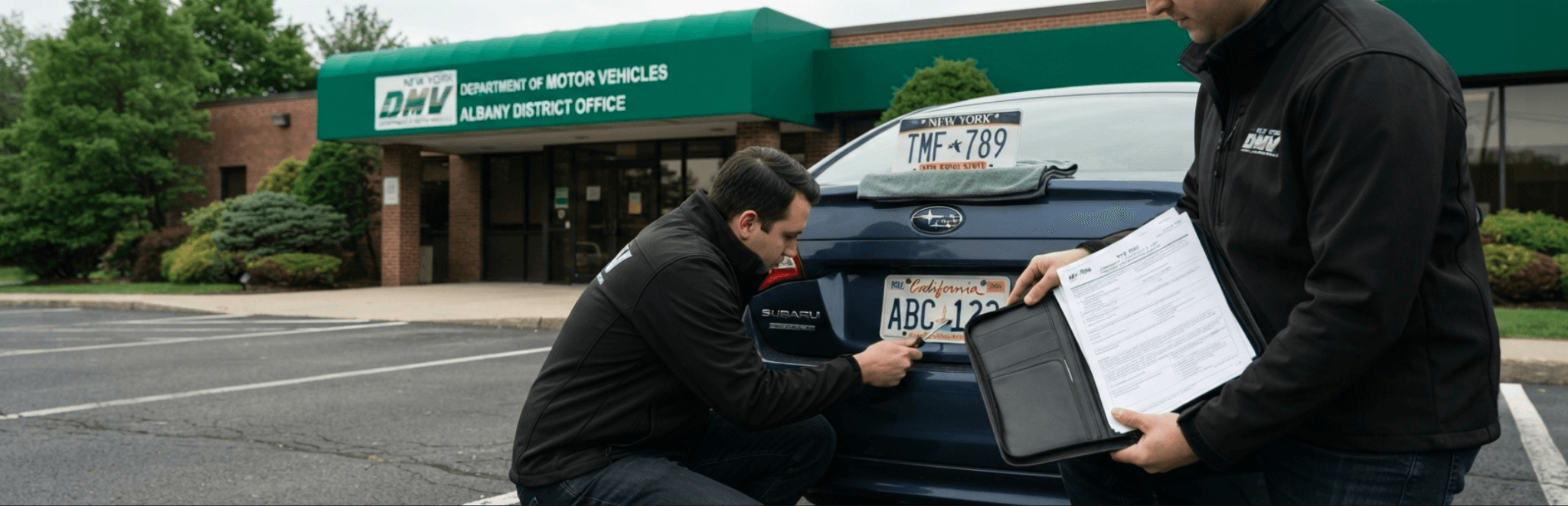
New York generally gives new residents 30 days to register a vehicle after moving in.
Getting the car there is only half the job. New York generally requires new residents to register a vehicle within 30 days of establishing residency, which means a title transfer, a New York State vehicle inspection, and proof of New York-compliant insurance before the DMV issues plates.
Have these ready before your car arrives:
-
Your California title
-
Proof of your New York address
-
A passed New York State inspection
-
New York-compliant auto insurance, not your old California policy
Timing matters more than people expect. If your car ships weeks after you've already established New York residency, the 30-day window may already be running before the vehicle even arrives. Coordinating your shipment date with your actual move-in date avoids the scramble. Our guide on shipping a car to another state covers the broader relocation timeline if you're juggling more than just the car.
Best Car Shipping Companies for the San Diego to New York Route
Three vetted options, each fitting a different kind of shipper on this specific lane.
Before naming anyone, the standard should hold regardless of reputation: active FMCSA operating authority, real reviews outside the company's own website, and cargo insurance terms in writing. A bigger ad budget isn't the same as the right fit for a 2,750-mile move.
|
Company |
Best For |
Notable Strength |
|
West Coast pickups, enclosed transport |
Strong communication track record and real depth on enclosed jobs |
|
|
Budget-conscious shippers who need scheduling flexibility |
Large carrier network with competitive quote comparison |
|
|
Deliveries into the New York area specifically |
New York-based operation with high review volume and 24/7 support |
Corsia's West Coast roots make it a natural fit for the San Diego pickup side of this route, especially for enclosed jobs. Mercury's carrier network gives budget-focused shippers more flexibility on dates. SGT's home base near the New York end of this lane is a genuine edge, not just a marketing detail, for anyone who wants a company that knows the delivery side as well as the pickup side.
Verify any of these three, or any company you're considering, directly through FMCSA's carrier search before booking. Fit matters more than favoritism here: a dealer moving several cars needs something different than someone shipping one sedan for a job move.
See what these carriers would actually charge you. Get quotes for your San Diego to New York shipment and compare real numbers before choosing.
What People Ask Before Shipping a Car From San Diego to New York
The specific questions that come up most once someone starts pricing out this exact route.
Does my car insurance cover it while it's being shipped from San Diego to New York?
Standard car insurance rarely covers a vehicle in transit. The carrier's cargo insurance is your primary protection, so confirm coverage limits and get proof in writing before pickup.
Can I leave personal belongings in the car during a San Diego to New York shipment?
Most carriers allow up to 100 pounds of personal items, packed low or in the trunk, but belongings aren't covered by cargo insurance. Confirm your specific carrier's weight limit before packing.
What's the actual difference between booking a broker versus a direct carrier for this route?
A broker vs. carrier comparison comes down to this: brokers match you to a vetted network and handle paperwork, while a direct carrier owns the truck and drives your car itself.
Is San Diego to New York car shipping priced differently than New York to San Diego?
Yes, slightly. Pricing shifts with the direction that carries more freight demand that week. Neither lane runs consistently cheaper, so compare live quotes for your specific direction and dates before booking.
How much notice does a carrier need if my pickup date has to change after booking?
Give your carrier as much notice as possible, ideally 48 to 72 hours. Last-minute pickup date changes can push you to the back of the dispatch queue.
What Actually Determines Your San Diego to New York Move
Budget-focused shippers should book two to four weeks out and take open transport. Classic and exotic car owners should go enclosed regardless of the roughly 50% premium. Dealers moving multiple SUVs should ask about volume pricing up front. Anyone shipping a non-running vehicle should confirm winch capability before booking, not after a carrier shows up without the right equipment.
San Diego to New York car shipping isn't a mystery once you know what actually moves the price: distance sets the floor, but vehicle type, season, and booking flexibility decide where you land inside that $800 to $1,500 range.
Ready to see your real number? Get matched with vetted carriers for your San Diego to New York move and compare quotes in one place.