



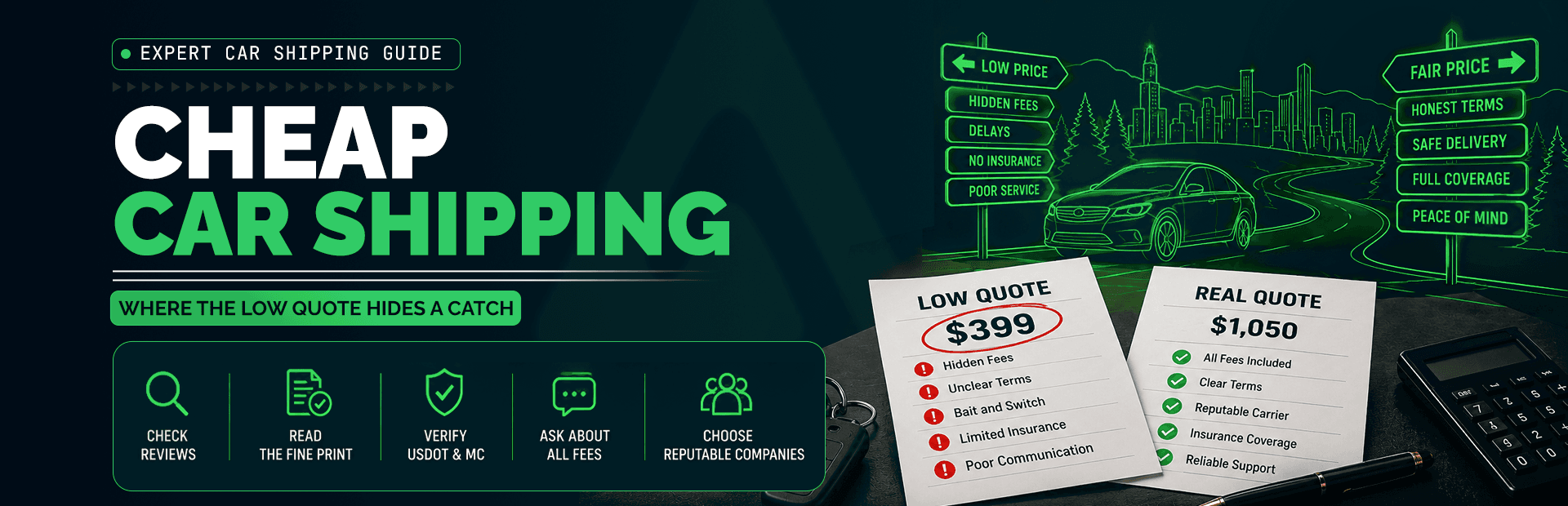
The average car moves for about $1,195, which works out to roughly $1.89 per mile on an open carrier, according to Move.org's 2026 cost data. Keep that number in your head. It is the single most useful fact for spotting a bad deal.
When a quote lands $300 or $400 under that mark, it is rarely a discount. It is usually a hook. Cheap car shipping is real and worth chasing, but the lowest quote and the lowest final bill are almost never the same number. This guide shows you how to tell a smart low price from a trap, how to verify a company before you pay, and where the honest savings actually hide.
Want a real starting point? Get a free, no-obligation quote and see what your car costs to move before anyone asks you for a deposit or a commitment.
Why the Cheapest Car Shipping Quote Is Rarely the Cheapest Bill
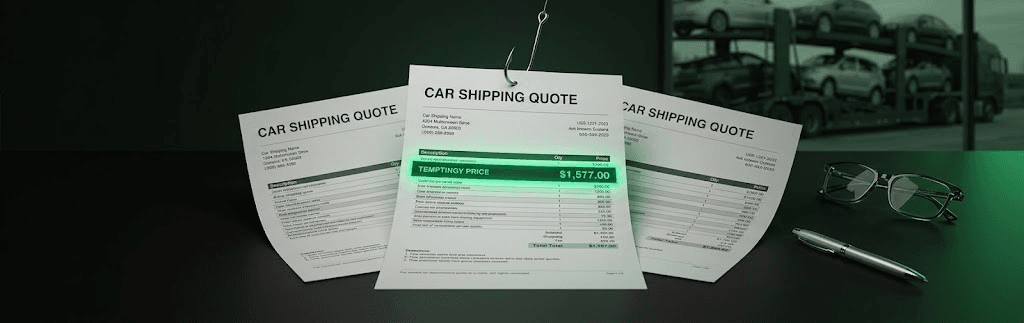
A quote that sits far below everyone else is not a bargain your competitor missed. It is a number chosen to win your signature.
Here is the mechanic behind it. Most companies you contact are brokers, not truck owners. A broker posts your car on a national load board and waits for a carrier to accept the job. Carriers only move for what the route actually pays. If a broker quotes you $700 on a lane that truckers will not touch under $1,000, no driver takes the load. Your car sits. Then the phone rings with a new, higher price and a reason that sounds urgent.
So the low quote was never a price. It was bait. The cheapest way to ship a car is not the lowest opening number. It is the most accurate one, from a company that can actually cover the route.
Bold Callout: A quote that beats the market by 30 to 40 percent is a red flag, not a win. Real savings usually run 5 to 15 percent under average, not half off.
Treat any car shipping quote too good to be true as exactly that. The rest of this guide gives you the tools to check.
How a Non-Binding Quote Turns Into a Bigger Number
Almost every online quote you get is non-binding. That word does a lot of quiet work, and most first-time shippers never notice it until the price moves.
What "Non-Binding" Actually Means on Your Contract
A non-binding car shipping quote is an estimate, not a locked price. The company can change it before pickup if the market shifts or if the details you gave turn out to be off. That is legal and, for honest brokers, normal. Fuel prices move. Routes fill up. A running sedan is cheaper to haul than a dead truck with a roof rack.
The problem starts when a company uses "non-binding" as cover for a number it never intended to honor. A fair non-binding car shipping quote asks for your VIN, your exact locations, and whether the car runs. A bait quote skips the details and just wants a deposit. If nobody asked what you are shipping, the price is a guess at best and a lure at worst. For a deeper breakdown, this expert guide to reading car shipping quotes walks through what a real estimate should contain.
Bait and Switch: How the Price Climbs After You Commit
A car shipping bait and switch follows a script. You get a quote well under the pack. You book and pay a deposit. Days pass with no assigned carrier. Then comes the call: the market went up, your car is oversized, the driver needs more, and it all has to be decided today.
By then you are anchored. Your move date is close, your options feel thin, and the higher number feels like the only way out. That pressure is the whole point of the car shipping bait and switch. Watch for these signs the estimate was never real:
-
The quote is far below every other one you received
-
No one asked for your VIN or whether the car runs
-
You are pushed to book same day, before you can compare
-
The pickup window is vague or "flexible" with no firm range
-
The deposit is large and charged the moment you say yes
Many of these price jumps show up later as hidden car shipping fees. Knowing the pattern is how you refuse to play along.
Broker vs Carrier: Who Actually Sets Your Price

You cannot judge a quote until you know who is on the other end of it. The car shipping broker vs carrier split is the most useful thing a first-time shipper can learn.
A broker arranges the shipment. A carrier owns the truck and does the driving. Most quotes come from brokers, and that is not a bad thing. Good brokers have deep carrier networks and can find a truck fast. But the broker does not set the final price. The carrier does, by accepting or ignoring the load at the price offered. A broker who lowballs you is really lowballing the driver, and drivers do not work for free.
|
Factor |
Broker |
Carrier |
|
Owns the truck |
No |
Yes |
|
Sets the real price |
Posts the offer |
Accepts or declines it |
|
Deposit typical |
Often yes |
Less common |
|
Best for cheap car shipping |
Wide network, more quotes |
Direct rate, fewer routes |
|
Main risk |
Lowball bait to win you |
Limited routes and dates |
There is a real regulatory reason brokers exist and can be trusted when licensed. Freight brokers must register with federal authorities and carry a $75,000 surety bond, a rule you can confirm on the FMCSA registration pages. That bond is one reason a licensed broker has skin in the game. If you want the pricing logic in more depth, TransportVibe breaks down how broker and carrier pricing differs. Either way, knowing who quoted you tells you how much that number can move.
Deposit Traps: Scams, Refunds, and What Sets Them Apart

The moment real money changes hands is the moment risk peaks. This is where cheap car shipping goes wrong fastest.
How Deposit Scams Actually Work
Car shipping deposit scams are simple by design. A company takes an upfront deposit, assigns no carrier, and then either goes quiet or invents a "cancellation fee" that swallows your refund. The Better Business Bureau has warned consumers about vehicle transport scams tied to exactly this pattern, with reports of deposits taken and cars never picked up.
Protect yourself before you pay a cent:
-
Prefer companies that charge no deposit until a carrier is assigned
-
Read the cancellation clause before you hand over any money
-
Pay by credit card, never by wire, Zelle, cash app, or gift card
-
Confirm the company has active federal authority and insurance on file
-
Be suspicious of any deposit that is a large share of the total
A wire transfer has no chargeback. A credit card does. That one choice is the difference between a bad week and a lost deposit. TransportVibe's guide to avoiding auto transport scams covers more of these traps in detail.
Is a Car Shipping Deposit Refundable? Read This First
Whether a car shipping deposit is refundable depends on two things: when it is charged and what the cancellation clause says. This is the question most people ask too late.
The safest structure is deposit-on-dispatch, where you pay nothing until a real carrier is assigned to your car. If a company charges at booking, read exactly how and when you can cancel. Honest contracts give you a clear window to walk away for a full refund before a driver is assigned. Predatory ones bury a fee that keeps most of your deposit no matter what. If a car shipping deposit is refundable only after a "processing" cut you were never told about, that is a design choice, not an accident. Your rights when a company cancels last minute are worth reading before you sign, not after.
Bold Callout: A fair deposit is small and refundable until a carrier is assigned. If a company wants a big deposit up front with a vague refund policy, keep looking.
Verify Before You Pay: The DOT Number Check That Takes Two Minutes
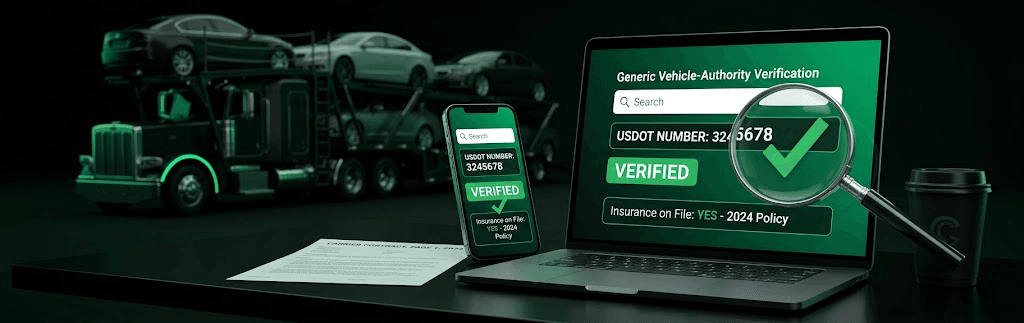
Here is the fastest scam filter that exists, and it costs nothing. Learning how to verify a car shipping company DOT number turns a stranger into a known quantity in about two minutes.
Every legitimate mover operates under a USDOT number, and brokers also carry an MC number. Ask for it, or find it on their site, then run it. The federal SAFER Company Snapshot tool shows you whether the authority is active, whether insurance is on file, and how the operation is classified. It is public, free, and the single best use of two minutes in this whole process.
When you learn how to verify a car shipping company DOT number, walk through this checklist:
-
Get the USDOT number, and the MC number if it is a broker
-
Run it through the SAFER Company Snapshot tool
-
Confirm the operating authority reads active, not inactive or revoked
-
Check that insurance is on file
-
Scan the complaint and safety history for anything alarming
A company that dodges this question or cannot give you a working number has already told you what you need to know. TransportVibe lists more questions to ask before hiring a transport company, and the DOT check belongs at the top.
The Real Levers of Cheap Car Shipping
Enough about traps. There are honest ways to pay less, and they come down to two things you control: how the car ships and when it ships.
Open Transport and Cost Per Mile
Open transport is the default cheap option, and for most cars it is the right call. Your car rides on an open multi-car trailer, the same way new cars reach dealerships. It costs less because carriers move more cars per trip.
Cost per mile is the number that matters, and open car transport cost per mile drops as distance grows. Move.org puts the average open-carrier rate near $1.89 per mile, but that average hides a curve. Short hauls cost more per mile because the truck still has to show up. Long hauls spread the fixed cost across more miles, so the open car transport cost per mile falls on cross-country runs. This is why the cheapest way to ship a car cross country is often better value per mile than a short in-state move.
|
Distance |
Typical Open $/Mile |
Example Route Cost |
|
Under 500 miles |
Roughly $1.00 to $1.50 |
Short haul, $300 to $600 |
|
500 to 1,500 miles |
Roughly $0.75 to $1.00 |
Regional, $700 to $1,200 |
|
Over 1,500 miles |
Roughly $0.60 to $0.80 |
Cross-country, $1,100 to $1,600 |
Ranges are typical open-carrier figures and shift with fuel, season, and route demand. Always confirm with a live quote.
If open transport fits your car, it is the clearest path to a lower bill. You can read the full breakdown on TransportVibe's open car shipping service page before you decide.
Timing: The Cheapest Time of Year and the Snowbird Effect
When you ship changes the price as much as how you ship. The cheapest time of year to ship a car is usually late fall and winter on most lanes, roughly November through February, when demand cools off outside the snowbird routes. Spring and summer are peak, so rates climb with the moving season.
Snowbird routes flip that script. Snowbird car shipping to Florida spikes in October and November as retirees head south, then spikes again in March and April as they return north to states like New York. If your car rides one of those lanes in those months, expect to pay peak. Ship a few weeks off the rush and the same route gets cheaper. This is the core of every seasonal car shipping strategy, and it is free money if your dates are flexible.
Bold Callout: Flexible pickup dates are worth real money. A window of a few days, instead of one fixed day, gives carriers room to slot your car into a full load and often lowers the quote.
For a full seasonal plan, TransportVibe's seasonal car relocation service is built for exactly these swings.
Door to Door vs Terminal to Terminal: Where You Can Trim the Bill
Most people never ask about this, and it is one of the few places you can genuinely cut the price. The door to door vs terminal to terminal car shipping choice is about convenience versus cost.
Door to door means the driver picks up and delivers as close to your addresses as the truck can safely reach. It is the standard, and it is easy. Terminal to terminal car shipping means you drop the car at a lot and collect it from another lot near the destination. Because the carrier batches cars at fixed hubs, terminal to terminal car shipping can shave the base rate on some routes.
|
Factor |
Door to Door |
Terminal to Terminal |
|
Convenience |
High, pickup at your address |
Lower, you drive to a lot |
|
Typical cost |
Standard rate |
Can be lower base rate |
|
Best for |
Most shippers, busy schedules |
Flexible shippers near a hub |
|
Hidden fees |
Few |
Possible storage or lot fees |
|
Cheap-shipping verdict |
Simpler, safer default |
Only cheaper if hubs are close |
Here is the honest catch. Terminal fees, storage charges, and the drive to a distant lot can wipe out the discount fast. Terminal to terminal car shipping only saves money when the hubs sit near both ends of your route and the lot does not charge storage. If you have to drive an hour each way and pay to park, door to door was the better deal all along. TransportVibe compares both in this door to door vs terminal to terminal guide.
Insurance and Enclosed Coverage: What a Cheap Quote Quietly Skips

A cheap quote can turn expensive the day your car arrives with a scratch. This is the gap most lowball prices hide.
Every licensed carrier must carry cargo insurance, so the real question is how much does car shipping insurance cover. The answer is the carrier's liability limit, not your car's full value. If the carrier's policy caps cargo at a number below what your car is worth, the difference is on you when something goes wrong. Ask for the certificate of insurance, read the coverage amount, and check the deductible before you book. A cheap quote that comes with thin coverage is not cheap. It is a bet.
Confirm these before you sign:
-
The carrier's cargo coverage amount and whether it meets your car's value
-
The deductible you would owe on a claim
-
Whether your own auto policy adds any protection in transit
-
The exact claims process and the deadline to file
For high-value, classic, low-clearance, or exotic cars, enclosed transport is the smart spend even in a cheap-shipping mindset. It runs 30 to 60 percent more than open, but it protects a car that is hard or impossible to replace. TransportVibe's enclosed vehicle shipping service explains when the premium is worth it, and this car shipping insurance guide covers what is and is not protected.
Brokers That Ship Cheap Without the Catch
Once you know what to check, the goal is a company that quotes straight, holds its price, and does not hide the deposit terms. A few brokers have built their name on exactly that. Note that pricing and policies change, so verify current terms and each company's DOT authority before you book.
|
Company |
Quote Style |
Deposit Approach |
Stands Out For |
|
Sherpa Auto Transport |
Locked, price-guarantee reputation |
No deposit until a carrier is assigned |
Holding the quoted price |
|
Easy Auto Ship |
Upfront, all-in quotes |
Deposit-light structure |
Clear pricing with fewer surprises |
|
SGT Auto Transport |
Instant online quotes |
No large upfront deposit |
Big carrier network, fast pickup |
Sherpa built its reputation on a price-lock approach, where the quote you accept is the price you pay, which is the opposite of the bait pattern. You can read the full Sherpa Auto Transport review for the details. Easy Auto Ship leans on all-in quotes so the number you see is closer to the number you pay. SGT Auto Transport pairs instant quotes with a wide carrier network and no large deposit up front, covered in this SGT Auto Transport review. None of these is a magic cheapest button. They are examples of the transparency you should demand from anyone you hire.
One savings angle worth asking about directly is the student car shipping discount. If you are relocating for school or a first job, many brokers cut a percentage for students, and some extend a student car shipping discount to recent grads and interns too. It is rarely advertised, so ask. The college student car shipping guide shows how to stack that discount with off-peak timing for the lowest realistic price.
What Shippers Ask Most Before Booking
The five questions that come up again and again when people start pricing a move. Short, straight answers so you can book with confidence.
How do I know if a cheap car shipping quote is a scam?
A cheap car shipping quote is likely a scam when it beats the market by 30 to 40 percent, skips your VIN, or demands a big upfront deposit. Always run the company's DOT number to confirm active authority.
Is a car shipping deposit refundable if the carrier never shows up?
Usually yes, if you paid by credit card and the contract allows cancellation before dispatch. Deposit-on-dispatch companies charge nothing until a carrier is assigned, so there is no deposit at risk. Read the refund clause first.
What is the cheapest way to ship a car cross country in 2026?
The cheapest way to ship a car cross country in 2026 is open transport booked in off-peak months, roughly November through February, with flexible pickup dates. Long hauls cost less per mile than short ones.
Do I need a broker's DOT number or an MC number to verify them?
Both help. Brokers carry a USDOT number and an MC number. Run either through the SAFER Company Snapshot to confirm active authority, insurance on file, and a clean complaint history before you pay.
Is terminal to terminal car shipping always cheaper than door to door?
No. Terminal to terminal car shipping only saves money when hubs sit near both ends and the lot skips storage fees. Add a long drive or parking charges, and door to door often wins.
Reading a Cheap Quote the Smart Way
Come back to that first number. The average car moves for about $1,195. So the goal was never to fear cheap car shipping. It was to tell an honest low price from a car shipping quote too good to be true. The two look identical on a screen and behave nothing alike once your deposit clears.
The whole method fits on a sticky note. Run the DOT number before you trust anyone. Read the deposit and cancellation clause before you pay. Prefer open transport and flexible, off-peak dates for real savings. And never book on pressure, because urgency is the scammer's favorite tool. Do that, and cheap car shipping stops being a gamble and becomes a plan.
Ready to move? Compare real, verified quotes in minutes and choose a company that locks its price instead of chasing you for a bigger deposit later.