


Open carriers account for roughly 90% of all domestic vehicle shipments in the United States, according to 2026 interstate auto transport industry data. On the Miami to Los Angeles corridor, that ratio holds.
Driving it yourself takes 40-plus hours across 2,757 miles. Add two nights in a hotel and fuel stops through four states, and the math tips toward shipping. Most people relocating from Florida to California already know it.
This guide covers what car shipping from Miami to Los Angeles actually costs in 2026, how long transit realistically takes, who this route suits best, and which carriers hold up on this specific corridor.
Get a free quote for your Miami to Los Angeles shipment — no deposit, no commitment.
How Much Does It Cost To Ship A Car From Miami To Los Angeles?
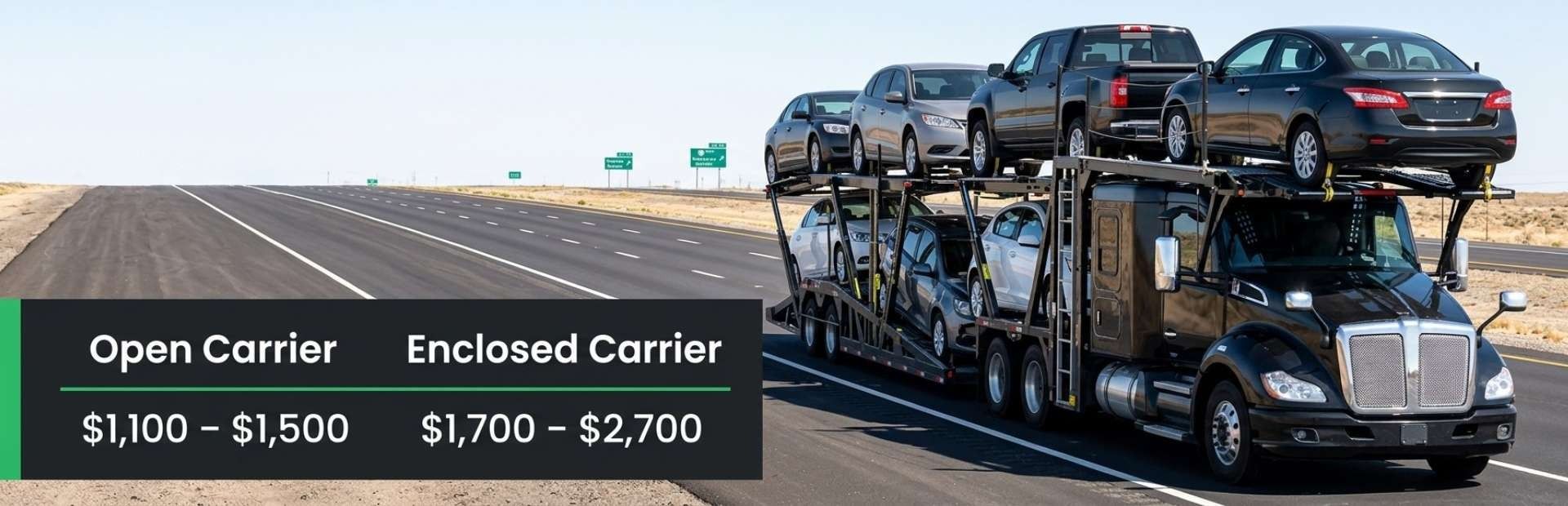
The cost to ship a car from Miami to Los Angeles in 2026 runs between $1,100 and $2,700, depending on the transport type, your vehicle's size, and when you book. That's a wide spread. Here's how to read it.
Open Carrier Vs. Enclosed Carrier Pricing
The two transport types account for most of the price difference. Here's what the numbers look like on this route:
|
Open carrier |
Enclosed carrier |
|
|
Average cost (Miami to LA) |
$1,100 – $1,500 |
$1,700 – $2,700 |
|
Best for |
Standard vehicles, SUVs, trucks |
Classic, luxury, and exotic vehicles |
|
Typical transit |
7 – 10 business days |
8 – 12 business days |
|
Weather exposure |
Fully exposed to elements |
Fully protected, no road exposure |
Open transport keeps costs lower because carriers fit 8 to 10 vehicles per load. Your car shares trailer space with others headed in the same direction, and the cost splits accordingly.
Enclosed is a different setup. Fewer vehicles per trailer, more careful handling, and a higher rate to match. It's not an upgrade in the lifestyle-upgrade sense. It's a risk calculation — one that changes significantly when your vehicle is worth $50,000 or more on a 2,757-mile haul through desert heat and highway debris.
For standard sedans and family SUVs, open car shipping is the industry default — and it works well for the vast majority of shipments on this route.
For a classic, collector, or luxury vehicle, enclosed vehicle shipping is the minimum you should consider, not an optional add-on.
Want a full cost comparison between the two options? This breakdown of open vs. enclosed transport costs covers what you'll actually pay across different vehicle types and routes.
What Pushes The Cost To Ship A Car From Miami To Los Angeles Up Or Down
Vehicle size is the biggest variable. A standard sedan typically sits at the lower end of the open-carrier range. A full-size pickup or 3-row SUV can add $200 to $400 because of the extra trailer space it occupies.
Beyond size, these are the factors that move your quote up or down on this specific route:
-
Booking lead time: Book 2 to 3 weeks out and you'll see the best available rates. Within 48 hours of your preferred pickup date, expect a 15 to 25% price increase. Carriers charge a premium for short-notice availability.
-
Snowbird season: October through March sees a surge in carrier demand from South Florida. Fewer available trucks moving north and west during peak outflow means higher prices and longer waits. The tightest windows are typically February through mid-March.
-
Door-to-door vs. terminal-to-terminal: Door-to-door service picks up and delivers at your address. Terminal requires you to drop off and pick up at a facility. Terminal is cheaper by $50 to $150, but factors in your time and logistics on both ends.
-
Running vs. non-running vehicle: Non-running vehicles require a winch to load and specialized equipment. Most carriers charge $100 to $300 more for NRVs.
-
Payment method: Some carriers discount for cash or ACH payment versus credit card, since card processing fees come out of their margin.
Current quotes for this specific corridor range from $1,100 to $2,699, per FreightWaves Checkpoint route data from May 2026. The cost to ship a car from Los Angeles to Miami — the reverse run — sits in a similar range, though eastbound carrier availability can tighten depending on seasonal demand patterns.
For a full national picture of car shipping costs before your first quote, this 2026 car shipping cost guide is worth reading first.
How Long Does Car Shipping From Miami To Los Angeles Take?
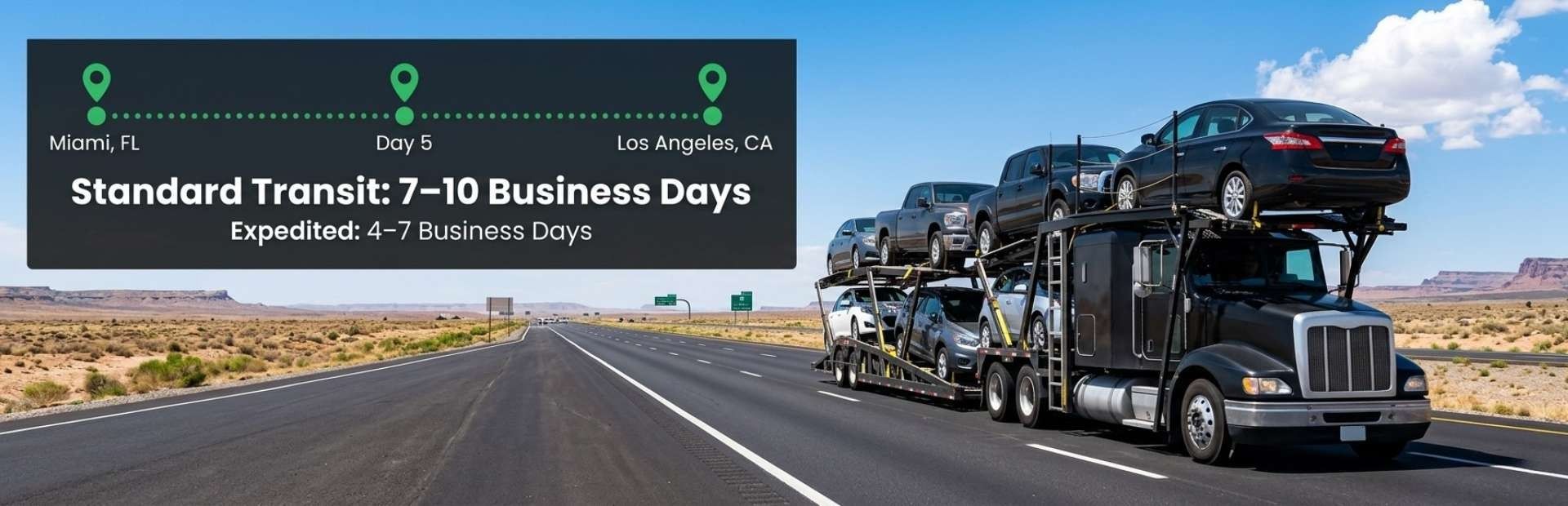
Standard transit on an open carrier runs 7 to 10 business days. That's the baseline for this route, and most shipments fall within it.
But it's an estimate, not a guarantee. Transit time depends on driver availability, how close your pickup and delivery addresses are to the carrier's primary run, and what happens along the 2,757-mile highway between South Florida and Los Angeles.
|
Transport type |
Estimated transit |
Best suited for |
|
Standard open carrier |
7 – 10 business days |
Most personal and dealer shipments |
|
Expedited open carrier |
4 – 7 business days |
Tight timelines, job relocations |
|
Standard enclosed |
8 – 12 business days |
Classic, luxury, or high-value vehicles |
|
Expedited enclosed |
5 – 8 business days |
High-value vehicles with hard deadlines |
Weather through Texas causes the most common delays on this route. The Miami-LA corridor cuts directly across I-10 through the Texas panhandle and desert southwest — a stretch that sees spring tornado activity, summer heat-related road closures, and occasional flooding near the Gulf Coast. Most carriers account for seasonal conditions in their estimates, but it's worth knowing before you set a hard arrival date.
Snowbird season adds another wrinkle. October through March, carrier capacity out of South Florida gets absorbed fast. If you're shipping a car from Miami to Los Angeles during that stretch, expect longer pickup windows, not just higher prices.
Requesting a specific pickup date versus "first available" costs 10 to 20% more. And even with a confirmed date, delays happen. The carriers who handle them best are usually the ones with straightforward communication, not just good average ratings.
One thing worth clarifying: transit time starts from pickup, not from booking. If your carrier confirms pickup on day 5 after booking, delivery on day 14 is still within a 7 to 10-day transit window. That distinction matters when you're coordinating around a move-in date.
For a full breakdown of what slows down cross-country shipments, this guide on what affects car shipping time covers the variables in detail.
If you're a snowbird doing this run seasonally, Transportvibe's seasonal car relocation service is built for exactly this corridor and timing.
Who Actually Ships On This Route — And What Each Group Tends To Get Wrong

The Miami to Los Angeles corridor isn't one type of shipper. It's a route that overlaps several very different situations, and the common mistake in each one is different.
The 2025 United Van Lines National Movers Study confirms that job-driven and lifestyle-driven long-distance moves are the top reasons Americans cross state lines. Florida and California sit at the center of that pattern year after year. That context matters, because what's right for a military officer doing a PCS move is wrong for a snowbird doing their seasonal run — even on the same route.
Here's how each group tends to approach this, and where things go sideways:
People relocating for work or school: They book too close to the start date and end up paying expedited rates they didn't plan for. If you have a start date, count back 3 weeks and book then. Not when the moving truck is already reserved.
Snowbirds headed back west in spring: Waiting until late March is the most expensive time to ship my car from Los Angeles to Miami or in the reverse direction. March is peak outbound season from Florida. Carriers fill up fast, prices spike, and timelines stretch. Booking a month out is the single biggest cost lever for this group.
Car dealerships moving inventory: Multi-vehicle discounts exist on this corridor, but most dealers don't ask. They get quoted a single-unit price and accept it. If you're moving 3 or more vehicles, the rate per car drops. Always ask before you agree to a price.
Classic car owners: The open carrier savings feel significant until there's road debris damage on a car with original paint or a custom finish. On a 2,757-mile haul through desert heat and highway grit, the math on enclosed vehicle shipping for classic cars makes sense much earlier than most people think.
Luxury and exotic car owners: The common gap is insurance. Carrier liability coverage has declared-value limits — often far below the vehicle's actual worth. Before booking, ask specifically what the carrier's declared value maximum is, and check whether your personal auto policy covers transit. Most don't. If not, ask about supplemental coverage.
Military personnel on a PCS move: PCS-specific discounts exist, and most people don't mention their status when they call for a quote. Say it upfront. Several brokers handling military vehicle relocation on this route have negotiated carrier rates for active-duty and veteran shippers.
Seniors shipping a car for the first time: The broker vs. carrier distinction is genuinely confusing. A broker books your shipment and finds a carrier. A carrier physically moves your car. The company you call for a quote is almost always a broker. The driver who shows up is the carrier's employee. Knowing this matters when something goes wrong and you need to know who to call.
Motorcycle owners: Same corridor, entirely different process. Motorcycles ship on specialized trailers, usually enclosed for a run this long. Pricing, lead time, and carrier selection differ from standard car shipping. Don't assume the same companies or the same rates apply.
For what luxury and classic car owners specifically should verify before booking on this route, this guide on shipping classic or luxury cars across the U.S. covers the insurance and carrier vetting steps in detail.
How To Book Your Miami To Los Angeles Car Shipment
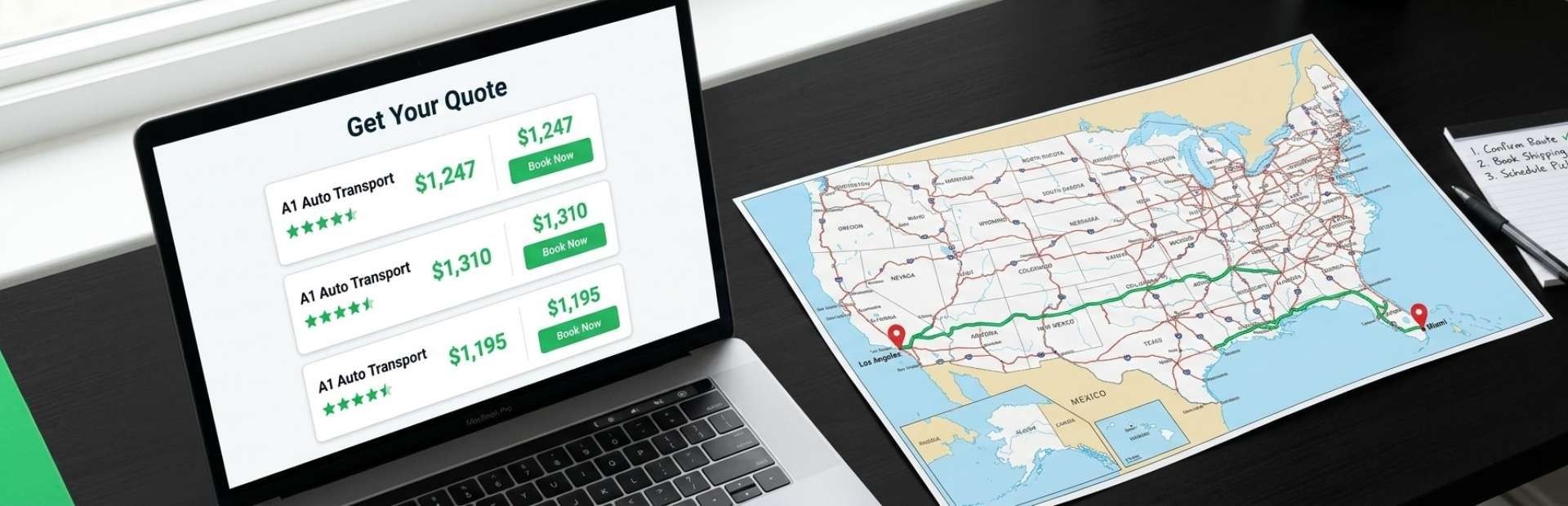
Booking a cross-country shipment is a 5-step process. Most problems trace back to step 1 (comparing on price alone) or step 3 (choosing the wrong pickup window).
Step 1 — Get at least 3 quotes and compare on more than price. Low prices with no carrier reviews are a red flag, not a deal. The quote is easy to give. The actual pickup and delivery is where the difference shows. Look at how recently the company has been reviewed, and whether their reviews are for this type of route.
Step 2 — Verify the carrier's FMCSA registration before you pay anything. Every legitimate auto transport carrier and broker operating across state lines is registered with the Federal Motor Carrier Safety Administration. Before you hand over a deposit, run the company's name or DOT number through the FMCSA Company Snapshot tool. It's free and takes 30 seconds. If they're not in the system, stop there.
Step 3 — Choose your pickup window intentionally. "First available" is cheaper and means the carrier picks up whenever a truck is in your area. A specific date costs more and still isn't fully guaranteed. For most personal shipments, first available saves money without causing real problems. If you have a hard deadline, pay the premium and confirm the window in writing.
Step 4 — Prepare your car before pickup day. Fuel to one-quarter tank. All personal items removed. Timestamped photos of every panel. Disable Florida SunPass or any toll transponder — otherwise, you'll pay for the carrier's tolls across multiple states.
Step 5 — Sign the Bill of Lading at pickup and keep a copy. This document is your legal record of your vehicle's condition at handoff. If there's pre-existing damage, make sure it's noted on the BOL before you sign. A copy of that document is what a damage claim rests on if something happens during transit.
A question worth asking before booking: are you working with a broker or a carrier? Brokers match you to a carrier from their dispatch network. Carriers own the trucks. Both are legitimate and regulated. But when you need to follow up on a delay or a claim, knowing which one you're dealing with tells you who to call first.
Before you commit to a carrier, compare quotes and read verified reviews for this specific route. See Miami to Los Angeles carrier ratings on Transportvibe — it takes about 2 minutes.
For the questions worth asking any broker before you give them a deposit, this guide covers the 5 most important ones.
For a full walkthrough of the auto transport process from booking to delivery, this start-to-finish guide is the clearest breakdown available.
If you're looking for priority-level service on a tight timeline, priority auto shipping is built for situations where the standard first-available window doesn't work.
Before Pickup And After Delivery: What Actually Matters
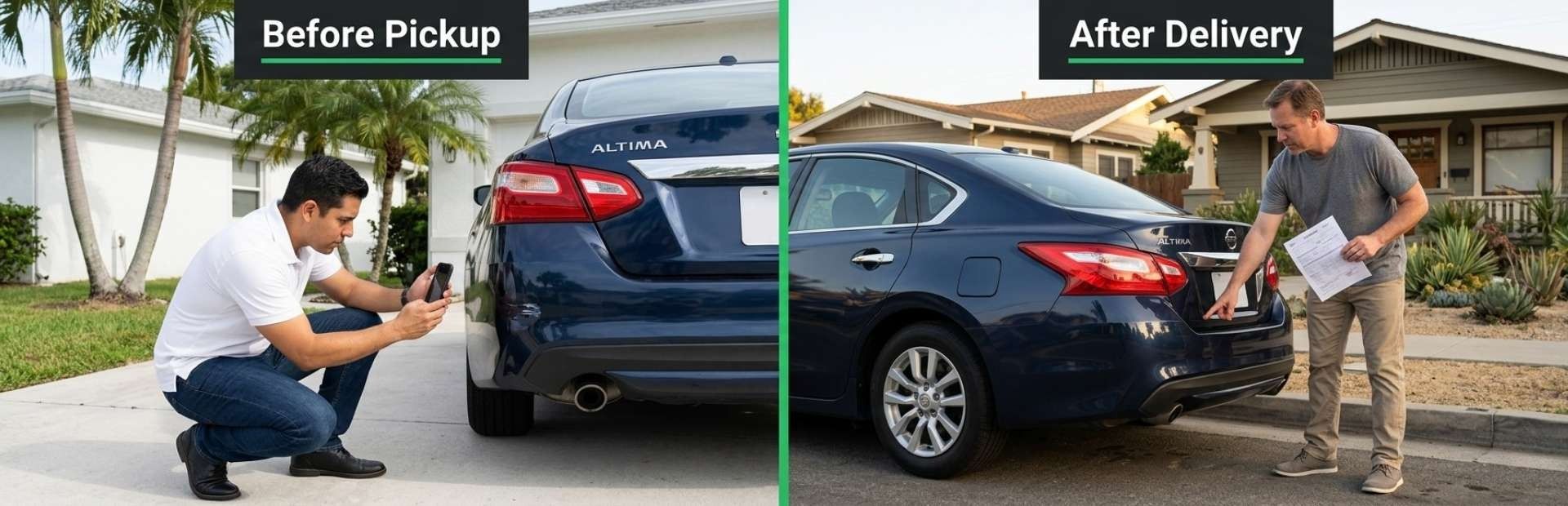
Most shipping problems happen at two points: the handoff in Miami and the inspection in Los Angeles. Both are preventable.
Before Pickup
Do these before the carrier arrives. Not the morning of — before:
-
Fuel level at one-quarter tank or less. Most carriers require it. Excess fuel adds weight to the load; some won't accept the vehicle above a certain fuel level.
-
All personal items out of the car. Carriers are not licensed to transport belongings. Items left inside aren't covered under carrier insurance, and some carriers will refuse pickup if the car has visible personal property.
-
Photograph everything before the driver arrives. Every panel, every bumper, the windshield, the interior. Use timestamps. These photos are your baseline for any condition dispute at delivery.
-
Disable toll transponders. Florida SunPass and E-ZPass transponders stay active during transit. You'll be charged for every toll the carrier passes through on the entire route unless you disable or remove the device.
-
Check tire pressure and battery charge. A flat tire or dead battery at pickup may get your vehicle classified as non-running, triggering a surcharge.
-
Get the assigned carrier's direct contact number. Not just the broker's dispatch line — the actual driver or carrier company. If there's a delay or a question, you want to be able to reach the person with the vehicle.
For a full list of preparation steps that prevent problems, this guide on avoiding car shipping mistakes covers what experienced shippers check before every handoff.
At Delivery
Don't sign anything before you walk around the car.
-
Inspect before signing the delivery receipt. Every panel. Compare against your pre-shipment photos.
-
Mark any new damage on the Bill of Lading before signing. This step is non-negotiable. A clean signature on a delivery receipt with undisclosed damage significantly weakens any claim you file afterward.
-
Photograph any new damage immediately if it exists, before the driver leaves.
-
File a claim within 15 days of delivery. Most carriers close their claims window at that point. After 15 days, the burden of proof shifts heavily to you.
The 5-minute walk-around at delivery is the most skipped step in the entire process. It's also the one that decides whether a damage claim succeeds or fails.
These 6 ways to track your car during shipping can also help you stay informed between pickup and delivery, which reduces the anxiety and makes the delivery inspection less of a surprise.
For a full guide on what the car transport process looks like from booking to delivery, this resource walks through every step.
Best Carriers For The Miami To Los Angeles Route
These aren't ranked as the best car shipping companies overall. They're here because they have documented performance specifically on the Miami to Los Angeles corridor, based on user reviews, route volume, and carrier vetting data on Transportvibe.
The route matters. A carrier with a strong national reputation may have limited capacity on the Florida-to-California run specifically. Route familiarity and driver availability on this corridor are what you're actually evaluating.
Best For Standard Vehicles (Open Carrier)
|
Company |
Best for |
Key strength |
Transportvibe review |
|
Sherpa Auto Transport |
Budget-conscious shippers who want price certainty |
Price-lock guarantee — no surprise at pickup |
|
|
AmeriFreight |
Shippers who want insurance tier options |
Multiple coverage tiers available at booking |
|
|
Ship A Car Direct |
First-time shippers wary of upfront deposits |
No deposit required until carrier is assigned |
Each model works differently. Sherpa locks your rate at booking — the price you're quoted is the price you pay, even if the carrier tries to renegotiate at pickup, which does happen in the industry. AmeriFreight gives you options at the quoting stage, including additional insurance coverage. Ship A Car Direct collects nothing upfront, which removes the deposit risk entirely.
For a detailed breakdown of which open carriers consistently perform on long-haul routes, this guide to the best open carrier auto transport services compares verified customer experiences.
Best For Classic, Exotic, Or High-Value Vehicles
If you're shipping a car from Miami to Los Angeles and the vehicle is worth worrying about, open transport is the wrong call for a run this long.
Two carriers that specialize in enclosed transport on high-value, long-haul shipments:
-
Intercity Lines: Enclosed only — no open option. Known for collector vehicles, classic cars, and exotics. White-glove handling, soft-strapping to prevent frame contact, and full documentation at pickup and delivery. Their rates run higher, but the service level reflects it.
-
Reliable Carriers Inc.: Long-haul enclosed specialists. Frequently used for auction vehicles, dealership transfers of rare inventory, and private collector moves. Reputation for consistent communication and careful handling on cross-country routes.
On a 2,757-mile run from Miami to Los Angeles, the difference between open and enclosed isn't just weather protection. It's road debris at highway speed, temperature swings between Florida humidity and Mojave heat, and a carrier who's loading and unloading multiple times along the route. For any vehicle you'd genuinely regret damaging, the $400 to $600 price difference for enclosed service is straightforward math.
For a curated look at which enclosed carriers hold up on runs like this, this guide to the best enclosed car shipping services in the U.S. covers the options with customer-verified data.
For exotic and collector vehicles specifically, Transportvibe's luxury and exotic car shipping service page outlines what to look for in a carrier before you commit.
What Shippers Ask Most About This Route
These come up before nearly every booking on the Miami to Los Angeles corridor. Straight answers, no filler.
What Is The Average Cost To Ship A Car From Miami To Los Angeles In 2026?
Open carrier quotes run $1,100 to $1,500 in 2026. Enclosed starts around $1,700. Your final cost to ship a car from Miami to Los Angeles depends on vehicle size, booking lead time, and transport type.
How Long Does It Take To Ship A Car From Miami To Los Angeles?
Standard open carrier transit runs 7 to 10 business days on this route. Expedited service cuts it to 4 to 7 days at a higher rate. Snowbird season and weather delays through Texas can stretch the standard window.
Is Open Or Enclosed Transport Better For The Miami To LA Route?
Open transport works for most standard vehicles and costs $400 to $600 less. Enclosed is the right call for any vehicle worth $50,000-plus, or any car with original paint or custom bodywork on a 2,757-mile haul.
How Much Does It Cost To Ship A Car From Los Angeles To Miami?
Shipping a car from Los Angeles to Miami costs roughly the same as the reverse: $1,100 to $2,700 depending on carrier type. Eastbound carrier availability from California can vary seasonally, which shifts the price slightly.
What Should I Look For In A Carrier Before Booking On This Route?
Verify FMCSA registration before paying anything. Read recent reviews specific to this route, not just overall ratings. Confirm whether the company is a broker or a carrier, and ask about their declared value coverage limit.
Before You Book
Here's the short version of everything in this article.
Open carrier works well for most standard vehicles on the Miami to Los Angeles route — it's how roughly 90% of cars move across the country, and the carrier pool on this corridor is large enough that competitive rates are available. Book 2 to 3 weeks out. Avoid the October-March snowbird window if price matters. Go first-available unless a specific date is genuinely necessary.
Enclosed is worth it for anything you'd genuinely worry about on a 2,757-mile haul. Not because open carriers are careless, but because road debris and weather exposure over that distance are real variables. The cost difference on this route is $400 to $600 on average. For a vehicle worth $50,000 or more, that's not a close decision.
The biggest risk on this route isn't the transport itself. It's choosing a carrier without verifying their FMCSA registration and reading recent customer reviews. The corridor is well-serviced. Competition keeps pricing honest. The gap between carriers is in communication, handling, and what happens when something doesn't go as planned.
Read the reviews. Verify the registration. Book with lead time. And get at least 3 quotes before you commit to any single carrier.
Get a free, no-obligation quote for your Miami to Los Angeles car shipment and see which verified carriers are available for your dates.


