



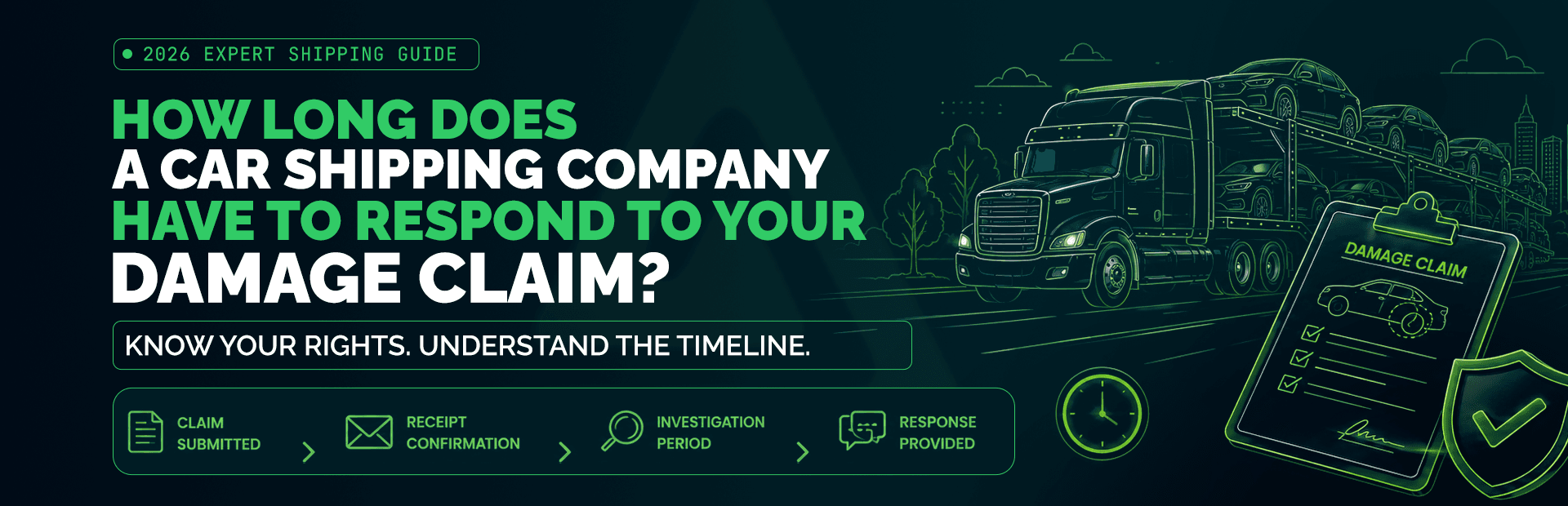
Federal law gives a motor carrier up to 120 days to pay, decline, or make a written settlement offer once you file a damage claim, and it has to acknowledge that claim in writing within 30 days (49 CFR §370.9).
Most people never learn that until their car rolls off the truck with a fresh dent and the phone stops getting answered. That gap is what this guide closes. Knowing the damage claim response time in car shipping tells you exactly when a company owes you an answer, who actually pays, and what to do the second the silence starts.
Shipping soon and want it handled right the first time? Get a free, no-pressure quote from carriers who put pickup, delivery, and claim terms in writing before your car ever moves.
The Real Answer: How Long a Car Shipping Company Has to Respond to Your Damage Claim
Here is the short version, up front, so you can act on it today.
Once you file a written claim, the carrier has 30 days to acknowledge it and 120 days to pay it, deny it, or send a firm settlement offer in writing. If it still cannot resolve the claim after 120 days, it has to update you in writing every 60 days until it does. Those windows come straight from the federal claims rules that govern motor carriers (49 CFR Part 370).
That is the legal backbone of the damage claim response time in car shipping. It is not a customer-service promise a company can bend. It is the rule, and every step of the auto transport damage claim process runs on these windows.
|
Stage |
Who acts |
The window |
What starts the clock |
|
Acknowledge the claim |
Carrier |
30 days |
The day they receive your written claim |
|
Pay, deny, or offer settlement |
Carrier / insurer |
120 days |
Same filing date |
|
Ongoing status updates |
Carrier / insurer |
Every 60 days |
If unresolved past 120 days |
Two things trip people up. First, the clock does not start when your car gets damaged. It starts when you file a proper written claim. Every day you wait to file is a day the clock is not running for you. Second, the response window is separate from your car shipping insurance claim time limit, which is the deadline to file and something we cover below. Confuse the two and you can lose a real claim on a technicality.
For a plain-English refresher on how a shipment moves from booking to doorstep, this car transport guide and this walk-through on how to choose the right auto transport service both help. If you want the full booking-to-delivery picture, start with auto transport from start to finish. For a dealership owner moving several units, the same 30 and 120-day windows apply to each unit, so track every claim on its own clock.
Broker vs Carrier: Who Actually Pays for Car Damage During Transport
This is the question that sends people in circles. You booked through a broker, but a carrier's driver did the actual hauling. So who pays for car damage during transport?
The short answer: the carrier and its cargo insurance pay for damage that happens on the truck. The broker arranged the job. In most cases the broker does not carry the insurance that covers your paint and panels. Getting the auto transport broker vs carrier liability split right decides where you send your claim, and where you waste your time.
|
Broker |
Carrier |
|
|
Role |
Arranges the shipment, matches you to a hauler |
Physically transports your car |
|
Carries cargo insurance? |
Usually no |
Yes, this is who pays |
|
You file your claim against |
The carrier (broker can assist) |
The carrier |
|
Escalation help |
Can push the carrier on your behalf |
The party legally on the hook |
What the Carrier Is Legally on the Hook For
Under the Carmack Amendment, the interstate carrier is generally liable for loss or damage to your vehicle while it is in their care, from pickup to delivery (Benesch Law overview). That liability is why every legitimate carrier has to carry active cargo insurance and a valid operating authority. Before you book, confirm both. Most cars ship fine on open car shipping, and the coverage rules are the same whether the trailer is open or enclosed. This is exactly why the auto transport broker vs carrier liability distinction matters. You file against the party with the insurance, not the party who answered your first call.
What the Broker Does, and Does Not, Cover
A good broker earns its fee here. It can chase the carrier, help you assemble paperwork, and keep the file moving. What it usually cannot do is cut you a check from its own pocket, because it is not the insurer. Some brokers carry contingent cargo coverage, but that is a backstop with limits, not your primary path.
-
The broker arranges. The carrier insures.
-
The broker can advocate. The carrier pays.
-
Contingent broker coverage exists, but treat it as a fallback, not the plan.
That is who pays for car damage during transport in almost every case: the carrier's cargo insurance, with the broker in a support role.
For a military family on PCS orders or a student relocating across the country through a door-to-door service, this is the part to nail down before signing. If your route crosses state lines, the same rules follow the truck whether you are shipping a car to another state or across the country.
The Bill of Lading: Your Single Most Important Piece of Evidence
If you remember one thing, remember this. The bill of lading is the document that wins or kills your claim. It is the inspection record both you and the driver sign at pickup and again at delivery, and its condition notes are the evidence a claim stands on. A careful bill of lading car shipping inspection is worth more than any argument you make later.
Skip it, and you hand the company its easiest defense.
The Delivery Inspection Checklist: Do This Before You Sign
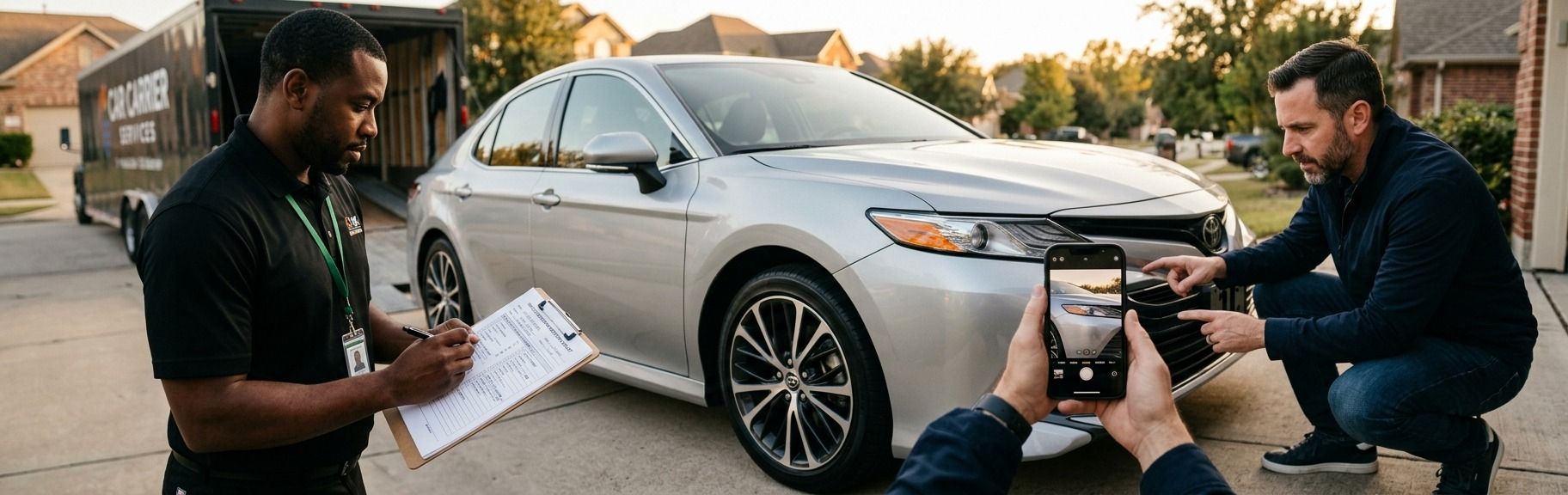
Do not rush this, even at a bad hour. Walk the whole car with the driver and your phone out. Use covered vehicle transport if your car warrants extra protection, but inspect every delivery the same careful way.
-
Walk the car in one direction, roof to rockers, front to back.
-
Check panels, bumpers, wheels, mirrors, and glass in good light.
-
Look under the front lip and rear valance, where scrapes hide.
-
Take timestamped photos and a slow video, all sides plus close-ups.
-
Note any new damage on the bill of lading before you sign.
-
Get the driver's name and the carrier's contact on the spot.
That delivery inspection car shipping checklist takes ten minutes and protects thousands of dollars. If you loaded personal items, know the rules first, because packed belongings usually fall outside cargo coverage and can complicate a claim.
"No Damage Noted on the Bill of Lading": Can You Still Claim?
Yes, but it is harder. A no damage noted on bill of lading claim starts on your back foot, because the signed document says the car arrived clean. Harder is not the same as hopeless. What still helps: clear pickup photos that prove the damage was not there before, a fast written report, and the driver's own condition report auto transport records from the pickup end.
The realistic play is speed and proof. The sooner you report a no damage noted on bill of lading claim and the stronger your pickup-versus-delivery photos, the better your odds. This is why the bill of lading car shipping inspection and the condition report auto transport paperwork both matter so much. They are the timeline of your car's condition, and a good delivery inspection car shipping checklist is what keeps that timeline honest. Seniors and anyone taking a late-night delivery, this is your moment to slow down, not speed up.
Car Damaged During Transport? What to Do in the First 24 Hours
Spotting fresh damage is a gut-punch. What you do in the next day decides how the claim goes. Here is car damaged during transport what to do, in order.
-
Do not sign a clean bill of lading. Note the damage first.
-
Photograph everything, all angles, close and wide, with timestamps.
-
Refuse the "sign now, sort it out later" line. Once you sign clean, you have given away your strongest card.
-
Report it in writing to both the carrier and the broker the same day.
-
Log every call and message with names, dates, and times.
Those are the photos needed for car shipping damage claim files that adjusters actually accept, and together with the signed delivery notes they are how you start proving car damage during shipping. A motorcycle owner should check the tie-down points and lower fork area first, because strap pressure and loading are where two-wheel damage usually shows. If you are weighing how a bike travels, open-air versus enclosed motorcycle shipping changes the risk profile. A classic or exotic owner should photograph original details up close, since proving car damage during shipping on a collector car often comes down to documenting what was factory-correct before pickup. Knowing car damaged during transport what to do in that first day is the whole difference between a paid claim and a denied one.
How to File a Car Shipping Damage Claim, Step by Step
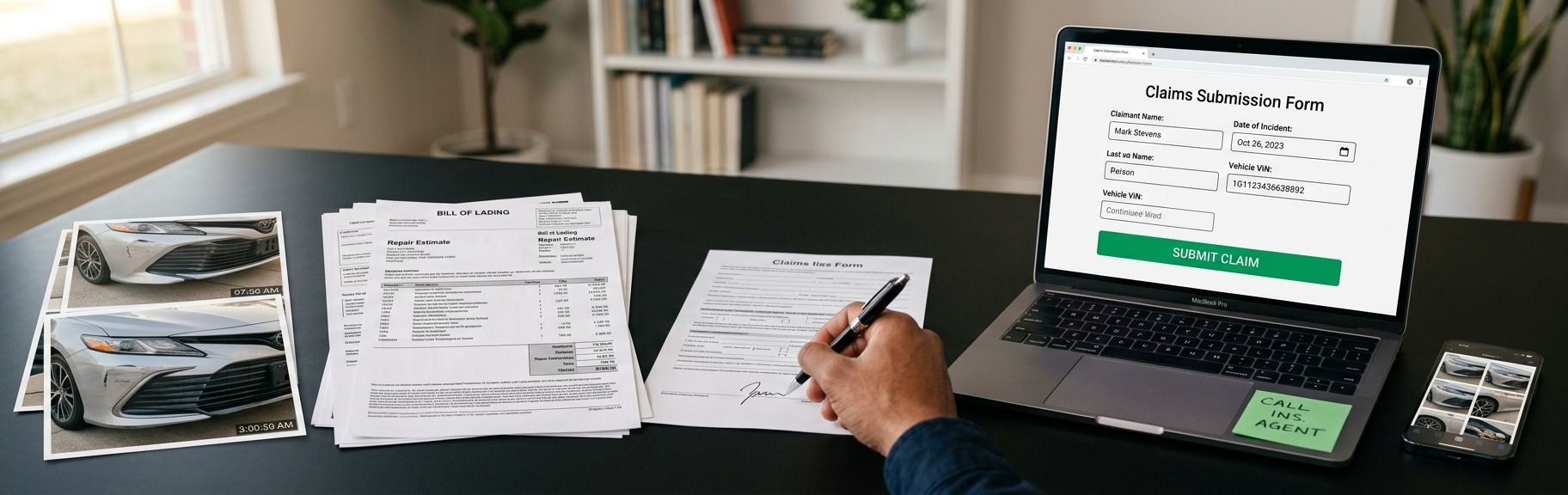
Once you have documented the damage, filing is a process, not a phone argument. Follow the steps and the deadlines and you keep every advantage. This is how to file a car shipping damage claim without giving the company an easy out.
-
Notify the carrier in writing that you are filing. Email creates a record.
-
Request the carrier's official claim form and insurance details.
-
Assemble your evidence: signed bills of lading, photos, and a repair estimate.
-
State a specific dollar amount. A vague claim invites a vague answer.
-
Submit within the filing window, then keep copies of everything.
-
Follow up on a schedule and hold them to the 30 and 120-day rules.
|
Step |
What you send |
The deadline that applies |
|
Notice |
Written notice of intent to claim |
As soon as possible after delivery |
|
Formal claim |
Claim form, photos, estimate, dollar figure |
Within the carrier's filing window |
|
Response |
Nothing, you wait |
Carrier owes an answer in 120 days |
The one deadline you cannot miss is the filing window. Under Carmack, a carrier cannot require you to file in less than 9 months, and cannot require a lawsuit in less than 2 years after a denial (SNJ Legal). Many bills of lading set the filing window right at that 9-month floor, so read yours. That is your real car shipping insurance claim time limit, and it is the answer to how long to file an auto transport claim: usually up to nine months, but confirm it in writing. When people ask how long to file an auto transport claim, nine months is the safe assumption, and your bill of lading is the final word.
Filing a claim against an auto transport carrier is the same auto transport damage claim process whether you moved one car or a driveway full. Rules vary a little by state, so this state-by-state look at car shipping regulations is worth a scan. A dealership owner running several claims at once should log each on its own filing clock and its own response clock. Nine months is generous until it is not.
The Documents That Make or Break Your Auto Transport Insurance Claim
Adjusters stall claims for "missing information." Give them nothing to stall on. The auto transport insurance claim documents below are the full set that keeps a file moving.
-
The signed bill of lading from both pickup and delivery.
-
Timestamped photos and video from delivery, plus your pickup shots.
-
A written repair estimate, or an appraisal for a high-value car.
-
The carrier's insurance policy reference and claim form.
-
Copies of every written notice and message you sent.
Those are the auto transport insurance claim documents that turn a "we're reviewing it" into a real answer. Your delivery photos are the same photos needed for car shipping damage claim approval, and they are the backbone of proving car damage during shipping when a company pushes back.
One number to plan around: the deductible. A car shipping insurance deductible claim only pays out above the carrier's deductible, so if the repair is small, the payout can be small or nothing. Get the repair estimate first. If it sits below the deductible, a car shipping insurance deductible claim may not be worth the paperwork, and knowing that early saves you a month of chasing. For a collector car, get a proper appraisal, not a body-shop guess, because the numbers are different and so is the coverage.
When a Car Shipping Company Denies or Ignores Your Claim
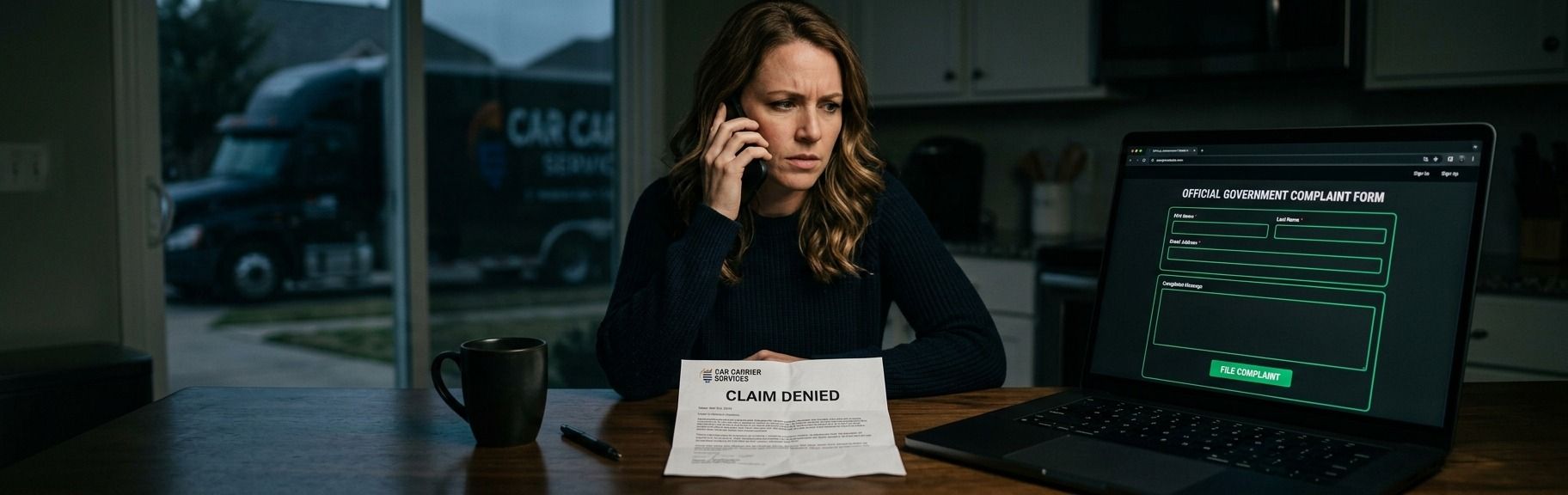
Denial and silence are common opening moves, not the final word. If a company goes quiet or says no, you have a clear ladder to climb. Here is what to do if car shipping company denies claim requests, or simply stops replying.
-
Send a written follow-up with a firm response deadline.
-
Ask for the denial reason in writing. A vague "denied" is not a real answer.
-
Loop in the broker and have them push the carrier.
-
File a complaint with the FMCSA National Consumer Complaint Database.
-
Send a demand letter, then use small claims court for smaller amounts.
-
For larger losses, talk to an attorney about a Carmack claim.
That is what to do if car shipping company denies claim requests or simply stalls: climb the ladder, in writing, on the record. A car shipping company not responding to claim messages is often betting you will give up before the 120 days are gone. Do not. The regulation is on your side, and a documented paper trail changes the tone fast. If you are dealing with a car shipping company not responding to claim follow-ups, the written federal complaint is the step that tends to wake people up.
This matters most for people who are far from the carrier when a claim goes cold. Snowbirds heading between Florida and Arizona often ship in one state and settle in another, so keep every record digital and keep filing a claim against an auto transport carrier on schedule even from a distance. If you booked through a broker, revisit that guide to choosing a service and lean on them to escalate.
Companies Known for Handling Damage Claims Fairly, and How to Vet Any of Them
Names help, but the skill you actually want is being able to vet any company yourself. Here are a few with strong claims and insurance reputations, then the method that works on all of them.
AmeriFreight is known for offering gap coverage that can reimburse the carrier's insurance deductible, which is often the exact amount customers get stuck paying out of pocket (AmeriFreight's coverage page). For a deeper look, see this AmeriFreight review.
American Auto Shipping is known for upfront pricing and a straightforward process, which tends to mean fewer surprises if a claim comes up.
And Intercity Lines runs its own enclosed vehicle shipping fleet built around classic, exotic, and collector cars, usually with higher coverage limits and drivers trained for high-value work. For that crowd, this roundup of top enclosed car shipping services is a useful shortlist.
The real skill is vetting. Do it the same way every time.
-
Confirm active cargo insurance and a valid operating authority before booking.
-
Read how the company answers its negative reviews, not the glowing ones.
-
Ask for the claims process and the filing window in writing, before you sign.
-
Ask directly about their damage claim response time in car shipping, and get the answer on paper.
A classic-car owner in Texas shipping to a show, a snowbird, a first-time shipper, they all benefit from the same three minutes of homework. The company that answers claims questions clearly before your car moves is usually the one that answers them clearly after.
What People Ask Us Most Before They File
The quick-hit questions that come up again and again once a car shows up with damage.
How Long Does A Car Shipping Company Have To Respond To A Damage Claim?
Federal rules give the carrier 30 days to acknowledge your claim and 120 days to pay it, deny it, or make a written offer. After that, it has to update you every 60 days.
What Happens If There's No Damage Noted On The Bill Of Lading But I Find Damage Later?
You can still file, but it is harder, since your signed paperwork says the car arrived clean. Move fast and use your pickup photos to prove the damage was not there before.
Who Pays For The Damage — The Broker Or The Carrier?
The carrier and its cargo insurance pay for damage that happens on the truck. The broker only arranged the shipment, so you file against the carrier, not the broker.
How Long Do I Have To File An Auto Transport Damage Claim After Delivery?
Usually up to nine months. Under the Carmack Amendment, a carrier cannot make you file in less than nine months, but check your bill of lading for the exact deadline.
What Can I Do If The Car Shipping Company Ignores Or Denies My Claim?
Follow up in writing with a deadline, get the denial reason on paper, loop in the broker, and file an FMCSA complaint. For big losses, consider small claims or an attorney.
Before You Sign, Know Your Clock
Every part of this comes down to a decision you make at the curb, not in a courtroom. The response clock, the filing clock, and the deductible all reward the person who documents fast, files in writing, and holds the company to the 30 and 120-day rules. That is the whole of the damage claim response time in car shipping, and it is not complicated once you see the timeline.
The single move that protects every driver, from the dealership owner to the senior to the motorcycle rider, is this: never sign a clean bill of lading you have not verified with your own eyes and your own camera. Do that, and most claims never turn into a fight.
Ready to ship with a carrier that treats claims like a promise, not a problem? Request a free quote today and compare companies that put timelines, coverage, and response windows in writing before you book.