



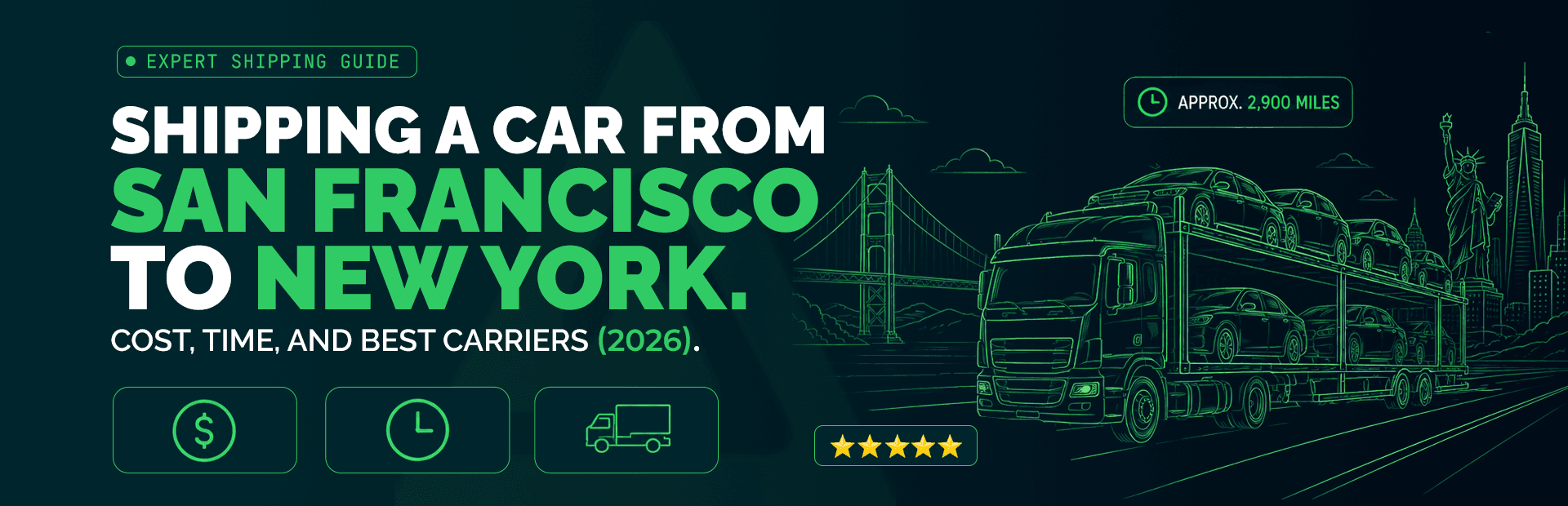
According to United Van Lines' 49th Annual National Movers Study, New York and California each recorded 58% outbound migration rates in 2025, among the highest in the country. For a lot of those moves, a car needs to cross 2,900 miles.
The San Francisco to New York corridor is one of the busiest in domestic auto transport. Whether you're relocating for work, shipping a recently purchased car, or sending your vehicle ahead of a full move, the questions are the same: how much, how long, and who do you trust for a cross-country haul?
This article covers real 2026 pricing, transit windows, open vs. enclosed options, delivery logistics, and the carriers that consistently perform on this specific run.
Get accurate, carrier-verified quotes for the San Francisco to New York car shipping route before you commit to any online estimate. Start at Transportvibe.
What It Costs to Ship a Car from San Francisco to New York in 2026
The price range for this route in 2026 runs $950 to $2,800, and the gap is wide for a reason: open and enclosed carriers are priced differently, and vehicle size changes the math too.
Shipping a car from California to New York on an open carrier typically runs $950 to $1,500 for a standard sedan. An SUV or full-size truck? Expect $1,200 to $1,800. Enclosed shipping starts around $1,600 for a sedan and can reach $2,800 or more for larger high-value vehicles.
Open carrier from SF to NYC: $950–$1,500 for standard sedans. $1,200–$1,800 for SUVs and full-size trucks. Enclosed: $1,600–$2,800 depending on vehicle type and timing.
Open Carrier Cost by Vehicle Size
What you'll pay on an open trailer from San Francisco to New York depends primarily on your vehicle's footprint on the carrier, not just its weight.
|
Vehicle Type |
Low Estimate |
High Estimate |
Notes |
|
Sedan / Coupe |
$950 |
$1,400 |
Standard fit, most available carrier slots |
|
SUV / Crossover (standard) |
$1,100 |
$1,500 |
More trailer space = higher base rate |
|
SUV / Crossover (full-size) |
$1,200 |
$1,700 |
Third-row SUVs are often treated as oversized |
|
Pickup Truck (standard bed) |
$1,200 |
$1,700 |
Bed height adds carrier placement complexity |
|
Pickup Truck (lifted/oversized) |
$1,400 |
$1,900 |
Requires specialized carrier positioning |
|
Minivan |
$1,100 |
$1,600 |
Similar footprint to a full-size SUV |
These are SF metro-to-NYC metro estimates. Rural or suburban Bay Area pickup adds $75 to $150 because the carrier has to detour off its primary route. Expedited first-available pickup adds another $200 to $400 on top of the base rate. Booking 2 to 3 weeks out generally keeps you in the lower half of these ranges.
For more on how open vs. enclosed pricing compares by vehicle type, see this open vs. enclosed transport cost breakdown.
Enclosed Carrier Cost and When It's Worth It
Enclosed shipping costs more because fewer vehicles fit per trailer, and the equipment is more expensive to run. The premium over open carrier typically runs $400 to $800 on this route.
|
Vehicle Type |
Estimated Range |
When Enclosed Makes Sense |
|
Luxury sedan |
$1,600 – $2,200 |
Vehicles $40K+ where cosmetic damage creates a real claim |
|
Exotic / sports car |
$1,800 – $2,800 |
Any exotic, regardless of value |
|
Classic or collector vehicle |
$1,700 – $2,500 |
Enclosed is the industry standard for these |
|
Modified / custom vehicle |
$1,600 – $2,400 |
Custom bodywork changes damage thresholds significantly |
|
Standard vehicle (optional upgrade) |
$1,500 – $2,000 |
Rarely necessary for daily drivers |
On a 2,900-mile run, open carriers perform fine for most vehicles. Enclosed makes financial sense when the car's value or condition means minor road debris becomes a costly problem.
Explore your open car shipping options, or get pricing for enclosed vehicle shipping based on your specific vehicle and route.
How Long Does It Take to Ship a Car from San Francisco to New York?

Transit time on this route runs 7 to 14 days for standard service. Here's exactly why that range exists, and when expedited changes the picture.
Your car isn't on a direct truck. It's on a carrier that loads 7 to 10 vehicles and makes multiple stops along the way. That truck may drop one car in Salt Lake City, another in Denver, a third in Chicago, then continue east. The stops are what keep the price from being $3,000. They're also what makes the window a range rather than a date.
|
Service Type |
Typical Window |
Notes |
|
Standard open carrier |
7–14 days |
Most shipments land here |
|
Expedited open carrier |
4–7 days |
First-available pickup; add $200–$400 |
|
Standard enclosed |
8–14 days |
Thinner carrier pool = slightly wider range |
|
Expedited enclosed |
4–8 days |
Premium for both speed and protection |
|
Door-to-door (any service) |
Add 1–3 days |
Pickup window is separate from transit time |
The 1-to-7-day pickup window is a separate variable from transit time. Most brokers won't give a guaranteed pickup date. They give a window. If you need to vacate your Bay Area home by a fixed date, that distinction matters a lot.
FMCSA Hours of Service regulations cap drivers at 11 hours of driving per 14-hour on-duty period. On 2,900 miles, that's a minimum of 5 to 6 driving days before you factor in weather through the Rockies, Midwest congestion, or multi-stop scheduling. That's why the published window is always a range. You can read more on carrier regulations at FMCSA.dot.gov.
If your move date is fixed, expedited pickup, sometimes called first-available or priority service, bumps your load to the front of the dispatch queue. It costs more but removes the pickup window uncertainty entirely. See priority auto shipping options for details.
For a full look at what drives transit variability on cross-country routes, this car shipping time breakdown covers the major factors in depth.
Open Carrier vs. Enclosed Shipping on a 2,900-Mile Run
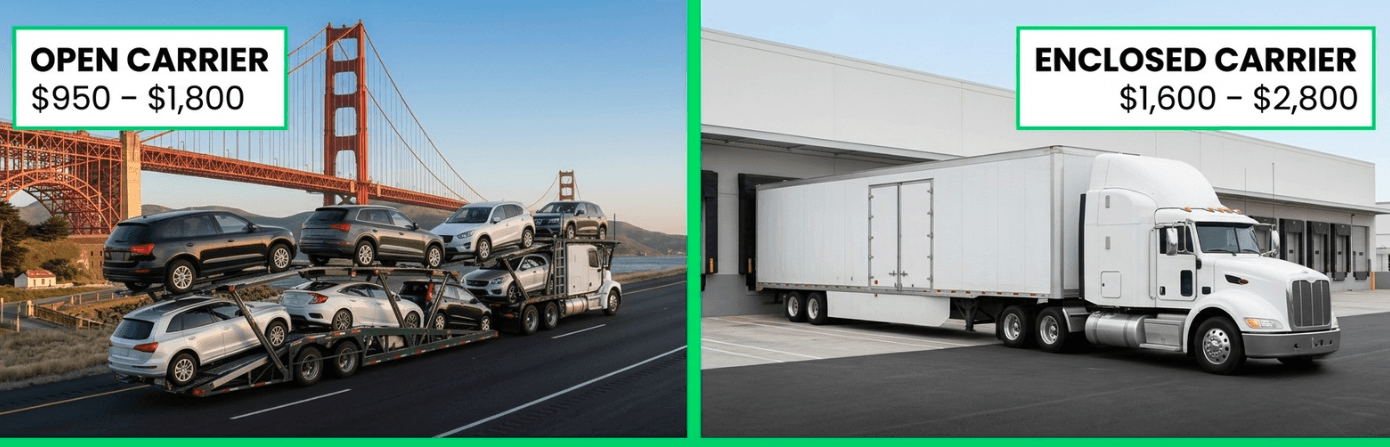
A side-by-side look at both carrier types for the SF-to-NYC corridor, including cost, exposure, availability, and who each option actually fits.
About 90% of all domestic auto transport moves on open trailers. On the SF-to-NY corridor specifically, open carrier availability is strong because it's one of the highest-volume cross-country routes in the country. More volume means more carriers running it, faster dispatch times, and competitive pricing.
Enclosed availability is decent but thinner, especially for first-available pickup windows.
|
Factor |
Open Carrier |
Enclosed Carrier |
|
Typical cost (sedan) |
$950 – $1,400 |
$1,600 – $2,200 |
|
Typical cost (SUV) |
$1,200 – $1,700 |
$1,800 – $2,600 |
|
Transit time |
7–14 days |
8–14 days |
|
Weather and debris exposure |
Yes, full exposure |
No, fully covered |
|
Carrier availability (SF to NYC) |
High, frequent |
Moderate |
|
Best for |
Daily drivers, relocations, dealership inventory |
Classics, exotics, luxury vehicles, high-value cars |
Who Should Choose Open Carrier
Open carrier is the right call for most people on this route. Here's who that includes:
-
Employees relocating with a daily driver
-
College students and recent grads moving cross-country
-
Dealership owners shipping inventory (volume discounts are often available for multiple vehicles)
-
Military members on PCS orders with a standard vehicle
-
Snowbirds shipping a seasonal vehicle they don't want sitting idle
-
Anyone where the car's market value doesn't justify the enclosed premium
Open is not a downgrade. The cars you buy from dealerships move on open carriers. Factory-to-dealer transport runs on open trailers. It's the industry standard because it works at scale.
Who Should Choose Enclosed
Enclosed makes financial sense when the car's value, condition, or purpose justifies the premium over open carrier. Here's who typically needs it:
-
Classic car owners and car show organizers (enclosed is the standard for show-quality vehicles)
-
Exotic and luxury car owners with vehicles worth $40,000 or more
-
Anyone shipping to or from an auction or collector event
-
Owners with custom paint, bodywork, or modifications that are costly to repair
-
Seniors moving a vehicle they've maintained in pristine condition
-
Military members transporting a high-value vehicle on a long-haul PCS move
For show organizers shipping multiple collector vehicles, the $400 to $800 per-car premium over open is the cost of doing business. One road debris claim on a $150,000 car costs far more than the enclosed difference.
Looking at classic vehicle shipping if you're moving a collector car? The handling protocols are different from standard bookings.
What Actually Moves the Price on the SF to New York Route
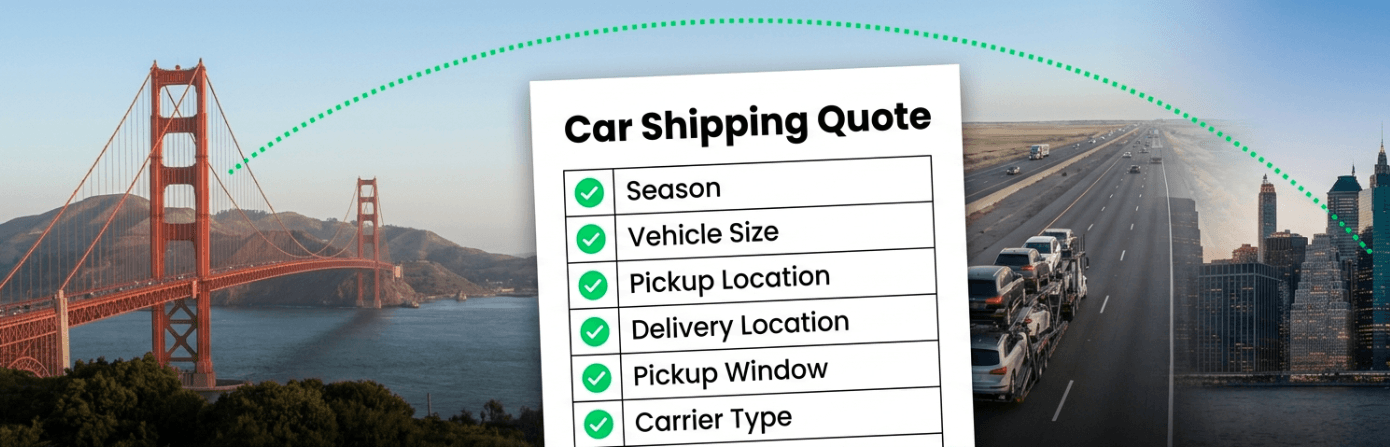
Six real factors that change your San Francisco to New York car shipping cost, with specific detail on how season, vehicle size, and booking timing work on this corridor.
This isn't a generic cost list. Each factor below is specific to how pricing behaves on the SF-to-NYC run.
Book 2 to 3 weeks in advance and you can typically reduce your quote by $100 to $300 compared to same-week booking. Peak summer rates (June through September) run 15 to 25% higher than fall and winter windows on this route.
1. Season and demand. Spring and summer peak from June through September. College moves, job relocations, and summer movers all compete for the same carrier slots heading east. Fall generally softens for west-to-east shipments. Winter brings lower demand but slower transit through the Rockies and Midwest.
2. Vehicle size. Larger vehicles take more physical space on a carrier that holds 7 to 10 cars. More space means a higher base rate. A lifted pickup costs more to ship than a Civic, every time.
3. Pickup location. The SF metro is well-serviced with frequent carriers. Rural or suburban Bay Area pickup adds $75 to $150 because the carrier has to detour off its primary route.
4. Delivery location. Manhattan delivery adds complexity. Large carriers can't always navigate tight streets or low-clearance areas. Outer boroughs and suburban New York are easier and usually cheaper to reach.
5. Pickup window type. Standard 1-to-7-day window vs. expedited first-available. The difference is $200 to $400 on open carriers, more on enclosed.
6. Carrier type. Open vs. enclosed. Already covered above, but it's the single biggest cost variable after distance.
Snowbirds shipping a second car east in the fall often catch favorable rates, since west-to-east demand is softer than the reverse. If your timing is flexible, September and October are typically the best windows for this run.
For broader seasonal strategy, this guide on when to ship a car for the best rates covers the full calendar year. If you ship seasonally on a recurring basis, seasonal car relocation services may offer better options than one-off bookings.
Door-to-Door vs. Terminal-to-Terminal from the Bay Area to New York
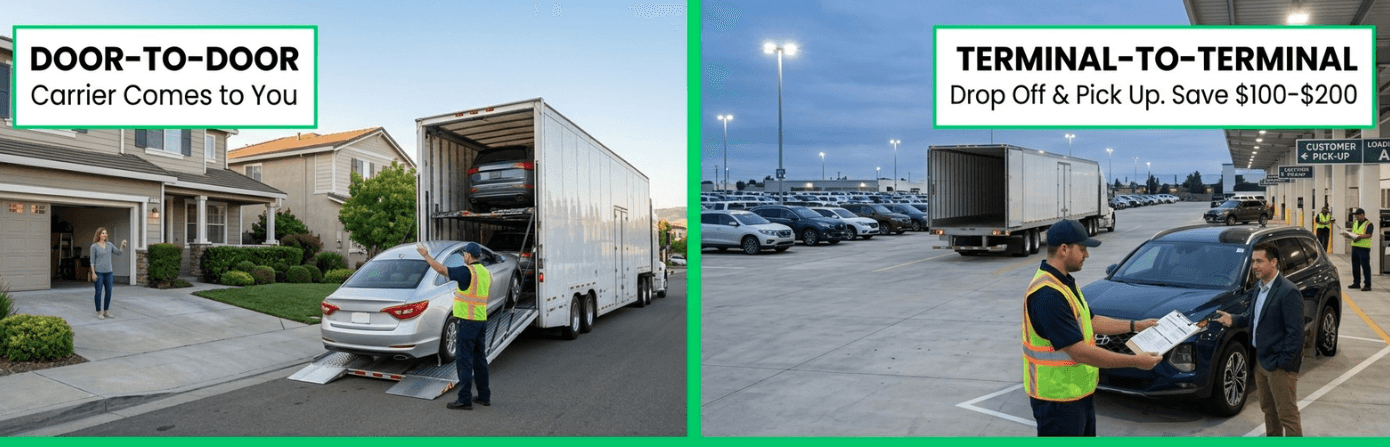
How each delivery option works on this route, what the price difference looks like, and the specific Manhattan logistics wrinkle that most car shipping articles don't address.
Door-to-door is the standard on most SF-to-NY shipments. The carrier picks up at your Bay Area location and delivers to a New York address. Most residential neighborhoods, outer borough streets, and suburban delivery addresses are accessible without issue.
Manhattan is a different situation.
|
Factor |
Door-to-Door |
Terminal-to-Terminal |
|
Price difference |
Standard market rate |
$100–$200 cheaper on average |
|
Pickup window |
Standard 1–7 day window |
Fixed drop-off date at terminal |
|
Delivery flexibility |
Carrier comes to you |
You pick up at the terminal |
|
Best for |
Most private shippers, seniors, and anyone without local transport at the destination |
Budget-conscious shippers with rides available at both ends |
|
Manhattan delivery |
Carrier delivers to the nearest accessible street or drop zone |
Nearest terminal, often in outer boroughs |
The Manhattan note: Large auto transport carriers can't access tight streets, low-clearance garages, or most residential parking structures. Many carriers route Manhattan deliveries to a street-accessible drop zone, sometimes in Midtown, the outer boroughs, or a nearby commercial area. If you're in Manhattan, confirm the exact delivery location before you book. "Door-to-door" on this route means accessible-street delivery, not necessarily your building's specific garage.
Terminal-to-terminal saves $100 to $200 on average, but you need to drop off your car in the Bay Area and pick it up in New York yourself. If you're flying out and have no way to reach the terminal on either end, factor in those logistics costs.
For a full walkthrough of how both options work from booking to delivery, this terminal-to-terminal vs. door-to-door guide covers the key differences in detail.
If you're coordinating a full household move alongside your vehicle, home relocation services can sometimes bundle vehicle and household shipments more efficiently.
Best Auto Transport Companies for San Francisco to New York in 2026
Three companies with strong track records on this cross-country corridor, plus how to verify any carrier's registration before you hand over a deposit.
Most people booking SF-to-NYC auto transport work with a broker, not a direct carrier. Brokers dispatch your car through a vetted carrier network. On a 2,900-mile run, that network depth matters. A broker with strong West Coast relationships gets your car dispatched out of San Francisco faster than one whose carrier pool is thin in California.
Before you book anyone, verify their DOT/MC registration at FMCSA's company snapshot tool. Active registration and a satisfactory safety rating are the baseline. After that, you're comparing communication quality, pricing transparency, and their specific record on this corridor.
|
Company |
Best For |
Notable Strength |
Transportvibe Review |
|
Mercury Auto Transport |
Budget-conscious shippers needing scheduling flexibility |
Large carrier network, fast dispatch, competitive quote comparison |
|
|
Crestline Auto Transport |
Shippers who prioritize communication and billing clarity |
Consistent updates throughout transit, no surprise charges at delivery |
|
|
uShip |
Shippers who want to compare carrier bids directly |
Marketplace model: carriers bid on your specific route and timeline |
A quick note on the broker vs. carrier question: for a 2,900-mile run, brokers give you more scheduling flexibility and access to a larger pool of carriers running the I-80 and I-90 corridors. Direct carriers can work well if your timeline is flexible and they already run this specific lane. For most private shippers on this route, a broker is the practical choice.
Get quotes from vetted carriers and compare your options for the San Francisco to New York run at Transportvibe.
For a broader list of top-rated brokers in 2026, this roundup of the best car shipping companies covers options across budget tiers and service types.
How to Prepare Your Car for the San Francisco to New York Haul
A practical pre-shipment checklist, what to do if your vehicle doesn't run, and how the carrier's cargo insurance actually works on a run this long.
Most carriers don't require much from you before pickup. But skipping the basics creates problems at the other end of a 2,900-mile trip. Here's what to do before your car gets loaded:
-
Document existing damage. Take photos of all four sides, the roof, and the undercarriage if accessible. Timestamp them. These photos are your only protection if something arrives wrong.
-
Keep fuel at a quarter tank or less. Full tanks add weight and can create carrier safety concerns.
-
Remove personal items from the interior. Most carriers won't accept them, and they're not covered under cargo insurance if something happens.
-
Disable your toll transponder or set it to pause. An active E-ZPass traveling through every toll state on the eastern corridor for 2,900 miles will rack up charges fast. Set it to manual before pickup.
-
Check tire pressure. No slow leaks. Carriers can refuse vehicles with flat or significantly low tires.
-
Secure loose accessories. Custom antennas, spoilers, or anything that could catch highway wind for two weeks.
-
Disable the alarm. Or leave the disarm code with the carrier. An alarm that triggers mid-transport is a genuine problem.
Shipping a non-running vehicle: You can ship an inoperable car from California to New York, but you must declare it at booking. Most carriers add $100 to $200 because they need a winch or specialized ramp to load it. Don't disclose it at pickup instead. Carriers who arrive to a non-running vehicle they weren't told about will either refuse the load or significantly reprice on the spot.
On cargo insurance: The carrier's policy covers damage caused during transport. It does not cover pre-existing damage. Those timestamped pre-pickup photos are the difference between a successful claim and a dispute you can't win. For a full breakdown of what's covered and what isn't, this guide on car shipping insurance in the USA is worth reading before you book.
If you're shipping a luxury or collector vehicle, luxury and exotic car shipping includes handling protocols that standard broker bookings don't cover by default.
What People Search Before Booking SF to New York Car Shipping
Quick, verified responses to the most common searches on this route.
How Much Does It Cost to Ship a Car from San Francisco to New York in 2026?
In 2026, the San Francisco to New York car shipping cost runs $950–$1,500 for open carrier and $1,600–$2,800 for enclosed. Final price depends on vehicle size, pickup timing, and whether you book standard or expedited service.
How Long Does It Take to Ship a Car from San Francisco to New York?
Standard transit runs 7 to 14 days. Expedited service shortens it to 4 to 7 days. Add 1 to 3 days separately for the pickup window. Most shippers land somewhere in the 8 to 12-day range.
Is It Cheaper to Ship Open or Enclosed from California to New York?
Open carrier is cheaper by $400 to $800 on average. Most standard vehicles ship fine on open. Enclosed is worth it for cars over $40,000, classics, and custom builds. See the full cost breakdown.
Can I Ship a Non-Running Car from San Francisco to New York?
Yes, but you must declare it at booking. Most carriers add $100 to $200 for winch loading. A car that isn't running is shippable, but surprises at pickup cause refusals or last-minute price changes.
What's the Best Time of Year to Ship a Car from California to New York?
September and October are the best months. Summer peak (June to August) drives rates up 15 to 25%. Fall demand softens for west-to-east shipments, giving you better availability and pricing.
Before You Book Your SF to New York Shipment
A decision-making summary for every type of shipper on this route, from daily drivers to classic car owners to military members.
Here's the short version of everything above:
Choose open or enclosed based on what your car is worth, not anxiety. Open is the right call for most people. Enclosed is right when cosmetic damage to the car would be genuinely costly to repair.
Confirm Manhattan delivery logistics before you book if that's your destination. "Door-to-door" on this route means accessible-street delivery, not a building garage.
Book 2 to 3 weeks out when you can. It reduces your quote and widens your carrier options.
Verify every carrier's FMCSA registration before you pay a deposit. Active status and a satisfactory safety rating are the minimum.
A few notes for specific shippers: if you're military on PCS orders, ask about military pricing directly. Dealership owners moving multiple vehicles should ask about volume discounts upfront. Seniors who need extra coordination at pickup should ask brokers about door-assist service. And if you're also moving a motorcycle, enclosed motorcycle shipping is a separate booking that can sometimes run on a parallel timeline to your car shipment.
One more practical note: after delivery, you'll generally have 30 days to register your vehicle in New York. California to New York vehicle registration transfer is a DMV process handled separately from your shipping contract. Plan for it before the clock starts.
Ready to ship? Compare real, carrier-verified quotes on the San Francisco to New York route at Transportvibe.