



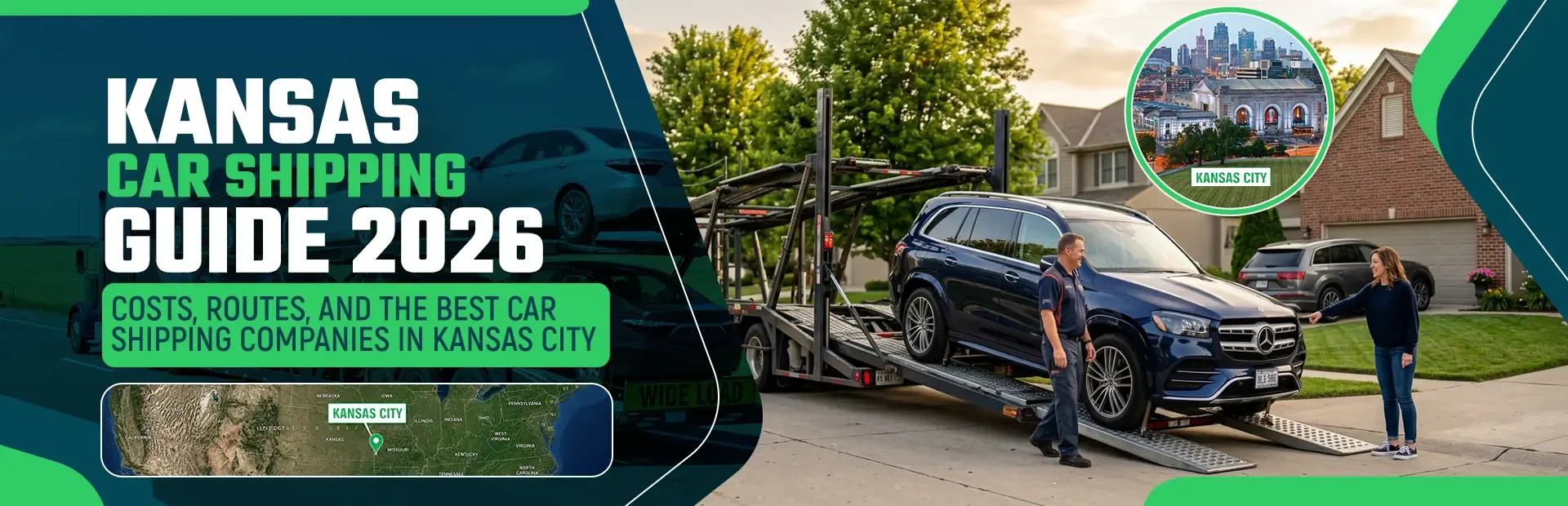
According to the U.S. Bureau of Transportation Statistics, trucks move more than 71% of the nation's domestic freight by value. Two of the corridors powering that number, I-70 and I-35, cut directly through Kansas.
That's not background detail. It's the structural reason kansas car shipping quotes tend to come in lower than what most people expect, and why auto transport carriers are already running loaded trucks through Wichita, Topeka, and Kansas City as part of their standard cross-country routes. Your vehicle isn't creating a new trip for those carriers. It's filling a slot on one that's already happening.
This guide covers what car shipping in Kansas actually costs in 2026, why Midwest routes price differently than coastal ones, what the most traveled Kansas routes look like in real numbers, and what to verify before you sign anything with a car shipping company.
Whether you're relocating for work, managing a PCS move, sending a classic to a car show, running a seasonal snowbird route, shipping a motorcycle to a rally, or moving recurring dealer inventory, the core decisions come down to the same three things: carrier type, company credentials, and timing. Get a free quote from verified Kansas carriers at Transportvibe and compare your options before you commit.
What Kansas Car Shipping Costs in 2026
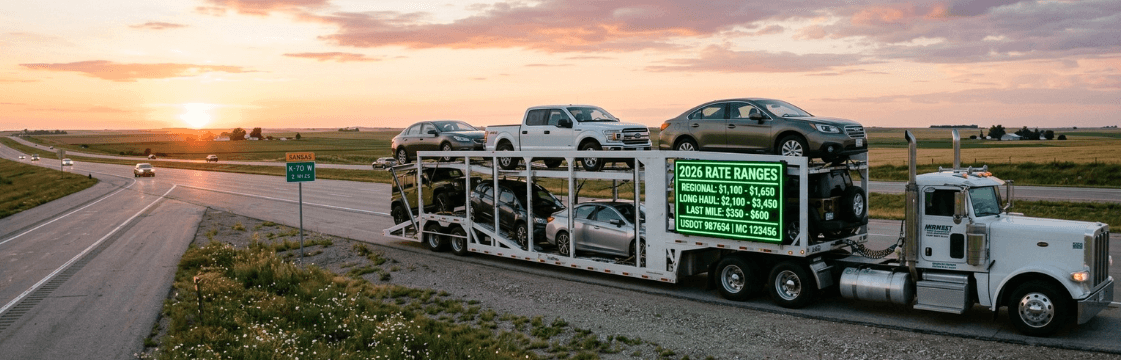
Most people searching "car shipping cost in Kansas" want a single number. That number doesn't exist, because price shifts significantly based on route length, carrier type, vehicle condition, and how far out you book. Here's how each factor actually works.
How Distance Changes Your Price
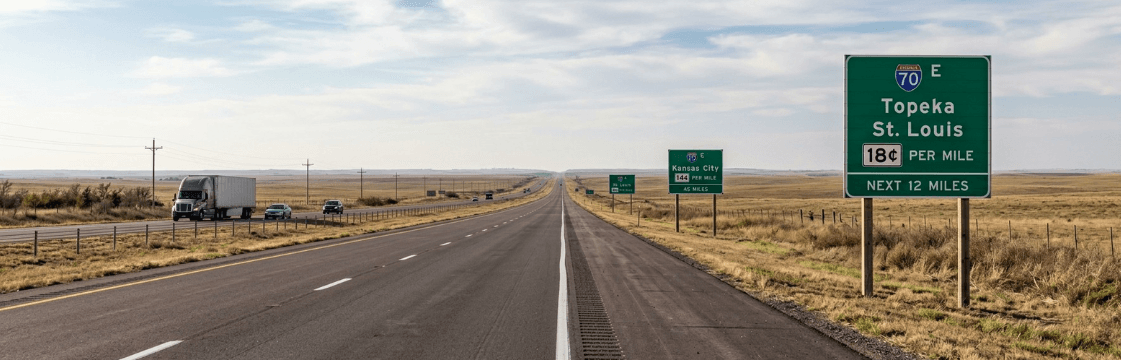
Short hauls cost more per mile, not less. That surprises people every time.
On a 300-mile move within Kansas, you might pay $1.50-$2.50 per mile on an open carrier. On a 1,800-mile run from Kansas to New York, that same open carrier type drops to $0.60-$0.90 per mile. The reason is overhead. A carrier can't spread fuel, driver pay, and operational costs across a 300-mile trip the way it can across 1,800 miles. Short hauls are simply less efficient for carriers to run, and they price accordingly.
|
Route Type |
Approx. Miles |
Est. Price Range |
Cost Per Mile |
|
Within Kansas |
200-500 mi |
$400-$900 |
$1.50-$2.50 |
|
Kansas to a neighboring state |
400-700 mi |
$600-$1,100 |
$1.00-$1.80 |
|
Kansas to the East Coast |
1,400-1,900 mi |
$900-$1,500 |
$0.65-$0.90 |
|
Kansas to the West Coast |
1,600-2,000 mi |
$1,000-$1,600 |
$0.60-$0.85 |
Other factors push the number up or down within any of these ranges. A pickup truck or SUV costs more to ship than a sedan because it takes up more space on the carrier deck. A non-running vehicle adds a loading surcharge, typically $100-$200. Booking within 48 hours of your pickup date usually means paying a premium to jump the queue. Booking 1-2 weeks out gives carriers room to work your vehicle into an existing load at a standard rate.
Open vs. Enclosed: The Price Split for Kansas Shipments
Open car shipping is the default for most Kansas shipments. Open carriers run I-70 and I-35 constantly, which keeps availability high and rates competitive on routes across the state. For a daily driver or a standard passenger car, it's the practical choice. It runs 30-40% cheaper than enclosed, and damage rates on reputable open carriers are low.
Enclosed vehicle shipping puts your car inside a covered trailer, protecting it from road debris, weather, and dust on long hauls. It costs more, but for certain vehicles, skipping it is a bad trade.
Enclosed shipping typically adds $300-$600 to Kansas-to-coast routes versus open carrier.
Who should default to enclosed:
-
Classic car owners and collectors
-
Exotic and luxury vehicle owners
-
Motorcycle owners shipping to rallies or events
-
Any non-running vehicle you can't afford to expose to road debris or weather
For a full cost breakdown of both carrier types across different route lengths, see Open vs. Enclosed Transport Cost.
Why Kansas Routes Cost Less Than Coastal States
The price difference between car shipping in Kansas and shipping from California or New York isn't random. It comes from how the national freight network is actually structured.
Kansas sits at the intersection of I-70 and I-35, two of the busiest freight corridors in the country. Carriers running cross-country loads pass through the state as part of their standard routes. When a broker posts a vehicle on the dispatch network, carriers already operating in the area can pick it up without making a special trip. That's the core of it.
Deadheading, which is when a carrier drives an empty trailer to reach a pickup, is one of the biggest cost drivers in auto transport pricing. Kansas generates less of it than coastal states. Carriers aren't going out of their way to service the market. They're already there.
Here's what makes Kansas specifically cheaper than coastal shipping markets:
-
High carrier volume on I-70 and I-35 keeps competition active among car shipping companies in Kansas
-
Kansas City is one of the most active auto transport dispatch hubs in the Midwest, with strong access to vetted direct carriers
-
No port congestion delays that add unpredictable days to coastal shipments
-
No mountain corridors that spike fuel consumption and slow transit times
-
Flat terrain keeps per-mile fuel costs predictable
-
Relatively balanced inbound and outbound load volume, which prevents the demand spikes carriers use to justify higher prices in markets where they run heavy in one direction
Compare that to California or New York. More vehicles want to move out of those states at certain times of year than there are trucks to take them. That supply imbalance pushes rates up in ways that Kansas doesn't experience to the same degree.
Kansas City, MO is consistently one of the top Midwest auto transport dispatch hubs by carrier network density. Brokers and shippers there have access to more vetted direct carriers than in most comparable cities.
For military families near Fort Riley or McConnell AFB, this freight geography matters. PCS moves originating from Kansas installations tend to price lower than equivalent moves from coastal bases. For snowbirds running the Kansas-to-Florida or Kansas-to-Arizona seasonal circuit, timing matters more than the route itself. Fall and early spring see demand spikes that push prices up 10-20% on those corridors. If your calendar gives you flexibility, use it.
Military vehicle relocation comes with its own compliance requirements and timeline considerations around PCS orders. Confirm those specifics with your carrier before booking, and make sure the company you choose has experience with military moves specifically.
The Most Common Kansas Shipping Routes: Costs and Transit Times
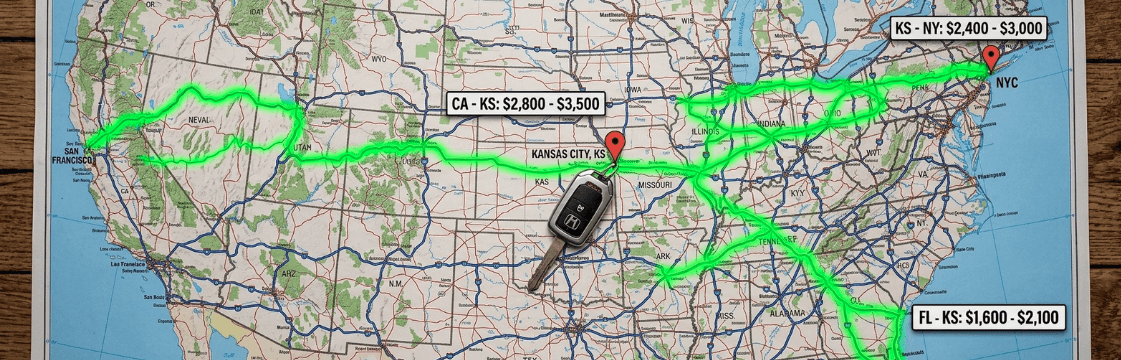
The route questions come up constantly. California to Kansas, Florida to Kansas, Kansas to New York. Here's what each one actually looks like in 2026 in real numbers.
California to Kansas and Kansas to California
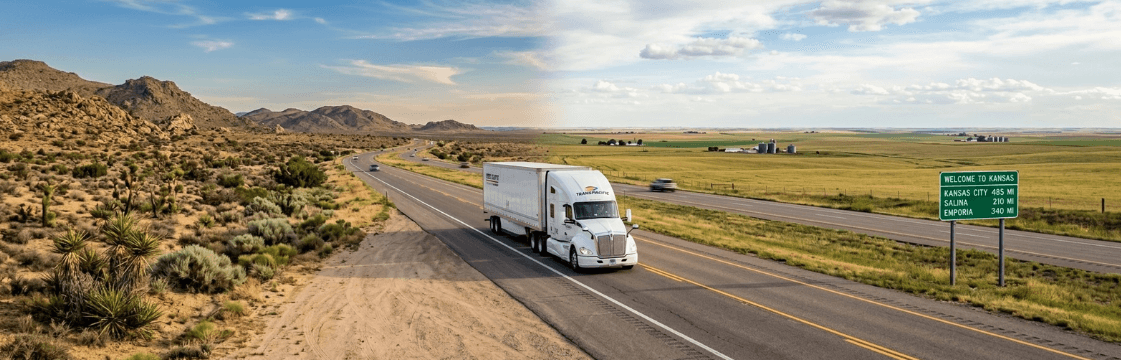
The California-to-Kansas corridor is one of the most active long-haul auto transport routes in the U.S. Distance runs approximately 1,600-1,900 miles depending on your origin and destination city. Carriers run it frequently enough that availability is rarely a problem, which keeps rates stable.
Shipping from Los Angeles to Wichita or from San Francisco to Kansas City typically runs $1,000-$1,500 on open carrier with transit times of 4-7 days.
|
Direction |
Approx. Miles |
Open Carrier |
Enclosed |
Transit Time |
|
California to Kansas |
1,600-1,900 mi |
$1,000-$1,500 |
$1,400-$2,100 |
4-7 days |
|
Kansas to California |
1,600-1,900 mi |
$1,100-$1,600 |
$1,500-$2,200 |
4-7 days |
The Kansas-to-California direction can price slightly higher. Westbound loads out of the Midwest are sometimes less available than eastbound, so carriers adjust the rate to cover lower load density on that leg. Booking 1-2 weeks out gives you the best shot at the competitive end of those ranges in either direction.
Florida to Kansas, Kansas to Florida, and Kansas to New York
The Kansas-Florida route runs on a seasonal cycle. Seniors and retirees moving vehicles between the two states for winter months push demand up noticeably in October and November heading south, and again in February and March heading back north. If you're on this route, booking early is less about convenience and more about price.
Seasonal car relocation carriers are familiar with these predictable migration patterns. If you run this route every year, it's worth asking whether a carrier offers recurring booking arrangements at a consistent rate.
|
Route |
Open Carrier |
Enclosed |
Transit Time |
Watch Out For |
|
Florida to Kansas |
$900-$1,300 |
$1,200-$1,900 |
3-6 days |
Snowbird peak Oct-Nov |
|
Kansas to Florida |
$950-$1,350 |
$1,250-$1,950 |
3-6 days |
Spring peak Feb-Mar |
|
Kansas to New York |
$950-$1,400 |
$1,300-$2,000 |
4-7 days |
NYC metro delivery surcharge |
The Kansas-to-New York route is common for students relocating for college, job-movers heading east, and classic or exotic car owners shipping to East Coast shows. New York City metro delivery often carries a small additional surcharge because of urban navigation, bridge restrictions, and traffic. Terminal-to-terminal delivery can cut that cost if you're flexible on pickup and dropoff location.
How to Choose a Kansas Car Shipping Company Without Overpaying
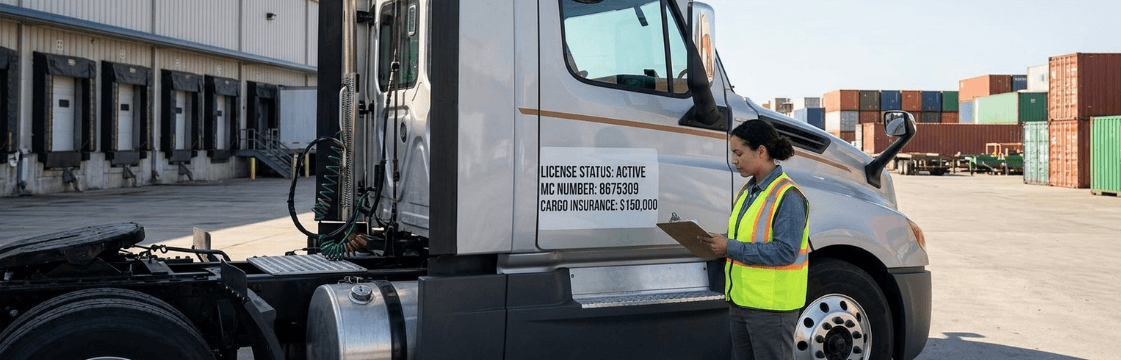
The search for "best car shipping companies in Kansas" returns a wide mix: national brokers, regional carriers, and companies that exist primarily on lead-generation directories. "Best" depends entirely on what you're shipping, where it's going, and when you need it there. No single company wins every route or every vehicle type.
What you can control is whether the company you pick is operating legally and has the infrastructure to back its quote.
Before booking any Kansas car shipping company, check these things:
-
Verify an active FMCSA license and a current MC number. If a company can't produce those on request, stop there.
-
Confirm whether you're working with a broker or a direct carrier. Both are legitimate. Brokers post your load to a carrier network. Direct carriers own their trucks. Know which you're dealing with before you sign anything.
-
Confirm cargo insurance coverage. The FMCSA minimum is $100,000. Many reputable companies carry higher. Ask for the certificate.
-
Get deposit and cancellation terms in writing. Standard practice is a small booking deposit ($100-$200) with the balance due to the driver at delivery.
-
Check reviews from the past 12 months specifically. A strong overall rating with no recent activity tells you very little about the company's current operation.
Red flag: any company requesting 50% or more of the total price upfront, before a carrier is assigned to your shipment, is not operating by standard industry practice.
Car shipping companies in Kansas City sit at a national dispatch crossroads. Whether you're working with brokers or direct carriers, Kansas City operators tend to have access to more vetted carrier options than companies running from smaller markets. Car shipping in Kansas City, MO is a competitive space, which generally works in the shipper's favor on availability and pricing.
Dealers shipping recurring inventory should ask directly about volume pricing. Most car shipping companies in Kansas will negotiate per-unit rates for accounts moving five or more vehicles regularly. The retail quote you see on a website is not your rate. Ask for the account rate. Dealer vehicle transport solutions operate on different scheduling and pricing structures than single-car moves, and most carriers who handle dealer accounts know the difference.
To verify any company's active DOT registration and MC number before you book, use the FMCSA carrier lookup. It's free and takes about 90 seconds.
For a ranked list of top-rated carriers with verified customer reviews from Q1 2026, see Best Car Shipping Companies.
Compare verified Kansas car shipping companies at Transportvibe, read real customer reviews, and get your free quote in minutes.
What Kansas Shippers Ask Most
These come up before almost every Kansas shipment. No fluff, just the answers.
How much does it cost to ship a car from California to Kansas in 2026?
California to Kansas car shipping runs $1,000-$1,500 on open carrier, $1,400-$2,100 enclosed. Distance is roughly 1,600-1,900 miles with a 4-7 day transit window. Booking 1-2 weeks ahead gets you the best rate on this corridor.
What are the best car shipping companies in Kansas City, MO?
The best car shipping companies in Kansas City, MO are licensed with the FMCSA, carry $100,000+ cargo insurance, and have verified recent reviews. Compare top-rated options at Transportvibe before you book.
How long does it take to ship a car from Kansas to Florida?
Kansas to Florida car shipping typically takes 3-6 days on open carrier. Distance runs 1,200-1,500 miles. Expect longer during peak snowbird season, October through November and February through March, when carrier availability tightens and transit windows stretch.
Is open or enclosed transport better for shipping a car to or from Kansas?
Open transport is the better choice for standard vehicles. It's cheaper and carriers run Kansas routes constantly. Enclosed is the right call for classics, exotics, and motorcycles. See the full comparison to decide.
How do I verify that a Kansas car shipping company is licensed and legitimate?
Run the company's MC number through the FMCSA carrier lookup. Confirm active operating authority and current cargo insurance. Any company that can't provide an MC number on request is not a carrier or broker you should use.
Before You Book Your Kansas Shipment
Shipping a car to or from Kansas comes down to three decisions: which carrier type fits your vehicle, whether the company is properly licensed, and whether you've given yourself enough lead time to get a competitive rate. Get those three right and most of the risk is already off the table.
Kansas routes are genuinely price-friendly compared to coastal markets, and that advantage is real. The freight infrastructure is already there. But affordable doesn't mean you skip the vetting. A low quote from a company with no verifiable MC number is the most expensive mistake you can make in this process. The FMCSA database is free. Use it before you sign anything.
Book at least one to two weeks out when you can. Avoid the October-November and February-March peaks on the Florida routes if flexibility is an option. If you're shipping a classic, an exotic, or a motorcycle, verify enclosed carrier experience specifically, not just a general auto transport license. And if you're a dealer or repeat shipper, the published rate is a starting point, not a ceiling.
The price advantage Kansas offers is real. Work within it by being selective about who you hand your vehicle to.
Ready to ship? Get a free, no-obligation Kansas car shipping quote at Transportvibe and compare rates from verified carriers right now.