



Motorcycle shipping vs car shipping looks straightforward on paper. Most people assume one is just a smaller version of the other. It isn't. The cost gap is real, the handling protocols differ, and the insurance exposure shifts based on how each vehicle is secured in transit. Treating them as interchangeable is how bikes arrive with bent fairings and cars end up at relay terminals three days late.
This guide covers what actually separates the two: real cost ranges by route and transport method, how carriers physically secure each vehicle, when open transport is the right call vs when enclosed is worth the premium, and how to vet a carrier before you hand over the keys.
Ready to ship? Get a motorcycle or car shipping quote from FMCSA-licensed carriers today.
What Motorcycle Shipping Actually Costs Vs Car Shipping
The US vehicle shipping services industry is worth $10.5 billion in 2025, with nearly 580,000 registered carriers operating routes coast to coast. Inside that market, the pricing gap between motorcycle and car shipping is one of the most misunderstood variables for anyone trying to budget a move.
According to Roadrunner Auto Transport, the national average cost to ship a car in 2025 is $1,245, based on a median distance of 971 miles. Shipping a motorcycle on a comparable cross-country route runs $600 to $1,200, per Angi's 2026 pricing data. That difference, anywhere from 10% to 50% depending on route and method, comes down to three physical realities: trailer footprint, vehicle weight, and how each vehicle gets loaded. A motorcycle takes up roughly one-third of a carrier slot.
It weighs a fraction of what a car weighs. And it goes on by hand, not under its own power. Those three facts shape the entire vehicle shipping cost difference between the two.
The Factors That Push Motorcycle Transport Cost Up Or Down
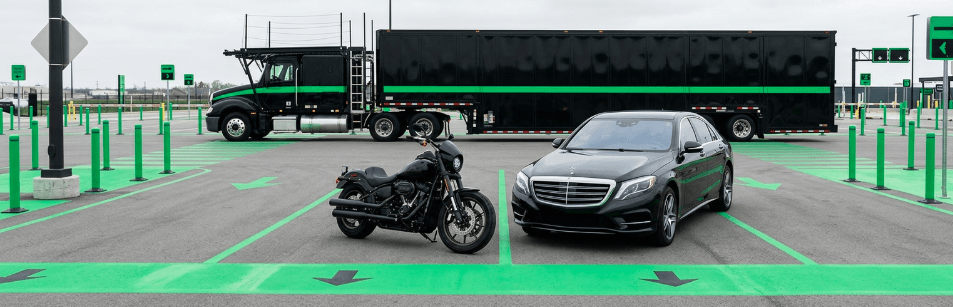
Distance is the single biggest lever on both sides of this equation, but motorcycles start from a lower base. On routes under 500 miles, motorcycle shipping rates can run as high as $2.20 per mile due to carrier minimums, according to CitizenShipper. On cross-country routes above 2,000 miles, that per-mile rate drops to $0.25 to $0.30. Car shipping averages $1.28 per mile nationally at the 971-mile median. The gap is real, but it's not fixed. Method, bike type, and season all move the number.
|
Vehicle Type |
Open Transport (Avg) |
Enclosed Transport (Avg) |
Cost Per Mile (Est.) |
Best Fit |
|
Standard Motorcycle |
$300–$700 |
$700–$1,200 |
$0.30–$0.50 |
Cross-country, budget-conscious shipping |
|
Touring or Cruiser Bike (e.g., Gold Wing, Road King) |
$400–$800 |
$800–$1,400 |
$0.35–$0.60 |
Heavier, wider bikes |
|
Standard Sedan |
$800–$1,400 |
$1,400–$2,200 |
$0.80–$1.28 |
Most common car shipments in the US |
|
Luxury or Exotic Car |
$1,200–$1,800 |
$1,800–$3,500+ |
$1.00–$1.50+ |
Enclosed always recommended |
|
Vintage or Classic Motorcycle |
$500–$900 |
$900–$1,800 |
$0.45–$0.75 |
Collector-grade bikes above $15K value |
The national average cost to ship a car in 2025 is $1,245. A cross-country motorcycle shipment on the same route runs $600 to $1,200 on open transport — a 10 to 50% cost advantage, depending on route and transport method. Sources: Roadrunner Auto Transport, Angi
The motorcycle transport cost advantage is real on paper. Here's what actually moves the number in practice:
-
Distance: Under 500 miles, carrier minimums eat the motorcycle's cost advantage. Over 1,500 miles, the gap widens again.
-
Bike type and dimensions: A Honda Gold Wing or Harley-Davidson Road King is heavier and wider than a sport bike. Carriers price to the space, not just the weight.
-
Pickup and delivery method: Door-to-door costs $50–$150 more than terminal-to-terminal. For a motorcycle, that premium can represent a significant slice of the base rate.
-
Season: Snowbird corridor routes (October through December, Southeast and Southwest) and summer relocation season (May through August, all routes) push both motorcycle and car rates up 15–25%.
-
Fuel surcharges: Almost never included in the first quote you see. Ask for them upfront. They shift monthly with national diesel prices.
-
Crating requirements: Open transport doesn't require crating. Collector bikes, custom builds, and high-value motorcycles on long hauls often do. A wooden or aluminum crate adds $150–$400 to the base quote.
When Motorcycle And Car Shipping Costs Start To Converge
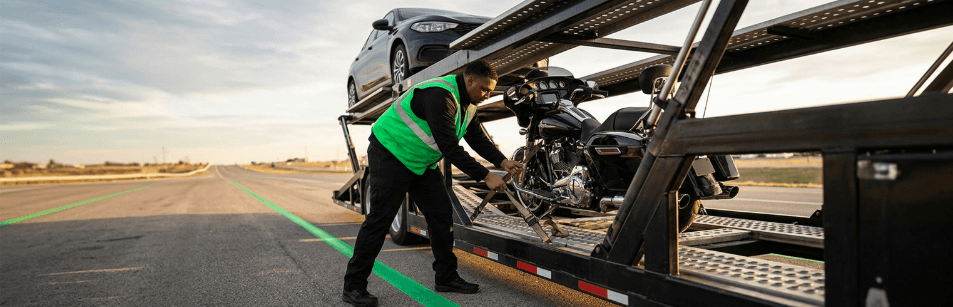
The motorcycle's cost advantage isn't permanent. It closes fast when enclosed transport enters the equation, when the pickup or delivery address is off the main carrier corridor, or when the booking is made with under 72 hours' notice. A fully enclosed motorcycle crate shipping quote for a high-value custom build or collector bike on a cross-country route runs $1,000 to $1,800. That's within range of what a standard sedan pays for open transport on the same route. When you're comparing car shipping vs bike shipping at the enclosed level, the gap shrinks to near parity.
|
Scenario |
Motorcycle Cost (Est.) |
Car Cost (Est.) |
Difference |
What It Tells You |
|
Both on open transport, LA to New York |
$400–$700 |
$900–$1,400 |
$500–$700 less for motorcycle |
Clear motorcycle advantage |
|
Motorcycle enclosed, car open, same route |
$800–$1,200 |
$900–$1,400 |
Near equal |
Enclosed transport erases the discount |
|
Both on enclosed transport, same route |
$900–$1,500 |
$1,400–$2,500+ |
$400–$1,000 less for motorcycle |
Motorcycle still cheaper, but margin is thin |
|
High-value motorcycle requiring crating |
$1,200–$1,800 |
$900–$1,400 (open) |
Car may actually cost less |
Crating flips the equation entirely |
|
Remote delivery (rural Midwest, mountain West) |
Add $100–$250 |
Add $75–$200 |
Gap closes further |
Both vehicles penalized by access |
|
Rush booking under 72 hours' notice |
Add 20–35% to base |
Add 15–25% to base |
Depends on route |
Urgency kills the motorcycle discount fast |
Situations where enclosed motorcycle shipping costs match or exceed standard car shipping quotes:
-
Collector and vintage motorcycles: requiring enclosed crating. A wooden crate adds $150–$400 on top of the enclosed base rate. For a $50,000 vintage Indian or Harley Knucklehead, that's still the right call.
-
Remote pickup or delivery zones: with limited carrier access, particularly rural Midwest states, mountain West corridors, and parts of Alaska and Hawaii where logistics costs spike for both vehicle types.
-
Rush shipments: booked under 72 hours. Broker fees spike 20–35% and the motorcycle's smaller trailer footprint stops being a pricing advantage when carriers charge flat urgency fees.
-
Non-standard motorcycle dimensions: sidecars, trikes, three-wheelers like a Can-Am Spyder, or choppers with extended forks. These don't fit standard motorcycle carrier configurations and get priced closer to car rates.
-
High-value bikes above $20,000: where standard carrier cargo insurance (typically $10,000–$20,000 per vehicle) doesn't cover full replacement, requiring supplemental transit coverage that adds to total cost.
How Carriers Handle Motorcycles And Cars Differently
Most people shipping a vehicle focus on price and forget about handling. That order is backward.
According to Roadrunner Auto Transport, enclosed auto transport — the premium-tier service for high-value cars and motorcycles — costs 30 to 50 percent more than open transport. That premium buys a specific set of physical protections.
But even within the same service tier, the protocols for motorcycle shipping vs car shipping are completely different from the moment each vehicle reaches a loading dock. A motorcycle has no bumper, no drive-on ramp capability, and no manufacturer-designated lifting points. A car has all three. Those structural differences dictate every handling decision a carrier makes — from strap placement to what gets written on the Bill of Lading at pickup.
Motorcycle Handling — Securing, Crating, And What Causes Damage Claims
A motorcycle doesn't load like a car. It gets pushed up a ramp by hand, balanced upright on a moving deck surface, and held in place entirely by the carrier's securing method. Done correctly, this process is safe. Done wrong, a single pothole at highway speed generates enough lateral force to tip a 700-lb touring bike into the trailer wall.
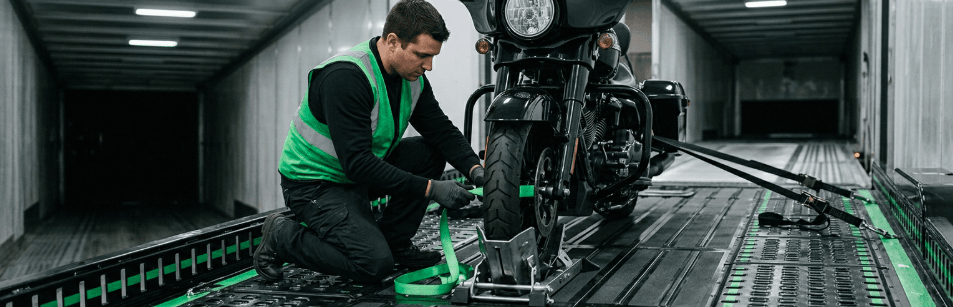
The primary cause of damage across motorcycle hauling services isn't road conditions or weather. It's improper securing at the load point.
Professional carriers follow a four-point tie-down system: two soft-loop straps at the front anchored to manufacturer frame points, two ratchet straps at the rear pulling the bike forward into the wheel chock. According to CitizenShipper, wheel chocks should be positioned as deep into the trailer as possible, with the front wheel fully seated in the chock before any strap is applied. Straps should never contact brake lines, chrome components, fairings, or soft seats.
Standard motorcycle securing protocol — what a professional carrier should do at every loading:
-
Disconnect the battery before loading to prevent drain and short-circuit risk on long hauls
-
Drain or stabilize fuel below one-quarter tank for enclosed transport and routes above 500 miles
-
Position front wheel chock deep in the trailer bed, motorcycle seated straight and fully upright
-
Apply soft-loop straps at designated frame points — never over handlebars, seat, mirrors, or fairings
-
Four-point strap configuration: two forward at 45-degree downward angles, two aft pulling the bike into the chock
-
Install a fork brace on telescopic-fork motorcycles for routes above 1,000 miles to prevent suspension damage from sustained strap tension
-
Document all pre-existing scratches, dents, and paint imperfections with timestamped photos before the ramp goes up
-
Complete and sign a Bill of Lading that itemizes every visible mark — this document is the legal baseline for any damage claim
What most shippers don't know: Under standard carrier liability terms, motorcycles shipped under a basic Bill of Lading can be covered for as little as $0.60 per pound, according to CompareTheCarrier. On a 400-lb motorcycle worth $5,000, that means $240 in coverage — not $5,000. If your bike's market value exceeds the carrier's stated cargo insurance limit, purchase a supplemental transit policy before the truck moves. This is where motorcycle shipping insurance gaps cause the most financial damage to shippers.
Motorcycle crate shipping takes protection a level further for collector bikes, custom builds, and high-value motorcycles above $20,000. A wooden or aluminum crate bolted directly to the trailer floor eliminates side-to-side movement entirely, removes strap tension from the frame, and is the industry standard for international shipments, car show deliveries, and any bike where cosmetic condition is non-negotiable.
When to request crating instead of standard tie-down securing:
-
Vintage and classic motorcycles with irreplaceable original parts, including pre-1980 American iron and British classics
-
Custom builds with extended forks, one-off bodywork, or non-standard frame geometry that doesn't accommodate standard chock positioning
-
Any motorcycle with a market value above $20,000 where carrier cargo limits don't cover full replacement
-
International and cross-ocean shipments where transit time and handling transfers multiply risk
-
Concours-condition show bikes where zero strap contact with any painted or chrome surface is required
Car Transport Handling — Loading, Inspection, And What Changes For Luxury Vehicles
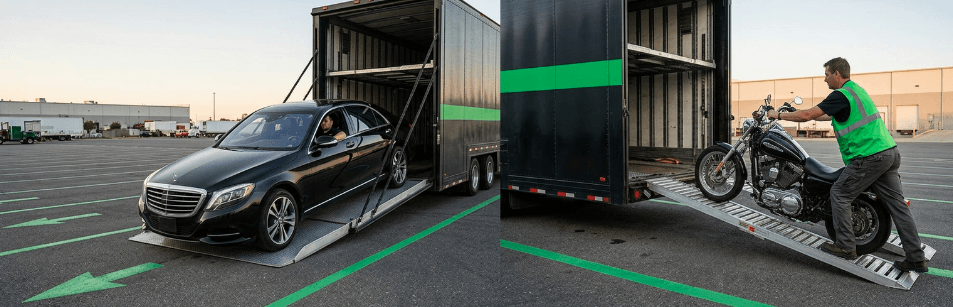
Cars drive onto carriers. That single fact changes the entire physical risk profile compared to motorcycles. The vehicle controls its own loading under power, OEM frame anchor points are engineered into the car's floor structure at rated load capacity, and the four-point tie-down distributes securing force across manufacturer-designed attachment locations. For a standard sedan or SUV on open transport, the car transport handling process is well-established, consistently executed, and statistically low-risk when done by a licensed carrier.
The process starts before the wheels touch the ramp. A pre-load inspection documents the vehicle's exact condition on a Bill of Lading, odometer reading included, with both the driver and the owner signing off on every mark. According to Montway Auto Transport, the Bill of Lading is the legally binding condition report for the entire shipment. It determines which damage claims get paid and which get dismissed. Any damage not noted before loading is near-impossible to claim successfully after delivery.
Standard car transport handling steps — from pickup to post-delivery inspection:
-
Pre-load walkaround: driver and owner document all existing dings, dents, scratches, and paint chips on the Bill of Lading
-
Odometer reading recorded and logged as required for all interstate auto transport
-
Fuel level confirmed below one-quarter tank to reduce weight and fire risk during transit
-
Four-point tie-down applied at manufacturer-designated OEM frame anchors, rated specifically for transport load
-
Vehicle clearance height checked against carrier deck clearance for supercars, lowered builds, and wide-body vehicles
-
Enclosed trailer: door seals inspected, soft cover placed over high-sensitivity paint finishes if requested by the shipper
-
Post-delivery inspection completed against the pickup Bill of Lading before the shipper signs — any new damage noted in writing before signature, every time
Handling comparison: motorcycle vs standard car vs luxury vehicle, step by step -
|
Handling Step |
Motorcycle |
Standard Car |
Luxury or Exotic Car |
Risk Level |
|
Loading method |
Pushed by hand up ramp |
Driven on under own power |
Driven by credentialed driver, often with a spotter |
Motorcycle: High / Car: Low |
|
Primary securing |
Four-point soft-loop and ratchet strap at frame |
Four-point OEM frame anchor |
Four-point plus secondary restraint, soft cover on paint |
Motorcycle: High if done wrong / Car: Low |
|
Fuel management |
Drain or stabilize before loading |
Quarter tank max |
Quarter tank max, fuel type documented |
Both: Medium |
|
Crating option |
Available for high-value bikes |
No direct equivalent |
Enclosed trailer functions as the crate |
Motorcycle: Optional / Car: N/A |
|
Pre-load documentation |
Timestamped photos plus Bill of Lading |
Bill of Lading required by law |
BOL plus independent condition report, often photographed by the broker separately |
Both: Critical |
|
Driver assignment |
Shared carrier, multi-bike load |
Shared carrier, multi-car load |
Often single dedicated driver for full route, no relay |
Luxury car: Lowest risk |
|
Fork or suspension protection |
Fork brace required over 1,000 miles |
Not applicable |
Not applicable |
Motorcycle only |
For luxury car shipping, the handling standard sits in a different category from standard car transport. An enclosed car carrier service assigns a sealed, climate-protected trailer to vehicles worth $50,000 or more.
White-glove providers that specialize in auto transport for luxury cars — companies like Intercity Lines — go further: a single dedicated driver covers the full route with zero relay handoffs, the vehicle is not moved by anyone other than the assigned driver, and delivery includes a post-transport inspection before the shipper touches the paperwork. For a Porsche 911 GT3 RS, a Ferrari Roma, or a classic Shelby Cobra, white-glove enclosed handling isn't an upgrade. It's the baseline standard for responsible luxury vehicle transport.
Open Vs Enclosed Transport — What You Actually Need For Your Vehicle
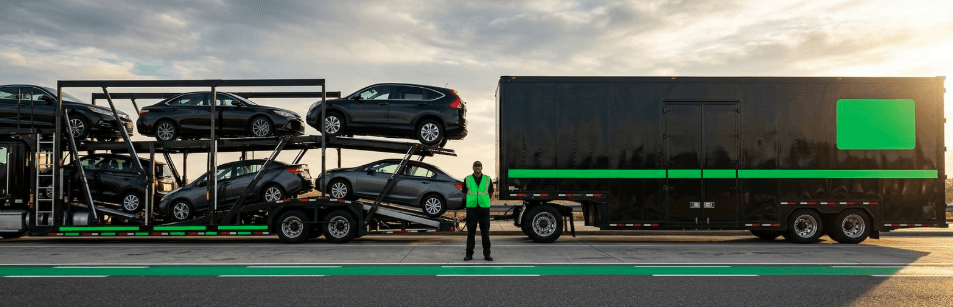
Here's the number most people don't expect: nearly 90% of all vehicle shipments in the United States move on open carriers, according to ConsumerAffairs. Not enclosed. Not white-glove. Open, exposed, highway-speed transport — and the overwhelming majority of those vehicles arrive without a scratch. That statistic matters because the conversation around open car transport vs enclosed transport often gets framed as a safety debate, when it's really a risk-profile question. The right service isn't the one that sounds safer. It's the one that matches your specific vehicle's exposure, value, and what you can't afford to lose.
Open transport is the working standard of the US auto shipping industry for a reason. An open-deck carrier holds eight to ten vehicles, runs high-frequency routes across every major corridor in the country, and keeps costs predictable. The vehicles are exposed to weather and road spray, but serious damage from those conditions is rare on any reputable, FMCSA-registered carrier. A standard daily driver, a dealer inventory car moving from Chicago to Dallas, a family SUV going from Seattle to Phoenix for a job relocation — open transport handles all of these well. The risk doesn't justify paying 40 to 60 percent more for enclosed service, which is the current cost premium according to Direct Connect Auto Transport's 2025 cost comparison.
Enclosed transport is a different calculation entirely. Vehicles shipped in fully sealed trailers have less than a 1% chance of sustaining damage during transit, according to FreightWaves. That near-zero damage rate is why enclosed is the non-negotiable standard for anything with irreplaceable value — a 1967 Shelby GT500, a current-generation Ferrari Roma, a custom Indian Motorcycle build, or a show-condition Harley-Davidson that took three years to restore. The question isn't whether enclosed is safer. It clearly is. The question is whether the premium makes sense for your specific vehicle.
Open vs Enclosed: Which service fits your vehicle -
|
Vehicle Type |
Open Transport |
Enclosed Transport |
Recommended Choice |
Why |
|
Standard daily driver (sedan, SUV, truck) |
Fine |
Overkill |
Open |
Low replacement risk, high route availability |
|
Standard motorcycle |
Fine |
Optional |
Open |
Cost-effective for bikes under $10K value |
|
Collector or vintage car |
Possible |
Strongly advised |
Enclosed |
Irreplaceable parts, finish condition critical |
|
Luxury or exotic car ($50K+) |
Not advised |
Required |
Enclosed |
Value exposure on open carrier is unjustifiable |
|
Classic or vintage motorcycle ($20K+) |
Not advised |
Required |
Enclosed |
Crating + sealed environment non-negotiable |
|
Custom motorcycle build |
Not advised |
Required |
Enclosed |
One-off components have no replacement market |
|
Car show or concours entry |
Never |
Always |
Enclosed |
Zero tolerance for transit blemish |
|
Military PCS vehicle |
Fine |
Optional |
Open (unless exotic) |
Budget and timeline constraints usually favor open |
|
Snowbird seasonal vehicle (standard car) |
Fine |
Dealer's choice |
Open |
Volume snowbird routes are among the most reliable in the US |
When to choose open transport without hesitation:
-
Your vehicle is a standard production model with a market value under $30,000 and no irreplaceable components
-
You're shipping on a well-traveled corridor: LA to New York, Chicago to Miami, Dallas to Atlanta, or any high-frequency snowbird route
-
Budget is a real constraint and the vehicle can absorb a minor road-debris scratch without a crisis
-
You're a dealer moving multiple inventory vehicles and volume discount matters more than premium protection
-
Delivery timeline is tight and open carrier availability is significantly faster in your pickup area
When enclosed transport is the only reasonable choice:
-
The vehicle's market value exceeds your carrier's cargo insurance limit (typically $10,000 to $20,000 on open carriers)
-
The vehicle has show-condition paint, custom bodywork, or one-off components that have no replacement cost equivalent
-
You're shipping a motorcycle, exotic car, or classic that would require a claim to be financially whole if anything went wrong
-
The vehicle has extremely low ground clearance or wide-body dimensions that make open-deck loading a mechanical risk
The math on the premium: Enclosed transport currently runs 40 to 60 percent more than open transport on the same route, according to Direct Connect Auto Transport. On a $1,200 cross-country open quote, that means $480 to $720 in extra cost. On a vehicle worth $150,000, that premium is less than half a percent of replacement value. On a vehicle worth $12,000, it's a different conversation entirely.
One detail that most shippers miss when choosing between enclosed motorcycle shipping and enclosed car carrier service: the logistics inside the trailer are different. A standard enclosed car carrier loads two to six vehicles per trailer.
An enclosed motorcycle carrier can fit eight to twelve bikes in the same trailer footprint, each taking up roughly one-third of a vehicle slot.
Some enclosed carriers specialize in cars only and will load a motorcycle into a car slot, charging car-rate pricing and using car-specific securing methods that aren't suited to a bike's frame geometry. If you're booking enclosed service for a motorcycle, ask directly whether the carrier regularly ships motorcycles in their enclosed trailers and what their specific securing method is.
Before you book any carrier for either service, these are the questions that actually separate a professional operation from a risk:
-
Do you specialize in motorcycles, cars, or both — and can you describe your securing protocol for my specific vehicle type?
-
What is your per-vehicle cargo insurance limit, and does it cover full replacement value or declared value only?
-
Will my vehicle ride with a dedicated driver for the full route, or does it transfer at a relay point? If relay, at which terminal?
-
What does your motorcycle shipping insurance or cargo policy specifically exclude, and what documentation do I need at pickup to protect a damage claim?
-
Can you provide references or documented reviews from shippers who transported the same vehicle type on the same route?
The carrier who hesitates on any of those questions, or deflects with general reassurances instead of specific answers, is telling you everything you need to know. Premium vehicle shipping services earn that label through documentation and protocol — not through price alone.
Compare quotes from FMCSA-verified enclosed and open carriers for your specific route and vehicle. The right service tier becomes obvious the moment you put your vehicle's replacement value next to the cost difference.
Check this article to find out the best motorcycle companies in USA.
Cross-Country Shipping — What Changes When The Distance Grows
A short regional haul is a single driver, a predictable timeline, and a quote that doesn't move much between booking and delivery. Cross-country shipping is a different category. Routes above 1,500 miles introduce carrier relay handoffs, fuel surcharge stacking, seasonal demand spikes, and delivery windows that carry real variance. Whether you're moving a motorcycle cross-country or shipping a car from coast to coast, the factors that affect price and risk multiply with every mile added to the route. The gap between motorcycle and car shipping costs is also at its widest on long routes, making it the highest-leverage moment to understand what you're actually paying for on each side of that comparison.
The relay handoff is the first thing to understand. Most carriers operating long cross-country routes don't run a single driver from pickup to delivery. The vehicle transfers between drivers or terminals at scheduled relay points. According to Navi Auto Transport, 82% of delayed deliveries on cross-country routes are resolved within two business days, and a one-to-three-day delay is considered a normal operational margin in the industry. That's manageable for a daily driver. For a vintage Triumph Bonneville or a Porsche 911 Carrera heading to a car show, it's a variable worth explicitly negotiating out of the contract by requesting a single-carrier, no-relay route.
Sample Cross-Country Shipping Costs: Motorcycle vs Car in 2025 -
|
Route |
Distance |
Avg Motorcycle Cost (Open) |
Avg Car Cost (Open) |
Est. Transit Time |
Peak Season Surcharge |
|
New York to Los Angeles |
2,800 mi |
$550–$850 |
$1,100–$1,500 |
7–10 days |
+15–22% (May–Aug) |
|
Los Angeles to Miami |
2,700 mi |
$500–$800 |
$1,200–$1,800 |
7–11 days |
+20–30% (Oct–Dec) |
|
Chicago to Miami |
1,380 mi |
$350–$600 |
$800–$1,100 |
5–8 days |
+25–35% (Oct–Dec) |
|
Seattle to Dallas |
2,000 mi |
$400–$650 |
$900–$1,250 |
6–10 days |
+10–18% (Jun–Aug) |
|
Boston to Phoenix |
2,600 mi |
$500–$800 |
$1,000–$1,400 |
7–11 days |
+15–20% (May–Aug) |
Route cost ranges sourced from uShip, iDriveCertified, and Roadrunner Auto Transport.
Booking window matters more on long routes than on short ones. Off-peak shipping runs 15 to 25 percent below peak-season averages, according to Navi Auto Transport. Booking two to three weeks ahead of your target pickup date on any route above 1,500 miles protects that savings window. Booking under a week out on a high-demand corridor in peak season can add $150 to $300 to the same quote.
Cross-country realities that most first-time shippers don't factor in until after they've booked:
-
Relay handoffs: Any route above 1,500 miles likely involves at least one carrier transfer. Ask your broker or carrier directly whether your vehicle will stay on a single truck from pickup to delivery. If it won't, get the relay terminal locations in writing before you sign.
-
Fuel surcharges stack on long hauls: Surcharges are calculated per mile on most carrier contracts. A $0.08 surcharge per mile adds $224 on a 2,800-mile New York to Los Angeles run. These are almost never included in the first quote.
-
Corridor availability varies by season: High-frequency snowbird corridors like Chicago to Miami and New York to Florida run with strong carrier availability in fall. Routes heading back north (Florida to New York) in the spring are harder to fill, which pushes prices up 15 to 20 percent in March and April.
-
Weather delays are not exceptions: A standard 7-to-10-day coast-to-coast estimate assumes no weather disruption. Winter storms in the Midwest, hurricanes tracking the Southeast corridor, and flooding in the Southwest can each add 1 to 3 days. Build that buffer into any timeline with a hard deadline attached.
-
Terminal-to-terminal vs door-to-door: On routes above 2,000 miles, terminal delivery can save $75 to $150, but requires you to pick the vehicle up from a designated lot. For a motorcycle, that means arranging your own transport from the terminal to your address.
Snowbirds, Seasonal Shippers, and Anyone with a Fixed Deadline
Snowbird season is the most predictable demand spike in US auto transport. Carriers flood southbound routes in October and November, then reverse north in March and April. Northbound spring routes are consistently harder to fill, so carriers charge more. A New York to Florida shipment costing roughly $1,000 in October can exceed $1,400 by December, according to Rapid Auto Shipping's snowbird transport guide. That 40 percent jump isn't an anomaly. It's the market repricing a service that every snowbird in the Northeast needs at the same time.
For snowbirds shipping both a car and a motorcycle to a seasonal address in Florida, Arizona, or Southern California, bundling both vehicles with a single carrier is the sharpest cost-reduction move available. Most major carriers offer multi-vehicle discounts of 10 to 20 percent when both vehicles move on the same contract. (The full breakdown of how open and enclosed service choices interact with this bundling decision is in the Open vs Enclosed Transport section above — the service tier you choose for your car and your motorcycle don't have to match.)
Military PCS Moves: Motorcycles and Cars Under Orders
Military members shipping on a PCS move face a specific set of rules that civilian shippers don't encounter. For CONUS-to-CONUS moves, the government does not cover POV shipping costs but does pay MALT mileage reimbursement toward a personal drive. For OCONUS assignments, one POV may be shipped at government expense through International Auto Logistics (IAL), the DoD's contracted global POV shipper. Appointments are made through PCSmyPOV.com at a Vehicle Processing Center near the departure installation.
For motorcycles specifically, a bike can be shipped either as part of your Household Goods (HHG) weight allowance or as a separate POV on OCONUS orders, according to Military OneSource. On a CONUS move, the motorcycle typically ships as HHG, counting toward your total weight entitlement. According to WCS Shipping's 2025 military guide, the bike must have fuel drained and the battery removed before any government-arranged or civilian carrier pickup. If you're using the PPM (formerly DITY) option and arranging your own carrier, a civilian motorcycle hauler that has experience with base-access requirements and VPC documentation will save you significant headache at the gate.
Car dealers moving cross-country inventory operate on different economics entirely. Volume discounts kick in at three vehicles or more on most major brokers. Seasonal route pricing applies the same way it does for individual shippers, but dealers booking on a recurring schedule can negotiate locked rate agreements with carriers for specific lanes, eliminating the spot-market price swings that affect one-off shippers.
Cross-country shipping tips that apply whether you're moving a motorcycle, a car, or both:
-
Get at least three quotes from different carriers or brokers, and compare them on the same pickup and delivery dates — quotes shift with calendar timing, not just with distance
-
Confirm whether each quote includes fuel surcharges and whether those surcharges are capped or floating
-
Ask every carrier for their relay policy in writing before you sign anything
-
Avoid the peak booking windows (mid-October through December for southbound, and June through August for all major corridors) unless your timeline is fixed
-
For motorcycles specifically, confirm that the cross-country carrier runs enclosed or open-deck motorcycle-specific equipment and not car-only carriers attempting to accommodate a bike in a car slot — the securing methods are different and the distinction matters.
Cross-country shipping rewards shippers who plan early and ask specific questions. The carriers who handle long routes well are not the cheapest ones on a single quote. They're the ones who can tell you which relay terminal your vehicle will pass through, what their on-time rate is on your specific corridor, and what their cargo coverage limit is before you've handed over any keys.
Get a cross-country shipping quote for your motorcycle or car from FMCSA-licensed carriers on your specific route. Compare the relay policy, not just the price.
Choosing A Carrier — Motorcycle Transport Companies Vs Car Shipping Services
Not every auto transport company handles motorcycles. Not every motorcycle transport company has the equipment or insurance to move a $200,000 exotic car safely. Assuming "they ship vehicles" means "they can ship your vehicle correctly" is where most damage claims begin.
Before comparing prices, verify three things on every carrier: their active MC number in the FMCSA SAFER database, their per-vehicle cargo insurance limit, and whether their reviews specifically cover your vehicle type on a comparable route.
-
MC number active? Check safer.fmcsa.dot.gov before you read a single review
-
Cargo insurance limit? Standard cargo policies cover $10,000 to $20,000 per vehicle — not enough for most collector bikes or luxury cars. (The motorcycle shipping insurance gap covered earlier tells you exactly what that means at claim time.)
-
Vehicle-specific reviews? Filter for shippers who moved your exact vehicle type, not just general auto transport feedback
-
Relay policy in writing? Any carrier who won't confirm their relay protocol upfront is a carrier worth passing on
The rule that holds across every situation: verify insurance first, confirm handling protocol second, check vehicle-specific reviews third, then compare price. Price is the last variable to optimize.
What Most Shippers Search Before They Book
These are the six questions that come up every time someone compares motorcycle and car shipping for the first time. Each answer is written for fast decisions, not for reading time.
Is It Cheaper To Ship A Motorcycle Than A Car?
Yes, typically 40 to 60 percent cheaper on the same route. A cross-country motorcycle shipping quote averages $400 to $800 on open transport. A comparable car shipment runs $900 to $1,400. Distance, bike size, and season all affect both figures.
Can I Ship A Motorcycle And A Car Together On The Same Carrier?
Yes, some carriers handle both on a single contract, which usually saves 10 to 20 percent on the combined cost. Always confirm the carrier uses motorcycle-specific securing equipment, not just a modified car slot, before you sign anything.
What Is The Difference Between Open And Enclosed Motorcycle Shipping?
Open transport exposes the bike to weather and road debris, costs less, and works well for standard bikes. Enclosed motorcycle shipping uses a sealed trailer, costs 30 to 50 percent more, and is the standard for collector or high-value bikes.
How Long Does Cross-Country Motorcycle Shipping Take?
Most cross-country motorcycle shipments on 2,000-to-3,000-mile routes take 7 to 14 days on open transport. Enclosed service typically runs 5 to 10 days. Weather delays and carrier relay handoffs can add 1 to 3 days to either estimate.
Does Motorcycle Shipping Insurance Cover The Full Replacement Value Of My Bike?
Usually not. Standard carrier cargo policies cover $10,000 to $20,000 per vehicle. If your bike is worth more, you need a supplemental transit insurance policy. Always confirm the cargo limit in writing before your carrier schedules a pickup
What Is The Safest Way To Ship A Vintage Or Classic Motorcycle?
Enclosed transport with full crating. A wooden or aluminum crate eliminates strap-to-frame contact, prevents side-to-side movement, and is the industry standard for pre-1980 classics, concours-condition show bikes, and any vintage motorcycle valued at $20,000 or more.
Ship Smart, Not Just Soon — Know What You're Booking Before You Book It
Motorcycle shipping vs car shipping isn't a coin flip between two identical services. The cost gap is real. The handling protocols are different. The insurance exposure shifts depending on your vehicle's value and the service tier you choose. A standard daily driver and a 1965 Harley-Davidson Panhead don't belong on the same carrier, under the same contract, with the same conversation about price.
The shippers who come out ahead every time follow the same order: verify the carrier's FMCSA registration, confirm their per-vehicle cargo insurance limit, check reviews from shippers with your exact vehicle type, then compare price. Whether you're relocating cross-country motorcycle shipping style or moving a luxury car across the country, that order doesn't change.
Open transport or enclosed, motorcycle delivery service or full car transport, the right choice is the one that matches your vehicle's actual risk profile — not the cheapest quote in your inbox.
Ready to compare rates from verified carriers? Get a Quote for your motorcycle, car, or both — and use everything in this guide to ask the right questions before you commit.