


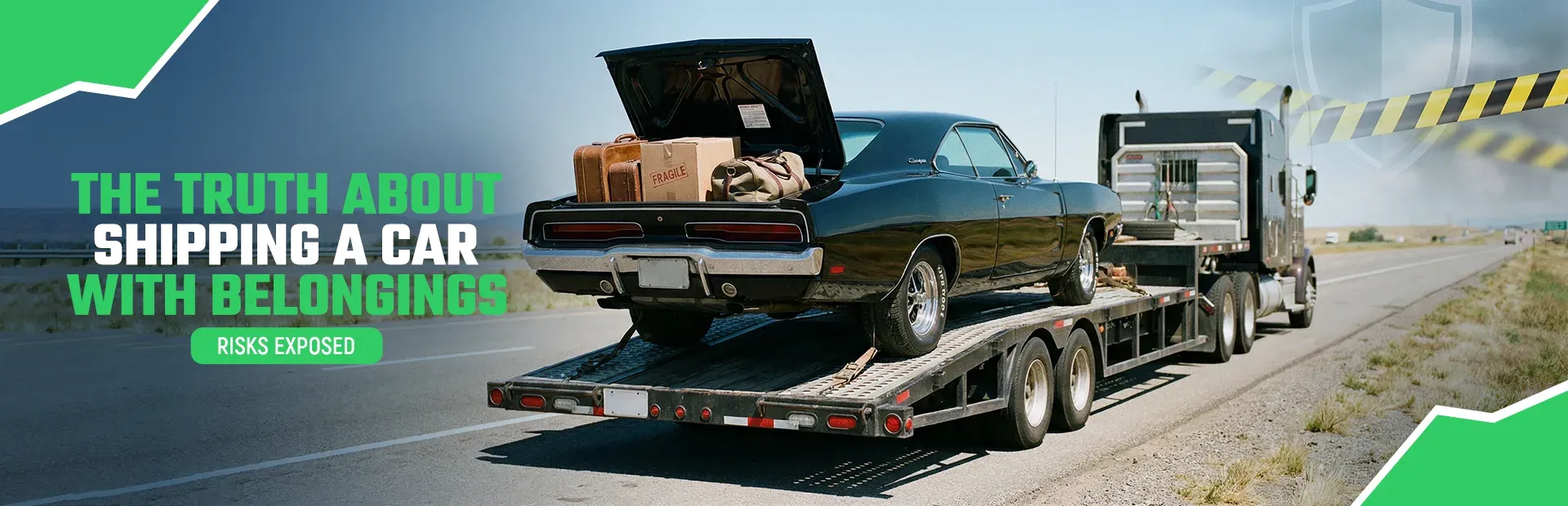
Can You Ship Car With Belongings? What Carriers Won’t Tell You - Risks Exposed!

Can You Ship Car With Belongings? What Carriers Won’t Tell You - Risks Exposed!

Transportvibe
November 13, 2025
19 min read

The quick answer is NO, you can not ship car with belongings. Many people can disagree, saying YES, but it happens only in a very limited way! 

This is one of the most confusing parts of moving, and carriers won't always give you the full story on the risks of shipping car with personal items. Many people assume they can load their vehicle like a moving truck to find the cheapest way to ship car and belongings. But listen to this: most carriers operate under strict DOT auto transport rules that make this basically illegal for them.

When you try shipping car with goods, you could risk delays, fines for the driver, and zero insurance coverage for your stuff. Is it worth the risk? We explain exactly what car shipping rules say about car moving with luggage and what happens if you ship a car with stuff inside. Don't risk your move or your wallet.

Ready to find an auto transport company that handles your items the right way? Get transparent quotes and find a carrier who follows the rules for your specific relocation needs, whether you're shipping a car with household goods or just a few small boxes.

Can You Put Stuff in Car When Shipping?

The simple answer is generally no, based on the letter of the law.

The official guidelines, specifically the DOT auto transport rules (Department of Transportation), prohibit carriers from transporting household goods alongside vehicles. These rules treat your car as cargo, not a shipping container for your possessions.

This is where the industry reality hits a gray area. Most reputable carriers strongly discourage you from using your car for shipping car with goods. They will tell you about strict car shipping rules and their own internal carrier restrictions for belongings.

However, many people still try to do it.

There’s a clear gap between what is strictly allowed and what often happens on a car hauler.

Officially, the government regulates what trucks carry. If your driver is stopped and they find household goods, they could face large fines. That’s why many companies have a zero-tolerance car hauler belongings policy.

In practice, many carriers will allow you to leave a small amount of "soft" items, like clothes or bedding. This is usually restricted to no more than 100 pounds and must be stored securely in the trunk or rear cargo area.

The allowance is purely at the carrier restrictions for belongings and the individual driver's discretion. They take on the risk. You should know that if you exceed these limits, the driver may refuse to load your vehicle or ask you to remove the items right there.

It's common to ask, "Can you leave clothes in car when shipping?" For many, the answer is a cautious "yes," as long as you follow the low-weight rules. If you're wondering about the full regulations and want to avoid common problems, you can review some of the critical tips for understanding car shipping contracts

When you look into shipping car with items inside, always check the specific carrier’s policy. Their rules are often stricter than what the bare minimum DOT auto transport rules require. You need to know exactly what risks you face when transporting a car in this manner.

Let’s take a look at why carriers are so hesitant about this practice and what it means for your insurance coverage.

If you’re moving more than just a car, you might need guidance on other parts of your relocation, such as finding reliable home relocation services that specialize in moving your entire household. You can also read up on the official FMCSA regulations (Federal Motor Carrier Safety Administration) to understand the broader legal framework.

What You Can Ship With Car While Shipping A Car?

You can typically ship car with personal items like clothes, blankets, books, and empty luggage in a car during transport. However, these items must be lightweight, secure, placed in the trunk or below window level, and not exceed a common limit of 100 pounds. Carriers have strict carrier restrictions for belongings. 

Items Generally Allowed for Shipping Car With Personal Items

If you're wondering, "Can you leave clothes in car when shipping?" or how to handle car moving with luggage, here is a breakdown of generally accepted, non-valuable items. Remember, keeping the weight low is key to abiding by auto transport restrictions.

  • Clothing and Linens: Clothes, blankets, sheets, and towels are common allowable items.
  • Lightweight Household Items: Small, non-fragile household goods and non-breakable kitchenware can be included.
  • Books and Paperwork: Books, paperwork, and general office supplies are often permitted.
  • Travel Bags: Empty luggage, duffel bags, and soft-sided bags are acceptable ways to pack belongings.

Now, here comes the part why we said NO at the beginning. Shipping personal items with car needs to be notify the carrier vendor. Otherwise, they wont be liable if anything happens to the items. Moreover, such items adds extra weight to the carrier, which should be properly documented and compansated. Otherwise, the carrier can fine you. The compensation is not negligible, and can be much lesser if you go with Goods shipping service. Thats why, its ideal not to ship any personal items while shipping a car.  

If you're looking for guidance on how to manage the items you must remove, you may want to look at alternative services. Find out how different types of items are handled in our guide on car shipping with personal items.

Prohibited Items That Your Cant Ship With Car

Don't ignore the list of prohibited items. If you break the car shipping rules, you risk finding out what happens if you ship a car with stuff inside the hard way: refusal of service or fines for the carrier.

Category Prohibited Items Why They Are Forbidden
Hazardous Materials Flammable liquids, chemicals, compressed gases, paint Violation of federal DOT auto transport rules; extreme safety risk.
Weapons Firearms and ammunition, explosives High legal and liability risk; often against state laws.
Perishables Food items, plants Risk of spoiling, attracting pests, and damaging the vehicle interior.
Valuables Jewelry, cash, important documents, electronics (TVs, laptops) Not covered by insurance coverage if items in car shipping; high theft risk.

This is the only way to ensure your attempt at shipping car with goods follows both the company's rules and the federal DOT auto transport rules.

Before You Ship Car With Personal Items Inside

Taking a few moments before pickup can save you hours of stress.

  1. Confirm with Your Carrier: Always contact your auto transport company to review their specific policies regarding personal items, as rules vary. Don't assume.
  2. Clean the Vehicle: A clean interior can prevent agricultural concerns and make it easier to inspect the car for any damage.
  3. Be Prepared to Remove Items: If the carrier finds too many items or prohibited goods, they may require you to remove them on the spot. Pack with their car hauler belongings policy in mind. Knowing the car shipping rules upfront helps avoid this panic moment.

For a clearer understanding of how to manage expectations during your move, read our guide on 5 essential questions to ask before hiring a car transport company

Why Do Carriers Restrict Shipping Cars With Personal Items?

It's tempting to think of your car as a giant suitcase when you ship car with belongings. However, there are serious risks and liabilities involved. Carriers impose auto transport restrictions and a strict car hauler belongings policy primarily due to government rules. They want to avoid problems like fines for violating DOT auto transport rules and the complex insurance issues that arise if something happens while shipping car with boxes inside. Understanding these carrier restrictions for belongings is key before you decide to load your vehicle.

DOT Auto Transport Rules Explained

The federal government regulates the movement of goods across state lines. The Department of Transportation (DOT) and the Federal Motor Carrier Safety Administration (FMCSA) classify what a carrier can legally transport. This is the main reason you cannot simply load your vehicle for shipping a car with household goods.

Your vehicle is classified as "freight" or "motor vehicle cargo." Household goods, like furniture, boxes, and personal items, fall under a separate classification. The driver’s license, insurance, and operating authority are typically set up for one type of cargo, not both.

Here’s the breakdown of why mixing them is a problem:

  • Cargo Classification: A carrier permitted to move cars is not automatically authorized to move household goods. To legally move both, they often need a different type of license and operating authority, which most standard auto transport companies do not have.
  • Inspections and Fines: If a driver is stopped for a random inspection and authorities find personal items, the carrier and driver can face significant fines. This is a direct violation of their operating rules. It can cause serious delays for your vehicle's delivery.
  • Commercial vs. Personal Use: The core issue is that when you are shipping car with belongings, you are essentially using a commercial auto carrier for a personal household move. This violates the established car shipping rules that govern their operations.

So, while you might think you’re finding the cheapest way to ship car and belongings, the carrier faces a financial and legal risk. This is why many companies refuse to allow anything more than 100 pounds of soft, non-valuable items. You need to know that asking, "can you load personal items in car delivery?" will often get you a firm "no."

To learn more about what to expect on the legal side of your move, read our guide on is auto transport is covered by your existing car insurance?

Weight Limit & Fuel Efficiency Issues

One of the most immediate and practical concerns for the carrier is weight. Every truck, including the one carrying your car, must adhere to strict Federal Gross Vehicle Weight Rating (GVWR) limits. Going over these limits is illegal and dangerous.

How belongings affect the hauler’s overall weight compliance:

  • Federal Compliance: An auto transport truck usually carries 9 to 10 vehicles. If every customer decides to ship car with personal items—say, an extra 300 pounds each—that’s an added 2,700 to 3,000 pounds the truck was not designed or legally registered to carry.
  • Safety and Mechanics: Extra weight stresses the truck’s tires, brakes, and suspension. It increases the risk of mechanical failure or an accident on the road. Carriers prioritize safety over letting you get away with car moving with luggage.
  • Fuel and Costs: More weight means lower fuel efficiency. If a carrier allows customers to use their vehicle for shipping car with goods, they take on unexpected fuel costs. Because they don't charge you for moving these items, they lose money on the trip.

This weight issue is why most companies limit you to a small amount of non-heavy items only in the trunk. If you want a deeper look into all the costs involved, check out 5 factors that determine your car shipping quote.

Safety & Theft Concerns

Beyond the legal and weight concerns, carriers worry about two major issues that directly affect the transport process: safety and security. You might be focused on the convenience, but the carrier sees potential disaster.

  • Items Shifting During Transport: Auto haulers face bumps, sharp turns, and sudden stops. If boxes or loose items inside your car are not secured, they can shift violently.
    • Shifting items can scratch your car's interior, smash the windows, or even damage the dashboard.
    • If items move to the front seat, they could impede the driver's view during loading, unloading, or transit.
  • Increased Chance of Theft: An empty car is less appealing to thieves. If you are shipping car with items inside, you increase the target value.
    • Drivers often leave keys accessible during pickup and delivery, making it easier for thieves to break in.
    • Even if the car is secured, drivers stop at rest areas and terminals. If someone can see a laptop or expensive bag through a window, the risk of a break-in goes up dramatically.

The simplest way to avoid these safety issues is to follow the auto transport restrictions and not leave valuables. If you're transporting specialized vehicles, these risks are even higher. You can find guidance on Tips for shipping classic or luxury cars in the U.S.A.

Insurance Liability

This is arguably the most critical reason why carriers discourage you from trying to ship car with belongings. When you sign an auto transport contract, you agree that your personal belongings are explicitly excluded from the carrier's insurance policy.

This means you are accepting all financial risk for your items.

  • Zero Coverage: Most carrier liability insurance only covers damage to the vehicle itself, caused by the carrier's negligence. It does not cover the contents inside the vehicle. If your items are lost, stolen, or damaged—say, a box of dishes breaks or a laptop is stolen—you have zero recourse through the shipping company.
    • This answers the question: "insurance coverage if items in car shipping?" The answer is almost always none.
  • Homeowner’s Policy: You need to check if your personal homeowner’s or renter’s insurance covers belongings while they are in transit in a vehicle. Many policies have limits or exclusions for items shipped commercially.
  • Claim Denial Risk: If your car is damaged during transport, and the carrier finds you overloaded the car against their car hauler belongings policy, they could potentially deny your vehicle damage claim, arguing that the extra weight was a contributing factor.

Don’t find out the hard way what happens if you ship a car with stuff inside and a problem occurs. If you have valuable items, ship them separately through a dedicated moving company. If you need a comprehensive view of insurance, you can check out this resource on the topic: Insurance Information Institute on Auto Transport

Ready to find a carrier who is transparent about their auto transport restrictions and helps you follow the rules for your move? Start comparing reputable companies and get your free quote today.

What Happens If You Ship a Car With Stuff Inside?

When you disregard the auto transport restrictions and try to ship car with belongings beyond the accepted limits, you face real consequences. Carriers have a strict car hauler belongings policy for a reason. 

Understanding what happens if you ship a car with stuff inside means knowing you risk insurance denial, delays, and unexpected fees. Don't assume you found the cheapest way to ship car and belongings just because you packed your vehicle like a storage unit. You need to be aware of these risks before you hand over the keys.

Insurance Coverage If Items Are Inside

This is the biggest risk you take when you decide to ship car with personal items. If you're asking about insurance coverage if items in car shipping, the answer from nearly every auto transport broker and carrier is zero.

The carrier's cargo insurance is legally mandated to cover the vehicle itself against damage or loss caused by the carrier's negligence. It is not designed—or priced—to cover household goods. When you sign your contract for shipping car with household goods, it specifically states that all car moving with luggage or other personal property is excluded from coverage.

Consider this case example:

A customer leaves several large, poorly packed car shipping with boxes inside in the back seat. During a sudden stop on the highway, one heavy box shifts forward and cracks the windshield and damages the dashboard.

Item Damaged Covered by Carrier's Insurance? Reason
Windshield/Dashboard Yes (But Claim Risk Exists) Damage to the vehicle itself is covered, unless the carrier proves the contents caused the damage.
Contents of the Box No Carrier policies exclude all personal property. The customer is 100% responsible for the loss.

If the carrier determines that the unsecured personal property—your boxes—caused the damage to your vehicle, they could potentially deny the entire claim for the cracked windshield. They would argue you violated the car shipping rules by trying to ship car with belongings that were not secured and exceeded the weight allowance.

Don't assume your personal items are safe just because they are inside a locked vehicle. To avoid this headache, you should check your homeowner’s or renter’s policy to see if it offers any coverage for items in transit, as this is your only potential safety net for shipping car with items inside. For more on this, it's smart to review what's covered in car shipping insurance in the USA.

If you need more detail on how different types of coverage work, you can check out this resource: Car Shipping Insurance in the USA: What’s Covered, What’s Not. For further assistance on the topic of insurance liability, look into FMCSA guidance on liability coverage.

Potential Hidden Fees

Many customers try to sneak in extra items to get the cheapest way to ship car and belongings. They figure if they can leave their car moving with luggage, they save on a separate moving truck.

But even when a carrier allows some latitude for shipping car with goods, they often charge a premium for the extra effort, weight, and risk. These aren't advertised prices; they are fees a driver may impose at the pickup location.

Here’s why you get charged:

  • Weight Violation Risk: The driver takes a risk of violating DOT auto transport rules when they allow you to can you leave clothes in car when shipping heavy items. They may charge you a "heavy load" fee to offset that personal risk.
  • Loading Time: Loading a vehicle with extra items takes the driver longer. They have to inspect the items, ensure they are secured (or tell you to secure them), and confirm they aren't blocking anything vital. Time is money for truckers.
  • Cost Range: These fees are not standard. They can range anywhere from $100 to $500 and are often cash-only payments directly to the driver at pickup. They are a direct result of trying to exceed the typical carrier restrictions for belongings.

This means that your plan to find the cheapest way to ship car and belongings often backfires. Instead of saving money, you end up paying an unexpected fee with no insurance coverage for your goods.

To avoid this, stick to the clear rules. If you have household items, ship them separately. If you are focused on saving money, learn about the factors that truly affect the cost of transport, such as shipping methods and timing.

For more helpful details on managing your budget, read up on the complete breakdown of car shipping costs in the USA.

Want to ship without surprises? Use our transparent platform to compare carriers and get clear, fixed quotes that detail all fees and adhere to proper car shipping rules.

Your Top Concerns About Car Shipping With Personal Items

Here are the most common questions people ask when they're planning to move their vehicle and need to know the official rules about leaving items inside.

What is the cheapest way to ship car and belongings?

The cheapest way to ship car and belongings is usually to ship the car empty and send your possessions through a separate, dedicated moving service. Trying to sneak items into the car often leads to unexpected fees or fines, which makes your move more expensive in the long run.

Do movers allow packing in shipped car?

Generally, traditional household movers do not allow packing in shipped car because auto transporters are governed by different regulations. Movers specialize in household goods, and auto carriers specialize in vehicles. You need to use separate services for each type of item.

Can you leave clothes in car when shipping to a different state?

Yes, you can you leave clothes in car when shipping to a different state, but only if they are lightweight (under 100 pounds) and stored securely in the trunk or below the window line. Anything more violates the standard auto transport restrictions.

Is it safe to put items in car during shipping if I secure them?

While you can try to secure items, the fact remains: is it safe to put items in car during shipping? Not entirely. The primary risk is that the carrier's insurance will not cover the items if they are stolen or damaged while in transit. You accept all liability for the contents.

What happens if you ship a car with stuff inside and it gets delayed?

If what happens if you ship a car with stuff inside causes a delay, the reason is usually a failed weight inspection or a violation of DOT auto transport rules. The driver may have to stop and require you to remove the items, which can hold up the entire car hauler schedule.

What about insurance coverage if items in car shipping are lost?

For insurance coverage if items in car shipping are lost or damaged, you are typically out of luck. The carrier's insurance covers damage to the vehicle caused by them, not the contents. You would need to rely on your own homeowner's or renter's policy for potential coverage. You can read more about your rights if a car is delayed in delivery here: Who Is Responsible If a Car Is Delayed in Delivery?

What documents do you need when car shipping with boxes inside?

When car shipping with boxes inside (even just a small amount of soft items), you still need the standard transport documents: a bill of lading, vehicle title/registration copies, and a clear inspection report. There are no extra documents just because you included a few non-prohibited personal items.

Making the Smart Choice for Your Vehicle and Belongings

Navigating the auto transport restrictions doesn't have to be confusing. While you technically can ship car with belongings, you risk insurance issues, delays, and unexpected fees. Remember, the DOT auto transport rules make it clear: your carrier is primarily licensed for the vehicle, not for shipping car with goods. 

Stick to the 100-pound limit of soft, non-valuable items and avoid violating the car hauler belongings policy. This approach protects your car and ensures a smoother, penalty-free delivery. Don't compromise your move by pushing the limits on shipping car with personal items.

Ready to find a carrier who follows the car shipping rules and provides transparent service? Get a quote today and make the confident, informed choice for your move.

Related articles

NOV 23, 2025
Do You Really Need Car Shipping Insurance In USA? Here’s What Experts Reveal

Do You Really Need Car Shipping Insurance In USA? Here’s What Experts Reveal

TRANSPORTVIBE

Do you really need car shipping insurance in USA? Experts agree that while carriers must provide auto transport insurance and basic vehicle delivery coverage, relying only on the carrier's car hauler liability insurance or standard auto carrier insurance is risky. Most people assume the carrier's policy covers everything, but that's not true. Did you know most standard policies only protect against major carrier negligence, not every scratch or ding? This one detail surprises most Americans when they ship a car across the country. The peace of mind you get from understanding your full car shipping coverage policy is worth the time it takes to check. We will break down what insurance for enclosed car shipping and open transport actually mean for you, and how to check the carrier’s transport company insurance rules. Ready to find out your total transport cost and what options you have for auto transport liability coverage? Get your free, non-binding quote today and ship with confidence. Car Shipping Insurance In USA and Its Importance You need to know exactly what kind of protection you get when you book vehicle delivery coverage. Every licensed carrier is required to carry specific policies, but they are very different from your own personal coverage. Auto Transport Insurance Coverage Auto transport insurance is commercial coverage. The Federal Motor Carrier Safety Administration ( FMCSA ) mandates that all carriers must have car hauler liability insurance. This system works in two parts: Liability: This covers damage the truck driver might cause to other people or property on the road, not your vehicle itself. Cargo: This is the policy that protects your car. It covers your vehicle against theft, vandalism, fire, and damage from accidents or carrier negligence during loading, transport, and unloading. You must check the limits of this coverage. Most cargo policies have a maximum payout, like $100,000 to $300,000, which is split among all cars on the truck. This means if you have a high-value car, the auto carrier insurance might not cover its full replacement cost. This is a critical detail to understand. Car Shipping Insurance Vs personal Auto Insurance Your personal car insurance policy and the carrier's car shipping insurance in USA are not the same thing. Your personal insurance protects you when you are driving. It almost always excludes the time your vehicle is being transported by a professional carrier. Do not assume your policy covers damage during transport. Is personal insurance valid during auto transport? You need to call your agent and ask them directly. If you rely on your own policy as backup, you will likely still have a deductible to pay. You should consider supplemental coverage, often called gap insurance, if your car is especially valuable or if you choose shipping options like insurance for enclosed car shipping. This extra layer protects you against a shortfall if the carrier's payout is less than your car’s actual value. We have explained how to check the carrier's insurance and inquire before booking in Questions to Ask Before Hiring a Car Transport Company . If you want to read more about the U.S. federal laws for motor carriers and insurance requirements, you can visit the Insurance Filing at FMCSA website. Types of Car Shipping Insurance In USA Understanding the levels of auto hauler insurance is paramount when arranging vehicle delivery coverage across the United States. Reputable companies offer various car transport insurance policies to protect your investment, ranging from federally mandated minimums to optional, comprehensive coverage tailored for high-value assets like a classic car. Carrier-Provided Insurance (Standard Coverage) Every licensed carrier operating an auto carrier in the U.S. is legally required to carry commercial insurance. This standard coverage is the foundation of your protection and is always included in the price of your quote. The two main components carriers must legally provide are: Public Liability Insurance: This coverage is designed to protect the general public. It pays for damages and injuries that the transport truck or driver may inflict on other people or property during transit, such as a multi-car accident on the interstate. Cargo Insurance: This is the policy that directly protects your vehicle. It covers your car against physical damage, theft, or total loss resulting from the carrier’s negligence, such as improper loading or a collision. It is crucial to be aware of the typical limits and conditions. Cargo coverage generally ranges from $100,000 to $300,000, but this amount is usually divided among all the vehicles on the trailer. This means the coverage per car might be insufficient for a high-value asset. Car hauler liability insurance deductibles can also vary, and in some cases, the client may be responsible for a portion of that deductible before the claim is paid. Always ask your broker for a copy of the carrier's Certificate of Insurance (COI) to verify coverage limits and any deductibles that may apply to your specific shipment. Third-Party or Extra Insurance Options While standard coverage is mandatory, extra insurance for car shipping is highly recommended for added financial security. It is particularly essential when the risk of a financial gap between your car's value and the carrier's policy limit is high. This supplemental protection is a non-negotiable step for: Luxury Vehicles & Exotic Cars: A high-end sports car or a luxury sedan with a value exceeding $150,000 will easily surpass the per-vehicle limit of many carrier cargo policies. Classic Cars & Antique Cars: The specialized nature and often irreplaceable value of an antique car require higher protection limits to cover restoration or true market replacement costs. Check out our guide on shipping exclusive classic cars . Long-Distance & Cross-Country Routes: Extended vehicle delivery journeys expose your vehicle to more time on the road, increasing the probability of unforeseen events. The most important added protection is gap insurance for car shipping. This coverage does not replace the carrier’s insurance but rather steps in to bridge the financial exclusion. It covers the difference between the carrier’s payout for damage or total loss and your vehicle’s Actual Cash Value (ACV) or the amount you still owe on a loan/lease. This ensures you are not left with a significant out-of-pocket loss. Before you book, call us today to get a no-obligation auto transport quote with clear, verified insurance details. Enclosed vs. Open Transport Coverage The type of trailer used for transport directly affects the level of protection your vehicle receives and, consequently, the insurance coverage provided. The choice between enclosed vs. open auto transport is often determined by a simple risk-versus-cost analysis. Open Carrier: This is the most common and cost-effective method. While very safe, the open carrier transportation vehicle is exposed to road debris, dust, and weather. Cargo insurance coverage tends to be lower because of the increased risk of minor damage. Enclosed Carrier: This method completely shields the vehicle from the elements. Due to the reduced risk of damage and the high-value nature of the cars typically shipped this way, insurance for enclosed car shipping policies often include significantly higher coverage limits. Naturally, enclosed transportation carriers provide premium protection that comes at a higher cost. Use the table below to compare the typical price difference and coverage limits. Transport Type Average Cost per Mile Typical Insurance Coverage Ideal For Open Carrier $0.60 – $1.00 $100K – $150K (Total Load) Standard vehicles Enclosed Carrier $1.00 – $1.50 $250K – $500K (Total Load) Luxury, exotic, or antique cars For a detailed breakdown of this cost and coverage comparison, read our article on open versus enclosed transport options . What Does Auto Transport Insurance Cover and Exclude? A comprehensive look at car transport insurance clarifies what your vehicle delivery coverage protects you against and the risks you still carry. Knowing the precise details of an auto hauler insurance policy is critical for protecting your investment in classic car shipping and ensuring complete peace of mind during transit. Commonly Covered Damages The primary purpose of a carrier's cargo insurance is to cover damages that occur while your vehicle is under their direct care, custody, and control. This typically includes a variety of incidents directly related to the transport process: Physical Damage from Carrier Negligence: This is the most common category. It covers tangible damage such as new scratches, dents, or broken mirrors that occur during the critical stages of loading, transit, and unloading. The use of specialized equipment, like ramps or liftgates for enclosed auto transport, reduces this risk, but human error is always a factor. Accidents During Transport: If the auto carrier is involved in a collision with another vehicle or object, the carrier’s insurance is designed to cover the resulting damage to your car. This often includes major structural damage from an unforeseen road incident. Theft or Vandalism: While rare with reputable carriers, insurance will cover the loss of your entire vehicle if it is stolen while in the carrier’s custody. It also covers damage caused by acts of vandalism that may occur at a terminal or during a layover. When you choose a professional broker, they are responsible for ensuring the assigned carrier is fully insured and reputable. Don't hesitate to request a copy of the Certificate of Insurance ( COI ) before your vehicle delivery is confirmed. Common Exclusions You Should Know Understanding what the insurance does not cover is just as important as knowing what it does. These exclusions are standard across the industry and highlight the owner’s final responsibilities when preparing their vehicle for transport. Exclusions typically fall into the following categories: Personal Items Inside the Car: Carrier insurance only covers the vehicle itself. Personal items such as electronics, luggage, or other valuables left in the trunk or cabin are expressly excluded from coverage for damage or theft. Mechanical Issues Unrelated to Shipping: Damage resulting from a mechanical failure, wear and tear, or dead battery that is not directly caused by the shipping process is not covered. For example, a pre-existing oil leak that causes a fire would be excluded. Natural Disasters (Acts of God): Standard cargo insurance often excludes damage from extreme weather events, such as hurricanes, earthquakes, or hail. You may need to verify if your own personal comprehensive auto insurance policy extends to cover these acts of God while your car is in transit. Pre-Existing Damage: Any dents, scratches, or mechanical issues present before the vehicle was loaded are not covered. This is why a thorough pre-shipping inspection and a signed Bill of Lading (BOL) at pickup are non-negotiable—they establish the car's initial condition and protect against false claims. To avoid costly claim denials, please ensure you thoroughly document your vehicle’s condition. Our guide on Understanding your auto transport contract provides details on pre-shipping documentation. When Do You Need Extra Insurance for Car Shipping While your carrier is legally required to provide standard cargo liability insurance, this base level of protection may not fully cover your financial exposure. It is crucial for customers to proactively assess risk and determine when to purchase supplemental auto transport insurance. The need for additional coverage typically arises in specific, high-risk scenarios that exceed the scope of the standard policy. The most common trigger for upgrading your vehicle delivery coverage is the value of the car itself. High-Value and Specialty Vehicles: For an exotic car, classic car shipping, or a brand-new luxury vehicle, the standard carrier insurance maximum—which can range from $50,000 to $250,000 depending on the carrier—might be significantly less than your vehicle’s market value. If a total loss occurs, relying only on the carrier's policy leaves you financially vulnerable to the difference. In these cases, purchasing a specialized, full-replacement-value policy is non-negotiable. This consideration for high value also extends to scenarios where the vehicle's coverage is split: Maximum Liability Concerns: Be aware that the carrier's total insurance policy is often divided among all vehicles on the transport trailer. If multiple vehicles are damaged in an accident, the available funds might be stretched thin. Supplemental coverage acts as a private parachute to bridge this gap. Furthermore, additional insurance is often necessary to cover common exclusions found in carrier policies: Protection Against Specific Exclusions: Standard auto hauler insurance almost always excludes damage from Acts of God—natural disasters like hail, floods, or tornadoes. If your shipping route crosses areas prone to severe weather, a third-party policy that specifically covers these environmental risks provides essential peace of mind. Similarly, if your vehicle is still under an auto loan, consider Gap Insurance to cover the difference between the carrier payout and your remaining loan balance in the event of a total loss. Ultimately, although not legally mandatory for the customer, purchasing additional insurance is a smart financial decision whenever the cost of potential damage to your vehicle outweighs your comfort level with the carrier's base coverage limit. How to File a Claim For Car Shipping Insurance In USA (Step-by-Step) Navigating a claim of car shipping insurance in USA can seem complex, but by following a structured process, you can secure fair compensation efficiently. This guide outlines the essential steps to document damage, file your claim, and ensure a prompt resolution from your auto transport carrier. Step 1 – Inspect Your Car Before Pickup The foundation of any successful auto transport claim is robust documentation of your vehicle's condition before the carrier takes possession. This initial inspection is your primary safeguard against disputes over pre-existing damage. The Bill of Lading (BOL) is the most critical document in the entire vehicle delivery process, as it serves as both a receipt and a contract. Before the driver departs, you must complete a joint inspection. Document All Pre-Existing Damage with Photos: Use a high-resolution camera or smartphone to take dozens of photos and videos. Capture every exterior panel from various angles, paying close attention to tires, bumpers, and the roof. Zoom in on and clearly photograph any existing chips, scratches, or dents. Date-stamping or time-stamping this media is highly recommended. Also, record the current odometer reading to prevent future disputes over usage during transport. Pro Tip: For a high-value car shipping service, take pictures of the interior as well, noting any unique features or customizations. Review and Sign the Bill of Lading (BOL) Accurately: The BOL contains a diagram of the vehicle. Ensure the driver accurately marks every piece of existing damage on this diagram. Do not sign the BOL until you have personally verified that every pre-existing mark is noted. Your signature attests that the description is accurate. If you're using an enclosed auto transport service, verify that the BOL reflects the added protective measures agreed upon. Make sure you get a signed copy of the BOL immediately. Step 2 – Inspect Upon Delivery The moment your vehicle is delivered is your last, best chance to formally establish that damage occurred during transport. Do not let the driver leave until this step is complete. You must conduct a meticulous inspection of your vehicle before signing the final Bill of Lading. Have your copy of the initial BOL and your pre-pickup photos ready for a side-by-side comparison. Perform the inspection in bright, natural light, if possible, as shadows can conceal minor scratches or swirls. Look for any changes, especially fresh chips, scrapes, or dents that were not recorded on the pickup BOL. If you discover new damage, you must note it explicitly on the delivery receipt section of the BOL. This is not optional—it is the evidence that validates your claim. Be Specific: Do not write general statements like "damage on the door." Write down details such as "New 8-inch scratch on driver-side rear door" or "New dime-sized dent on hood." Get Signatures: Ensure the delivery driver co-signs the BOL, acknowledging your written note of the damage. This co-signed document is the single most important piece of evidence in your car transport insurance claim. Withholding Payment: You must still pay the transport company for their services, even if you are filing a claim. Claim resolution is separate from the payment of the agreed-upon car shipping quote. Step 3 – File the Claim Quickly Once the damage is documented on the signed Bill of Lading, speed and thoroughness in filing are essential. Most auto transport carriers enforce strict, short deadlines for submitting a formal claim. The formal claim submission requires compiling and submitting a comprehensive package of evidence. This packet proves the damage occurred while in the carrier's custody. Required Documentation Purpose Signed Bill of Lading (BOL) Critical evidence showing a new damage notation co-signed by the driver. Pre- and Post-Transport Photos/Video Visual proof of the vehicle's condition before and after shipment. Repair Estimate A written quote from an authorized body shop detailing the cost to fix the damage. Formal Claim Form The official document supplied by the carrier or their insurance provider. The car shipping claim resolution process generally takes about 30 to 45 days. Federal law requires the carrier to acknowledge your claim within 30 days of receipt. A full investigation, assessment by an independent adjuster, and final decision can take up to 120 days. Providing a complete, accurate package of documents from the outset is the most effective way to expedite this timeline. Be prompt, detailed, and persistent. Step 4 – Follow Up with Carrier and Insurance Company The final stage requires persistent follow-up to ensure your claim is processed according to the transport company insurance rules. Once you submit the full claim package, you must open a consistent line of communication. Contact the carrier's designated claims department weekly for an update. If you purchased supplemental insurance, file a copy of your claim with them simultaneously, as they will often work to cover any difference left by the carrier's policy. Ensure you understand the carrier liability limits outlined in your original contract—this defines the maximum payout you can expect from their insurance. f the carrier or their insurance company fails to respond promptly or denies a legitimate claim, you have recourse. Federal Motor Carrier Safety Administration (FMCSA): This is the federal body that regulates auto transport carriers. You can file a formal complaint against the carrier via the National Consumer Complaint Database on the FMCSA's website. This action often compels a carrier to process a stalled claim. Better Business Bureau (BBB): Filing a complaint with the BBB can also pressure a company toward resolution, as it impacts their public rating. Legal Action: As a final resort, small claims court or consulting an attorney specializing in transportation law may be necessary. For peace of mind regarding service quality, always check a company's reputation before booking. Don't delay! File your complete claim package immediately and track your correspondence diligently. For professional guidance on avoiding issues, consider securing an enclosed auto transport service for maximum protection. Ready to ship your vehicle with confidence? Request your car shipping quote from an insured and licensed professional today to start the process with maximum peace of mind. Does Car Shipping Insurance In USAAffect Total Cost? Understanding the impact of car shipping insurance in USA on your final bill is essential when comparing quotes from different auto transport carriers. The good news for customers in the United States is that insurance is often already integrated into the baseline price. In most cases, the base shipping quote you receive from a licensed carrier is comprehensive. This quote inherently includes the federally mandated cargo insurance, meaning standard liability coverage for your vehicle during transport is factored into the initial auto transport cost. This primary coverage protects against damage caused by carrier negligence. For most standard moves, this means the effect of insurance on your total price is virtually zero, as it is bundled into the service fee. However, many shippers opt for enhanced or supplemental coverage, especially for high-value car shipping or exotic vehicles. This is where a separate, additional cost may be introduced. Typically, extra coverage to protect against a wider array of perils or to cover the full appraisal value of the vehicle might add only $50 to $200 to your overall expense, depending on the value of the car and the route complexity. Carriers often provide this additional protection to give you maximum peace of mind. To illustrate how minimal the change can be, review this comparison of standard car shipping quotes versus a total cost that includes supplemental insurance: Route Transport Type Base Shipping Cost Extra Insurance Total Car Shipping Cost New York → Florida Open Carrier $900 $0 (included) $900 California → Texas Enclosed Carrier $1,500 $120 $1,620 Chicago → Los Angeles Open Carrier $1,200 $75 $1,275 As you can see, the supplemental cost for premium coverage is a small fraction of the total investment. Ultimately, whether you rely on the carrier's included carrier liability or invest in additional peace of mind, the insurance component is a manageable part of your vehicle delivery budget. Request a full car shipping quote breakdown to see exactly what is included. Top Car Shipping Insurance In USA Inquiries From Our Readers Here are the most common questions shippers have when preparing their vehicle for transport and selecting a service. We address these critical operational and preparatory steps for a seamless experience. What documents are required for car shipping? You need the Bill of Lading, vehicle title or registration copy, and photo identification. For a financed car, you may need lien-holder authorization. How do I choose the best auto transport carrier for my needs? Look for licensed and bonded carriers with strong safety records, positive customer reviews, and transparent pricing. Always verify their FMCSA authority. What is the difference between open vs enclosed car transport? Open transport is cheaper and faster, while enclosed auto transport offers maximum protection from road debris and weather, ideal for high-value car shipping. How can I prepare my car for auto transport to ensure a smooth pickup? Wash your car, remove all personal items (this is required), and ensure the gas tank is about one-quarter full. Check all fluid levels and tire pressure. What is the average transit time for vehicle delivery across the United States? The typical transit time for a cross-country move is 7 to 14 days, though shorter distances can be resolved in just 2 to 5 days. Can I ship personal items in my car when using an auto transport service? No. Federal regulations strictly prohibit shipping personal belongings in a vehicle transported by a commercial carrier. Remove all items before the vehicle is delivered. Is door-to-door car shipping always possible, or will I have to use a terminal? Door-to-door car shipping is the preferred service, but if the street is too narrow for the large truck, the driver will arrange pickup or drop-off nearby. Your Stress-Free Auto Transport Journey Successfully navigating the auto shipping process—from securing a competitive car shipping quote to handling a potential car shipping insurance in USA claim—boils down to preparation and using a reputable auto transport carrier. By meticulously documenting your vehicle's condition, understanding the protections included in your base shipping quote, and knowing the simple steps for filing a claim, you ensure your interests are protected. Whether you select standard carrier liability or premium enclosed auto transport, having a solid plan is the key to a stress-free experience. Don't leave your valuable vehicle delivery to chance. Partner with professionals who prioritize transparency and safety.Ready to book your move with confidence? Get A Quote today and lock in your reliable car shipping cost!

NOV 12, 2025
How Much Does Car Shipping Cost in 2025? Hidden Auto Transport Expenses Exposed!

How Much Does Car Shipping Cost in 2025? Hidden Auto Transport Expenses Exposed!

TRANSPORTVIBE

The car shipping cost in 2025 typically ranges from $600 to $2,000 for cross-country moves, with the shipping cost per mile decreasing for longer trips. If you're wondering, "How much does car transport cost per distance?" you're not alone. Most people focus on the first quote, but that initial number is rarely the final one. What many US consumers don't realize is that hidden auto transport expenses can quickly add hundreds of dollars to their final bill. You need to know precisely what you are paying for when you receive those auto transport quotes from the USA. We're here to expose those extra fees, so you understand the real cost of vehicle shipping and find the cheapest way to ship a car long distance. Get ready to learn how to lock in a genuinely affordable auto transport quote and avoid unexpected charges. Ready to see real-time vehicle delivery rates and discover your actual car relocation cost? Compare reliable options today! Find out your average cost to move a car and get a personalized quote now! What Is the Average Car Shipping Cost in 2025? When you look for auto transport quotes USA, the distance is the biggest factor determining your final price. The car shipping cost per mile changes dramatically depending on whether you are moving your car across town or across the country. The typical cost of vehicle shipping in 2025 ranges from about $600 to $2,000. However, to truly understand the car transport service rates, you need to break it down by mileage. This gives you a clear picture of the actual average cost to move a car. The general rule is simple: the shorter the trip, the higher the shipping cost per mile. Short Distance (0–500 miles): For a short-haul trip, like moving your car interstate, expect to pay the highest per-mile rate. This distance has an average price to move car interstate between $1.40 and $2.00 per mile. Your total cost typically falls between $550 and $800. Medium Distance (500–1500 miles): As the mileage increases, the carrier can spread their fixed costs over a longer route. The rate drops significantly to between $0.85 and $1.20 per mile. You look at a total cost of roughly $800 to $1,200. Cross-Country Car Shipping Prices (1500+ miles): This is where you see the lowest per-mile rate. For long distance car shipping prices, expect to pay between $0.60 and $0.85 per mile. Total car relocation cost usually lands between $1,200 and $1,800. You can see that a long haul trip, even with a higher total, is much more efficient for the carrier. Use a cross-country car shipping calculator to see this difference clearly. We look at open transport averages here, which are the most common rates. Distance Average Cost Range (Open Carrier) Price Per Mile Short (0–500 mi) $550 – $800 $1.40 – $2.00 Medium (500–1500 mi) $800 – $1,200 $0.85 – $1.20 Long (1500+ mi) $1,200 – $1,800 $0.60 – $0.85 These numbers provide a solid estimate of your car shipping cost. But remember, these are just starting points. The type of carrier you choose completely changes the final quote. For instance, enclosed vs open car shipping cost is a major decision point. We encourage you to read more about maximizing your value, especially by understanding the quotes you receive. Learn the 5 essential questions to ask before hiring a car transport company . Knowing the factors that drive these vehicle delivery rates helps you secure a better deal. Ready to find a top-rated, reliable service for your move? Discover trusted companies and read honest, verified customer reviews to make a confident decision about your next vehicle shipment. Find Your Transport Company Now! What Factors Influence Car Shipping Cost? You now know the car shipping cost per distance—but why do auto transport expenses still vary so wildly between companies? The quick answer is that pricing depends on four core logistical elements. These elements determine the carrier's effort and cost, which they pass to you. Understanding them helps you find the most affordable auto transport quotes. Route, Location, and Demand The route dictates your overall car relocation cost. Shipping between major US cities, like New York to Miami, is often cheaper per mile because these are high-demand, high-volume lanes. Urban vs Rural: Moving a car to or from a rural area increases the rate. Carriers charge more because the driver must detour from major highways, consuming extra time and fuel for a single vehicle delivery. Seasonality: Car transport service rates fluctuate dramatically throughout the year based on "snowbird" migration and moving seasons. Season Typical Price Trend Demand Driver Summer (May–Sept) Highest (+15% to 25%) Peak family relocation and student moves. Winter (Dec–Feb) Moderate (Excluding Snowbird routes) Bad weather delays and low general demand. Spring/Fall Moderate/Lowest Optimal booking windows with balanced demand. Vehicle Type and Size The size and weight of your vehicle directly impact your car shipping cost. Simply put, bigger cars mean higher fuel consumption and take up more valuable space on the trailer. Cost of Shipping SUV vs Sedan: Shipping a standard sedan is the most economical choice. Larger vehicles, like SUVs, trucks, or vans, often cost $100 to $300 more than a sedan for the same route. Condition: Inoperable or non-running vehicles require specialized equipment like a winch, adding a $150 to $300 surcharge to the final price. Carrier Type and Protection Your choice of carrier determines the level of protection and is a major auto transport expense. Enclosed vs Open Car Shipping Cost: Open auto transport is the industry standard and the cheapest way to ship a car long distance. Enclosed shipping protects your vehicle from road debris and weather. It adds 40% to 60% to the cost but is necessary for luxury, classic, or customized cars. Find out if enclosed vs open car shipping is worth the extra price for your vehicle. Pickup and Delivery Flexibility Your personal convenience has a price tag. Carriers prefer flexibility to optimize their route planning and fuel consumption. Door-to-Door: This premium service means the carrier attempts to get as close to your exact address as legally and safely possible. It is the most convenient option but costs more. Terminal-to-Terminal: This is usually cheaper, but you deliver and pick up your car from a central hub. This option works best if you need flexible dates and are comfortable driving to and from the terminal. When you use a car shipping cost estimator, you must consider these four factors. They are the keys to understanding the true nationwide auto transport pricing. How Much Does Car Shipping Cost Per Mile? Understanding your car shipping cost per mile is the key to mastering nationwide auto transport pricing. While the total price is higher for longer journeys, the core principle of affordable auto transport is the economy of scale. The Economy of Scale: Long Routes are Cheaper Per Mile Is cost per mile cheaper on long routes? Yes. This is a crucial concept to grasp. A long-haul carrier has fixed operational expenses—labor, administration, and initial loading—regardless of whether they drive 300 miles or 3,000 miles. Shorter Routes: The fixed costs are spread over fewer miles, resulting in a higher per-mile rate (e.g., $1.50 to $2.00/mile for 500 miles). Longer Routes: The fixed costs are absorbed over thousands of miles, dramatically reducing the per-mile rate (e.g., $0.50 to $0.75/mile for 2,500 miles). This is why cross-country car shipping offers a lower rate per mile than shipping within state lines. To illustrate this, here is an average breakdown of car transport service rates per mile for standard open carrier service: Distance Range (Miles) Cost Per Mile (Approx.) Total Cost Example 0 - 500 $1.40 - $1.95 $560 - $975 501 - 1,500 $0.90 - $1.35 $900 - $2,025 1,500+ $0.50 - $0.75 $1,200+ The Impact of Pickup/Delivery Flexibility Beyond the mileage, your choice of delivery service significantly alters the price. This brings us back to the level of convenience you are willing to pay for. Door-to-Door: This is the most popular method for vehicle delivery. It is convenient but can be slightly more expensive. The carrier gets your car as close as legally possible to your specified addresses. Terminal-to-Terminal: This service is generally $100 to $200 cheaper as the carrier delivers to a central hub, avoiding the extra time and fuel required for residential routes. This is one of the cheapest ways to ship a car long distance. Car Shipping Cost Estimator Accuracy To get an initial baseline for your car relocation cost, you can use one of the many car shipping cost estimator tools available online. But how accurate are they? Accuracy is High for Estimates: These tools are typically accurate for providing a reliable range based on distance, vehicle type, and the current fuel market. Final Quotes Differ: They cannot factor in carrier availability on your specific dates, unique routing challenges, or last-minute demand spikes. Always compare at least three car shipping quotes before booking to secure the best rate. How Much Does It Cost to Ship SUVs vs. Sedans? The answer to “Does vehicle size affect auto transport expenses?” is a resounding yes. The physical dimensions and weight of your vehicle are among the most significant factors influencing your final car shipping quote. The Premium for Larger Vehicles Transport carriers operate under strict weight and space limits. A smaller vehicle, like a standard compact car (sedan or hatchback), is the industry’s base rate. Compact Cars (Sedans/Hatchbacks): These vehicles are the cheapest way to ship a car because their size allows the carrier to maximize the number of vehicles per load, leading to lower costs for everyone. SUVs and Trucks: Larger and heavier vehicles, such as an SUV, trucks, and oversized vehicles (e.g., dually trucks or large vans), occupy more surface area and add more weight to the load. This reduced efficiency—fewer cars per truck and higher fuel consumption—translates directly into a higher price for the customer. Expect to pay an additional $100 to $300 over the price of a standard sedan for auto transport services. Vehicle Delivery Rates by Size (2025) The size differential remains consistent whether you are arranging shipping within state lines or planning an expensive cross-country car shipping journey. The percentage increase for a larger vehicle applies across all distances. Vehicle Type Size Differential (Approx.) Open Transport Average Sedan/Coupe Standard Base Rate $0.60–$1.50 per mile Mid-Size SUV/Small Truck 15%–25% Increase $0.70–$1.80 per mile Full-Size SUV/Large Truck 25%–40% Increase $0.80–$2.00 per mile Cost of Shipping Oversized Vehicles For vehicles like lifted trucks, customized vans, or those with significant modifications, the vehicle delivery rates can rise further. These oversized vehicles might require special placement on the trailer and may limit the carrier’s route options due to bridge and tunnel restrictions. Always be upfront about your vehicle’s exact dimensions when requesting your car relocation cost to avoid unexpected fees. For those shipping valuable or modified vehicles, consider the enhanced protection of enclosed auto transport.. What’s the Cheapest Way to Ship a Car Long Distance? The cost of long distance car shipping is a primary concern for anyone relocating across state lines. Fortunately, a few strategic decisions can significantly lower your overall car relocation cost. It boils down to maximizing efficiency for the auto transport company, which in turn offers you better rates. The Foundation of Savings The most impactful choices relate to timing and location. By optimizing these factors, you can tap into the most budget-friendly options available in the auto transport market. Savings Strategy Description Typical Impact Book in Advance Avoid last-minute, expedited service fees by scheduling your shipment 2-4 weeks ahead of your first available ship date. This gives brokers ample time to secure a carrier on their regular route. Avoids $100–$300+ in premium fees. Flexible Pickup Dates Carriers prioritize filling their trailers efficiently. Offering a flexible date range (e.g., 3-5 business days) allows them to slot your vehicle into the most cost-effective route, lowering your vehicle shipping price. Can save 10–20% on the total quote. Optimize Your Service Type The next major area for savings is how and where your vehicle is picked up and delivered. Convenience comes at a price, so a small sacrifice in time can translate into tangible savings on your car shipping quote. To reduce the carrier's logistical overhead, consider this key alternative: Choose Terminal-to-Terminal over Door-to-Door: While door-to-door car shipping offers maximum convenience, carriers prefer terminal-to-terminal service. By dropping off and picking up your vehicle at a major metro terminal, you eliminate the need for the driver to navigate residential streets, saving fuel and time. This efficiency is passed on to you. To learn more about the pros and cons, see our guide on Door-to-Door vs. Terminal-to-Terminal Auto Shipping . The Non-Negotiable Step: Compare Quotes No single car transport company has the lowest rate for every single route. To secure the most affordable car shipping rate, you must embrace comparison shopping. Compare Multiple Car Shipping Cost Estimators: Utilize free online car shipping quote calculators from at least three different, reputable auto transport providers. This helps you establish a realistic market price for your specific route and avoids falling for quotes that are suspiciously low (a common sign of hidden fees). Comparing rates from multiple sources is the definitive way to ensure you are getting the best deal on your cross-country shipment. These combined strategies—from smart timing to choosing an efficient service method—are the best practices for minimizing your car transport service expenditure. What Hidden Auto Transport Expenses Should You Know About? A common question for customers seeking long distance car shipping is: Are there costs not included in quotes? The unfortunate truth is that some less transparent companies use low initial car shipping quotes to lure you in, only to apply unexpected surcharges later. Being aware of these potential hidden fees is crucial to getting an accurate and final vehicle shipping price. Surprising Charges Based on Your Vehicle and Location Certain characteristics of your vehicle or the pickup/delivery location can trigger legitimate, yet often undisclosed, fees. Reputable auto transport brokers will always confirm these details upfront to prevent unexpected bills. Non-Operable Vehicle Fee: If your car is inoperable, meaning it cannot be driven, it requires special equipment—a winch—for safe loading. This extra labor and equipment typically incurs an additional charge of $150–$300. Oversized Vehicle Surcharge: Quotes are generally based on standard sedans. If you are shipping a large truck, full-size SUV, or a vehicle with non-standard modifications (like a lift kit), it occupies more space on the carrier, resulting in a higher auto transport fee. Rural Location/Inaccessibility Fee: Carriers operate most efficiently on major highways and in metropolitan hubs. If your chosen address for door-to-door car shipping is in a remote, rural area or on a street inaccessible to a large carrier truck, the driver may charge an accessibility fee. Fees Related to Time, Policy, and Payment Beyond the physical logistics, other charges can arise from scheduling decisions or company policies, directly affecting your total car transport service expense. Hidden Charge What It Is How to Avoid It Expedited Service Fee A premium charge for rush-shipping your vehicle or guaranteeing an exact pick-up/delivery date. Book your shipment at least two weeks in advance. Fuel Surcharge An added charge intended to offset volatile diesel prices, often applied after the booking. Only work with companies that guarantee all-inclusive pricing. Storage Fees Charged in terminal-to-terminal transport if you fail to pick up your vehicle from the terminal within the allowed grace period (usually 24–48 hours). Communicate closely with the terminal and your driver. (For guidance on this, check out our piece on Choosing a Car Shipper .) Cancellation Fee A penalty if you cancel your shipment after a carrier has been assigned or dispatched. Carefully review the company's cancellation policy before booking. To avoid these pitfalls, always insist on an all-inclusive car shipping quote that details every potential charge, ensuring complete transparency for your cross-country car shipping needs. Top Considerations When Booking Auto Transport Here are some of the most common queries and essential details to ensure a smooth vehicle shipping experience, so you have all the necessary information before booking. What is the difference between an auto transport broker and a carrier? A carrier is the actual truck driver or company that physically owns the truck, hauls your car, and is responsible for the transport from start to finish. A car shipping broker acts as a logistics specialist, managing a vast network of vetted carriers to find the best available rate and service for your specific route and timeline, saving you considerable time and effort. This allows for greater flexibility. Will my car be safe on an open auto transport carrier for long-distance shipping? Yes, for the vast majority of vehicles, open car shipping is a perfectly safe and economical choice for cross-country car shipping. Carriers are fully licensed and insured, protecting your vehicle from significant damage. Although your car will be exposed to the elements, this is the industry-standard method used for over 90% of all vehicle shipments. Is the initial car shipping deposit refundable if I have to cancel my order? The policy on whether your initial car shipping deposit is refundable varies significantly by company. Most reputable brokers offer a full refund if they have not yet assigned a carrier to your order, meaning your booking is still technically pending. However, a deposit often becomes non-refundable once your vehicle has been dispatched or a truck has been scheduled specifically for your shipment. How long does it take to ship a car across the country right now? The transit time for a long distance car shipping typically depends on the mileage between the pickup and delivery locations. Generally, you can expect the duration to range from 2–5 days for trips under 1,000 miles to 7–14 days for a full cross-country car shipping journey (for instance, coast to coast). Unexpected weather or heavy traffic can sometimes cause minor delays in the estimated arrival window. Should I choose open or enclosed auto transport for my high-value classic car? For a high-value, classic, or exotic vehicle, you should definitely opt for enclosed auto transport. This service shields your vehicle from all external hazards, like road debris, dust, and inclement weather. While it costs about 40–60% more than standard open car shipping, the increased protection and peace of mind for an irreplaceable asset is well worth the investment. Can you ship a car with personal items inside the vehicle? Most auto transport companies will allow you to ship a small amount of personal items—typically up to 100 lbs—in the trunk. However, the Federal Motor Carrier Safety Administration ( FMCSA ) prohibits carriers from transporting household goods. Any items left inside are not covered by the carrier's insurance, so for the safety of your belongings, it is strongly recommended that you remove all valuable or essential items before pickup. What insurance is included when I book a vehicle shipping service? Federal law mandates that all licensed car transport service carriers must maintain comprehensive cargo insurance, which covers any damage to your vehicle resulting directly from carrier negligence during the transit process. Be sure to ask your broker for the carrier's certificate of insurance prior to shipping, and to understand the deductible and coverage limits, especially if you have an extremely valuable vehicle. Making the Right Call on Your Auto Transport Service Choosing the right auto transport service boils down to a clear understanding of your vehicle's needs and the logistics of your move. Whether you opt for cost-effective open carrier transport or the premium protection of enclosed shipping, knowing the difference between a broker and a carrier ensures a transparent process. For a stress-free experience, always confirm details like insurance coverage, personal item restrictions, and the estimated time frame for your long distance car shipping. We are committed to providing you with reliable service and transparent pricing for your upcoming relocation. Get a quote today!