




If you've been searching for a car shipper, you've already run into RoadRunner Auto Transport vs Nexus Auto Transport on every comparison list. Both are FMCSA-licensed brokers. Both have built real reputations over the years. And both have enough mixed reviews to make the final call harder than it looks.
This guide skips the generic praise. You'll get pricing context, a service breakdown, and review patterns from verified customer feedback on Trustpilot, Google, and the BBB. Whether you're moving a daily driver across three states, shipping a classic to a show, or handling a military PCS, the goal is simple: help you choose the right broker for your situation.
Ready to compare? Get a free quote on your route today.
Company Backgrounds — What RoadRunner and Nexus Actually Operate As
Both RoadRunner Auto Transport and Nexus Auto Transport are brokers. Not carriers. That distinction matters more than most shippers realize before they book, and it's the right place to start any honest comparison.
A broker's job is to match your shipment with an independent carrier from their network. They negotiate the rate, coordinate the logistics, and serve as your point of contact throughout the move. The actual truck, the driver, and the transport itself are handled by a third-party carrier that the broker selects and assigns. Neither RoadRunner nor Nexus owns a fleet. What they own is a network, a vetting process, and a reputation built on how consistently they manage both.
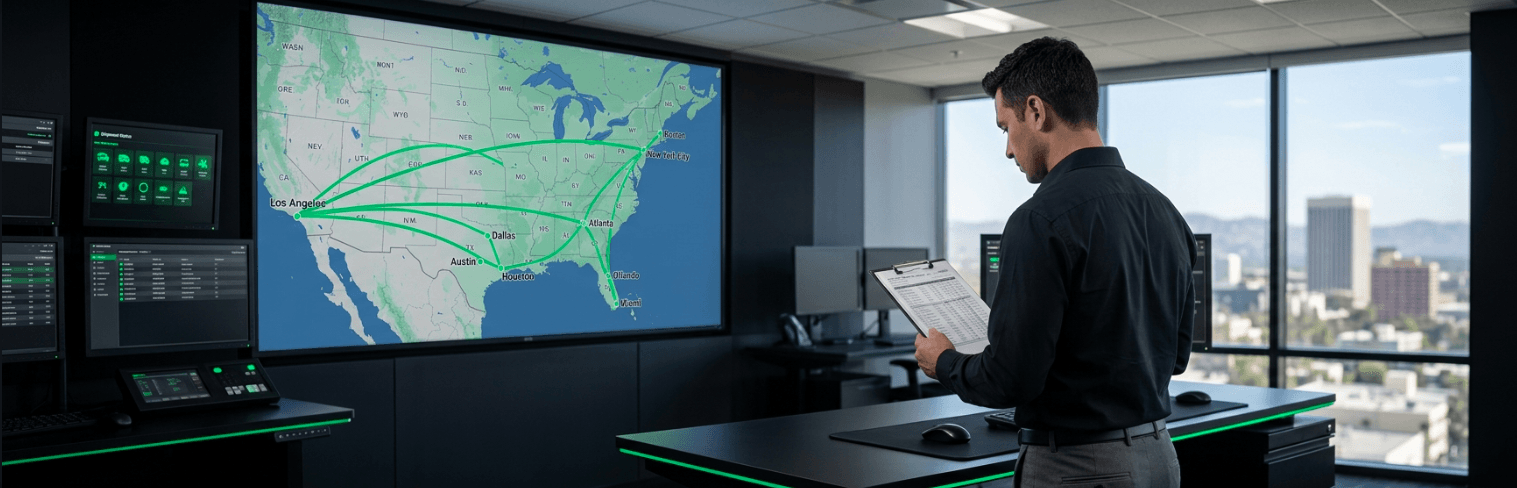
RoadRunner Auto Transport operates out of Los Angeles, California, and has built one of the more recognized names in the broker space over the past several years. Their footprint covers all 48 contiguous states. By 2026, their review volume across Trustpilot and Google runs into the thousands, which gives you a statistically meaningful picture of how they perform at scale. Their model is volume-driven. They move a high number of vehicles, which gives them greater carrier availability on popular routes like California to Texas or Florida to New York, but can create variability on thinner, less-traveled lanes.

Nexus Auto Transport operates out of Florida and has built its reputation on a different model — proactive customer communication. The Nexus Auto Transport review pattern in 2026 consistently surfaces themes around responsiveness and coordination, particularly on enclosed and high-value shipments. Like RoadRunner, Nexus holds active FMCSA broker authority across the contiguous 48 states. Where their approaches diverge is in how much each company prioritizes keeping you informed between booking and delivery.
The practical implication of the broker model is one both companies share: you are not necessarily getting the same carrier twice. Your experience depends, in part, on which carrier gets assigned to your specific route on a specific day. This is why how a broker vets its network, resolves disputes, and handles post-booking communication tells you more than any individual review. A reliable auto transport broker earns that label through its carrier relationships, not its marketing.
Before booking either, confirm their active broker authority at the FMCSA licensing database. That check takes 30 seconds and tells you more than most review summaries.
RoadRunner Car Shipping Prices vs Nexus Auto Transport Pricing in 2026
Pricing is the first thing most shippers compare. It's also the variable most people misread.
Neither RoadRunner nor Nexus offers a fixed rate. Both use a market-based model, which means your quote reflects carrier availability, fuel conditions, and route demand on the specific day you book — not a price list sitting on a shelf.
What Drives the Quote for Both Brokers
Before you compare any number from either company, understand what's actually inside it. The quote you receive is a function of several factors stacked on top of each other.
Here's what moves the price for both brokers:
-
Distance. Longer routes cost more. A 500-mile regional move prices very differently from a 2,500-mile cross-country shipment. Every mile adds carrier time, fuel, and risk.
-
Vehicle type. A compact sedan ships cheaper than a full-size pickup, a lifted SUV, or an oversized truck. Deck space and gross vehicle weight both factor into what carriers charge per load.
-
Transport type. Open carrier is the default and the lower-cost option. Enclosed transport runs 40–60% higher, covering climate-controlled loading, fewer vehicles per trailer, and tighter handling protocols. For a full breakdown of what that price gap actually covers, see the open vs. enclosed transport cost guide.
-
Season. Florida-bound routes spike in winter as snowbirds head south. Summer is peak season nationally. Rates soften in fall and early spring when demand cools and carrier availability improves.
-
Route density. High-traffic corridors — California to Texas, New York to Florida, Chicago to Dallas — have more carrier competition, which keeps rates reasonable. Low-volume or rural routes cost more because carriers are harder to source and less willing to run them at standard rates.
-
Booking timing. Booking last-minute compresses car shipping delivery times and almost always raises the price for both brokers. Carriers fill their loads in advance, and sourcing one on short notice carries a real cost. If you're working with a tight timeline, read more about why car shipping prices increase closer to the pickup date.
RoadRunner car shipping prices for a standard sedan on a 1,500-mile open-carrier route typically fall between $850 and $1,350 in 2026, depending on season and route density. A California to Texas shipment tends to land in that window. Coast-to-coast moves — California to New York or Florida to Washington state — run closer to $1,200 to $1,900 for the same vehicle class on open carrier.
Nexus Auto Transport pricing on comparable routes generally sits in a similar range, roughly $900 to $1,400 for mid-length hauls and $1,250 to $1,850 coast-to-coast. Enclosed transport from either broker adds approximately 40–60% to the base rate. A $1,100 open-carrier quote becomes $1,540 to $1,760 for a covered move on the same route.
Treat both sets of numbers as directional baselines. Your actual quote reflects the carrier market on the specific day you book it. Get quotes from both on the same day if you want a clean comparison.
Deposits, Cancellation Windows, and What to Watch in the Contract

The price in your quote is step one. How each company structures its deposit, balance, and cancellation terms is where the real conditions of service begin.
RoadRunner Auto Transport typically requires a deposit at booking, generally in the $100–$200 range depending on route and shipment type, with the remaining balance due directly to the assigned carrier driver at delivery by cash or cashier's check. What RoadRunner Auto Transport reviewers in 2026 flag with real consistency is the possibility of a rate adjustment after carrier assignment. The price you agreed to at booking can shift when an actual carrier accepts your load. It doesn't happen on every shipment, but it appears in their review record at a frequency worth knowing about before you pay the deposit.
Cancellation before carrier assignment is generally available without a penalty. After the assignment, fees apply, and the deposit may not come back. Get those specific terms in writing before you commit.
Nexus Auto Transport follows a comparable structure. Deposit at booking, COD balance to the driver at delivery, and a cancellation window before carrier assignment. The Nexus Auto Transport review pattern in 2026 shows fewer reports of post-booking price changes relative to RoadRunner, though their underlying broker model is the same. Read their contract with the same attention regardless.
Here's what to look for in both contracts before you sign:
-
Rate changes after carrier assignment. Your quoted price can increase when a carrier accepts your load. Ask each broker directly what triggers this, how much it can change, and what happens if you decline the new rate.
-
COD payment directly to the driver. Final payment goes to the carrier driver in cash or certified funds at delivery. Not a card, not a payment app. If someone else is receiving the vehicle, make sure they know this before the truck arrives.
-
Fuel surcharges. Some carrier contracts passed through brokers carry variable fuel surcharges not visible in the original quote. Ask upfront whether the quoted rate is all-in or subject to fuel adjustments at dispatch.
-
"Estimated window" vs. guaranteed dates. Neither broker guarantees exact pickup or delivery dates on standard shipments. The window in your confirmation is an estimate. Standard broker contracts almost never carry financial penalties for delays, which means the legal obligation to hit a date is minimal.
Auto transport broker consistency on pricing is one of the most repeated complaints in this industry. Before signing anything with either company, review FMCSA's consumer guidance on auto transport rights so you know exactly what leverage you have as a shipper. Knowing what to read before you sign is the difference between a straightforward move and a dispute you didn't see coming.
Open Carrier, Enclosed Transport, and Route Reach
Open carrier car shipping is the default for both brokers, and it covers the overwhelming majority of standard vehicle moves in the U.S.
You're looking at a nine- to ten-car open trailer, the same rigs you see rolling down any major interstate loaded with new vehicles headed to dealerships.
For most people, this is the right call — no debate needed.
Individual owners moving a daily driver, professionals relocating for a new job, and dealerships shipping inventory between lots are all well served by open carrier.
Your vehicle gets strapped down, transported exposed to the road environment, and typically arrives with a layer of road dust on the exterior. A wash takes care of that. Structurally and mechanically, it arrives the same way it left.
Where open carrier falls short is with vehicles that don't have that kind of margin for exposure.
As an enclosed auto transport broker, both RoadRunner and Nexus can move your vehicle in a fully covered trailer — but availability and lead time differ depending on your route and how far out you book.
Enclosed trailers carry fewer vehicles, use hydraulic lift gates for loading, and protect your car from road debris, weather, and UV exposure the entire way.
For a '69 Camaro, a Porsche 911 GT3, or any vehicle where a paint chip in transit turns into a four-figure correction bill, enclosed is the only practical option. Same applies to anything you're shipping to a car show, where condition on arrival isn't just preference, it's the whole point.
If you're weighing whether enclosed makes sense for your specific vehicle, this breakdown of open vs. enclosed transport covers the cost difference and what each method actually protects.
On route reach, both RoadRunner and Nexus cover all 48 contiguous states.
As a cross country car shipping broker, either company can move your vehicle from California to Maine, Texas to Minnesota, or anywhere the lower 48 takes you.
But there's a difference between coverage on a map and carrier density on the ground.
For anyone evaluating the best auto transport company for long distance, route density matters more than coverage alone.
High-traffic corridors like California to Texas, Florida to New York, and Chicago to Dallas have strong carrier competition. That keeps pricing competitive and pickup windows tighter.
Low-volume routes, rural pickups, and smaller secondary markets are a different story. Fewer carriers run those lanes, which typically means longer wait times and higher rates from both brokers.
Alaska and Hawaii are separate categories entirely.
Hawaii requires an ocean freight leg, usually departing from the Port of Los Angeles or Long Beach. Alaska typically routes through Seattle or Portland before the final overland segment.
Both brokers can arrange these, but they carry separate pricing structures, longer timelines, and distinct logistics coordination. Get those details locked down at the quote stage, not after you've already committed.
For specialty transport, here's where both brokers stand:
Motorcycles
Both RoadRunner and Nexus ship motorcycles. Open crating on a shared carrier is the standard, lower-cost method. Enclosed crating is available for custom builds, vintage bikes, and anything where road exposure is a real concern.
Before you book, go through the motorcycle shipping options guide to understand the handling differences, what you'll need to prep before pickup, and what each method actually covers in terms of protection.
Inoperable Vehicles
Both brokers handle non-running vehicles, but it costs more and has to be flagged at booking.
The carrier needs a winch truck or rollback capability to load and unload. Don't assume standard equipment applies. If the carrier shows up unprepared because the vehicle's condition wasn't disclosed, the shipment gets pushed and you lose your window.
Military Relocations
Both companies work with military clients on PCS moves.
RoadRunner advertises a military discount on their website. Nexus handles military shipments as well, but confirm their current discount terms directly at the quote stage.
Either way, military vehicle relocation comes with documentation requirements that differ from standard civilian moves. Have your orders ready before you call.
Seniors
Neither broker runs a formal senior program, but both can accommodate longer pickup windows and more frequent communication touchpoints if you request it upfront.
Say so at booking. It gets noted in the order and sets the right expectation with whoever manages your shipment on their end.
Service Comparison: RoadRunner vs. Nexus Auto Transport
|
Service Type |
RoadRunner |
Nexus Auto Transport |
Notes |
|
Open carrier |
Available |
Available |
Default option; most competitive on high-volume corridors |
|
Enclosed transport |
Available |
Available |
Book early; carrier availability varies by route and season |
|
Door-to-door |
Available |
Available |
Standard for both; tight residential streets may require a nearby staging point |
|
Terminal-to-terminal |
Available |
Available |
Lower-cost option; less convenient; confirm terminal locations at booking |
|
Motorcycle shipping |
Available |
Available |
Open crating is the default; enclosed available on request |
|
Inoperable vehicle |
Available |
Available |
Additional fee applies; winch truck required. Disclose at booking |
|
Expedited/priority |
Available |
Available |
Cost premium applies; narrows pickup and delivery window significantly |
|
Military discount |
Advertised |
Verify directly |
Confirm current terms at the quote stage before committing |
|
Alaska/Hawaii |
Arrangeable |
Arrangeable |
Separate ocean freight leg; additional cost and extended timeline |
Customer Reviews and Complaints — What Real Shippers Say in 2026
Reviews tell you what a broker is like when everything goes right.
Complaints tell you what they're like when it doesn't.
For RoadRunner and Nexus, the numbers look close on the surface. But dig into where each company earns its rating, and where it loses it, and you get a picture worth reading carefully before you commit.
RoadRunner Auto Transport — What the Reviews Actually Show
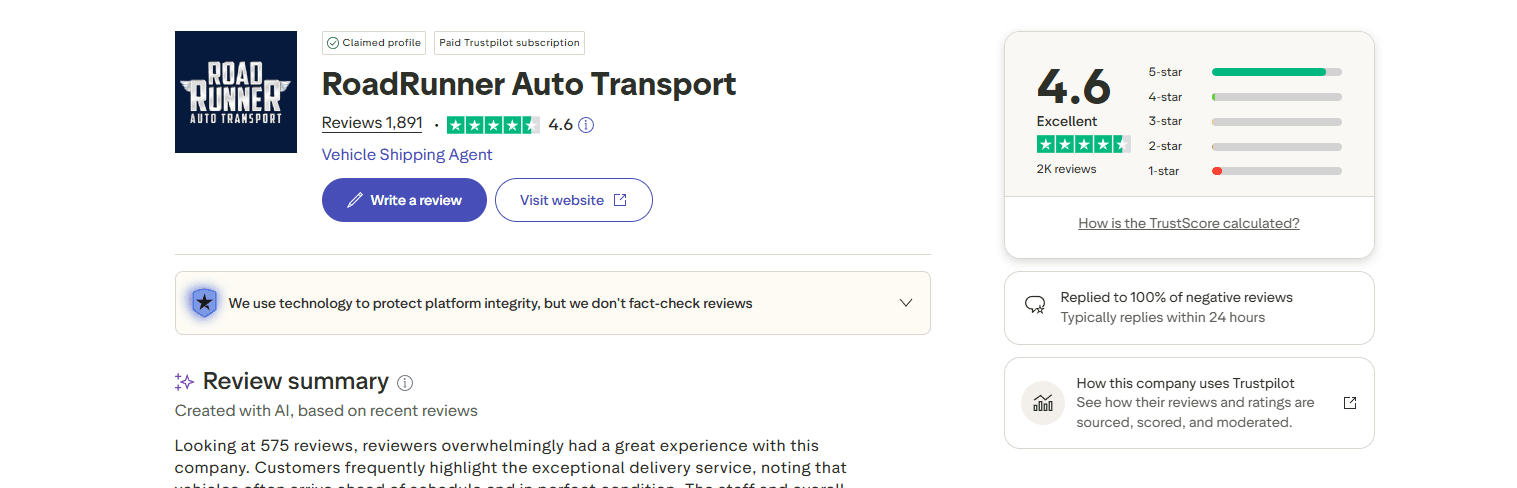
Based on vehicle transport customer reviews across Trustpilot as of early 2026, RoadRunner holds a 4.7 out of 5 across 1,722 reviews, with 89% of reviewers awarding five stars and only 8% giving one star.
That's a strong number. The BBB profile tells a different story.
RoadRunner is not BBB accredited and currently holds an C+, attributed to a documented pattern of unanswered complaints and unresolved issues at the organizational level.
You need to hold both numbers at the same time, because they're measuring different things.
The Trustpilot score reflects individual shipment experiences, many of which go well. The BBB F rating reflects what happens when they don't. For a clear breakdown of what each review platform actually measures and how to weigh them, see how Trustpilot, BBB, and Transportvibe compare as sources.
What RoadRunner customers consistently praise:
-
Driver communication. The most repeated theme in five-star reviews isn't the broker — it's the assigned carrier driver. Reviewers repeatedly name specific drivers for proactive, clear contact before pickup and throughout transit.
-
Delivery speed. A solid portion of positive reviews mention early arrival. One reviewer shipped NJ to Dallas in three days. Another got a Boston-to-Seattle move done with a day-early pickup.
-
Vehicle condition on arrival. Nearly every five-star review confirms the vehicle arrived in the same condition it left in — no damage, no surprises.
-
Booking experience. First-time shippers consistently describe the quote and scheduling process as easy and well-communicated from the start.
-
Repeat usage. Several reviewers note this is their second, third, or fourth shipment with RoadRunner — a reliable indicator of baseline satisfaction on standard routes.
The most common RoadRunner Auto Transport complaints on Trustpilot center on a consistent set of failures you should know before booking:
-
Price changes after booking. Multiple reviewers flag charges that didn't appear in the original quote. One reviewer mentioned a $300 difference between the invoice and what was expected at delivery.
-
Pickup window delays. In one documented case, a confirmed Tuesday pickup didn't happen until Friday, despite multiple confirmation emails from the broker that turned out to be inaccurate.
-
Communication gaps during transit. A CO-to-CA shipment that should have taken around 15 hours stretched to 9 days, with no meaningful status updates in between.
-
Customer service accessibility. When problems surface, some reviewers report being unable to reach a live agent or receiving inadequate follow-through when they do.
-
Off-hours delivery. One Trustpilot review documents a delivery notification arriving at 4:30 AM with no advance warning — leaving a 72-year-old woman to receive the vehicle alone in the dark.
-
BBB complaint resolution. The F rating exists because the company has a documented pattern of failing to respond to or resolve complaints at the organizational level. That matters if you end up needing dispute support.
For a full breakdown of how RoadRunner performs across individual routes, see Transportvibe's detailed RoadRunner Auto Transport review.
Nexus Auto Transport — What the Reviews Actually Show
Nexus regularly appears on lists of top rated car shipping companies, and when you look at the institutional data, that positioning has real grounding behind it.

Nexus holds an A+ BBB rating, is fully accredited, and carries a 4.62 out of 5 from 898 BBB customer reviews.
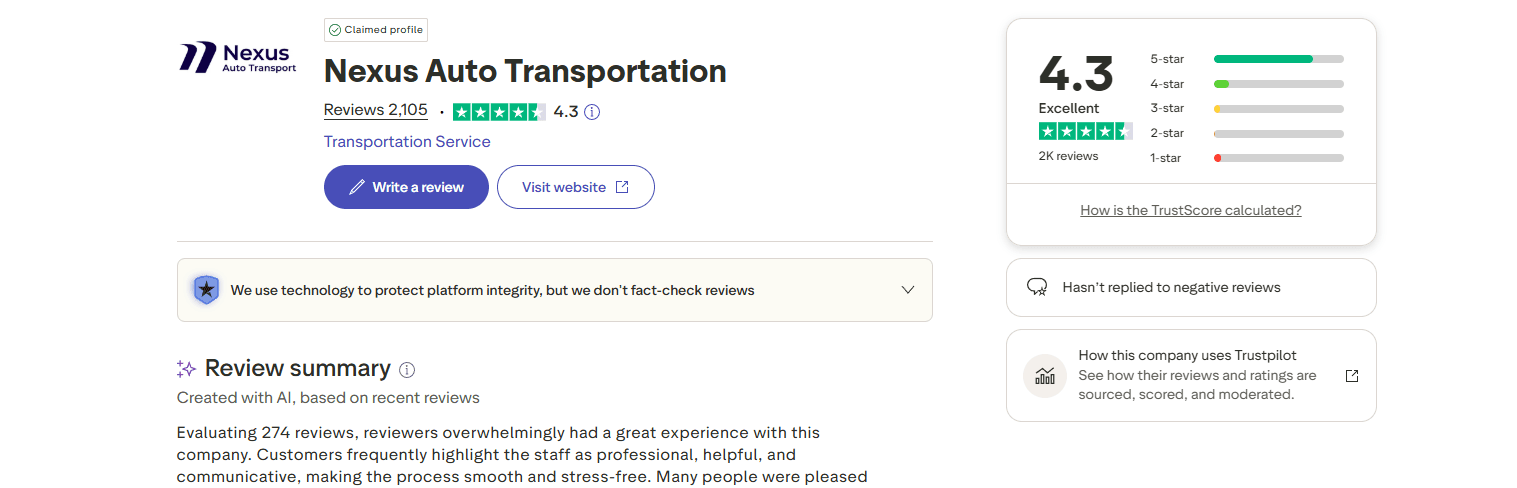
On Trustpilot, Nexus sits at 4.4 out of 5 across approximately 2,000 reviews — slightly lower than RoadRunner's Trustpilot score, but paired with BBB credibility and dispute accountability that RoadRunner doesn't have.
Here's the contrast worth keeping in mind: RoadRunner wins on Trustpilot. Nexus wins on accountability. Which one matters more depends on which scenario you're planning for.
What Nexus customers consistently praise:
-
Locked-in pricing. Multiple reviewers specifically call out that Nexus didn't raise their quoted price after booking — a direct contrast to what you'll find in the complaint threads of most brokers.
-
Proactive communication. Reviewers describe being kept informed from booking through delivery, with consistent updates at each stage.
-
Professional handling of specialty vehicles. High-value and non-standard shipments appear frequently in their strongest reviews.
-
Operational efficiency. On standard domestic routes, reviewers describe the experience as "Simple, Easy, Reliable and Professional and Fast."
-
BBB responsiveness. Active complaint responses and an A+ standing signal a company that engages when things go wrong rather than going quiet.
Nexus Auto Transport complaints follow a pattern: most center on pricing adjustments or documentation gaps at delivery.
-
Last-minute rate increases. At least one BBB-documented case describes a $275 increase issued after a confirmed locked-in quote, characterized by the reviewer as bait-and-switch.
-
Missing delivery documentation. One BBB-reviewed case flagged no bill of lading and no pre-load inspection report provided by the driver at delivery — which has real implications if you later need to file a damage claim.
-
Delivery window variance on longer routes. Reviewers shipping on lower-density or rural lanes report extended windows with limited visibility into vehicle location during transit.
-
Escalation difficulty. Some reviewers note trouble getting past initial customer service when a complaint requires escalation to a decision-maker.
Here is a side-by-side review comparison of these two companies -
|
Review Category |
RoadRunner Auto Transport |
Nexus Auto Transport |
|
Trustpilot Score |
4.7 / 5 |
4.4 / 5 |
|
Trustpilot Review Volume |
1,722 reviews |
~2,000 reviews |
|
BBB Accreditation |
Not accredited |
A+ accredited |
|
BBB Rating |
F |
A+ |
|
BBB Customer Review Score |
N/A |
4.62 / 5 (898 reviews) |
|
Top Praise Theme |
Driver communication, early delivery |
Locked-in pricing, proactive updates |
|
Top Complaint Theme |
Price changes post-booking, pickup delays, CS gaps |
Rate increases post-quote, missing delivery docs |
|
Dispute Resolution Pattern |
F rating reflects unanswered BBB complaints |
Actively responds; A+ standing maintained |
Which Broker Fits Your Situation And Why
The right answer in the RoadRunner Auto Transport vs Nexus Auto Transport debate depends entirely on what you're shipping, where you're going, and what you're willing to trade off.
Choose RoadRunner if:
-
Your vehicle is a standard sedan, SUV, or truck with no special handling requirements
-
Budget is the primary driver and a 2-5 day pickup window fits your schedule
-
Your route runs a high-density corridor: coast-to-coast, FL to NY, TX to CA
-
You're moving a daily driver and you're comfortable managing any pricing adjustment at dispatch
For budget-conscious shippers on popular domestic routes, RoadRunner remains a competitive option as a best car shipping broker in 2026.
Choose Nexus if:
-
Your vehicle is high-value, non-standard, or requires enclosed transport
-
You're moving a classic, exotic, or modified vehicle where delivery condition matters most
-
Tighter communication and proactive updates from booking through delivery are non-negotiable
-
Your route runs through a lower-density or less-traveled market
For shippers who need a car transport broker with strong customer service and proactive communication, Nexus has a documented edge in reviews.
Auto transport broker consistency is the deciding factor for time-sensitive and high-value shipments.
|
Shipper Type |
Better Fit |
Primary Reason |
|
Individual car owner (standard vehicle) |
RoadRunner |
Competitive pricing on high-density routes |
|
Relocating student or professional |
RoadRunner |
Cost efficiency, flexible pickup window |
|
Car dealership (volume shipping) |
Either / Negotiate |
Both offer dealer programs; depends on route mix |
|
Snowbird (FL/AZ focus) |
RoadRunner |
High-volume seasonal routes, stronger carrier availability |
|
Nexus |
Enclosed transport handling and communication |
|
|
Car show organizer |
Nexus |
Reliability on delivery timing and vehicle condition |
|
Military (PCS move) |
Nexus |
Documentation handling, communication during deployment |
|
Nexus |
Customer service responsiveness noted in reviews |
|
|
Motorcycle owner |
Verify per route |
Both handle motorcycles. Confirm availability per lane |
Before you book either broker, get quotes from both on the same day.
Prices shift daily and the gap between them can surprise you. Read each contract for dispatch price-change clauses before you pay anything.
A reliable auto transport broker won't hesitate to share their MC number upfront. Verify both at the FMCSA carrier lookup before you commit to either.
Before You Book: The Questions That Come Up Every Time
If you're still deciding between the two, these are the questions most shippers ask before committing. Every answer pulls from real review data and verified platform information.
Is RoadRunner Auto Transport or Nexus better for long-distance moves?
RoadRunner edges ahead on high-traffic long-distance routes like CA to TX or FL to NY. On less-traveled lanes, Nexus's tighter communication makes it the better fit. Your route density matters more than either company's overall rating.
What is the average shipping cost with RoadRunner vs Nexus Auto Transport in 2026?
Both brokers price open-carrier mid-length routes between $850 and $1,400 in 2026, depending on season and route demand. Enclosed transport adds 40-60%. Get a quote from both on the same day for an accurate comparison.
Do RoadRunner and Nexus Auto Transport offer enclosed transport for classic or luxury cars?
Yes. Both offer enclosed transport for classic cars, exotics, and luxury vehicles. Nexus has a stronger review record for these shipments. Book at least two weeks out, as enclosed carrier availability runs thin on most routes.
How long does delivery take with RoadRunner Auto Transport compared to Nexus?
Standard delivery runs 1-7 days for short hauls and 7-14 days coast-to-coast for both brokers. Neither guarantees exact dates. RoadRunner reviewers report more early deliveries. Nexus reviewers flag longer waits on rural and low-density routes.
What are the most common complaints about RoadRunner and Nexus Auto Transport?
The most common RoadRunner Auto Transport complaints involve price changes after booking, pickup delays, and poor customer service access during transit. Nexus Auto Transport complaints center on last-minute rate increases and missing delivery documentation at drop-off.
Which auto transport broker has better customer service — RoadRunner or Nexus?
Nexus. Based on verified BBB and Trustpilot data, Nexus holds an A+ BBB rating versus RoadRunner's F. For a car transport broker with better customer service and dispute resolution, Nexus has the stronger and more accountable track record.
Make the Call With Your Eyes Open
RoadRunner and Nexus are both licensed auto transport brokers with real track records behind them. In the RoadRunner Auto Transport vs Nexus Auto Transport comparison, neither is the universal right answer. RoadRunner competes on price and Trustpilot volume. Nexus leads on accountability and communication. The right broker is the one that fits your vehicle, your route, and what you're willing to trade off.
Before you commit to either, confirm their active broker authority at the FMCSA licensing database. A reliable auto transport broker will give you their MC number without hesitation. That one check protects you more than any review summary.
Get quotes from verified carriers and compare your options today.


