




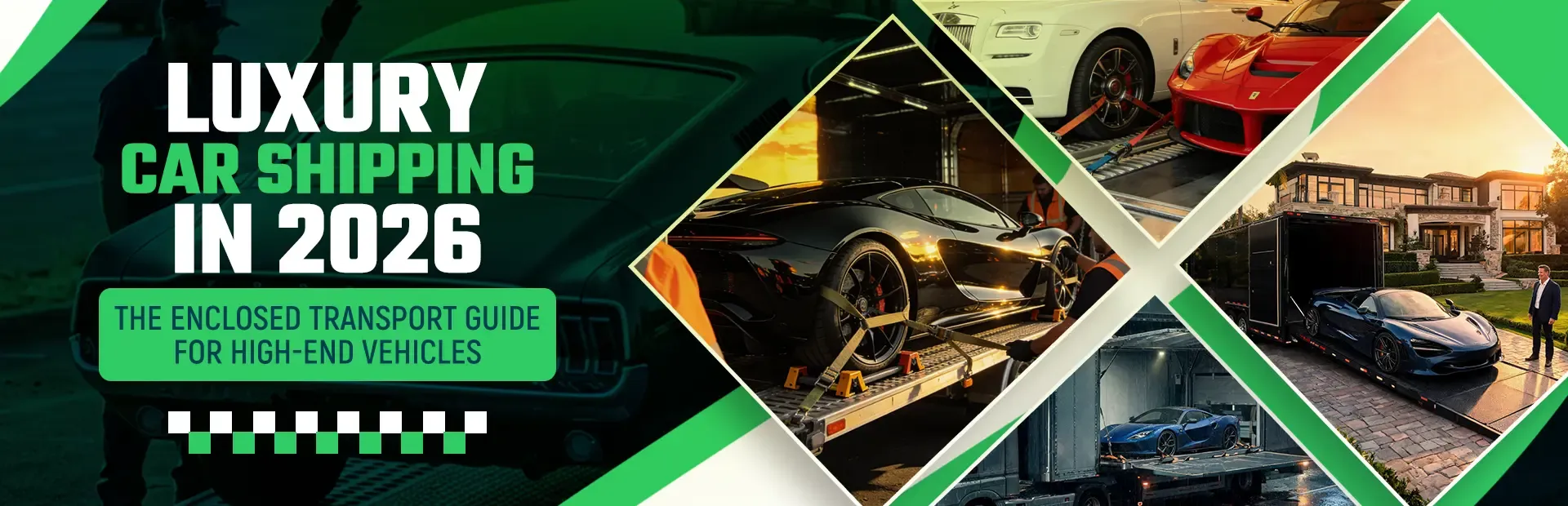
Luxury car shipping is one of those decisions that seems simple until something goes wrong. Book a carrier, get the car there, move on. That logic works fine for a used sedan. For a $160,000 AMG GT or a show-ready 1967 Mustang that took three years to restore, the stakes are different.
Here's what the wrong call looks like - The car arrives. Nothing seems off at first. Then you walk around it in decent light: a rock chip on the hood, a streak of brake dust from the truck loaded above it on the open trailer, a scuff near the rear bumper from an unpadded strap. The driver's already gone. The claims process starts Monday.
That scenario plays out more often than most owners expect. Open carrier transport leaves vehicles exposed to road debris, weather, and adjacent vehicles for the entire length of the haul. For a car worth $50,000 or more, that exposure is a real financial risk, not a theoretical one.
The U.S. luxury and exotic car market was valued at $110 billion in 2025, according to the Boston Consulting Group and duPont Registry. That figure is projected to reach between $180 billion and $215 billion by 2035, driven primarily by vehicles priced between $100,000 and $170,000. More of those vehicles are being shipped than ever before, relocated for job moves, transported to auctions and car shows, and delivered to buyers across the country. The demand for competent, high-value transport has grown alongside the market.
This guide covers who actually needs enclosed transport and why open carriers fall short, what the process looks like from booking to delivery, what it costs in 2026, and how to vet a company before handing over your keys. Shipping a luxury or exotic vehicle and want to see which enclosed transport carriers other owners have actually used? Browse verified reviews and get your free quote at Transportvibe.
What Qualifies as a Luxury Car for Auto Transport Purposes
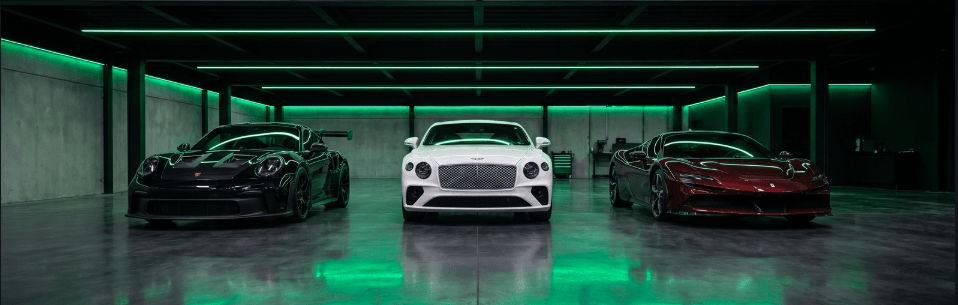
There's no universal cutoff, but most enclosed transport carriers work from a practical threshold: vehicles with a market value at or above $50,000 to $70,000 belong in enclosed shipping. Below that, an open carrier is often fine. Above it, the math changes fast. One rock chip on a carbon fiber hood panel can run $3,000 to repair. A full paint correction on a show car can exceed that.
Value alone isn't the whole picture. Rarity carries equal weight. A 1969 Chevelle SS 454 with a clean build sheet may not be worth $500,000, but finding another in the same condition is nearly impossible. That same logic applies to low-production modern vehicles: a Porsche 911 GT3 RS, a Ferrari SF90 Stradale, a McLaren 750S. These aren't just expensive cars. They're cars where transit damage creates a problem that no insurance check fully resolves.
Vehicles that warrant enclosed vehicle shipping:
-
Exotic and supercar brands: Ferrari, Lamborghini, McLaren, Porsche GT series, Bugatti, Koenigsegg
-
Classic and vintage cars, particularly pre-1980 collector vehicles and documented muscle cars
-
Modern luxury sedans and SUVs: Mercedes-Benz S-Class, BMW 7 Series, Rolls-Royce Wraith, Bentley Continental, Maserati GranTurismo
-
Limited-edition or low-production models where parts availability is restricted
-
Show-prepped or restored vehicles where surface condition defines the car's entire value
-
Dealer inventory above $80,000 MSRP being moved to a buyer or auction house
If the vehicle would be financially significant or practically irreplaceable to lose in transit, it qualifies.
Why Open Carriers Are the Wrong Choice for Luxury Vehicles
Open carriers move roughly 90% of all vehicles shipped in the United States. They're fast to book, widely available, and cost less than enclosed alternatives by $400 to $1,000 on most routes. For a six-year-old Honda CR-V or a leased commuter car, that tradeoff makes complete sense.
For a $180,000 Lamborghini Huracán or a numbers-matching 1970 Plymouth Hemi 'Cuda, it doesn't. The conditions that make open carriers acceptable for everyday vehicles are the exact conditions that put high-value cars at measurable, predictable risk. It's not a question of bad luck. It's physics and contract law working together in a way that rarely favors the owner of something expensive.
Physical Risks During Transit on an Open Carrier
An open carrier moves 7 to 10 vehicles simultaneously on two elevated decks. The car on the upper deck sits fully exposed above the roofline of highway traffic, absorbing three to seven days of road debris, weather, and UV exposure at highway speeds. The car on the lower deck sits directly beneath other vehicles, with no barrier between its hood and whatever fluid or grime drips from above.
These aren't edge-case scenarios. They're the standard operating conditions of every open trailer run, every single day:
-
Rock chips and windshield cracks from road debris kicked up by surrounding vehicles at 65+ mph
-
Brake dust and hydraulic fluid residue dripping from the upper deck onto lower-deck paint and glass
-
Industrial fallout, tree sap, and bird waste etching clear coat over multi-day hauls
-
UV exposure accelerating degradation of soft tops, rubber seals, exposed carbon fiber trim, and leather accents on convertibles
-
Improper tie-down angle stress on lowered suspension geometry not designed for open trailer loading
-
Sand, salt spray, and road chemicals accumulating in engine bays and underbody components on coastal or winter routes
A professional paint correction on a luxury vehicle typically runs $800 to $2,500 depending on condition. A single rock chip repair on a factory carbon fiber hood can cost $1,500 to $4,000. Neither is covered under standard carrier liability — only cargo insurance pays it, and cargo insurance is not guaranteed. More on that below.
Open car shipping is the right move for most standard vehicles. For anything with irreplaceable finish work or collector value, the math doesn't hold.
Insurance Gaps You Won't See Until It's Too Late
Here's the part that most shipping guides skip. According to the FMCSA's Insurance Filing Requirements, the federal minimum for non-household goods carriers requires $750,000 in bodily injury and property damage coverage for vehicles over 10,001 lbs GVWR. That figure covers accidents involving people and other property.
Cargo insurance is the coverage that pays out if your vehicle is damaged in transit that has a federally required minimum of $0 for non-household goods carriers. Zero. Carriers carry it voluntarily, or because a broker's contract requires it. The amount, the terms, and the exclusions vary by carrier. Many policies cap payouts at $100,000 per vehicle. On a $350,000 Rolls-Royce or a restored classic appraised at $220,000, that gap is entirely your problem.
|
Factor |
Open Carrier |
Enclosed Carrier |
|
FMCSA-mandated cargo insurance |
$0 required |
$0 required (same rule) |
|
Typical carrier cargo policy ceiling |
$50,000 to $100,000 |
$100,000 to $500,000+ |
|
Supplemental high-value coverage |
Rarely offered |
Commonly available |
|
Weather and debris damage coverage |
Often excluded as "acts of nature." |
Typically included |
|
Average deductible range |
$500 to $2,500 |
$0 to $1,000 |
|
Policy transparency at booking |
Inconsistent |
Standard with reputable carriers |
The situation gets worse on the open carrier side because damage from weather and road debris is frequently categorized as an "act of nature" and excluded from the cargo policy entirely. That rock chip that happened somewhere on I-40 between Oklahoma City and Nashville? The carrier's insurance team will tell you they can't prove when or where it happened.
Before booking any shipment, verify the carrier's active license and insurance status directly through the FMCSA Company Snapshot tool. Pull the MC number. Check that cargo insurance is on file and active, not just listed. If a carrier can't provide a certificate of insurance with your vehicle's value covered, that's your answer.
How Enclosed Luxury Car Transport Works, Step by Step
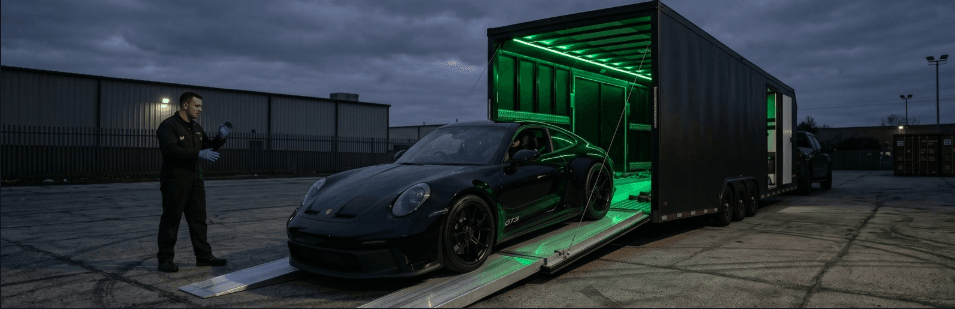
Enclosed transport isn't one service with a single definition. There are two main trailer types, and knowing the difference changes what you should book.
Hard-sided enclosed trailers use solid aluminum walls and a sealed roof. These are the most common choice for enclosed auto transport for luxury vehicles and offer structural protection against debris, weather, and road vibration across the entire haul. Soft-sided trailers use heavy-duty fabric curtains instead. Both eliminate open-air exposure, but hard-sided trailers are the industry standard for exotic and collector vehicles.
White glove car shipping is a specific tier within the enclosed category. It means one vehicle, one trailer, one driver, one direct route. No other cars share the space. No multi-stop loading sequences where your car sits in a staging lot while the driver picks up three more. The driver handles your vehicle exclusively from pickup to delivery. If you're shipping something above $200,000, or a car where a single handling incident is simply unacceptable, this is the tier worth asking about before you compare prices.
Here's the full process, from the moment you book to the moment the driver pulls away:
-
Request quotes from enclosed-only carriers: Get at least three. Confirm the trailer type in writing (hard-sided or soft-sided) and ask which specific carrier will handle your vehicle. A broker places the order; the carrier does the actual work. Know who that is before you sign.
-
Confirm cargo coverage before paying a deposit: Ask for a cargo insurance certificate. Confirm the payout ceiling covers your vehicle's full appraised or market value. If the carrier can't produce it in writing within 24 hours, keep looking.
-
Book door-to-door service: Terminal-to-terminal costs less, but it adds two unnecessary handling events for a vehicle worth protecting. Door-to-door pickup and delivery is standard with reputable luxury car transport companies.
-
Complete the pre-shipment Bill of Lading: This is the document that records your vehicle's existing condition before it leaves your possession. Photograph every panel, every wheel, every glass surface before loading. The Bill of Lading is your only enforceable legal record if a dispute arises during transit.
-
Confirm loading equipment: Legitimate carriers use hydraulic low-angle loading ramps and soft tie-down straps or wheel cradles, not chains. If a driver arrives with chain tie-downs for a lowered Porsche GT3 or a widebody build, that's a conversation worth having before the car goes on the trailer.
-
Track the shipment: Most reputable carriers provide GPS-based tracking for multi-day hauls. Coast-to-coast enclosed transport typically runs four to seven business days depending on route, season, and whether you've booked a dedicated single-vehicle run or a multi-car load.
-
Inspect at delivery before signing: Walk the car in good light. Compare delivered condition against your pre-shipment photos. Check every panel, the glass, the wheels, the underbody front lip. Once you sign the delivery receipt, the legal record is closed.
White glove enclosed car transport typically runs 20 to 35% more than standard multi-car enclosed service. On a coast-to-coast haul of a $300,000 vehicle, that premium is usually $400 to $800. For most owners shipping at that value, the math doesn't require much deliberation.
Not sure which enclosed carriers have actually handled high-value vehicles well? The best enclosed car shipping services in the U.S. breaks down verified customer reviews specifically for luxury and exotic shipments, which is a better filter than a generic star rating.
Luxury Car Shipping Costs in 2026 — What to Expect

Most people searching for a quote expect a single number. What they get instead is a range wide enough to fund a weekend detailing job on both ends. That's not a bait-and-switch. It's a market with real variables, and understanding them is the difference between getting a fair price and overpaying by $600 on a route where you had no leverage.
The baseline starts with distance. According to Kelley Blue Book's 2026 car shipping cost data, the average cost of shipping a standard vehicle on an open carrier is $751 for a 500-mile haul, $1,020 for 1,000 miles, and $1,406 for 2,500 miles. KBB notes that enclosed transport adds 50% or more to those figures. For luxury and exotic vehicles, which require specialized loading equipment, supplemental coverage, and experienced handlers, the premium typically runs higher than that baseline.
Enclosed vs. Open Carrier Cost Breakdown for Luxury Vehicles
These are realistic 2026 market ranges for high-end car shipping based on route distance, using open carrier figures from Kelley Blue Book as the verified baseline and applying the enclosed premium with luxury-specific adjustments:
|
Route Distance |
Open Carrier Avg. |
Enclosed Carrier (Luxury) |
White Glove Single-Vehicle |
|
Under 500 miles |
$650 to $890 |
$950 to $1,400 |
$1,800 to $2,800 |
|
500 to 1,500 miles |
$800 to $1,350 |
$1,400 to $2,200 |
$2,500 to $4,000 |
|
1,500 to 2,500+ miles |
$1,050 to $1,800 |
$2,100 to $3,200 |
$3,500 to $5,500+ |
|
Dealer batch (3 to 5 units) |
$600 to $900/unit |
$1,000 to $1,600/unit |
N/A |
Open carrier figures sourced from Kelley Blue Book (2026). Enclosed and white glove ranges reflect luxury vehicle market averages based on additional handling, coverage, and equipment requirements.
Enclosed luxury car transport runs an average of $800 to $1,400 more than open carrier service on a coast-to-coast haul. Put that against a $180,000 paint job or a $4,000 carbon fiber repair claim, and the premium stops looking like a luxury.
For a direct side-by-side look at what changes between open and enclosed pricing beyond the base rate, the enclosed vs. open carrier cost breakdown covers the full picture.
What Drives the Final Price for High-End Vehicle Transport
Two quotes on the same route can differ by $700. Here's what creates that gap:
-
Vehicle dimensions and ground clearance: Low-profile exotics, widebody builds, and vehicles with front splitters require hydraulic low-angle ramps and extra loading time. Carriers factor that in. A Lamborghini Aventador and a BMW 7 Series are both "luxury cars" but ship very differently.
-
Pickup and delivery location: Carriers run established lanes between major metros. New York, Los Angeles, Miami, Chicago, Dallas, and Houston get competitive pricing because trucks are moving through them anyway. A rural property in central Montana or the Florida Panhandle adds a repositioning cost that ends up in your quote.
-
Seasonal demand: Snowbird routes — primarily between the Northeast and Florida, and between the Midwest and Arizona — spike in October through November (heading south) and again in March through April (heading north). Booking during those windows without advance notice typically adds 15 to 25% to enclosed rates.
-
Booking window: The 2 to 4 week booking window is the pricing sweet spot for enclosed transport. Last-minute bookings inside 72 hours command a 15 to 30% premium because the carrier has to reprioritize a load. Plan ahead, and the savings are real.
-
Insurance add-ons: Requesting supplemental cargo coverage above $100,000 adds to the quote, typically $50 to $200 depending on vehicle value and carrier. Non-negotiable for anything above $150,000.
-
White glove vs. standard enclosed: Single-vehicle dedicated transport runs 20 to 35% higher than multi-car enclosed service, per consistent market pricing. The trade-off is no shared trailer space, no multi-stop loading sequences, and a direct route.
A Porsche 911 GT3 owner shipping from New York to Los Angeles in October, during peak snowbird conflict season, will pay 20 to 30% more than the same route in February. Booking 3 to 4 weeks out is the single easiest way to control costs on enclosed luxury car transport.
How to Choose the Right Luxury Auto Transport Company
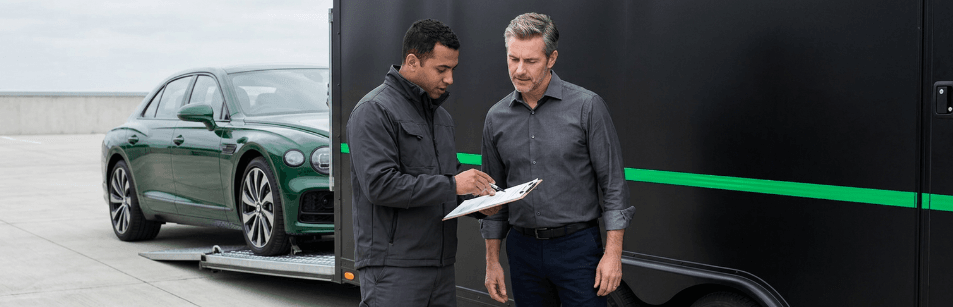
Most damage and delivery problems in the auto transport industry don't come from bad carriers. They come from the booking step, specifically from owners who hired a broker without knowing who the actual carrier was, or confirmed "enclosed" without verifying what that meant in writing.
The broker-carrier model is how most of this industry operates. A broker takes your order, posts it to a load board, and assigns it to a carrier who accepts the rate. That carrier may be excellent or may be a two-truck operation with minimum insurance and no experience loading a Lamborghini. The broker's job ends when the carrier is assigned. Your car's job starts then.
Here's what to confirm before you pay a deposit on anything:
-
Verify the carrier's FMCSA license: Every operating carrier must have an active USDOT number and MC number on file. Look them up before the call ends. A license that's suspended, revoked, or showing "out of service" orders is a hard stop regardless of how smooth the salesperson sounds.
-
Request the cargo insurance certificate in writing: Ask for it, not a verbal assurance. Confirm the coverage ceiling matches or exceeds your vehicle's value. If the carrier can't produce a certificate within 24 hours, move to the next quote.
-
Confirm the trailer type before signing: "Enclosed" in a sales conversation and "enclosed" in a written contract are two different things until you have it in writing. Specify hard-sided or soft-sided. If you're booking a single-vehicle dedicated run, confirm that in writing too.
-
Ask who the carrier is, not just the broker: A reputable broker will tell you the carrier name before you book. If they won't disclose the carrier until after payment, that's a red flag.
-
Read the Bill of Lading conditions: This document governs your legal protection during transit. Know what it says before the driver arrives, not while standing in your driveway handing over your keys.
-
Check platform reviews that reference luxury or exotic shipments: A five-star rating from 400 Honda Civic owners doesn't tell you much about how a company handles a Ferrari. Filter for reviews that specifically mention high-value vehicles, enclosed transport, or exotic cars.
-
No full payment before pickup: Reputable luxury car transport companies take a deposit at booking and collect the balance at delivery or pickup. Full payment upfront before the car is loaded is not standard practice in this segment.
|
Green Flag |
Red Flag |
|
Active FMCSA license, verifiable online |
No MC or USDOT number provided |
|
Cargo insurance certificate produced on request |
Verbal insurance assurances only |
|
Carrier name disclosed before booking |
Won't name the carrier until after payment |
|
Deposit only, balance at delivery |
Full payment required upfront |
|
Bill of Lading completed at pickup |
No Bill of Lading mentioned |
|
Reviews referencing exotic or luxury vehicles |
Generic 5-star reviews with no vehicle-type context |
|
Hard-sided trailer confirmed in writing |
"Enclosed" stated verbally, not in contract |
For a vetted list of companies with documented luxury and exotic transport experience, Transportvibe's luxury car transport service guide covers verified carriers alongside real customer accounts filtered by vehicle type.
Shipping a luxury or exotic vehicle and need a carrier you can trust? Browse verified enclosed transport companies and get your free quote at Transportvibe.
What Luxury Car Owners Ask Before They Book
These are the questions that come up every time someone ships a high-value vehicle for the first time. Short answers, no filler.
Is Enclosed Transport Really Necessary For Luxury Cars, Or Is Open Carrier Fine?
For any vehicle above $50,000 in market value, enclosed is the right call. Open carriers expose your car to road debris, brake fluid drips, and weather for days at a time. The $400 to $800 price difference is far cheaper than one paint damage claim.
How Much Does Enclosed Luxury Car Shipping Cost In 2026?
Expect $950 to $1,400 for under 500 miles, $1,400 to $2,200 for mid-range hauls, and $2,100 to $3,200 or more for cross-country. White glove single-vehicle service runs higher. Get at least three quotes before deciding.
What Is White Glove Car Shipping And When Does It Make Sense?
White glove means one vehicle, one enclosed trailer, one driver, direct route. No shared trailer space. It makes sense for vehicles above $200,000, show-prepped cars, or any shipment where a single handling incident is unacceptable.
Does My Personal Auto Insurance Cover My Car While It's Being Shipped?
Usually not during active transport. Most personal auto policies exclude coverage while a vehicle is in the care of a commercial carrier. Verify with your insurer before booking, and confirm the carrier's cargo insurance covers your vehicle's full value.
How Long Does Cross-Country Luxury Car Transport Take?
Standard enclosed transport coast to coast typically takes 5 to 7 business days. White glove dedicated transport can run 3 to 5 days. Seasonal demand, route traffic, and booking lead time all affect the actual delivery window.
How Do I Verify A Car Transport Company Is Legitimate Before I Book?
Look up their MC and USDOT numbers on the FMCSA Company Snapshot tool. Confirm active status and insurance on file. Any carrier that won't provide these details before you pay should be skipped entirely.
Choose Based on Facts, Not Just the Lowest Quote
Luxury car shipping comes down to one question: is the carrier you're booking actually built for what you're handing them?
Open carriers do that job well. For standard vehicles. For anything high-end, exotic, or collector-grade, the exposure risks and insurance gaps covered in this guide are real, not theoretical.
Secure luxury car transport means more than a covered trailer. It means verified credentials, confirmed cargo coverage, and a carrier that has handled vehicles like yours before.
Enclosed luxury car transport in 2026 doesn't require settling. There are enough reputable luxury auto transport companies operating across the U.S. to make a confident, well-researched decision. Check the credentials. Confirm the coverage. Choose based on facts.


